incident-managementrootlyoauth2apideveloper-tools
MCP server providing access to Rootly incident management API via OAuth2 or API token, with hosted and local options.
Quick Install
Automated & IDE SetupCopy the AI prompt to install this server into Claude Code, Cursor, or another agent — or use 1-click editor setup below.
Not yet automatically verified
We haven't yet run this listing's install command through our automated sandbox check. This isn't a red flag — we're steadily working through the catalog.
Manual Client & Custom JSON ConfigExpand JSON ▾
Client Config & Setup
Choose your client or environment
Target File:
💡 Paste the JSON block into your client's configuration file under mcpServers, then restart the application.
Overview
Use cases
Query and manage incidents and alerts in Rootly
Access on-call schedules and service information
Integrate Rootly incident workflows into AI agents
Authenticate via OAuth2 or API token for secure access
Use hosted endpoints or run the server locally
Key features
Supports OAuth2 authentication with automatic login
API token authorization for direct access
Multiple hosted transport endpoints including HTTP and SSE
Slim and full tool profiles for customizable capabilities
Compatible with major MCP clients like Claude, Cursor, Windsurf
Local installation option with Python 3.12+ and uv
Capabilities & Tool Schemas
Inspect callable tools, capabilities, and parameters exposed to AI agents by Rootly MCP Server.
Extracted Tool Capabilities
Supports OAuth2 authentication with automatic login
API token authorization for direct access
Multiple hosted transport endpoints including HTTP and SSE
Slim and full tool profiles for customizable capabilities
Compatible with major MCP clients like Claude, Cursor, Windsurf
Local installation option with Python 3.12+ and uv
Documentation Overview
Rootly MCP Server



An MCP server for the Rootly API for Cursor, Windsurf, Claude, and other MCP clients.
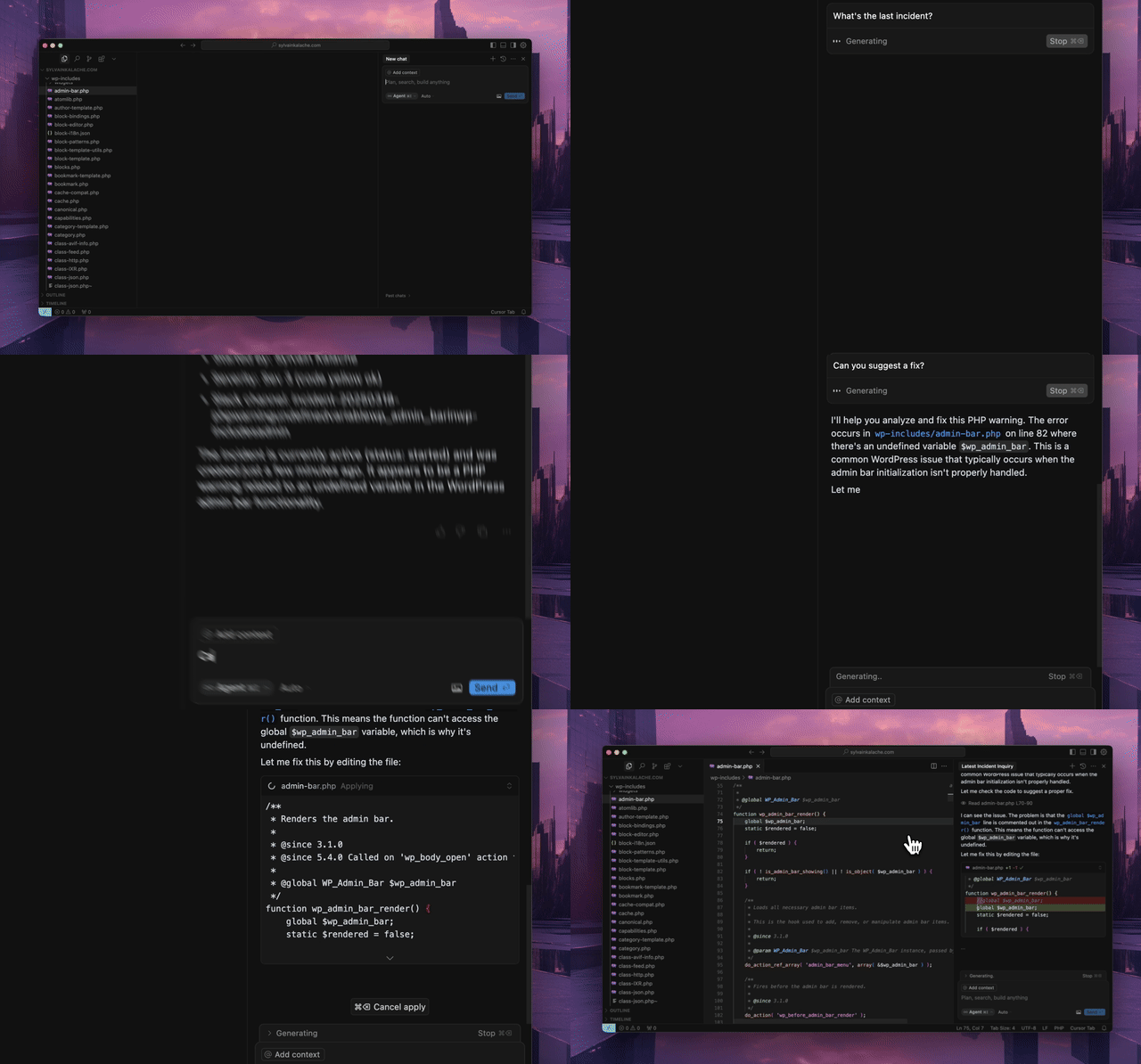
Quick Start
Use the hosted MCP server. No local installation required.
Hosted Transport Options
- Streamable HTTP (recommended):
https://mcp.rootly.com/mcp - SSE (stable alternative):
https://mcp.rootly.com/sse - Code Mode:
https://mcp.rootly.com/mcp-codemode
Hosted tool profiles:
- Full (default): use the URLs above as-is
- Slim (~70 tools): add
?tool_profile=slimto the hosted URL, for examplehttps://mcp.rootly.com/mcp?tool_profile=slim - Header alternative: send
X-Rootly-Tool-Profile: slim - Server-wide default: set
ROOTLY_MCP_HOSTED_TOOL_PROFILE=full|slim - Exact custom override: set
ROOTLY_MCP_ENABLED_TOOLS=...
General Remote Setup
With OAuth2 (recommended):
Your MCP client handles OAuth2 login automatically — a browser window opens for you to authenticate with Rootly. No API token needed.
With API Token:
SSE (alternative):
Code Mode:
Agent Setup
Claude Code
With OAuth2 (recommended):
With API Token:
Manual Configuration — Create .mcp.json in your project root:
Gemini CLI
Install the extension:
Or configure manually in ~/.gemini/settings.json:
Cursor
Add to .cursor/mcp.json or ~/.cursor/mcp.json:
With OAuth2 (recommended):
With API Token:
Windsurf
Add to ~/.codeium/windsurf/mcp_config.json:
With OAuth2 (recommended):
With API Token:
Codex
Add to ~/.codex/config.toml:
With OAuth2 (recommended):
With API Token:
Claude Desktop
With OAuth2 (recommended):
Add to claude_desktop_config.json:
Claude Desktop handles OAuth2 login automatically.
With API Token (via mcp-remote):
Rootly CLI
Standalone CLI for incidents, alerts, services, and on-call operations.
Install via Homebrew:
Or via Go:
For more details, see the Rootly CLI repository.
Alternative Installation (Local)
Run the MCP server locally if you do not want to use the hosted service.
Prerequisites
- Python 3.12 or higher
uvpackage manager- Rootly API token
API Token Types
Choose the token type based on the access you need:
- Global API Key: Full access across the Rootly instance. Best for organization-wide visibility.
- Team API Key: Access limited to entities owned by that team.
- Personal API Key: Access matches the user who created it.
A Global API Key is recommended for organization-wide queries and for actions that modify data, especially when workflows may span multiple teams, schedules, or incidents.
With uv
Self-Hosted Transport Options
Choose one transport per server process:
- Streamable HTTP endpoint path:
/mcp - SSE endpoint path:
/sse - Code Mode (experimental) endpoint path:
/mcp-codemodein hosted dual-transport mode
Hosted and self-hosted deployments now both expose the full tool surface by default.
- Hosted default: full surface
- Hosted slim profile: about 70 high-usage tools via
?tool_profile=slim - Self-hosted default: full surface
To restrict either deployment to read-only tools, start the server with --no-enable-write-tools or set ROOTLY_MCP_ENABLE_WRITE_TOOLS=false.
For hosted clients that want the smaller remote profile, append ?tool_profile=slim to the MCP URL or send X-Rootly-Tool-Profile: slim.
AgentCat and Sentry telemetry
Hosted deployments can send MCP telemetry to AgentCat by setting
ROOTLY_MCPCAT_PROJECT_ID. To also export AgentCat events to Sentry, provide
SENTRY_DSN through the deployment's secret store. The optional
ENVIRONMENT defaults to production, and SENTRY_RELEASE defaults to the
installed Rootly MCP Server version. Sentry performance tracing is enabled when
the exporter is configured.
Free-form event text is redacted and actor names are omitted from Sentry-bound
telemetry; stable internal actor IDs remain available for correlation.
Telemetry runs on AgentCat v2 (MCP 2026-07-28 spec). Sessions are correlated via
a session_id carried in the tool list rather than stateful connections, which
suits our stateless hosted transport; initialize and tools/list events are no
longer published by the SDK.
To override the hosted or self-hosted default profile entirely, set ROOTLY_MCP_ENABLED_TOOLS (or pass --enabled-tools) with a comma-separated allowlist of exact tool names. When that variable is set, it fully replaces the default selection.
To expose only a specific subset of MCP tools on a self-hosted deployment, set ROOTLY_MCP_ENABLED_TOOLS (or pass --enabled-tools) with a comma-separated allowlist of exact tool names, for example list_incidents,get_incident,get_server_version.
OpenAI Apps domain verification
Hosted deployments expose an unauthenticated domain-verification endpoint used by the OpenAI plugin directory:
- Endpoint:
GET /.well-known/openai-apps-challenge - Environment variable:
ROOTLY_OPENAI_APPS_CHALLENGE_TOKEN
Set ROOTLY_OPENAI_APPS_CHALLENGE_TOKEN to the token generated in the OpenAI submission portal. The endpoint returns that exact token as text/plain (with Cache-Control: no-store), and returns 404 when the variable is unset or empty. The token is read from the environment at request time — never hardcode or commit it. The route is served on both the dual-transport (--transport both) and profiled streamable-HTTP hosted deployments and is not subject to Bearer authentication.
To discover the exact tool names available under your current self-hosted configuration, run:
This prints the effective MCP tool names after applying your current settings, including ROOTLY_MCP_ENABLE_WRITE_TOOLS and ROOTLY_MCP_ENABLED_TOOLS.
Smoke-test a self-hosted allowlist:
Related MCP Servers
Adoption & maintenance
Factual signals from GitHub, npm, and our automated checks — not a rating.
GitHub stars
45
Stargazers on the source repository.
Last commit
Today
Most recent push to the default branch.
Directory activity
1 views
Config copies, upvotes, and views on AllMCPs.
Reviews
No reviews yet — be the first to share how this listing worked for you.
Frequently Asked Questions about Rootly MCP Server
AllMCPs Directory Badge
Showcase your server listing on GitHub or your project documentation. Embed this dynamic SVG badge to highlight official listing status and live engagement.
Badge Style:
Live Dynamic SVG Preview
Markdown (GitHub README)
[](https://allmcps.com/mcp/rootly-ai-labs-rootly-mcp-server)HTML Embed
<a href="https://allmcps.com/mcp/rootly-ai-labs-rootly-mcp-server"><img src="https://allmcps.com/api/badge/rootly-ai-labs-rootly-mcp-server?style=directory" alt="Rootly MCP Server on AllMCPs" /></a>