bioinformaticsspatial-transcriptomicsbiologymcp-servervisualization
MCP server providing 66 spatial transcriptomics methods via 20 schema-validated tools for reproducible analysis workflows.
Quick Install
Automated & IDE SetupCopy the AI prompt to install this server into Claude Code, Cursor, or another agent — or use 1-click editor setup below.
Not yet automatically verified
We haven't yet run this listing's install command through our automated sandbox check. This isn't a red flag — we're steadily working through the catalog.
Manual Client & Custom JSON ConfigExpand JSON ▾
Client Config & Setup
Choose your client or environment
Target File:
💡 Paste the JSON block into your client's configuration file under mcpServers, then restart the application.
Overview
Use cases
Load and preprocess spatial transcriptomics datasets
Perform cell type annotation and deconvolution
Conduct spatial domain identification and spatial statistics
Visualize spatial gene expression and embeddings
Run trajectory inference and RNA velocity analyses
Key features
20 MCP tools exposing 66 spatial transcriptomics methods
Schema-enforced orchestration for reproducible workflows
Supports 10x Visium, Xenium, Slide-seq v2, MERFISH, seqFISH data
Multiple analysis categories including deconvolution, cell communication, and enrichment
Runs via STDIO or configurable Streamable HTTP interface
Maintains backward compatibility with older MCP protocol versions
Capabilities & Tool Schemas
Inspect callable tools, capabilities, and parameters exposed to AI agents by ChatSpatial.
Extracted Tool Capabilities
20 MCP tools exposing 66 spatial transcriptomics methods
Schema-enforced orchestration for reproducible workflows
Supports 10x Visium, Xenium, Slide-seq v2, MERFISH, seqFISH data
Multiple analysis categories including deconvolution, cell communication, and enrichment
Runs via STDIO or configurable Streamable HTTP interface
Maintains backward compatibility with older MCP protocol versions
Documentation Overview
ChatSpatial
MCP server for spatial transcriptomics analysis via natural language








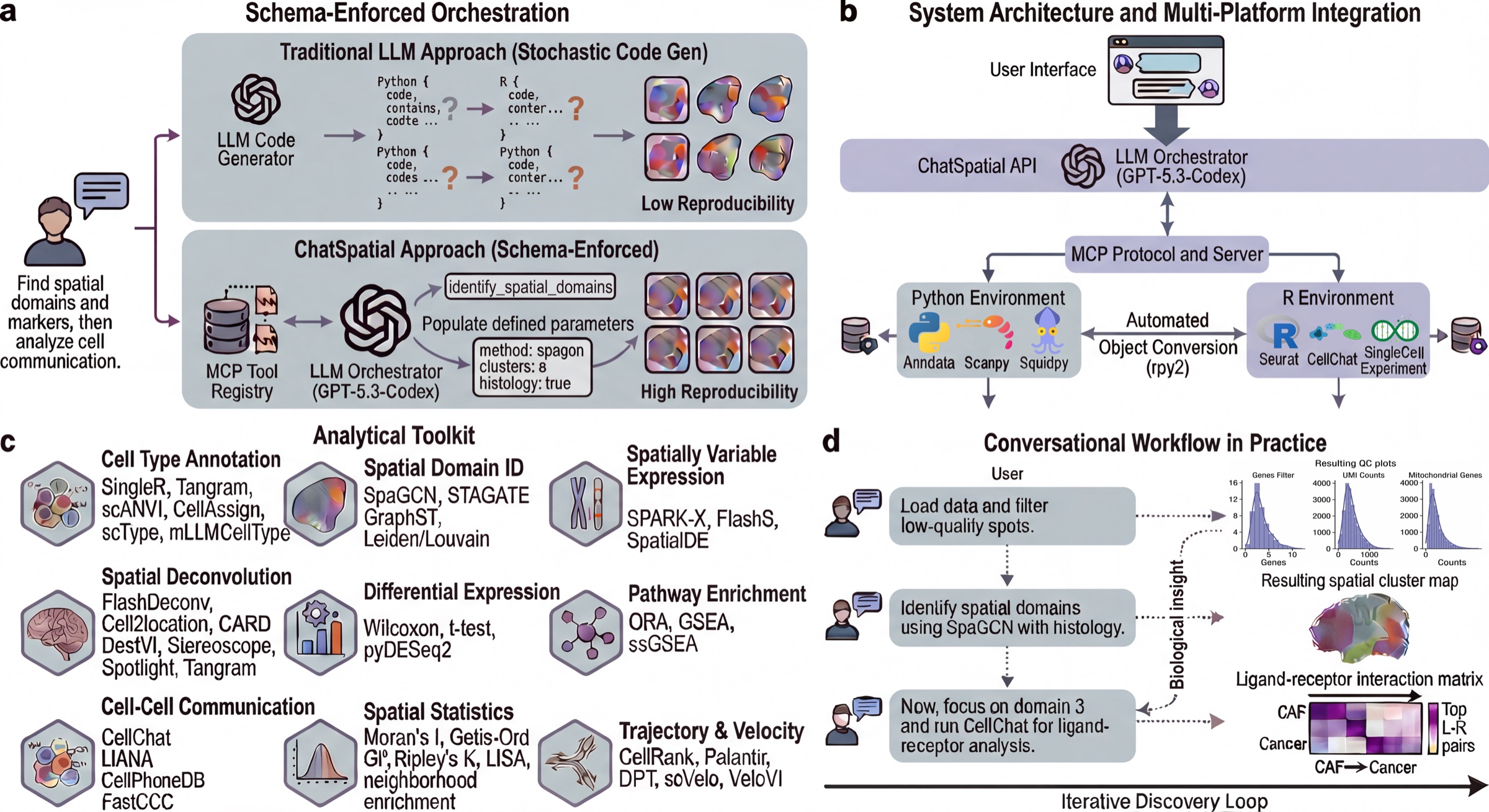
ChatSpatial replaces ad-hoc LLM code generation with schema-enforced orchestration. Instead of generating arbitrary scripts, the LLM selects tools and parameters from a curated registry, making spatial transcriptomics workflows more reproducible across sessions and clients.
ChatSpatial exposes 20 schema-validated MCP tools that orchestrate 66 spatial transcriptomics methods across 15 analytical categories. The tools are the stable natural-language interface; the methods are the analysis backends selected through tool parameters.
The server implements MCP 2026-07-28 through the official Python SDK v2 and
continues to serve 2025-11-25 clients through SDK-managed protocol negotiation.
STDIO remains the secure local default; Streamable HTTP is available for
explicitly configured HTTP deployments.
Start Here
Install uv once, then
register ChatSpatial without creating or managing a Python environment:
Codex:
Claude Code:
uvx creates an isolated environment on first launch and reuses its cache on
later launches. Restart the MCP client after adding the server.
The command above installs the standard runtime. To make all 15 composable Python method families available in the same isolated MCP environment, use:
full includes CellRank, FastCCC, the maintained spatial-domain and
registration backends, annotation, enrichment, and the other portable Python
families. R bridges, AESTETIK, and rctd-py remain separate because they have
system, platform, or large-runtime requirements. See the installation guide
before enabling those families.
Then:
- Run your first analysis — Quick Start
- Choose optional method families or a persistent environment — Installation Guide
- Configure another MCP client — Configuration Guide
- Inspect or reproduce the manuscript results — Reproducibility workspace
Docker quick start:
Minimal example prompt:
If you use Docker, mount host data to /data and prompt with the container path, for example /data/spatial_data.h5ad.
ChatSpatial works with any MCP-compatible client — Claude Code, Claude Desktop, Codex, OpenCode, and other MCP-capable tools.
Capabilities
Current coverage includes 66 methods across 15 analytical categories, exposed through 20 MCP tools. Supports 10x Visium, Xenium, Slide-seq v2, MERFISH, seqFISH.
| Category | Example methods |
|---|---|
| Data Loading & Preprocessing | Scanpy I/O, QC, Normalization, HVG, PCA, Neighbors |
| Visualization | Spatial plots, Embedding plots, Gene expression overlays |
| Spatial Domain Identification | SpaGCN, STAGATE, GraphST, BANKSY, AESTETIK, Leiden, Louvain |
| Deconvolution | FlashDeconv, Cell2location, RCTD (spacexr or rctd-py), DestVI, Stereoscope, SPOTlight, Tangram, CARD |
| Cell-Cell Communication | LIANA+, CellPhoneDB, CellChat (cellchat_r), FastCCC |
| Cell Type Annotation | Tangram, scANVI, CellAssign, mLLMCelltype, scType, SingleR |
| Differential Expression | Wilcoxon, t-test, Logistic Regression, pyDESeq2 |
| Trajectory Inference | CellRank, Palantir, DPT |
| RNA Velocity | scVelo, VeloVI |
| Spatial Statistics | Moran's I, Local Moran, Geary's C, Getis-Ord Gi*, Ripley's K, Co-occurrence, Neighborhood Enrichment, Centrality Scores, Local Join Count, Network Properties |
| Enrichment Analysis | GSEA, ORA, Enrichr, ssGSEA, Spatial EnrichMap |
| Spatially Variable Genes | SpatialDE, SPARK-X, FlashS |
| Multi-sample Integration | Harmony, BBKNN, Scanorama, scVI |
| CNV Analysis | InferCNVPy, Numbat |
| Spatial Registration | PASTE, STalign |
Documentation
| Guide | Use this when... |
|---|---|
| Installation | You need optional methods or a persistent Python environment |
| Docker | You want a reproducible container runtime or local dependency resolution fails |
| Configuration | You need exact MCP client syntax or the runtime path model |
| Quick Start | ChatSpatial is installed and you want the first successful analysis |
| Concepts | You need to choose an analysis strategy from a biological question |
| Examples | You want copy-pasteable natural-language workflow prompts |
| Methods Reference | You need canonical tool names, method names, parameters, and defaults |
| Troubleshooting | Setup, data loading, or analysis behavior is not working |
| Full Docs | You want the complete documentation site |
Reproducibility
The manuscript experiment scripts, small aggregate result tables, and
supplementary tables are versioned in reproducibility/.
Large datasets, raw provider checkpoints, generated analysis directories, and
manuscript source files are intentionally kept outside Git. The reproducibility
workspace documents both the manuscript-era package baseline and the
current-checkout development workflow so historical evidence is not silently
regenerated with a different ChatSpatial release.
Citation
If you use ChatSpatial in your research, please cite:
ChatSpatial orchestrates many excellent third-party methods. Please also cite the original tools your analysis used.
Contributing
Documentation improvements, bug reports, and new analysis methods are all welcome. See CONTRIBUTING.md.
Related MCP Servers
Adoption & maintenance
Factual signals from GitHub, npm, and our automated checks — not a rating.
GitHub stars
44
Stargazers on the source repository.
Last commit
28d ago
Most recent push to the default branch.
Directory activity
1 views
Config copies, upvotes, and views on AllMCPs.
Reviews
No reviews yet — be the first to share how this listing worked for you.
Frequently Asked Questions about ChatSpatial
AllMCPs Directory Badge
Showcase your server listing on GitHub or your project documentation. Embed this dynamic SVG badge to highlight official listing status and live engagement.
Badge Style:
Live Dynamic SVG Preview
Markdown (GitHub README)
[](https://allmcps.com/mcp/cafferychen777-chatspatial)HTML Embed
<a href="https://allmcps.com/mcp/cafferychen777-chatspatial"><img src="https://allmcps.com/api/badge/cafferychen777-chatspatial?style=directory" alt="ChatSpatial on AllMCPs" /></a>Technical Specs & Signals
PricingFree
53Quality signal: Good · 53/100How this signal is calculated ▾
Server availabilityNot measured
Not scored for repo-hosted servers — we can't reach the running server, only its GitHub page. Hosted MCP endpoints are health-checked live.
Verified ownership10/20
Documentation & tools23/30
Adoption & activity7/15
Community engagement0/10
A guidance signal from public completeness & health data — not a user rating. New listings start lower and rise as they add docs, get verified, and grow adoption. Signals we can't observe for a listing are skipped, not counted against it.
Supply-chain signal
No high-severity advisories surfaced by our automated scan.
Critical 0High 0Medium 0Low 0
Scanned 27d ago via OSV.dev · --from (PyPI)
Own this project?
This directory is pre-filled from public sources. Claim via GitHub README, site badge, or DNS TXT to unlock edit access and the Official badge — proof is checked automatically, then reviewed by our team.
Free dofollow backlink: add your website and place the AllMCPs badge on it — no claim needed. We detect it automatically and keep it verified as long as the badge stays live.
Claim & get free dofollowShare & Embed
Add our SVG badge (dark/light directory styles) or embeddable widget to your site.