Local-first code context, impact analysis, and merge-readiness verdicts for AI agents.
Quick Install
Automated & IDE SetupCopy the AI prompt to install this server into Claude Code, Cursor, or another agent — or use 1-click editor setup below.
Not yet automatically verified
We haven't yet run this listing's install command through our automated sandbox check. This isn't a red flag — we're steadily working through the catalog.
Manual Client & Custom JSON ConfigExpand JSON ▾
Client Config & Setup
Choose your client or environment
Target File:
💡 Paste the JSON block into your client's configuration file under mcpServers, then restart the application.
Documentation Overview
Òtítọ́
Models generate the change. Otito proves whether it is safe to merge.



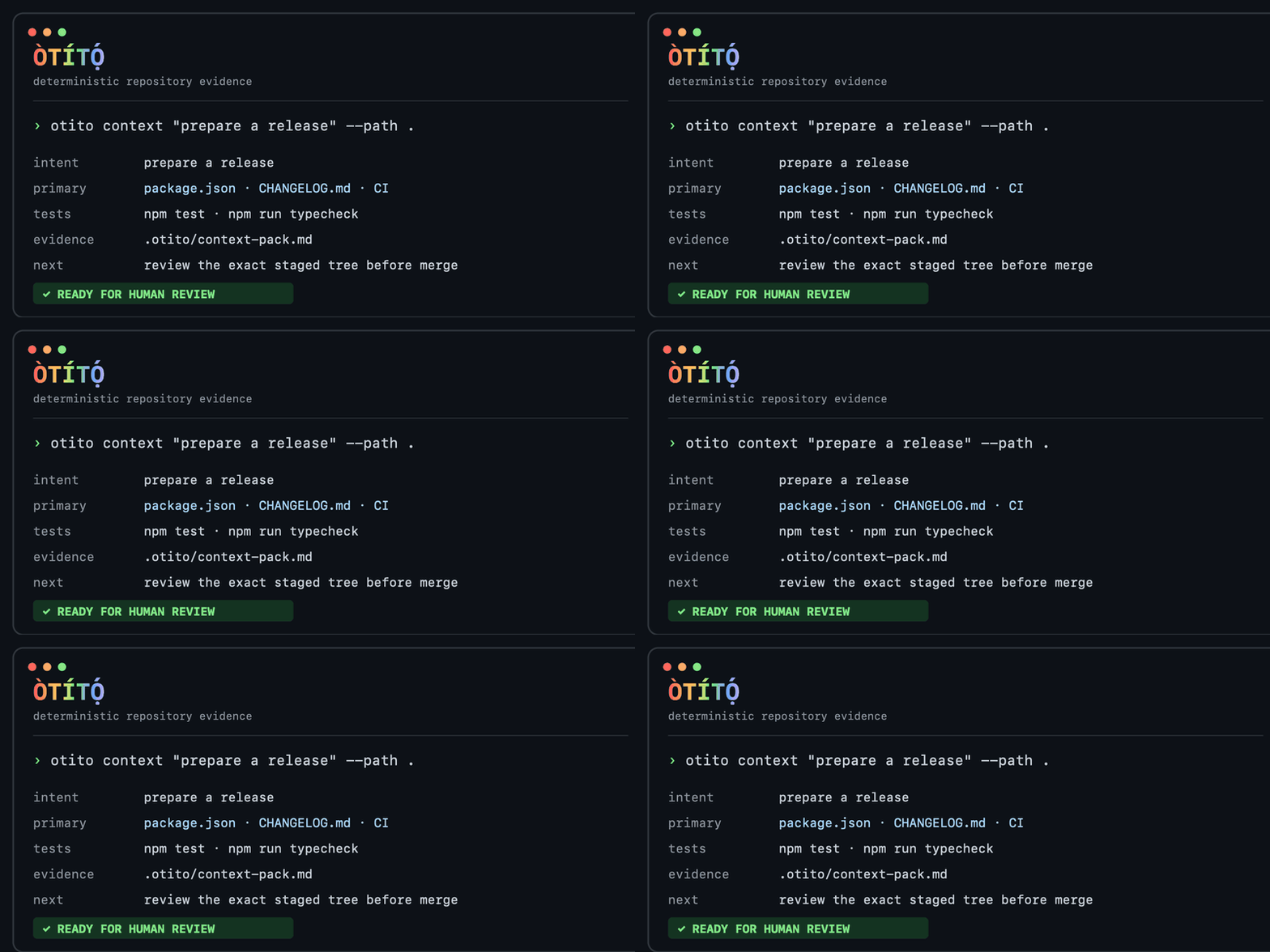
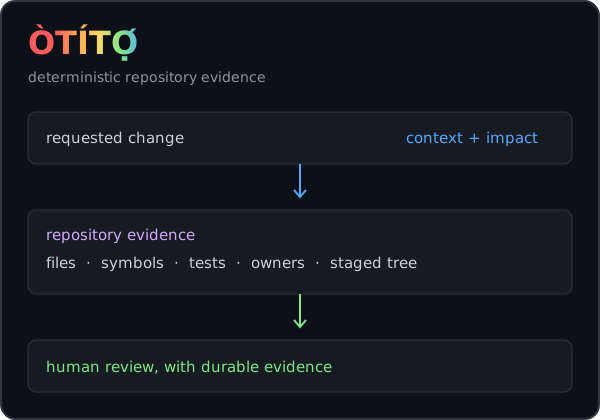
The generic agent loop (prompting, retries, tool routing, file editing) is becoming infrastructure. Frontier models already plan, search repositories, use tools, and recover from mistakes. Model vendors are packaging native harnesses with file tools and sandbox execution. Competing there is a losing bet.
What remains strategically important is the trust harness: accurate repository context, permission and sandbox boundaries, exact validation against the changed code, risk-sensitive policies, CODEOWNERS and human approval, reproducible receipts, and independent evidence the model cannot award itself. Stronger models increase that need, because teams will let them change more code with less supervision.
Òtítọ́ is that independent trust layer. It is local-first, deterministic, and model-agnostic: it discovers repositories, builds local indexes, generates task-aware context before an agent edits, scores how much a change actually touches, and gates merge readiness. It works the same way every time, with no server, no account, and no code leaving the machine. It does not compete with Codex, Claude Code, Gemini, Cursor, or future native harnesses. It integrates with them, and keeps working as models change underneath it.
Trusted agent workflow
New in v1.9.2: otito is now listed on mcpservers.org.
Otito helps the agent understand and bound a task before editing, then gives the maintainer evidence to decide whether to trust the result. A passing local gate is never an automatic merge approval: hosted CI, GitHub review, CODEOWNERS, and the human release decision remain separate authorities.
It does not try to replace native agent harnesses, opensrc, code-structure, Daytona, or Harnss. It gives developers and coding agents a single CLI that can:
Deterministic merge gates are the differentiated core. This is the human-in-the-loop checkpoint that a model cannot grade for itself:
- score merge readiness for local changes and pull requests with one
review_gatetool (gateon the CLI) - execute a protected validation plan against the exact staged tree and retain a bounded receipt of its outcomes
- bind staged web, API, and shared-contract changes into one workspace receipt
- resolve CODEOWNERS to required reviewers and surface owner-decision warnings
- check branch-protection expectations and required checks before merge
- generate actionable PR review context from git diffs and optional GitHub comments
- continuously prove the local gate against a committed valid control and adversarial change corpus with
otito eval --gate-effectiveness
Local-first context feeds the gates:
- inspect a repository
- discover and index local repositories
- maintain a local catalog and search across it
- generate task-aware context packets before an agent plans or edits
- generate AST-backed JSON-first code maps for agents
- generate a setup/validation/runtime harness for a repo
- produce Markdown or JSON reports
- estimate context-token size for generated artifacts
- run an MCP server for agent hosts with a persisted per-user index cache that never dirties an inspected repository
- expose simple agent-friendly tool metadata
- check tool availability
- generate TypeScript structure HTML through
code-structure - search dependency source through
opensrc
Documentation
The published MkDocs site is a practical discovery and delivery guide:
- Home
- Executive Summary
- Context Foundation
- MCP and Agent Workflows
- Contributor Governance
- Release Readiness
- Trust-Layer Demo
- Builder-Founder Operating Loop
- Harness Thesis & Agent Experience
- Tutorials Integration (Codespaces)
- Convergence Thesis & Score
- Usage & Performance Dashboard
- Determinism Thesis & Harness Boundary
- Dual-Mode Thesis & Complementary Stack
- Prompt Determinism Thesis & Settings Trap
- Trust Harness Thesis & Commodity Loop
- Herdr Integration
- Clean Code Thesis & the Smallest Owner File
- Evaluation Method and Gate-Effectiveness Corpus
- Glossary
Read it at:
Quick Start
Code maps use the TypeScript compiler for JS/TS and dedicated language extractors for Go, C#, Python, Java, Ruby, and Rust (see src/lib/code-map/ast-languages.js). Optional external tools are only needed for dependency-source lookup and HTML structure reports.
Install the published package from npm:
You can also run a command without a global install:
For source development:
The current release is available through npm, GitHub Releases, and the MCP Registry as io.github.BASHBOP/otito.
Run Otito as the trust layer inside a Herdr agent workspace:
The Herdr plugin uses the independently installed otito CLI. Herdr owns persistent agent terminals and worktrees; Otito owns context, impact, review, and deterministic gate evidence.
Optional external tools:
Then:
Usage Examples
| Goal | Command | Output |
|---|---|---|
| Inspect one repo | otito repo . --json | Repo facts, scripts, languages, entrypoints, and git state |
| Build a code map | otito map . --json | Source files, domains, imports, exports, symbols, and routes |
| Prepare task context | otito context "add a new MCP tool" --path . | Primary files, related files, tests, patterns, and validation commands |
| Generate an agent harness | otito harness . --out .otito/harness.md | Setup, validation, runtime, and context commands |
| Gate an exact staged change | otito gate . --staged --run-validation | Versioned validation outcomes bound to the staged Git tree |
| Gate a product change | otito workspace-gate ../web ../api --request "ship change" | One receipt across staged repositories |
| Review local changes | otito pr . --base origin/main --out .otito/pr-review.md | Changed files, risk prompts, review targets, and test hints |
| Index local projects | otito index ~/projects --discover | External per-user indexes plus a local catalog |
| Search indexed repos | otito search "events controller" | Ranked matches across paths, domains, routes, imports, exports, and symbols |
| Run the MCP server | otito mcp | Stdio MCP server exposing otito tools |
| Track usage & performance | otito dashboard | Self-contained HTML from an opt-in local usage log (off by default) |
| Help improve Otito | otito telemetry share on | Separately opt into a minimal anonymous usage event; no prompts, paths, repo data, or source content |
For Codex, Claude Desktop, VS Code, Cursor, Gemini CLI, Kimi Code, Grok handoff guidance, and generic stdio client snippets, see MCP and Agent Workflows.
otito vs alternatives
Related MCP Servers
Adoption & maintenance
Factual signals from GitHub, npm, and our automated checks — not a rating.
GitHub stars
1
Stargazers on the source repository.
npm downloads
26
Package downloads in the last 30 days.
Last commit
Today
Most recent push to the default branch.
Reviews
No reviews yet — be the first to share how this listing worked for you.
Frequently Asked Questions about Repoctx
AllMCPs Directory Badge
Showcase your server listing on GitHub or your project documentation. Embed this dynamic SVG badge to highlight official listing status and live engagement.
Badge Style:
Live Dynamic SVG Preview
Markdown (GitHub README)
[](https://allmcps.com/mcp/repoctx)HTML Embed
<a href="https://allmcps.com/mcp/repoctx"><img src="https://allmcps.com/api/badge/repoctx?style=directory" alt="Repoctx on AllMCPs" /></a>Technical Specs & Signals
CategoryDeveloper Tools
43Quality signal: Fair · 43/100How this signal is calculated ▾
Server availabilityNot measured
Not scored for repo-hosted servers — we can't reach the running server, only its GitHub page. Hosted MCP endpoints are health-checked live.
Verified ownership10/20
Documentation & tools16/30
Adoption & activity6/15
Community engagement0/10
A guidance signal from public completeness & health data — not a user rating. New listings start lower and rise as they add docs, get verified, and grow adoption. Signals we can't observe for a listing are skipped, not counted against it.
Own this project?
This directory is pre-filled from public sources. Claim via GitHub README, site badge, or DNS TXT to unlock edit access and the Official badge — proof is checked automatically, then reviewed by our team.
Free dofollow backlink: add your website and place the AllMCPs badge on it — no claim needed. We detect it automatically and keep it verified as long as the badge stays live.
Claim & get free dofollowShare & Embed
Add our SVG badge (dark/light directory styles) or embeddable widget to your site.