Entity-level code intelligence: semantic diff, impact analysis, blame, and context for AI agents
Quick Install
Automated & IDE SetupCopy the AI prompt to install this server into Claude Code, Cursor, or another agent — or use 1-click editor setup below.
Not yet automatically verified
We haven't yet run this listing's install command through our automated sandbox check. This isn't a red flag — we're steadily working through the catalog.
Manual Client & Custom JSON ConfigExpand JSON ▾
Client Config & Setup
Choose your client or environment
Target File:
💡 Paste the JSON block into your client's configuration file under mcpServers, then restart the application.
Documentation Overview
Part of the Ataraxy Labs stack: agent-native infrastructure for software development. See also: weave (entity-level git merge driver) · inspect (semantic code review) · opensessions (tmux sidebar for coding agents).
Read the manifesto: https://ataraxy-labs.com/#thesis · Essays: https://ataraxy-labs.com/blogs · LLMs: https://ataraxy-labs.com/llms.txt

Semantic version control built on Git.
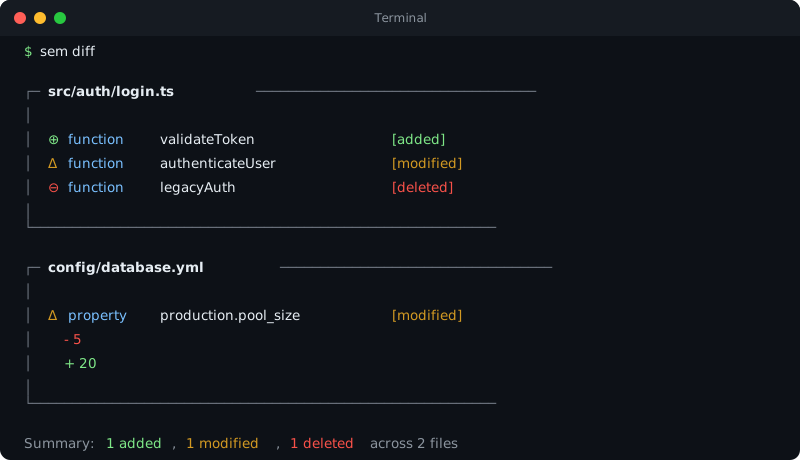
Instead of lines changed, sem tells you what entities changed: functions, methods, classes.
Why sem? · Install · Commands · Agents (MCP) · Cloud consent · Releases





sem is a semantic version control tool that works on top of Git. It parses your code with tree-sitter, extracts every function, class, and method as an entity, and diffs at the entity level instead of lines. This means you see "function blahh was modified" instead of "lines x-y changed."
It works in any Git repo with no setup.
Cloud-backed queries are opt-in per repo: logging in does not upload a repo or send a query. See the cloud consent flow for the public/private repo states, preview screen, local audit log, and forget controls.
Install
Or via Homebrew:
Or via winget on Windows:
Or via Scoop on Windows:
Or install the npm wrapper into node_modules:
With Bun, trust the package so its postinstall script can download the binary:
Once installed, update to the latest release any time:
Or via cargo, from crates.io:
Or build the latest main from source (requires Rust):
Or grab a binary from GitHub Releases.
Or run via Docker:
Name conflict with GNU Parallel
GNU Parallel ships a sem binary (/usr/bin/sem) as a symlink to parallel. If you have both installed, they'll collide. Run sem --version to check which one you're using. (#77)
Quick fixes:
If you installed via npm/bun, the binary lives in node_modules/.bin/sem and is invoked through npx sem or bunx sem, which avoids the conflict entirely.
Commands
Works in any Git repo. No setup required. Also works outside Git for arbitrary file comparison.
sem stores its SQLite entity cache outside the repository, under the OS cache directory by default. Set SEM_CACHE_DIR=/path/to/cache to override the cache root; repo-local overrides are ignored so cache files do not dirty the working tree.
sem diff
Entity-level diff with rename detection, structural hashing, and word-level inline highlights.
sem impact
Cross-file dependency graph shows what breaks if an entity changes.
sem blame
Entity-level blame showing who last modified each function, class, or method.
sem log
Track how a single entity evolved through git history.
With no entity, sem log analyzes recent repo history at the entity level:
hotspots (most-changed functions/classes, with author counts) and
co-change pairs (entities that repeatedly change in the same commits:
"if you touch one, don't forget the other"):
sem entities
List all entities under a file or directory path. No path is the same as ..
sem context
Token-budgeted context for LLMs: the entity, its dependencies, and its dependents, fitted to a strict content token budget.
When the target signature itself does not fit, JSON output reports target_omitted: true.
sem find / callers / refs / grep
Cold-start lookups backed by an on-disk, mmap-able query index (index.sem, stored next to the SQLite entity cache). The first call in a repo builds the index; every call after that reads it directly, no daemon or background process involved:
Measured on this repo (crates/) with time: the first sem find (index not built yet) took 185ms; the second call against the same repo, once the index existed, took 7ms. Run it yourself; the exact numbers will depend on your machine and repo size. The point is the cold-vs-warm gap: no daemon needs to stay alive for the warm number to hold.
sem graph
Prints the full entity dependency graph for the current repo, or --json for the underlying edge list (the same graph sem impact and sem context are built on top of):
sem stats
Local, cumulative counters: how many diffs sem has run in this environment and how much of that was noise filtered out. Nothing here leaves your machine (see Telemetry):
Use as default Git diff
Replace git diff output with entity-level diffs. Agents and humans get sem output automatically without changing any commands.
Related MCP Servers
Adoption & maintenance
Factual signals from GitHub, npm, and our automated checks — not a rating.
GitHub stars
3.4k
Stargazers on the source repository.
npm downloads
36
Package downloads in the last 30 days.
Last commit
3d ago
Most recent push to the default branch.
Directory activity
1 views
Config copies, upvotes, and views on AllMCPs.
Reviews
No reviews yet — be the first to share how this listing worked for you.
Frequently Asked Questions about Sem
AllMCPs Directory Badge
Showcase your server listing on GitHub or your project documentation. Embed this dynamic SVG badge to highlight official listing status and live engagement.
Badge Style:
Live Dynamic SVG Preview
Markdown (GitHub README)
[](https://allmcps.com/mcp/sem)HTML Embed
<a href="https://allmcps.com/mcp/sem"><img src="https://allmcps.com/api/badge/sem?style=directory" alt="Sem on AllMCPs" /></a>Technical Specs & Signals
CategoryDeveloper Tools
11/16 checks healthy over the last 45d
49Quality signal: Fair · 49/100How this signal is calculated ▾
Server availabilityNot measured
Not scored for repo-hosted servers — we can't reach the running server, only its GitHub page. Hosted MCP endpoints are health-checked live.
Verified ownership10/20
Documentation & tools16/30
Adoption & activity11/15
Community engagement0/10
A guidance signal from public completeness & health data — not a user rating. New listings start lower and rise as they add docs, get verified, and grow adoption. Signals we can't observe for a listing are skipped, not counted against it.
Supply-chain signal
No high-severity advisories surfaced by our automated scan.
Critical 0High 0Medium 0Low 0
Scanned 5d ago via OSV.dev · sem (npm)
Own this project?
This directory is pre-filled from public sources. Claim via GitHub README, site badge, or DNS TXT to unlock edit access and the Official badge — proof is checked automatically, then reviewed by our team.
Free dofollow backlink: add your website and place the AllMCPs badge on it — no claim needed. We detect it automatically and keep it verified as long as the badge stays live.
Claim & get free dofollowShare & Embed
Add our SVG badge (dark/light directory styles) or embeddable widget to your site.