Self-hosted memory for AI agents with hybrid search, knowledge graphs, tasks, and document sync.
Quick Install
Automated & IDE SetupCopy the AI prompt to install this server into Claude Code, Cursor, or another agent — or use 1-click editor setup below.
Manual Client & Custom JSON ConfigExpand JSON ▾
Client Config & Setup
Remote HTTPChoose your client or environment
Target File:
💡 Paste the JSON block into your client's configuration file under mcpServers, then restart the application.
Documentation Overview

Postgram
A self-hosted productivity and knowledge backend for humans and AI agents.
Website · Quick start · MCP guide · REST API · Demo
Postgram keeps the data you and your agents work from in one inspectable place: notes, documents, tasks, people, projects, interactions, decisions, and agent memory. Humans use the browser UI and CLI; agents use the same corpus over MCP, REST, or the CLI.
It is more than an agent-memory layer. Postgram preserves typed source objects, supports GTD-style task management and Markdown folder sync, combines full-text and vector retrieval with a knowledge graph, and separates short-lived agent working context from durable memory.
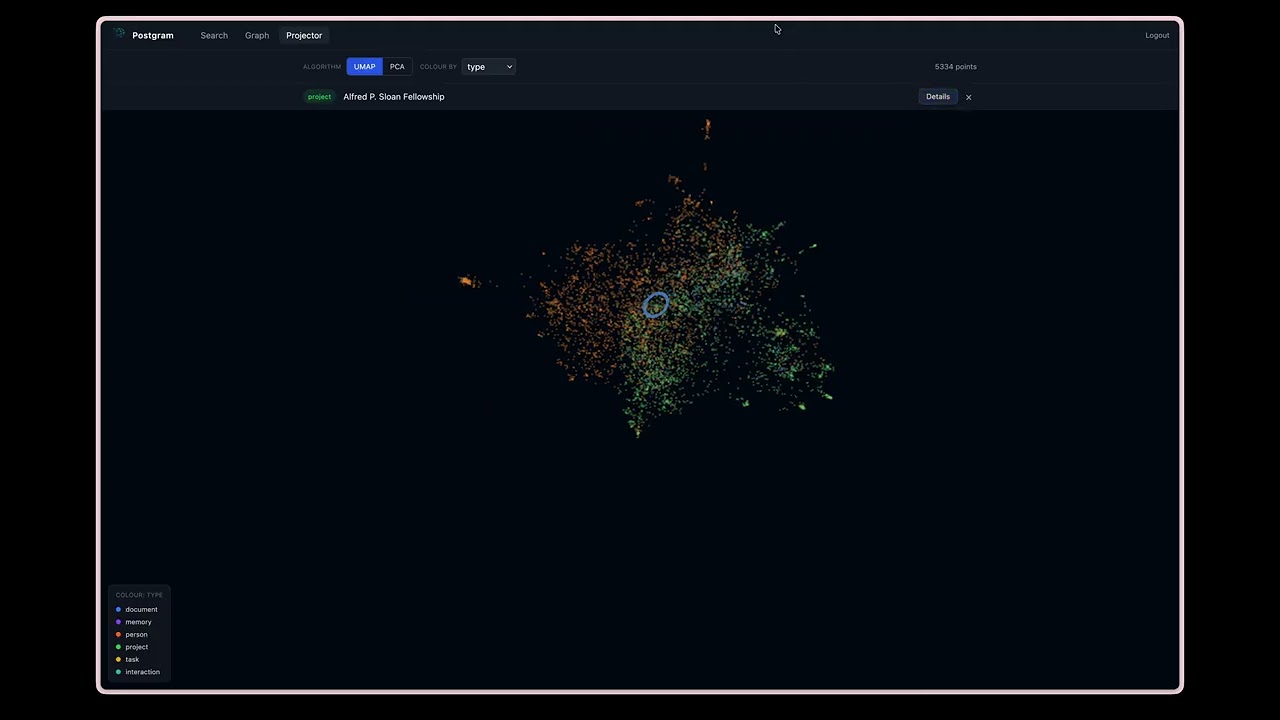
Watch the demo |
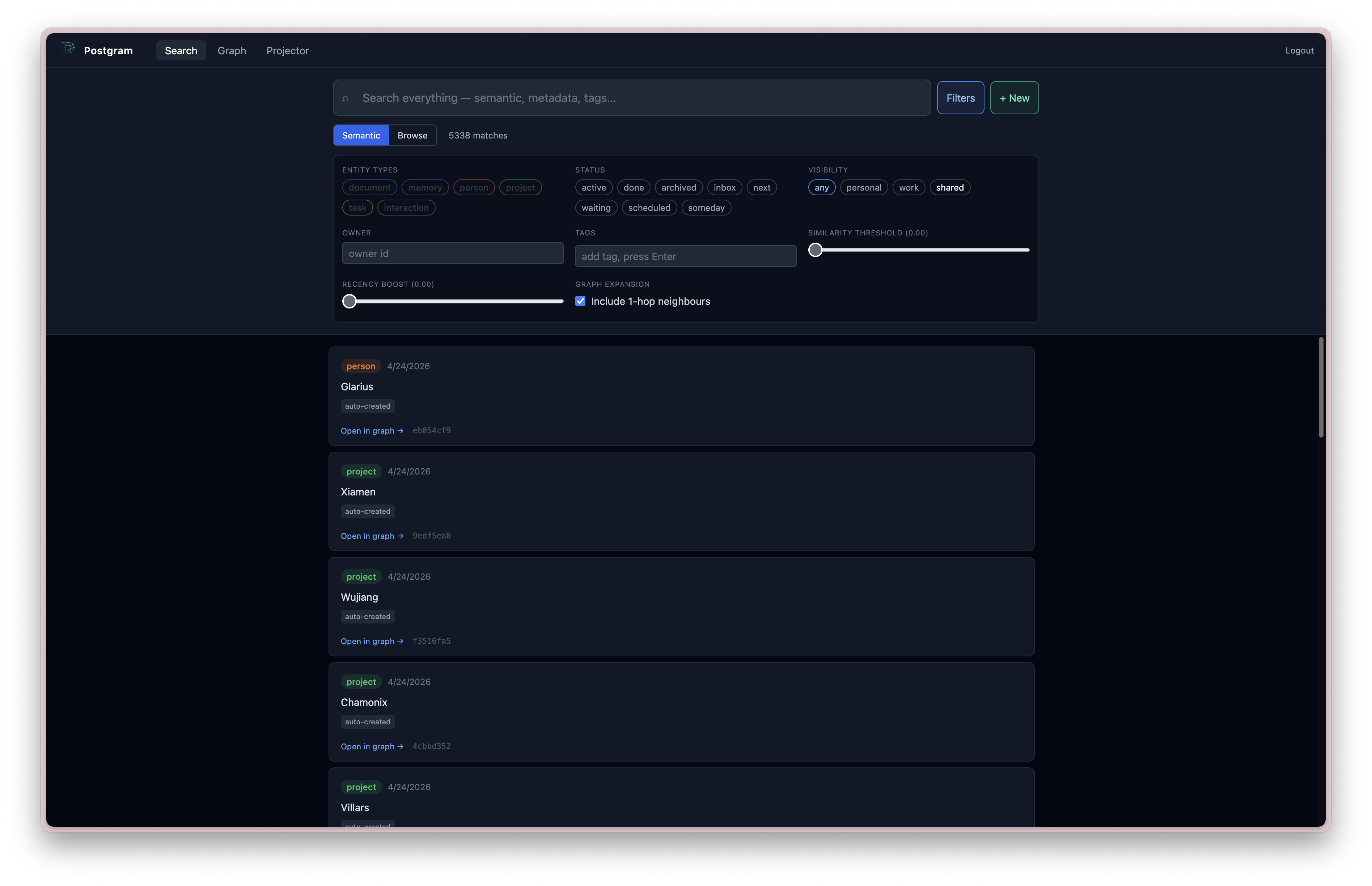
Search across memories, documents, people, projects, and tasks |
Why Postgram
- One private corpus across tools. Give different agents and devices access to the same data without tying it to one editor or hosted memory provider.
- Inspectable source data. Store typed entities instead of opaque chat summaries, then search, edit, link, archive, or delete them yourself.
- Search before graph expansion. Hybrid retrieval finds relevant entities; edge summaries tell an agent when related graph context is worth following.
- Working context is not durable memory. Session context has its own scope and lifecycle; grooming can archive it or distill selected context into durable memory.
- Operator control. Choose where PostgreSQL runs, which embedding and extraction providers are allowed, who receives API keys, and what is kept.
Postgram is built for one person or a small trusted team running a local or single-VM deployment. It is not a hosted service or a multi-tenant SaaS platform. Knowledge extraction is optional, and the provided Docker Compose setup binds the raw API and UI ports to loopback by default.
Quick Start (Docker Compose)
You need Git, Docker, and Docker Compose. Node.js 22+ is needed only for local
development or for installing the pgm CLI; gpg is needed only for encrypted
CLI backups.
-
Clone Postgram:
-
Choose an embedding path before the first start. For the local default, install and start Ollama on the Docker host, then pull Postgram's default embedding model:
For hosted OpenAI embeddings instead, create a
.envfile containing a real key before starting Compose: -
Start the stack:
The first run creates persistent Docker volumes for PostgreSQL and installation secrets. No
.envfile is required for the default Compose path. -
Read the one-time bootstrap token:
The plaintext appears only in the original first-start logs. Capture it before recreating the API container or discarding those logs.
-
Open http://127.0.0.1:3000/admin, paste the token, create the first admin, enroll MFA, and follow the onboarding flow.
-
Confirm the selected provider in the Admin Config tab. If you add or change staged settings, save, validate, and apply them, then restart
mcp-serverwhen Admin marks a restart as required:When Ollama runs on the Docker host, its base URL is
http://host.docker.internal:11434. Optional LLM relationship extraction is disabled by default and can use OpenAI, Anthropic, Ollama, or an OpenAI-compatible endpoint. Changing the embedding provider, model, or dimensions after the first start is migration work and is blocked from a simple config apply. -
Check health, then create an API key in the Admin Overview tab. For the smoke test below, allow
readandwrite, thememoryentity type, andpersonalvisibility:The response should include
"status":"ok"and"postgres":"connected". -
Install the CLI and verify an authenticated write and search. Enrichment is asynchronous, so wait for
pgm queueto report no pending work before the search:
If embeddings are unreachable, Postgram still starts and accepts writes, but enrichment and search will fail until the provider is available. See the full quick start and troubleshooting guide for the longer path.
For access from ChatGPT, Claude, or another remote MCP client, put Postgram behind HTTPS, enable OAuth, and follow the MCP integration guide. Do not publish the loopback development ports directly to the internet.
What It Does
Postgram provides:
- durable storage for typed entities:
memory,person,project,task,interaction,document - hybrid BM25 + vector search with asynchronous enrichment
- knowledge graph with typed directional edges between entities
- LLM-powered relationship extraction (OpenAI, Anthropic, or Ollama)
- document sync from local markdown repos via manifest comparison
- browser interfaces for knowledge work and guarded administration
- UMAP and PCA projections of embedded entities
- GTD-style capture, task organization, and Kanban views
- scoped API-key authentication and visibility restrictions
- a REST API for application and automation access
- a Streamable HTTP MCP endpoint for agent-native tool access
- a CLI (
pgm) for humans and agents - a container-local admin CLI (
pgm-admin) - Talon SQLite migration tooling
- encrypted backup support
- audit logging for mutating and privileged operations
How It Works
Postgram is a TypeScript Node.js application built around a service layer.
Main components:
- PostgreSQL +
pgvectorfor persistence and vector search - Hono for the HTTP server
- MCP over Streamable HTTP for agent-facing tool access
- CLI/admin CLIs built with Commander
- background enrichment worker for chunking, embeddings, and LLM extraction
High-level flow:
- a client stores or updates an entity
- the entity is written immediately
- enrichment runs asynchronously: chunking, embedding, and optionally LLM extraction
- chunks and embeddings are produced in the background
- edges are created from extracted relationships (if extraction is enabled)
- search queries use hybrid BM25 + vector scoring, with optional graph expansion
Main Features
1. Typed Knowledge Storage
Store structured knowledge objects with:
type(memory, person, project, task, interaction, document)contenttagsvisibility(personal, work, shared)status- arbitrary JSON metadata
Memory Roles
Postgram supports two roles for memory entities:
durable_memory: long-term memory future agents should trust, such as decisions, preferences, constraints, root causes, and completed-work summaries.session_context: working context for resuming recent conversations. Session context is scoped to the calling client, embedded for semantic recall, and skipped by graph extraction.
Use session context for "where were we in this thread?" Use durable memory for "what should future agents remember as true?"
CLI users can write session context with pgm memory session-context and search
it with pgm search --memory-role session_context.
Operators can groom stale session context with pgm-admin memory groom.
Use --client-id <client-id> for one client or --all-clients to batch over
every session-context scope. --all-clients keeps each client scope separate;
it is operational batching, not cross-client consolidation.
--older-than <duration> defaults to 7d and accepts values like 30m,
4h, 7d, or 0d. --dry-run previews eligible memories without calling
the LLM. Grooming has no default candidate cap; pass --limit <n> when you
want to process a bounded batch.
--mode archive --yes archives eligible working context directly.
--mode promote --yes uses the configured extraction LLM to decide whether
each session-context memory should be promoted; promoted memories are distilled
into new durable_memory entities, the source context is archived, and
provenance is recorded with metadata.promoted_to plus a promoted_to edge.
Authenticated users and agents can self-groom only their own client-scoped session context:
Related MCP Servers
Reviews
No reviews yet — be the first to share how this listing worked for you.
Frequently Asked Questions about Postgram
AllMCPs Directory Badge
Showcase your server listing on GitHub or your project documentation. Embed this dynamic SVG badge to highlight official listing status and live engagement.
Badge Style:
Live Dynamic SVG Preview
Markdown (GitHub README)
[](https://allmcps.com/mcp/postgram)HTML Embed
<a href="https://allmcps.com/mcp/postgram"><img src="https://allmcps.com/api/badge/postgram?style=directory" alt="Postgram on AllMCPs" /></a>Technical Specs & Signals
CategoryKnowledge & Memory
39Quality signal: Fair · 39/100How this signal is calculated ▾
Server availabilityNot measured
Not scored for repo-hosted servers — we can't reach the running server, only its GitHub page. Hosted MCP endpoints are health-checked live.
Verified ownership10/20
Documentation & tools16/30
Adoption & activity3/15
Community engagement0/10
A guidance signal from public completeness & health data — not a user rating. New listings start lower and rise as they add docs, get verified, and grow adoption. Signals we can't observe for a listing are skipped, not counted against it.
Own this project?
This directory is pre-filled from public sources. Claim via GitHub README, site badge, or DNS TXT to unlock edit access and the Official badge — proof is checked automatically, then reviewed by our team.
Free dofollow backlink: add your website and place the AllMCPs badge on it — no claim needed. We detect it automatically and keep it verified as long as the badge stays live.
Claim & get free dofollowShare & Embed
Add our SVG badge (dark/light directory styles) or embeddable widget to your site.