Semantic memory for AI agents with hybrid search, knowledge graph, and consolidation
Quick Install
Automated & IDE SetupCopy the AI prompt to install this server into Claude Code, Cursor, or another agent — or use 1-click editor setup below.
Not yet automatically verified
We haven't yet run this listing's install command through our automated sandbox check. This isn't a red flag — we're steadily working through the catalog.
Manual Client & Custom JSON ConfigExpand JSON ▾
Client Config & Setup
Choose your client or environment
Target File:
💡 Paste the JSON block into your client's configuration file under mcpServers, then restart the application.
Documentation Overview
neuromcp — Sovereign Memory for AI agents
Any model. Your memory. Stays local.
neuromcp is the first Sovereign Memory layer for AI: an open-source MCP server that gives Claude, GPT, Gemini, and Ollama persistent, searchable memory — stored entirely on your machine. No API keys. No cloud sync. No subscription required to remember who you are.
Sovereign Memory = data that you own outright, lives on hardware you control, and is portable across every model you use. Cloud memory products own your data; Sovereign Memory means you do.




Or run the bare server without any setup: npx neuromcp. Something not
working? npx neuromcp-doctor diagnoses the daemon, Ollama, embeddings
and the database in one run.
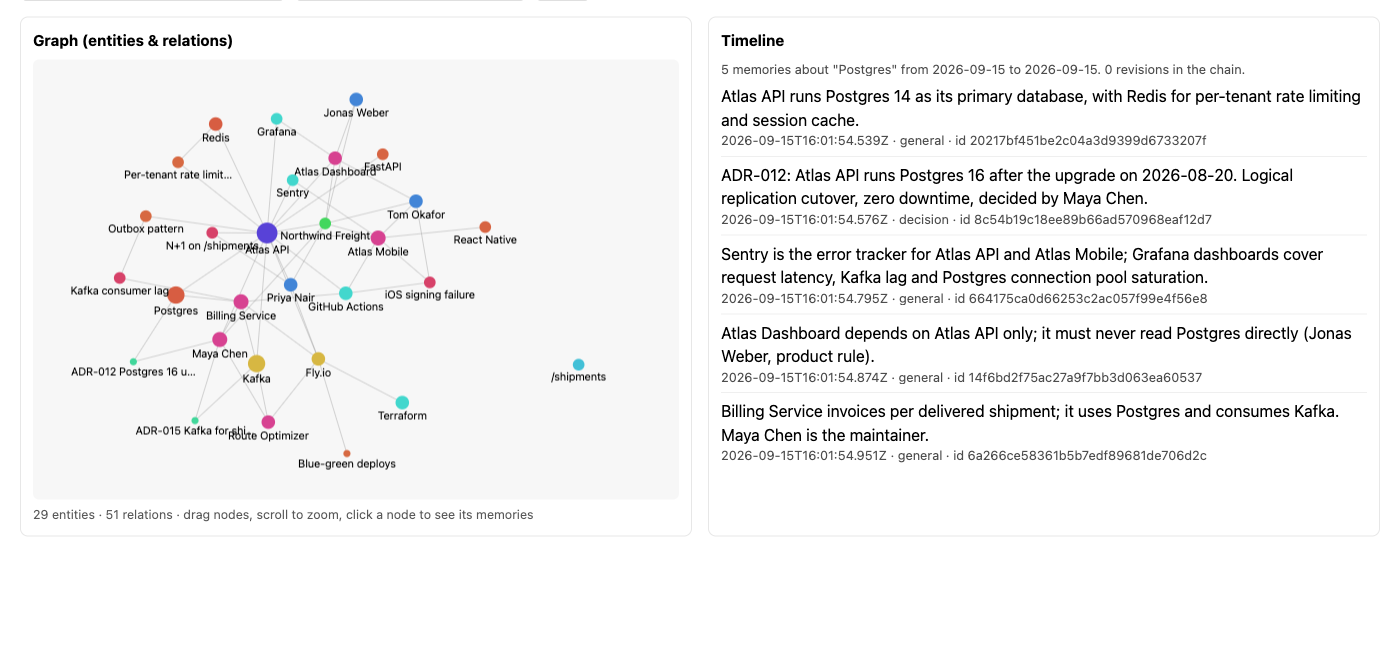
The built-in memory browser: the most-connected entities in a namespace
and the relations between them, as a force-directed graph you can drag,
zoom and click — served from localhost, never from a cloud. See
Memory browser & Obsidian.
Why neuromcp
The LLM is a commodity. Your memory is the moat. GPT-5, Claude 4, Gemini — they all converge. The model you use next year will differ. The memory of every conversation, decision, and preference you build is yours. neuromcp keeps that layer on your machine and makes it portable across any MCP-compatible client.
Local-first is a design choice, not a limitation. No telemetry. No data leaves your laptop. No vendor has a copy of your conversations. Audit every line of code that touches your memory. SQLite + local embeddings; everything fits on one disk.
One install. Every client. Claude Desktop, Cursor, Windsurf, Codex CLI, Continue, LibreChat, Open WebUI — neuromcp speaks MCP, so it works wherever MCP is supported. Switch models tomorrow; your memory follows.
Real recall, not keyword matching. Hybrid retrieval combines vector search (nomic-embed-text, 768-dim), BM25 full-text, graph links, and a learned usefulness prior. At 500 distractors on LongMemEval, R@5 holds at 93.3%. Your context window gets the right memory, not just the most recent.
LongMemEval-S accuracy
| Run | Score | Sample | Config |
|---|---|---|---|
| v7 (current) | 96.08% (98/102) | n=102 | Opus generator + Opus judge, single-model |
| v6 | 95.10% (97/102) | n=102 | Same as v7, prior hint set |
Repro: OMB_ANSWER_LLM=claude OMB_ANSWER_MODEL=opus OMB_JUDGE_LLM=claude OMB_JUDGE_MODEL=opus uv run omb run --dataset longmemeval -s s -m neuromcp -c "single-session-user,single-session-assistant,multi-session,temporal-reasoning,knowledge-update,single-session-preference" --query-limit 17
Sample size honesty. n=102 (17 per category × 6 categories). Wilson 95% CI for 98/102 ≈ 90.5–98.7%. Full 500q run with the same config is the next milestone before any "top-tier" claim.
Benchmarks (v0.18.0)
Oracle split (clean — easy mode)
| Mode | R@5 | R@10 | Hit Rate |
|---|---|---|---|
| Extracted (hybrid) | 100% | 100% | 100% |
Oracle-split LongMemEval isolates the correct memory in a small corpus. Every local MCP memory system claims ~99% here. It measures "does the ranker work on clean inputs" — nothing more.
Distractor split (v0.18.0, honest)
Same 30 questions + 1000 random distractor memories drawn from other questions' haystacks. The correct memory now competes against real noise.
| Embedder | Distractors | N | R@5 | R@10 | MRR |
|---|---|---|---|---|---|
Ollama nomic-embed-text | 0 (oracle) | 30 | 100% | 100% | 100% |
Ollama nomic-embed-text | 200 | 5 | 100% | 100% | 100% |
Ollama nomic-embed-text | 500 | 30 | 93.3% | 93.3% | 80.3% |
Ollama nomic-embed-text | 1000 | 5 | 100% | 100% | 74% |
Reproduce: npx tsx eval/longmemeval-distractor-runner.ts --limit 5 --distractors 1000
Sample sizes. The 500-distractor row is n=30 (Wilson 95% CI for 28/30 ≈ 78-99% R@5). The 1000-distractor row is n=5 — preliminary, Wilson 95% CI [57%, 100%]. The 1000-distractor n=30 run takes ~36 min on a single Ollama instance; cached-distractor batching is v0.19.0 work. Treat 500-distractor numbers as defensible, 1000-distractor as directionally positive but underpowered.
Head-to-head comparison is explicit v0.19.0 work. Hindsight (local OSS MCP, ~94.6% LongMemEval claimed) and Mem0/Zep publish their own numbers on their own harnesses. Until we run all of them against the same corpus + embedder, calling any local MCP server "state of the art" is marketing, not measurement. neuromcp publishes its numbers with sample-size caveats so you can judge direction; don't read absolute superiority into them yet.
Hybrid ranker (BM25 + vector + attention + graph + usefulness prior) keeps R@5 = 100% at 1000:1 distractor:target ratio on the observed sample. MRR drops to 74% because the correct memory is sometimes not rank-1 but always rank ≤ 5 in what we saw. Earlier v0.18.0 numbers (R@5 23%) were from a test FakeEmbedder — fixed in v0.18.1.
What this benchmark does NOT prove: end-to-end answer correctness, long-horizon multi-session reasoning, or superiority over commercial cloud systems (Mem0, Zep) on their own benchmarks. Those comparisons need their numbers on the same distractor split, which hasn't been published.
Why
AI agents forget everything between sessions. Existing solutions either store flat key-value pairs (useless for real knowledge) or require cloud infrastructure and API keys.
neuromcp gives you two layers of memory:
- MCP Server — hybrid search (vector + full-text + graph), verbatim recall, memory governance, automatic consolidation, all in a single SQLite file
- Wiki Knowledge Base — compiled Markdown knowledge that survives crashes, compounds over sessions, and gives your agent project-aware context at every startup
Inspired by Karpathy's LLM Wiki, Mastra's Observational Memory, and Zep's temporal knowledge graphs — but simpler than all of them. No vector DB, no embeddings pipeline, no cloud. Just Markdown files + Git + hooks.
Architecture
How the wiki works
| When | What happens |
|---|---|
| Session start | Hook injects index.md + user profile + auto-detected project page (~1300 tokens) |
| During session | LLM updates wiki pages when learning something persistent |
| Every 8 tool calls | Hook reminds LLM to update the wiki |
| Session end | Hook writes raw session log + git auto-commits all wiki changes |
| Crash | Checkpoint every 5 tool calls to file. Git history for rollback. |
Self-healing consolidation pipeline (v0.15.0+)
Every ~4h the launchd agent runs run-consolidation.sh, which
orchestrates four steps end-to-end:
consolidate-sessions.py— batches raw sessions per project, asks Claude for a factual summary, and fact-checks it against the raw sources. When the auditor flags specific unsupported claims the consolidator now auto-strips those lines and re-audits once — so one speculative sentence no longer kills a whole batch.rescue-rejected.py— any batch that still fails is parsed, the unsupported claims are removed, and the cleaned summary is appended to its wiki page. Pure text surgery, no LLM calls.entity-linker.py— cross-links every page: a bare-word mention of another registered entity (people/, projects/, systems/) is added to the page'srelated:frontmatter. Makes the wiki act like a graph without a separate graph database.rebuild-index.py— regeneratesindex.mdand per-category-index.mdfiles. Categories over 10 pages are auto-split so the session-start router stays compact as the wiki scales.
The pipeline is idempotent — safe to re-run at any time.
What the LLM knows at session start
Quick Start
One command (recommended)
Related MCP Servers
Adoption & maintenance
Factual signals from GitHub, npm, and our automated checks — not a rating.
GitHub stars
4
Stargazers on the source repository.
Last commit
9d ago
Most recent push to the default branch.
Reviews
No reviews yet — be the first to share how this listing worked for you.
Frequently Asked Questions about Neuromcp
AllMCPs Directory Badge
Showcase your server listing on GitHub or your project documentation. Embed this dynamic SVG badge to highlight official listing status and live engagement.
Badge Style:
Live Dynamic SVG Preview
Markdown (GitHub README)
[](https://allmcps.com/mcp/neuromcp)HTML Embed
<a href="https://allmcps.com/mcp/neuromcp"><img src="https://allmcps.com/api/badge/neuromcp?style=directory" alt="Neuromcp on AllMCPs" /></a>