Mydisease vs Opentargets
A side-by-side look at the Mydisease and Opentargets MCP servers: transport, auth, tools, quality signals, and the config to install either one in Claude, Cursor, Windsurf or VS Code.
Verdict: choose Mydisease for biology, medicine and bioinformatics work as a local process; choose Opentargets for biology, medicine and bioinformatics as a local process. You can also run both side by side in one mcpServers block.
Which MCP server should you choose?
 Choose Mydisease when
- You need dedicated capabilities in the Biology, Medicine and Bioinformatics domain.
- You prefer a local stdio subprocess transport.
- You want tools like
query, disease, metadata.
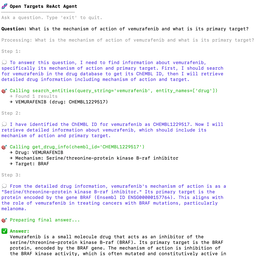 Choose Opentargets when
- You need dedicated capabilities in the Biology, Medicine and Bioinformatics domain.
- You prefer a local stdio subprocess transport.
- Its auth model fits you: No auth required.
- You have the keys it needs:
MCP_TRANSPORT, FASTMCP_SERVER_HOST, FASTMCP_SERVER_PORT, OPEN_TARGETS_API_URL, OPEN_TARGETS_RATE_LIMIT_RPS, OPEN_TARGETS_RATE_LIMIT_BURST, OPEN_TARGETS_RATE_LIMIT_ENABLED. - You want tools like
get_target_alternative_genes, get_target_associated_diseases, get_target_chemical_probes.
Feature & specification comparison
Rows where the two servers differ are marked.
| Spec | ||
|---|---|---|
| Category | Biology, Medicine and Bioinformatics | Biology, Medicine and Bioinformatics |
| Quality signal | 45/100 · Fair | 61/100 · Good |
| Install command | Confirmed | Confirmed |
| Transport | Local subprocess (stdio) | Local subprocess (stdio) |
| Auth | Not declared | No auth required |
| Pricing | Not declared | Free |
| Required env vars | None listed | MCP_TRANSPORTFASTMCP_SERVER_HOST |
Tools & capabilities
Mydisease tools 3
querySearch MyDisease.info for diseases by free-text name or fielded query. Returns matching hits, each keyed by a MONDO disease id (e.g. "MONDO:0015967") with the best-matching ontology and annotation keys. Use this to resolve a disease name to canonical ontology ids before calling the "disease" tool.…diseaseFetch the full aggregated annotation object for a single disease id. Accepts MONDO ("MONDO:0015967"), DOID ("DOID:9351"), OMIM ("OMIM:125853") and other supported ontology ids. Returns cross-referenced data including MONDO ontology (labels, synonyms, xrefs, parents/children), gene-disease associati…metadataReturns MyDisease.info build metadata: total disease document count, available annotation sources (MONDO, DOID, OMIM, DisGeNET, HPO, CTD), and their current release versions.
Opentargets tools 68
get_target_alternative_genesList alternate gene symbols and database cross-references for a target.get_target_associated_diseasesList diseases linked to a target with association scores.get_target_chemical_probesList available chemical probes and their quality metrics.get_target_classReturn ChEMBL target class annotations for a gene.get_target_depmap_essentialityFetch DepMap CRISPR essentiality scores across cell lines.get_target_expressionReturn baseline expression measurements for a target across biosamples.get_target_genetic_constraintFetch genetic constraint metrics (gnomAD) for a target.get_target_hallmarksReturn cancer hallmark annotations associated with a target.
Ready-to-paste client configs
Paste either block (or both) into your client config, e.g. claude_desktop_config.json or ~/.cursor/mcp.json. We only show a config when the install command is confirmed.
Mydisease
{
  "mcpServers": {
    "mydisease": {
      "command": "npx",
      "args": [
        "-y",
        "@pipeworx/mcp-mydisease"
      ]
    }
  }
}
Opentargets
{
  "mcpServers": {
    "opentargets": {
      "command": "uvx",
      "args": [
        "--from",
        "git+https://github.com/nickzren/opentargets-mcp",
        "opentargets-mcp"
      ],
      "env": {
        "MCP_TRANSPORT": "YOUR_MCP_TRANSPORT_HERE",
        "FASTMCP_SERVER_HOST": "YOUR_FASTMCP_SERVER_HOST_HERE",
        "FASTMCP_SERVER_PORT": "YOUR_FASTMCP_SERVER_PORT_HERE",
        "OPEN_TARGETS_API_URL": "YOUR_OPEN_TARGETS_API_URL_HERE",
        "OPEN_TARGETS_RATE_LIMIT_RPS": "YOUR_OPEN_TARGETS_RATE_LIMIT_RPS_HERE",
        "OPEN_TARGETS_RATE_LIMIT_BURST": "YOUR_OPEN_TARGETS_RATE_LIMIT_BURST_HERE",
        "OPEN_TARGETS_RATE_LIMIT_ENABLED": "YOUR_OPEN_TARGETS_RATE_LIMIT_ENABLED_HERE"
      }
    }
  }
}
Frequently asked questions
Mydisease is categorized under Biology, Medicine and Bioinformatics and uses a local stdio subprocess. Opentargets belongs to Biology, Medicine and Bioinformatics and uses a local stdio subprocess. Pick Mydisease for biology, medicine and bioinformatics work and Opentargets for biology, medicine and bioinformatics.
Copy the mcpServers block from the config section on this page into your client's config (for example claude_desktop_config.json or ~/.cursor/mcp.json), then fully restart the client.
Mydisease has no declared pricing — check the project's own site. Opentargets is listed as free. Auth: no auth required. If a server needs environment variables such as API keys, define them under the env key in your client's MCP config.
Yes. MCP clients support multiple servers: add mydisease and opentargets as separate keys in the same mcpServers object, and your assistant will call tools from either one.
On AllMCPs, Mydisease has a quality signal of 45/100 (Fair) with 2 views, 0 installs and 0 GitHub stars. Opentargets has 61/100 (Good) with 3 views, 0 installs and 19 GitHub stars.