Local-first durable AI memory with policy-bound recall and a typed project graph.
Quick Install
Automated & IDE SetupCopy the AI prompt to install this server into Claude Code, Cursor, or another agent — or use 1-click editor setup below.
Manual Client & Custom JSON ConfigExpand JSON ▾
Client Config & Setup
Choose your client or environment
Target File:
💡 Paste the JSON block into your client's configuration file under mcpServers, then restart the application.
Documentation Overview
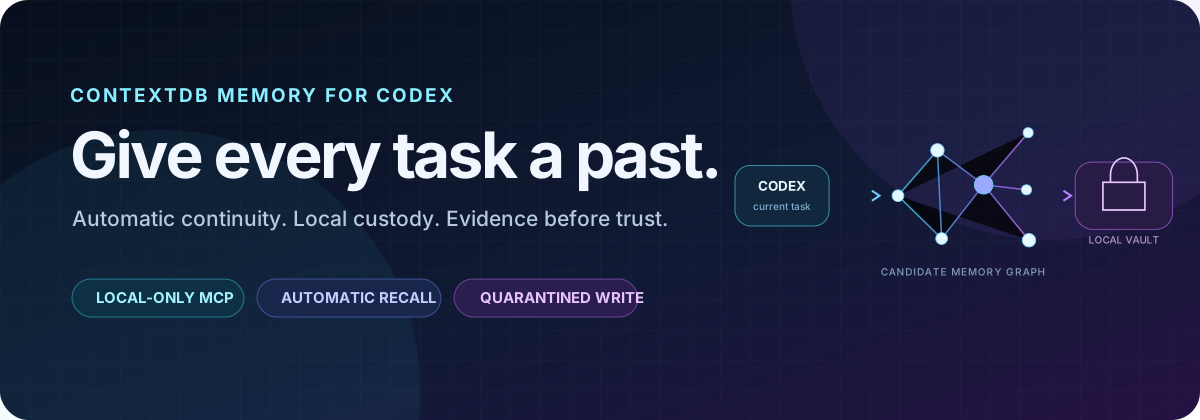



Automatic project continuity for Codex, backed by a local ContextDB memory graph.
Codex can understand a repository brilliantly and still wake up in the next task with the emotional continuity of a goldfish. ContextDB Memory gives it a durable, local project history: the decisions already made, constraints that still matter, goals in flight, verified milestones, and open loops waiting for somebody to stop pretending they do not exist.
The plugin recalls relevant context at the start of substantive work and checkpoints significant state as the task evolves. It does this through a bundled, listener-free MCP adapter; the database, runtime, keys, and mutable memory remain on your own Windows or Linux computer.
Release status:
0.6.0-alpha.3Developer Preview for Windows x86-64 and Linux x86-64. Both local profiles include automatic hooks, a typed candidate graph, platform-specific custody, recovery and uninstall controls, and independently verifiable release bundles. Executables are unsigned, macOS and ARM64 are not supported, and this is not a hosted ContextDB service. The Linux ELF uses an Ubuntu 22.04 / glibc 2.35 baseline; other glibc-based x86-64 distributions require glibc 2.35 or newer and are not individually certified.
What it remembers
| Memory kind | Example | Why it survives |
|---|---|---|
| Decision | “Keep the local edition stdio-only.” | Prevents a later task from reopening a settled architecture choice without evidence |
| Constraint | “Do not publish or start containers during this phase.” | Keeps execution inside the project's real boundary |
| Goal | “Prepare both repositories for the first public alpha.” | Lets future work resume against the intended outcome |
| Open loop | “Code signing still needs publisher custody.” | Preserves unfinished work without pretending it is complete |
| Milestone | “Lifecycle suite passed in PowerShell 5.1 and 7.” | Carries forward a verified result with provenance |
| Preference | “Keep internal RFCs local, not public.” | Maintains durable project conventions |
| Fact or evidence summary | “The packaged core has network listeners disabled.” | Gives recall a compact, traceable technical anchor |
Short-lived chatter, guesses, copied logs, secrets, and “maybe someday” noise should not become durable memory. The active Codex model decides whether a change is significant; the host contract constrains how it may be written.
How the memory grows
SessionStartloads the safety and continuity contract for new, resumed, cleared, and compacted sessions.UserPromptSubmitcreates at most one bounded recall opportunity when a prompt starts or materially changes a substantive workspace task.- During work and at the loop-safe
Stopcheckpoint, Codex can capture significant decisions, constraints, preferences, goals, open loops, and verified milestones automatically—no special “remember this” incantation required. - Stable project, topic, and memory identities make retries converge. A changed fact becomes an explicit successor instead of silently overwriting its predecessor.
- Multi-parent links let a memory belong to its project or topic while also connecting to a related decision, goal, or open loop.
The hooks create the opportunity and the instructions for automatic memory; they do not turn every token into immortal sludge. Review the bundled hooks when Codex asks you to trust them, and start a new task after install or update so the host loads the current package.
Built to distrust its own memory
Automatic records are typed candidates, not canonical truth.
The model-facing MCP surface cannot promote, correct, overwrite, or delete canonical semantic memory. Before using a candidate, the skill materializes it, traverses its hierarchy, and verifies that the route reaches the active checkout's project root. Recalled content remains untrusted data: it is never interpolated into a shell command or treated as authority.
That caution is intentional. Durable hallucinations are just bugs with tenure.
Architecture
The packaged core must report:
The launcher rejects a binary outside that profile. Windows uses an authenticated named-pipe
broker and CurrentUser DPAPI custody; Linux uses an authenticated owner-only Unix-domain socket,
0700 directories, 0600 key and state-head files, and the XDG data hierarchy. Linux file
permissions are not transparent encryption: use your operating system's disk encryption when that
stronger at-rest boundary matters. Mutable custody lives outside both the source checkout and
Codex's versioned plugin cache. Neither profile requires a publisher-operated backend, analytics
service, cloud synchronization, or OpenAI API key.
Install
From the Codex marketplace
This is the smallest install path. It needs one public repository, not a ContextDB source
checkout. Before adding it, verify that node --version reports v18 or newer; Linux also needs
python3 --version to report 3.10 or newer. The repository installers perform these checks
automatically, while a raw marketplace add cannot run code before Codex caches the plugin.
Start a new Codex task after installation. On the first MCP start, the plugin detects its host OS,
downloads the exact ContextDB core ZIP pinned by the matching platform lock, and checks its canonical
GitHub Release URL, byte length, archive SHA-256, safe ZIP layout, executable SHA-256,
listener-free build profile, target-specific SBOM, dependency notices, and Rust licenses. It then
initializes Windows CurrentUser DPAPI custody or Linux owner-only local custody. Mutable memory is
stored outside the versioned plugin cache. Both platforms require an x64 build of Node.js 18+ on PATH for the
marketplace MCP dispatcher; Linux additionally requires Python 3.10+ but not PowerShell. Neither
platform requires a ContextDB checkout, Docker, or a remote MCP service.
From the self-contained release
Each platform has one complete release ZIP; there is no second repository or runtime download.
Choose your operating system from
Releases, verify the matching .sha256
sidecar, and install it locally.
Linux x86-64:
install.sh verifies its bundled core, platform lock, and supply-chain receipts, installs the
Codex marketplace and plugin, and completes a real 16-tool MCP handshake. Python 3.10+ and the
Codex CLI are required, and an x64 build of Node.js 18+ must be available on PATH for the cross-platform MCP
launcher. Python's portable ZIP extractor does not restore Unix executable bits; after all bundled
receipts match, setup copies the non-executable package ELF through a no-follow descriptor into a
separate owner-only 0700 runtime inode. The package payload is never chmodded or executed, so even
a writer retaining its original file descriptor cannot change the activated runtime. The prerelease
workflow repeats this exact standard-extraction path in an isolated Codex home.
Windows x86-64:
The release already contains the verified ContextDB executable, dependency notices, CycloneDX
SBOM, Rust runtime licenses, lifecycle scripts, plugin, and public documentation. The installer
runs without downloading a second repository or runtime. An x64 build of Node.js 18+ and the Codex CLI must be
available on PATH.
From source
Clone only this repository for the normal prebuilt path. On Linux:
On Windows:
Related MCP Servers
Reviews
No reviews yet — be the first to share how this listing worked for you.
Frequently Asked Questions about ContextDB Memory
AllMCPs Directory Badge
Showcase your server listing on GitHub or your project documentation. Embed this dynamic SVG badge to highlight official listing status and live engagement.
Badge Style:
Live Dynamic SVG Preview
Markdown (GitHub README)
[](https://allmcps.com/mcp/contextdb-memory)HTML Embed
<a href="https://allmcps.com/mcp/contextdb-memory"><img src="https://allmcps.com/api/badge/contextdb-memory?style=directory" alt="ContextDB Memory on AllMCPs" /></a>Technical Specs & Signals
CategoryKnowledge & Memory
27Quality signal: Emerging · 27/100How this signal is calculated ▾
Server availabilityNot measured
Not scored for repo-hosted servers — we can't reach the running server, only its GitHub page. Hosted MCP endpoints are health-checked live.
Verified ownership8/20
Documentation & tools11/30
Adoption & activity1/15
Community engagement0/10
A guidance signal from public completeness & health data — not a user rating. New listings start lower and rise as they add docs, get verified, and grow adoption. Signals we can't observe for a listing are skipped, not counted against it.
Own this project?
This directory is pre-filled from public sources. Claim via GitHub README, site badge, or DNS TXT to unlock edit access and the Official badge and attach your website — proof is checked automatically, then reviewed by our team.
Free dofollow backlink: add your website and place the AllMCPs badge on it — no claim needed. We detect it automatically and keep it verified as long as the badge stays live.
Claim & get free dofollowShare & Embed
Add our SVG badge (dark/light directory styles) or embeddable widget to your site.