AllMCPs
BrowseBestCategoriesStackCompareToolsGuidesBlog Log in Submit MCP

Stay in the loop

Get new MCP servers and top picks in your inbox.

AllMCPs

The open directory for discovering and installing Model Context Protocol servers.

Explore

  • Browse servers
  • Best MCP servers
  • Categories
  • MCP clients
  • Agent prompts
  • Stack Builder
  • Compare servers
  • Tags index
  • Submit a server
  • Pricing

Learn

  • Guides hub
  • What is MCP?
  • Install guide
  • Troubleshooting
  • Security
  • Blog
  • Blog RSS

Tools

  • All tools
  • Config generator
  • Config validator
  • MCP playground
  • OpenAPI β†’ MCP
  • Badge generator

For agents

  • API docs
  • Trust & traffic
  • llms.txt β†— (opens in a new tab)
  • Catalog JSON β†— (opens in a new tab)
  • Remote MCP β†— (opens in a new tab)

Company

  • About
  • Contact
  • X (@AllMCPs) β†— (opens in a new tab)
  • GitHub β†— (opens in a new tab)
  • Terms
  • Privacy
AllMCPs VerifiedAllMCPs VerifiedFeatured on Nick LaunchesFeatured on Nick LaunchesLaunch Llama NewsletterLaunch Llama NewsletterVerified DR - allmcps.comVerified DR - allmcps.comFeatured on SaaSGrowFeatured on SaaSGrowFeatured on Twelve ToolsFeatured on Twelve ToolsFeatured on Saaspa.geFeatured on Saaspa.geFeatured on Findly.toolsFeatured on Findly.toolsFeatured on Startup FameFeatured on Startup FameFeatured on LaunchKiwiFeatured on LaunchKiwiFeatured on ScrollLaunchFeatured on ScrollLaunchFeatured on DailyPingsFeatured on DailyPingsFazier badgeFazier badgeFeatured on NewTool.siteFeatured on NewTool.siteFeatured on saasfame.comFeatured on saasfame.comDR Checker - Domain RatingDR Checker - Domain RatingListed on Turbo0Listed on Turbo0Launched on LaunchBoard - Product Launch PlatformLaunched on LaunchBoard - Product Launch PlatformList on SimilarlabsList on Similarlabshttps://codetrendy.comhttps://codetrendy.comListed on DevTool.ioFeatured on BuildlistFeatured on BuildlistAllMCPs VerifiedAllMCPs VerifiedFeatured on Nick LaunchesFeatured on Nick LaunchesLaunch Llama NewsletterLaunch Llama NewsletterVerified DR - allmcps.comVerified DR - allmcps.comFeatured on SaaSGrowFeatured on SaaSGrowFeatured on Twelve ToolsFeatured on Twelve ToolsFeatured on Saaspa.geFeatured on Saaspa.geFeatured on Findly.toolsFeatured on Findly.toolsFeatured on Startup FameFeatured on Startup FameFeatured on LaunchKiwiFeatured on LaunchKiwiFeatured on ScrollLaunchFeatured on ScrollLaunchFeatured on DailyPingsFeatured on DailyPingsFazier badgeFazier badgeFeatured on NewTool.siteFeatured on NewTool.siteFeatured on saasfame.comFeatured on saasfame.comDR Checker - Domain RatingDR Checker - Domain RatingListed on Turbo0Listed on Turbo0Launched on LaunchBoard - Product Launch PlatformLaunched on LaunchBoard - Product Launch PlatformList on SimilarlabsList on Similarlabshttps://codetrendy.comhttps://codetrendy.comListed on DevTool.ioFeatured on BuildlistFeatured on Buildlist
Β© 2026 Jackalope Digital LLC. All rights reserved.
  1. Home
  2. 🧠 Knowledge & Memory
  3. Memorix
M
Health: Not checked yetWe have not completed a health check for this listing yet.Last checked 8/10/2026, 11:44:52 PM

Memorix

Enrichment pendingWe haven’t run our AI enrichment pass on this listing yet, so the overview, use cases, and FAQ below may be sparse or missing. We work through the catalog over time β€” check back soon.
View RepositoryVisit Website

Local-first persistent project memory for AI coding agents across MCP clients and sessions.

Quick Install

Automated & IDE Setup

Copy the AI prompt to install this server into Claude Code, Cursor, or another agent β€” or use 1-click editor setup below.

Add to CursorAdd to VS Code
Manual Client & Custom JSON ConfigExpand JSON β–Ύ

Install Config Generator

Choose your client
claude_desktop_config.json
{
  "mcpServers": {
    "memorix": {
      "command": "npx",
      "args": [
        "-y",
        "memorix"
      ]
    }
  }
}

πŸ’‘ Paste into ~/Library/Application Support/Claude/claude_desktop_config.json (macOS) or %APPDATA%\Claude\claude_desktop_config.json (Windows)

Install Directory Badge Claim listing Alternatives🧠 More in Knowledge & Memory

Documentation Overview

Memorix

Memorix

Local-first shared memory layer for AI coding agents.
One project memory system for Claude Code, Codex, CodeBuddy Code, Cursor, Windsurf, Copilot, Gemini CLI, OpenCode, OpenClaw, Hermes Agent, Oh-my-Pi, Pi, Kiro, Antigravity, Trae, and any MCP-capable agent.

npm monthly downloads CI license stars

Listed in the official MCP Registry

View Memorix on MCP Toplist

Shared Project Memory | MCP | Git Memory | Reasoning Memory | Plugins | Orchestration

Chinese | Install | Capabilities | Agents | Quick Start | Memory Model | memcode | Active Work | Docs


Maintainer status and the current public work boundary live in ACTIVE_WORK.md. It is the repository's single living work tracker.

Memorix

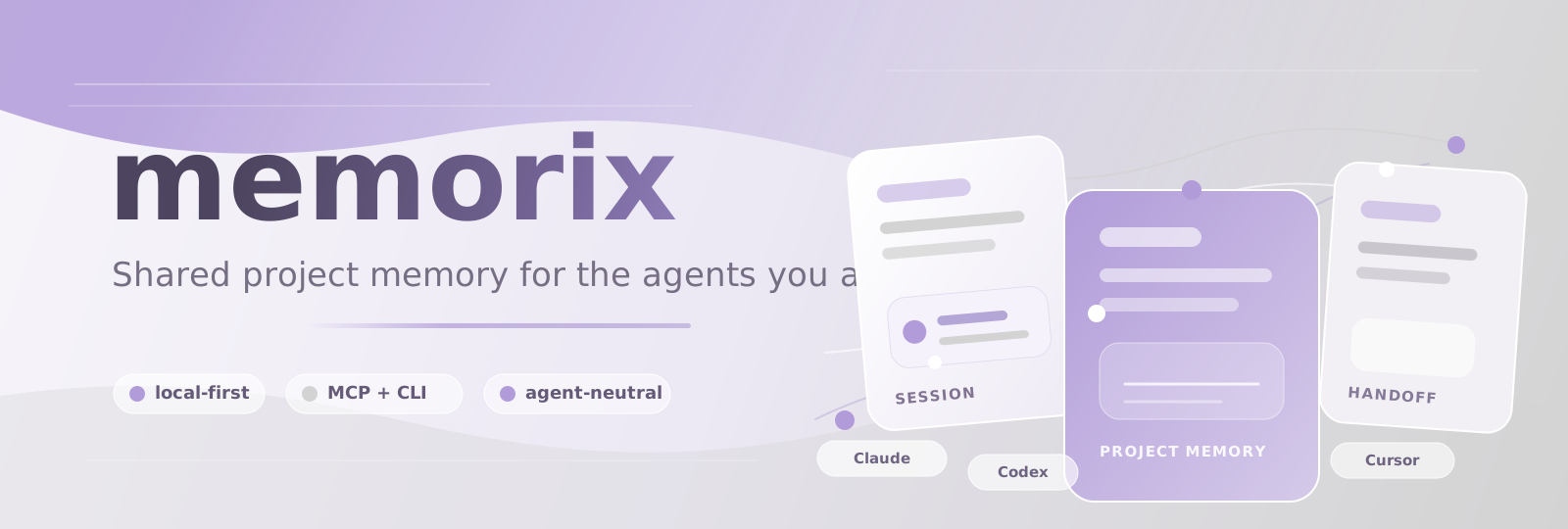
Memorix gives the AI coding agents you already use a shared, searchable project memory that survives new chats, IDE switches, terminal sessions, and handoffs. The memory lives under the Git project, not inside one chat window or one tool.

Use Claude Code today, Codex tomorrow, and Cursor in the afternoon. The agent can change; the project memory stays the same.

Use Memorix when you keep re-explaining the same project to a new agent session: the last session already figured something out, another IDE cannot see it, or a design decision is buried in a chat you cannot find anymore.

ProblemWhat Memorix adds
The next session forgets what the last session learnedProject-scoped memory, session summaries, timelines, and detail retrieval
Different agents know different thingsOne local memory pool available through MCP, hooks, CLI, SDK, and the bundled terminal agent
Git records what changed, but agents cannot recall it wellGit Memory turns commits into searchable engineering facts
Architecture decisions disappear into old chatsReasoning Memory stores why choices were made, with alternatives and trade-offs
Static rule files driftGotchas, fixes, and project skills evolve from real work
Parallel agent work gets messymemorix orchestrate coordinates task context, handoffs, locks, verification, and review loops

Memorix is local-first. SQLite is the canonical store, Orama handles search, and LLM-backed formation/embedding is optional. Without model keys, Memorix still works with local full-text retrieval.

Capabilities

Memorix is more than a memory store. It also installs agent integrations, keeps useful work events, turns commits into project facts, exposes a local control plane, and can coordinate multi-agent work when a task needs it.

CapabilityWhat it doesEntry point
Memory AutopilotA bounded task Workset with start files, current memory, source-backed knowledge, workflow starts, cautions, and verificationmemorix context "...", memorix resume "...", memorix_project_context
Observation MemorySearchable facts, fixes, gotchas, session summaries, and implementation notes scoped to the current Git projectmemorix memory, MCP memory tools
Curated Long-term MemoryDeliberately reviewed episodic, semantic, and procedural memory with source evidence. Only an explicitly portable user item can cross local projectsmemorix memory long-term
Code State and Code MemoryVersioned local code snapshots, file/symbol links, and freshness checks. The built-in Lite index is always honest about its limits; an already-indexed local CodeGraph can add a bounded semantic outlinememorix codegraph, automatic context refresh
Git MemoryCommit-derived engineering facts that answer what changed, where, and why it mattersmemorix ingest commit, git hook
Reasoning MemoryDesign rationale, alternatives, trade-offs, and risks that should survive beyond one chatmemorix reasoning, memory formation
Knowledge WorkspaceReview-gated source-backed claims, Markdown pages, and canonical project workflows; proposals never overwrite reviewed pages silentlymemorix knowledge, memorix knowledge workflow
Agent setupOne setup path for MCP, rules, hooks, skills, plugins, bundles, or extensions depending on the agentmemorix setup --agent <agent>
Agent doctorChecks whether agent MCP config and guidance are current, then repairs Memorix-owned entries when neededmemorix doctor agents, memorix repair agents
Hooks and skillsOptional capture from supported agents, plus reusable project skills promoted from durable knowledgememorix hooks, memorix skills
Dashboard and HTTPA local web UI and shared MCP endpoint for browsing memory, project state, teams, and diagnosticsmemorix dashboard, memorix background start
Orchestration and team workTask planning, worker handoffs, file locks, messages, verification gates, and review loopsmemorix orchestrate, memorix team, memorix lock
memcodeA bundled terminal coding agent that already reads and writes the same project memorymemorix, memcode
CLI and SDKScriptable access for automation, imports/exports, diagnostics, and custom integrationsmemorix ..., createMemoryClient()

Works with every agent

Memorix connects through the interfaces each agent already supports: plugin packages, MCP, project rules, hooks, skills, or the bundled terminal agent. memorix setup chooses the right setup for each agent and keeps stdio MCP as the default transport.

Claude Code
Claude Code
official plugin + MCP + hooks + skills
Codex CLI
Codex CLI
official plugin + MCP + AGENTS.md
GitHub Copilot CLI
GitHub Copilot CLI
plugin + MCP + hooks + skills
Cursor
Cursor
MCP + rules + skills
Windsurf
Windsurf
MCP + rules + hooks
Gemini CLI
Gemini CLI
extension + MCP + hooks + skills
OpenCode
OpenCode
local plugin + MCP + skills + AGENTS.md
pi coding agent
pi coding agent
package + extension + skill
Kiro
Kiro
MCP + steering + hooks
Antigravity
Antigravity
plugin + MCP + hooks + skills
Trae
Trae
MCP + project rules
memcode
memcode
bundled terminal agent
OpenClaw
OpenClaw
bundle + MCP + hooks + skills
Hermes Agent
Hermes Agent
plugin + MCP + hooks + skills
Oh-my-Pi
Oh-my-Pi
package + MCP + hooks + skills
Any MCP Client
Any MCP Client
stdio or HTTP MCP

Works with agents that speak MCP, expose hooks/rules, or support plugin/package entries. One local-first memory layer shared across all of them.

Integration surfaces:

SurfaceWhat it doesMemorix entry
Setup commandInstalls the recommended one-time user-level Memorix integrationmemorix setup --agent <agent> --global
MCPGives an agent compact Memorix tools for project context, search, detail retrieval, storage, and resolutionbundled in setup packages or memorix serve
Usage guidanceTeaches an agent when and how to use Memorix without forcing memory lookup on every promptbundled or generated by memorix setup
HooksOptional capture of prompts, tool events, file edits, session lifecycle events, and native compaction checkpoints where the agent exposes thembundled or generated by memorix setup
Plugin or bundle packageInstalls plugin, compatible-bundle, or package files where the agent supports themClaude Code, Codex, CodeBuddy Code, GitHub Copilot CLI, Antigravity, OpenClaw, Hermes Agent, Oh-my-Pi, Pi
ExtensionInstalls extension files where the agent supports themGemini CLI
Local pluginInstalls local plugin files where the agent loads them directlyOpenCode
MCP/rules configWrites MCP, rules, steering, guidance, or hook config for IDEs and agents that expose those surfacesCursor, Windsurf, Kiro, Trae
SkillsTurns durable project knowledge into reusable task guidancememorix skills and memorix_promote
memcodeOpens the bundled terminal agent that already uses Memorix memorymemorix or memcode

See Integration Surfaces for the current support matrix and what each generated file means.

Use the same setup command without --global only when you intentionally want repo-local guidance, rules, or hooks in the current Git project.

CLI, MCP, and HTTP are different entry points:

  • memorix CLI is the direct command surface for setup, memory search/store, Git Memory, import/export, dashboard, orchestration, diagnostics, and automation.
  • memorix serve is the stdio MCP bridge used by IDEs and coding agents. Its default tool profile is micro, so agents see only the compact core tool set.
  • memorix background start / memorix serve-http run the HTTP service for a shared endpoint, dashboard, Docker, or multiple clients.

Install

Requirements:

  • Node.js >=22.18.0
  • Git, because project identity is derived from the real Git root

Install and initialize:

Terminal
npm install -g memorix
memorix init --global                   # optional defaults
memorix setup --agent claude --global   # or codex, copilot, cursor, pi, gemini-cli, opencode,
                                       # codebuddy, windsurf, kiro, antigravity, trae, openclaw, hermes, omp

memorix init is optional. It creates or updates TOML configuration:

  • ~/.memorix/config.toml for global defaults
  • <git-root>/memorix.toml for optional project overrides

Legacy memorix.yml, .env, and ~/.memorix/config.json are still read for compatibility, but new setup flows use TOML.

If you want repo-local guidance or hooks for a specific repository, run the same setup command from inside that repo without --global. Codex is the exception: its supported path is the user-level plugin install, so Memorix leaves project .codex configuration alone.

Quick Start

Connect an existing agent

Use the setup command first. The global form is the normal one-time install:

bash
memorix setup --agent claude --global
memorix setup --agent codex --global
memorix setup --agent copilot --global
memorix setup --agent cursor --global
memorix setup --agent pi --global
memorix setup --agent gemini-cli --global
memorix setup --agent opencode --global
memorix setup --agent windsurf --global
memorix setup --agent kiro --global
memorix setup --agent antigravity --global
memorix setup --agent trae --global
memorix setup --agent openclaw --global
memorix setup --agent hermes --global
memorix setup --agent codebuddy --global
memorix setup --agent omp --global

What it installs depends on the target agent, but the goal is the same: make Memorix available wherever you open that agent without asking you to wire every repo by hand.

  • Claude Code: installs the Memorix plugin package, adds CLAUDE.md guidance, and enables hook capture when you do not pass --noHooks.
  • Codex: installs one user-level Memorix plugin with bundled stdio MCP, skills, and lifecycle hooks. It does not write project-local .codex config or change your model, approval, or sandbox settings. When Codex asks, review the plugin hook definition once with /hooks; --noHooks skips automatic capture.
  • GitHub Copilot CLI: installs the Copilot plugin package and official Memorix skills.
  • Pi: installs the user-level Pi package and official skills.
  • Cursor: writes Cursor MCP/rules/config entries in the chosen scope.
  • Gemini CLI: installs the extension package, GEMINI.md context, hooks, and skills. Antigravity CLI has an official Gemini CLI migration path, but Gemini CLI remains an active standalone target.
  • OpenCode: installs the local plugin file, opencode.json, skills, and AGENTS.md guidance.
  • Windsurf, Kiro, Trae: write the MCP/rules/hooks files the target supports.
  • Antigravity: installs the official plugin package with plugin.json, mcp_config.json, hooks.json, rules, and skills under ~/.gemini/config/plugins/memorix or .agents/plugins/memorix.
  • OpenClaw: installs an OpenClaw-compatible bundle with .mcp.json, official skills, and an OpenClaw HOOK.md/handler.ts hook pack.
  • Hermes Agent: installs into Hermes home (%LOCALAPPDATA%\hermes on native Windows, ~/.hermes elsewhere, or HERMES_HOME), enables the plugin in config.yaml, registers plugin hooks, slash/CLI commands, skills, and writes MCP config.
  • CodeBuddy Code: installs a user-scope local marketplace plugin under ~/.codebuddy/memorix-local with MCP, skills, and hooks. It does not change existing CodeBuddy model, permission, or settings files; CodeBuddy keeps third-party hook approval in its own /hooks flow.
  • Oh-my-Pi: installs an omp.extensions package with extension hook events, a memorix command, official skills, and writes MCP config.

Need a quieter install? Add --noHooks for targets where setup can control hook capture separately from the host's official package entry. It keeps MCP and guidance, but skips Memorix hook capture.

If you intentionally want repo-local guidance or hooks, run the same command inside that repository without --global.

If your agent only needs a manual MCP entry, use stdio:

config.json
{
  "mcpServers": {
    "memorix": {
      "command": "memorix",
      "args": ["serve"]
    }
  }
}

For a manually managed Claude Code entry, add "alwaysLoad": true inside the memorix server object. This lets Claude Code expose Memorix tools during print-mode startup; memorix doctor agents --agent claude can detect and repair a missing setting.

HTTP is not required for normal setup. Use it only when you intentionally want a shared background service, dashboard, Docker, or multiple clients using the same endpoint:

bash
memorix background start

Then point the client at:

text
http://localhost:3211/mcp

In HTTP mode, agents should bind the active repo explicitly with memorix_session_start(projectRoot=...) when the client can provide the workspace path. Git remains the final source of truth for project identity.

Uninstall

Preview what will be removed:

bash
memorix uninstall --dry-run

Stop the background service and remove hooks:

bash
memorix uninstall --background --hooks

Full cleanup:

bash
memorix uninstall --yes --background --hooks --purge-data
npm uninstall -g memorix

memorix uninstall reports MCP config entries for manual cleanup instead of silently editing every MCP file it finds.

Work from the CLI

server.ts
memorix --cwd /path/to/repo resume "continue release blocker"
memorix checkpoint list
memorix memory search --query "release blocker"
memorix memory --help

# Optional: activate one local agent identity for personal/team records and coordination.
memorix identity join --agent-type codex --name codex-main
memorix memory store --text "private investigation note" --visibility personal
memorix task create --description "verify the release package"

# Deliberate durable memory: create a candidate, then review it before it can enter a Workset.
memorix memory long-term add --kind procedural --scope user --portability portable --title "Release verification preference" --text "Run focused tests and a packed-package smoke before publishing." --applicability "When publishing an npm package."
memorix memory long-term qualify --id <id> --reason "The user explicitly confirmed this preference."
memorix memory long-term approve --id <id> --reason "Reviewed for future local projects."

memorix transfer export --format json --out ./.memorix-export.json
memorix transfer import --file ./.memorix-export.json
memorix reasoning search --query "why sqlite"
memorix git-hook --force
memorix ingest log --count 20
memorix workbench

The CLI is direct and does not depend on an MCP session. It binds to the current Git project, or to the project supplied with --cwd. Without an active identity it reads, writes, and exports project-visible memory only. Use memorix identity join or memorix identity use --agent-id <id> only when you intentionally need personal/team memory or coordinated task actions; memorix identity clear returns the terminal to project scope. --as <active-agent-id> is the one-command alternative for scripts. Both camelCase and kebab-case flags are accepted.

Manage controlled media

Media is opt-in. An explicit local import is copied into Memorix's local data directory, hashed, and kept outside the Git worktree. It becomes normal memory only when you attach it. Memorix never captures every screenshot or tool output. An asset may be up to the configured media limit (100 MiB by default). Automatic vision analysis is deliberately capped at 20 MiB; a larger image is still kept and can be attached, but Memorix records a clear text fallback instead of sending an oversized payload to a model provider.

server.ts
memorix media import --path ./architecture.png --json
memorix media attach --asset <asset-id> --title "Architecture diagram" --json
memorix media list --kind image --json
memorix media show --asset <asset-id> --json
memorix media remove --asset <asset-id> --force --json

# Legacy image analysis now uses the same controlled asset lifecycle.
memorix ingest image --path ./architecture.png --json

MiniMax image generation is a deliberate CLI operation. Video generation returns a durable job immediately; inspect or cancel that job rather than waiting in an agent request.

bash
# Configure MINIMAX_API_KEY in your user environment or .env, never in Git.
memorix media generate image --prompt "A clean system architecture diagram" --json
memorix media generate video --prompt "A short product walkthrough" --json
memorix media status --job <media-job-id> --json
memorix media cancel --job <media-job-id> --json

memorix_media is the compact MCP companion in the lite, team, and full profiles. It supports import, attach, list, show, and job status. MCP image and video generation are disabled by default because they may incur provider costs. Set MEMORIX_MCP_MEDIA_GENERATION=1 only after you deliberately want an agent to request billed MiniMax output. The normal OpenRouter text embedding lane is still text-only; media vectors are created only by a provider that explicitly declares support for that modality. Text descriptions and attachments remain a useful ordinary retrieval fallback.

Use the bundled terminal agent

bash
memorix
# or
memcode

This opens memcode, a terminal coding agent that uses the same Memorix project memory as your MCP-connected agents.

Memory Model

LayerStoresBest for
Observation Memoryfacts, gotchas, fixes, implementation notes"How does this work?"
Reasoning Memoryrationale, alternatives, constraints, risks"Why did we choose this?"
Git Memorycommit-derived engineering facts"What changed and where?"
Code Memoryfiles, symbols, import edges, and memory-to-code freshness"Which current code should I inspect first?"
Curated Long-term Memoryreviewed episodic events, stable facts, or reusable procedures with evidence"What should this agent still know or do later?"
Compact Continuityrecent host-native compact summaries or lifecycle markers"What survived the last context compaction?"

Search is project-scoped by default. scope="global" searches across projects. The search boosts Git Memory for "what changed" questions and reasoning records for "why" questions.

Long-term memory is deliberately not an automatic dump of every note. A source observation, Claim, workflow, session, and code snapshot keep their existing roles. An agent may ask memorix_store to create an additional long-term candidate, but candidates never enter task context. Use memorix memory long-term qualify|approve|archive|supersede to record the evidence-backed lifecycle. Only a manually created or user-confirmed user + portable item may be considered in another local project; project code, Git facts, tests, workflows, sessions, and observations cannot be promoted into portable user memory.

memorix context "..." is the default Memory Autopilot entry. It builds a compact task-lensed brief for agents: bugfix tasks lean toward tests and repros, release tasks lean toward package/changelog/build checks, onboarding tasks lean toward docs and entry points, and stale or unrelated memories stay in warning lanes instead of flooding the prompt. A normal new task does not receive an old-session dump. For an explicit continuation, memorix resume "..." adds only the latest useful session summary, up to three readable durable anchors, and at most one recent source-labelled host compact checkpoint. A durable anchor carries a durable:<id> reference, so an agent can expand the full reviewed record through memorix_detail only when needed. Keyword matches stay primary; when no reviewed durable item matches and an embedding provider is configured, Memorix makes one 1.8-second, no-retry semantic fallback for paraphrases or cross-language tasks. A slow or unavailable provider simply leaves the normal keyword-only Workset intact. A checkpoint is lifecycle evidence, not durable memory or a transcript backup. Agents should read the suggested files before trusting stored memory.

Runtime Modes

You wantRun
Install an agent integration packagememorix setup --agent <agent> --global
Check or repair an agent integrationmemorix doctor agents --agent <agent>, memorix repair agents --agent <agent>
Manually expose stdio MCPmemorix serve
Run shared HTTP MCP plus dashboardmemorix background start
Debug HTTP MCP in the foregroundmemorix serve-http --port 3211
Inspect or manage memory directlymemorix memory, memorix reasoning, memorix session, memorix ingest, memorix media
Manage reviewed long-term memory`memorix memory long-term list
Inspect native compaction continuity`memorix checkpoint list
Use the interactive terminal memory control planememorix workbench
Use the bundled terminal agentmemorix or memcode
Run orchestrated subagent workmemorix orchestrate --goal "..."

memorix serve defaults to --mode micro (7 tools) to keep MCP tool schemas small for agents. Use --mode lite for the extended solo memory surface, --mode team for coordination tools, or --mode full for advanced and compatibility tools such as checkpoint inspection.

memorix orchestrate uses the current checkout for single-worker runs. When running multiple workers, it creates task worktrees under .worktrees/ and merges successful task branches back. Use --isolated to force worktree isolation for one worker, --no-worktree to disable it, --allow-dirty to run with uncommitted changes, and --no-auto-merge to preserve task worktrees for manual review.

memcode

memcode is the terminal coding agent bundled with Memorix. It can read, edit, run commands, resume sessions, switch models, and use /memory commands β€” all backed by the same project memory as your MCP-connected agents.

Use it when you want a terminal agent with memory already wired in.

text
one Git project -> one shared Memorix memory pool

See docs/MEMCODE.md for the memcode-specific guide.

Configuration

Minimal ~/.memorix/config.toml:

toml
[agent]
provider = "openai"
model = "gpt-4o"
api_key = "..."

[memory.llm]
provider = "openai"
model = "gpt-4o-mini"
api_key = "..."

[embedding]
provider = "auto"

[memory]
inject = "minimal"
formation = "active"

Use [memory.llm] and [embedding] for Memorix memory quality and retrieval. Use [agent] for the model memcode talks to while coding. Keep credentials in global config or environment variables, and do not commit secrets.

For OpenRouter embeddings, use provider = "api", base_url = "https://openrouter.ai/api/v1", and model = "qwen/qwen3-embedding-8b". Memorix accepts OPENROUTER_API_KEY for that embedding endpoint; MEMORIX_EMBEDDING_API_KEY remains the explicit override.

For controlled MiniMax media generation, set MINIMAX_API_KEY (global) or MINIMAX_CN_API_KEY (China region) in your environment or .env. The media library never stores that key, a signed output URL, or base64 payloads. CLI generation is explicit; MCP generation additionally requires MEMORIX_MCP_MEDIA_GENERATION=1.

Docker

Docker is for the HTTP service, not stdio MCP:

Terminal
docker compose up --build -d

Then open:

  • dashboard: http://localhost:3211
  • MCP: http://localhost:3211/mcp
  • health: http://localhost:3211/health

The container must be able to access the repository path passed as projectRoot for project-scoped Git and config behavior.

SDK

Use Memorix directly from TypeScript:

server.ts
import { createMemoryClient } from 'memorix/sdk';

const client = await createMemoryClient({ projectRoot: '/path/to/repo' });

await client.store({
  entityName: 'auth-module',
  type: 'decision',
  title: 'Use JWT for API auth',
  narrative: 'Chose JWT because the API is stateless and used by multiple clients.',
});

const results = await client.search({ query: 'auth decision' });
await client.close();

Docs

Start hereUse when
Docs MapYou want the shortest route to the right guide
Setup GuideInstalling, using memorix setup, choosing stdio vs HTTP
Integration SurfacesPlugin packages, MCP, project rules, hooks, and skills support
ConfigurationTOML config, model lanes, compatibility files
API ReferenceMCP tools and CLI commands
Git MemoryCommit ingestion and searchable engineering truth
DockerContainerized HTTP service
memcodeUsing the bundled terminal agent
Agent PlaybookAI-facing execution guide for install, binding, hooks, and troubleshooting
DevelopmentContributing, testing, release checks
ChangelogWhat changed in each release

LLM-friendly summaries: llms.txt and llms-full.txt.

Development

bash
git clone https://github.com/AVIDS2/memorix.git
cd memorix
npm install
npm run lint
npm test
npm run build

Acknowledgements

Memorix draws from the MCP ecosystem and prior memory projects such as mcp-memory-service, MemCP, claude-mem, and Mem0. memcode is based on the Pi coding-agent codebase and adapts its terminal-agent model for the Memorix ecosystem.

License

Apache 2.0

Star History

Memorix Star History

Generated daily from GitHub stargazer events by GitHub Actions.

Related MCP Servers

View all in Knowledge & Memory View all alternatives
  • Moxie Docs MCP logoMoxie Docs MCP
    β˜… Featured

    MCP & Agent Skills for Automated Documentation, and codebase conventions + context

    🧠 Knowledge & Memory17 views
    Compare vs Moxie Docs MCP β†’
  • C
    Corvid

    Free, no-signup persistent memory for AI agents: remember & recall across sessions.

    🧠 Knowledge & Memory0 views
    Compare vs Corvid β†’
  • Mcp logoMcp

    AI memory layer β€” one shared, persistent memory across every AI tool you connect.

    🧠 Knowledge & Memory0 views
    Compare vs Mcp β†’
  • C
    Collective Memory

    MCP server for persistent, semantic memory across AI sessions

    🧠 Knowledge & Memory0 views
    Compare vs Collective Memory β†’

Frequently Asked Questions about Memorix

Add the following block to your claude_desktop_config.json under mcpServers: "mcpServers": { "memorix": { "command": "npx", "args": ["-y", "Memorix"] } }

AllMCPs Directory Badge

Full Badge Customizer

Showcase your server listing on GitHub or your project documentation. Embed this dynamic SVG badge to highlight official listing status and live engagement.

Badge Style:
Live Dynamic SVG PreviewMemorix AllMCPs Directory Badge

Markdown (GitHub README)
[![AllMCPs](https://allmcps.com/api/badge/memorix?style=directory)](https://allmcps.com/mcp/memorix)
HTML Embed
<a href="https://allmcps.com/mcp/memorix"><img src="https://allmcps.com/api/badge/memorix?style=directory" alt="Memorix on AllMCPs" /></a>

Technical Specs & Signals

Category🧠Knowledge & Memory
More technical detailsExpand β–Ύ
TransportSTDIO
RuntimeNode.js
0/5 checks healthy over the last 7h
Views0
Unique ViewsTotal visits recorded for this listing page on AllMCPs.
Installs0
Installs & Copy ActionsTotal times users copied install commands or configuration snippets for this server.
27Quality signal: Emerging Β· 27/100How this signal is calculated β–Ύ
Server availabilityNot measured

Not scored for repo-hosted servers β€” we can't reach the running server, only its GitHub page. Hosted MCP endpoints are health-checked live.

Verified ownership8/20
Documentation & tools11/30
Adoption & activity1/15
Community engagement0/10

A guidance signal from public completeness & health data β€” not a user rating. New listings start lower and rise as they add docs, get verified, and grow adoption. Signals we can't observe for a listing are skipped, not counted against it.

β˜… Spotlight Slot

Feature Your MCP Server

Get maximum visibility for your server across our directory, search results, and detail pages.

Spotlight Your Server

Own this project?

This directory is pre-filled from public sources. Claim via GitHub README, site badge, or DNS TXT to get the verified badge.

Free dofollow backlink: after claiming, verify your product site and place a dofollow AllMCPs badge β€” we recheck it stays live.

Claim & get free dofollow

Share & Embed

Add our SVG badge (dark/light directory styles) or embeddable widget to your site.

Explore more

More in 🧠 Knowledge & Memory β†’Best MCP servers for Memory & Knowledge β†’Alternatives to Memorix β†’Install in Claude DesktopInstall in CursorInstall in VS Code