Read-only MCP for AI usage profiles, leaderboards, stats, and docs; no writes or private data.
Quick Install
Automated & IDE SetupCopy the AI prompt to install this server into Claude Code, Cursor, or another agent — or use 1-click editor setup below.
One-click editor setup isn’t available for this listing yet — we don’t have a confirmed install command, and we’d rather show nothing than point your editor at the wrong package or host. Follow the project’s own setup instructions, linked above.
Manual Client & Custom JSON ConfigExpand JSON ▾
No confirmed setup config for this listing yet. We only publish a config block when the install details come from the project itself — its README, its docs, or a verified owner. We haven’t found those for UsageMax public observability, and we’d rather show nothing than a guess you’d paste into your client. Follow the project’s own setup instructions for the current steps.
Documentation Overview

UsageMax
Your AI work, in perspective.
A private-by-default usage ledger for people and teams building with AI.
Live app · Docs · Integrations · Pricing · How we count · Issues


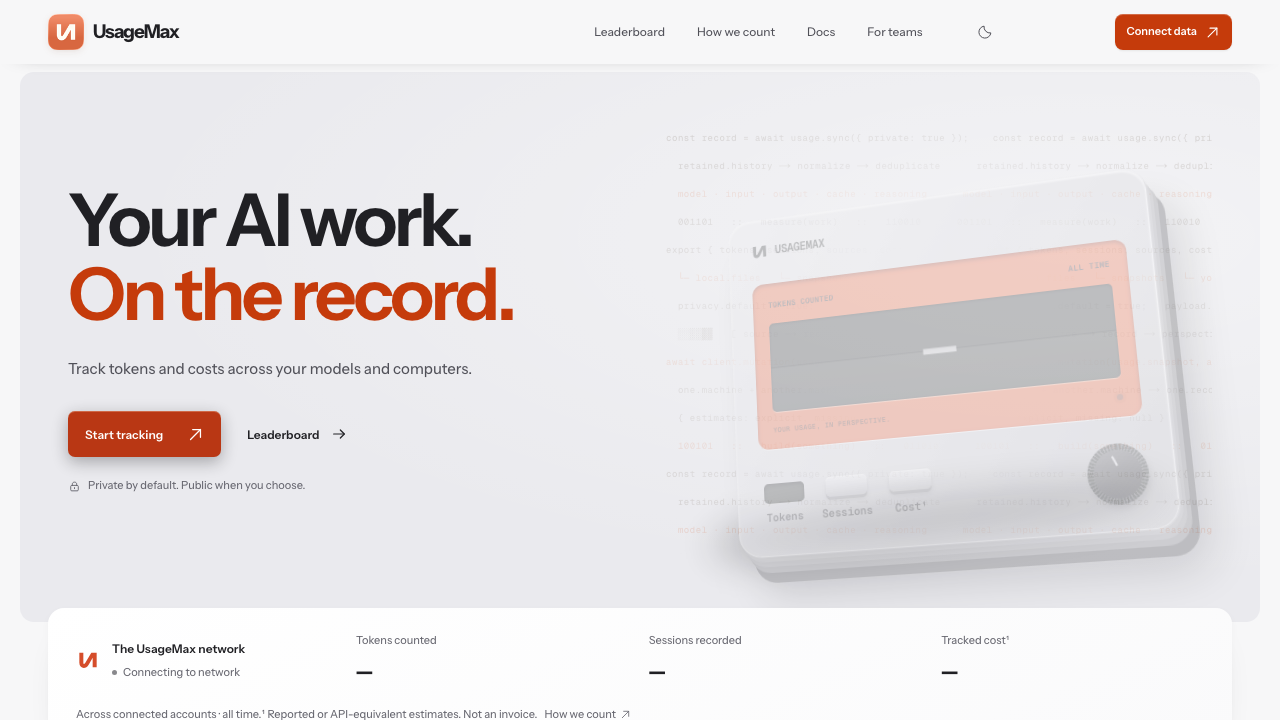
UsageMax reconciles the AI usage histories already on your computers into one clear view of tokens, model mix, tracked cost, sessions, and activity. The open-source CLI performs bounded local scans and uploads aggregate snapshots to the versioned UsageMax API.
The short version: one-shot collector, private by default, public only by choice. Prompts and completions never leave the computer.
What you get
| Surface | Purpose |
|---|---|
| Private workspace | Compare computers, providers, models, projects, and cost centers in one tenant-scoped view. |
| Public profile | Opt-in profile, leaderboard, activity, model mix, cost estimate, and streaks. |
| Collector API | Installation-bound, write-only snapshots and content-free telemetry. |
usagemax CLI | A bunx-friendly scanner with archive recovery, safe diagnostics, and optional OS scheduling. |
| Agent interfaces | Bounded OpenAPI, MCP, Markdown, WebMCP, A2A, and installable skill surfaces. |
The physical HUD/screen project is intentionally separate from this repository. It can consume UsageMax telemetry, but it is not required to use the platform.
Connect a computer
1. Create a link code
Sign in at usagemax.com/account, choose Link a computer, give it a name, and copy the one-use command. The code is valid for ten minutes and can be used once.
2. Link and sync
Run the command on the computer or WSL distribution that owns the history:
The first link performs a full one-shot sync. Every installation receives a stable random ID, so relinking or renaming it rotates its key without creating a duplicate device.
3. Reconcile when you choose
CLI updates and progress
The CLI checks npm's latest dist-tag at most twice per day. Run
usagemax update to update a global installation through Bun or npm; use
--check for a read-only check. Run usagemax update sync to hand a command
to the current release without typing @latest, or set USAGEMAX_AUTO_UPDATE=1 for an
explicit automatic handoff. Use --no-update-check or set
USAGEMAX_DISABLE_UPDATE_CHECK=1 in offline environments. Interactive
terminals show a small stderr progress line; JSON,
quiet, CI, and scheduled runs remain machine-readable and quiet.
Coverage and correctness
UsageMax pins ccusage v20.0.24 and uses its 16 adapters: Amp, Claude Code, Codebuff, Codex, GitHub Copilot CLI, Factory Droid, Gemini CLI, Goose, Grok Build, Hermes, Kilo Code, Kimi CLI, OpenClaw, OpenCode, Pi, and Qwen Code. Named Pi-format stores are discovered as well.
The collector recognizes supported provider overrides, bounded home locations,
Claude Desktop sessions, .cc-mirror, renamed Claude/Codex backup folders, and
supported Windows homes from WSL. Normal syncs inspect known locations and
immediate home entries; they do not crawl the whole disk.
Full scans can catalog retained history from 2024 onward. A readable file
inventory is not proof that an aggregate parser consumed every file and day.
UsageMax reports those two states separately; counter decreases and missing
rows remain protected unless the parser explicitly certifies its coverage.
Unknown models stay unattributed; unknown pricing stays unknown.
Cursor, Windsurf, Aider, Continue, Cline, Roo Code, hosted agents, direct provider API traffic, and enterprise billing systems do not all expose a stable local ledger. Feed those through the native or OTLP/HTTP JSON contract, or use a provider billing export when local evidence is unavailable.
Privacy and resource use
| Stays on the computer | May be uploaded |
|---|---|
| Prompts and completions | Aggregate token counters |
| Source code and file contents | Provider, model, and source names |
| Project paths and tool payloads | Dates, costs, and coverage state |
| Provider credentials and secrets | Opaque SHA-256 session identities |
The CLI is short-lived. It skips unchanged inventories, parses only the necessary date range, uses a local lock to prevent overlap, and never downloads a package per run. Optional scheduling invokes the same one-shot process and backs off after failures.
Scheduling is opt-in. macOS uses a user LaunchAgent, Linux/WSL uses a user systemd timer, and Windows uses Task Scheduler. Sleeping or battery-powered computers are not needlessly woken.
Credentials and safe diagnostics
UsageMax has separate credentials for website sign-in, one-use linking, and
collector writes. A collector key is exactly umx_ followed by 64 lowercase
hexadecimal characters. It is generated server-side, displayed once, stored
locally with user-only permissions, and stored by UsageMax only as a SHA-256
hash.
For an Advanced · custom telemetry collector key, pipe the secret through stdin. Never put it in a command-line argument, URL, request body, repository, or log:
token status and telemetry test are included in CLI 0.3.11. If a fresh
environment still has an older npm tag, run usagemax update token status or use
node packages/cli/src/cli.js token status from this repository until the new
package is published.
To prove the authenticated write path, send one content-free agent_state
event with all token and cost values set to zero:
This writes one observability event and does not change token or spend totals. An unbound advanced key becomes bound to this CLI installation on its first accepted write. The CLI returns a non-zero exit code if the credential cannot ingest or the API rejects the event.
The numeric projection is deliberately small:
| Result | Meaning |
|---|---|
200 1 | Recognized, active, and authorized to ingest. |
200 0 | Recognized but blocked; inspect the redacted JSON status. |
409 0 | The installation UUID does not match the key binding. |
401 0 | The format/key was not accepted; the server does not reveal which reason. |
The read-only diagnostic reports credential type, scopes, activation state, profile/name, binding state, and last accepted/rejected write. It never returns the token, its hash, or the authorized UUID. Advanced keys are active immediately; they bind on the first valid write. Linked CLI keys are bound during the link exchange.
Agent and developer surfaces
Related MCP Servers
Reviews
No reviews yet — be the first to share how this listing worked for you.
Frequently Asked Questions about UsageMax public observability
AllMCPs Directory Badge
Showcase your server listing on GitHub or your project documentation. Embed this dynamic SVG badge to highlight official listing status and live engagement.
Badge Style:
Live Dynamic SVG Preview
Markdown (GitHub README)
[](https://allmcps.com/mcp/usagemax-public-observability)HTML Embed
<a href="https://allmcps.com/mcp/usagemax-public-observability"><img src="https://allmcps.com/api/badge/usagemax-public-observability?style=directory" alt="UsageMax public observability on AllMCPs" /></a>