A local map of your codebase over time: symbols, callers, subgraphs and structural change.
Quick Install
Automated & IDE SetupCopy the AI prompt to install this server into Claude Code, Cursor, or another agent — or use 1-click editor setup below.
One-click editor setup isn’t available for this listing yet — we don’t have a confirmed install command, and we’d rather show nothing than point your editor at the wrong package or host. Follow the project’s own setup instructions, linked above.
Manual Client & Custom JSON ConfigExpand JSON ▾
No confirmed setup config for this listing yet. We only publish a config block when the install details come from the project itself — its README, its docs, or a verified owner. We haven’t found those for Treering, and we’d rather show nothing than a guess you’d paste into your client. Follow the project’s own setup instructions for the current steps.
Documentation Overview
 Treering
English | 한국어
Treering draws a map of your codebase and keeps a copy of it for every commit, so you can see how the structure changed: which types started depending on each other last week, or when a class began to collect callers. It runs entirely on your machine and sends nothing over the network. It doesn't use an LLM, so the same code always produces the same graph.
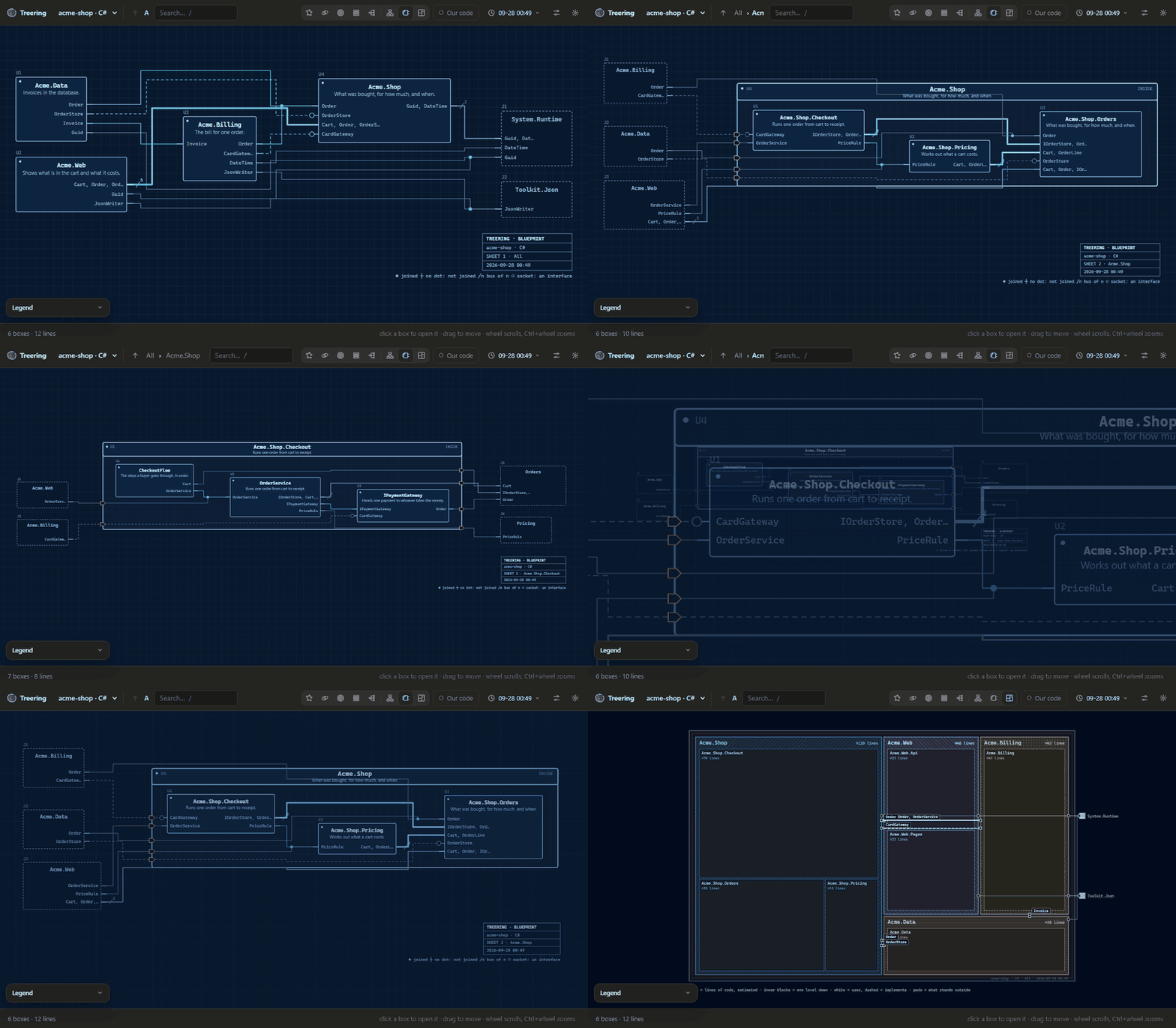
Click a box to go inside it; the part you opened frames what it holds. Then back out, and the same sheet as a chip.
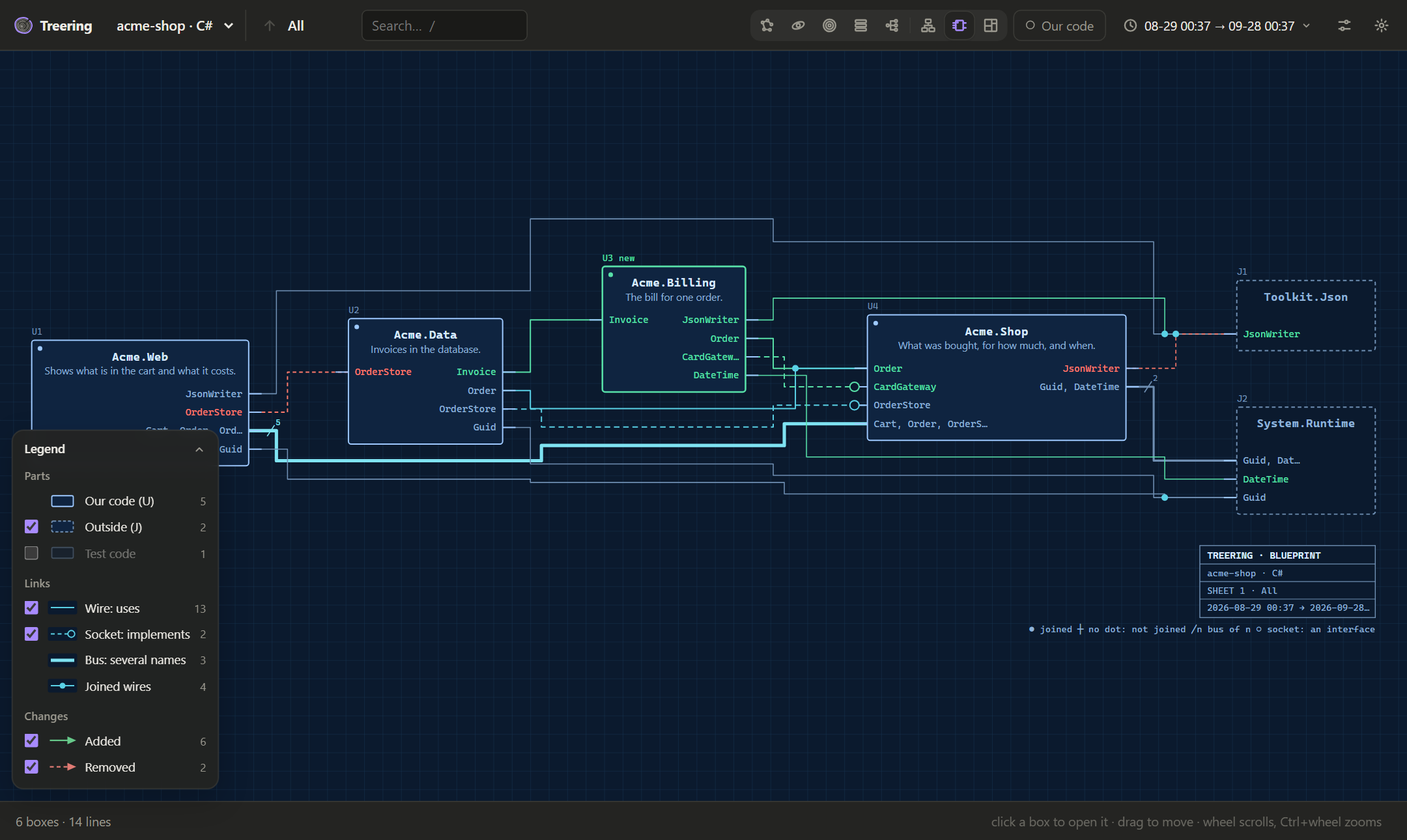
The sample project's modules as a schematic, compared with a month earlier. Green is new: a Billing module now implements the payment interface. Red dashed is gone: the web pages used to call the database directly.
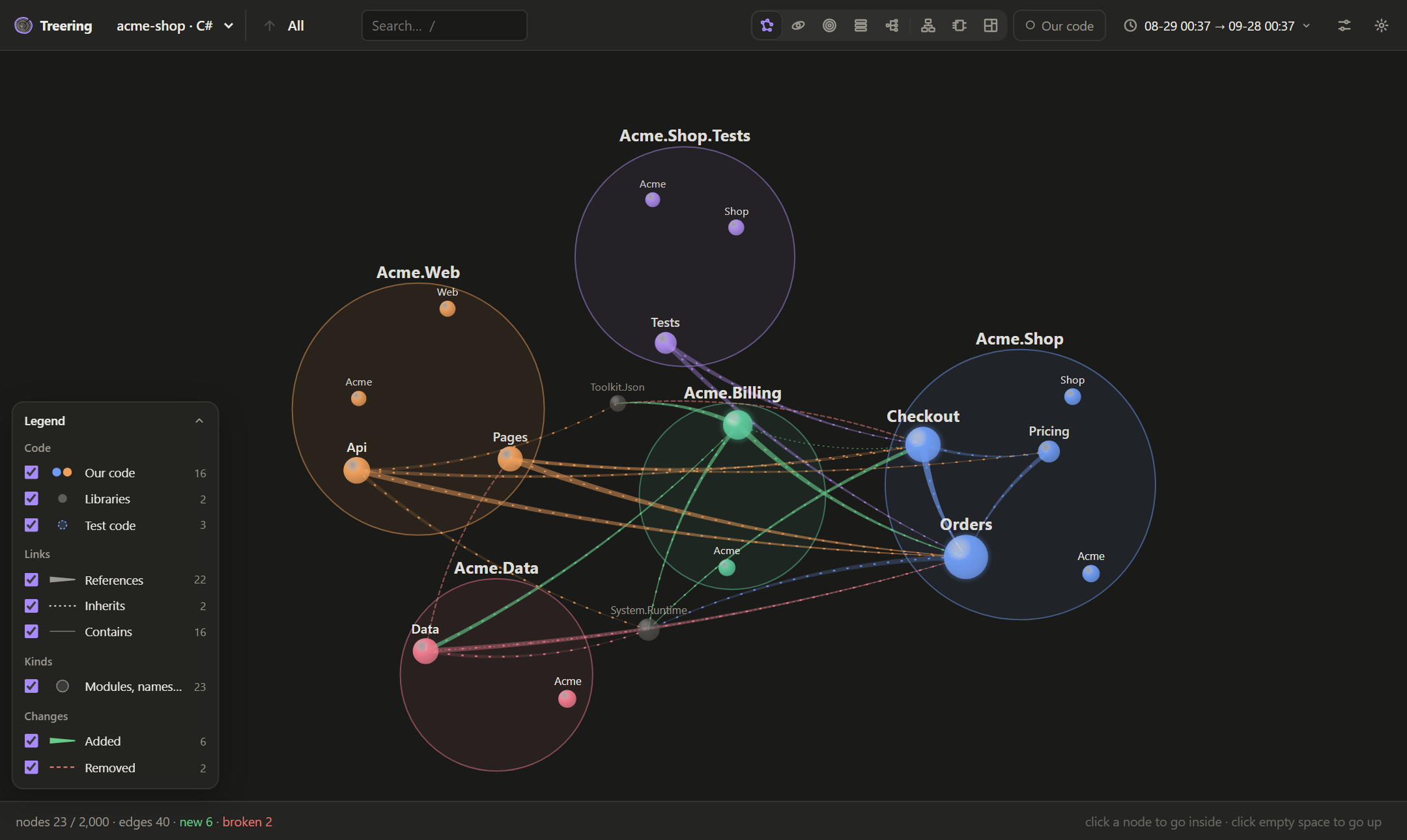 | 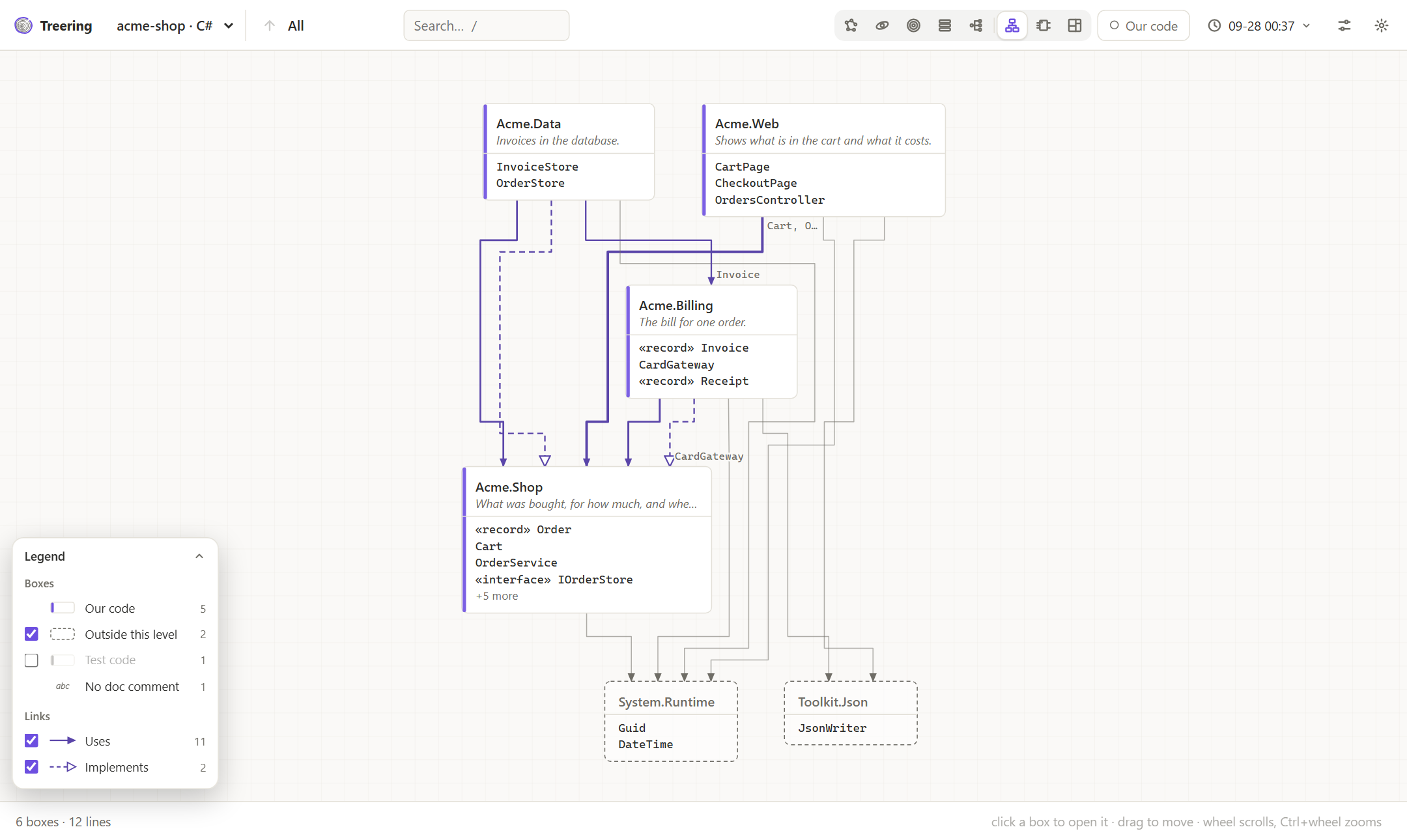 |
| Map. Modules as bubbles and the calls between them. New lines are green, broken ones red. | Blueprint. One level as boxes in tiers, each with its role and what the others use it for. |
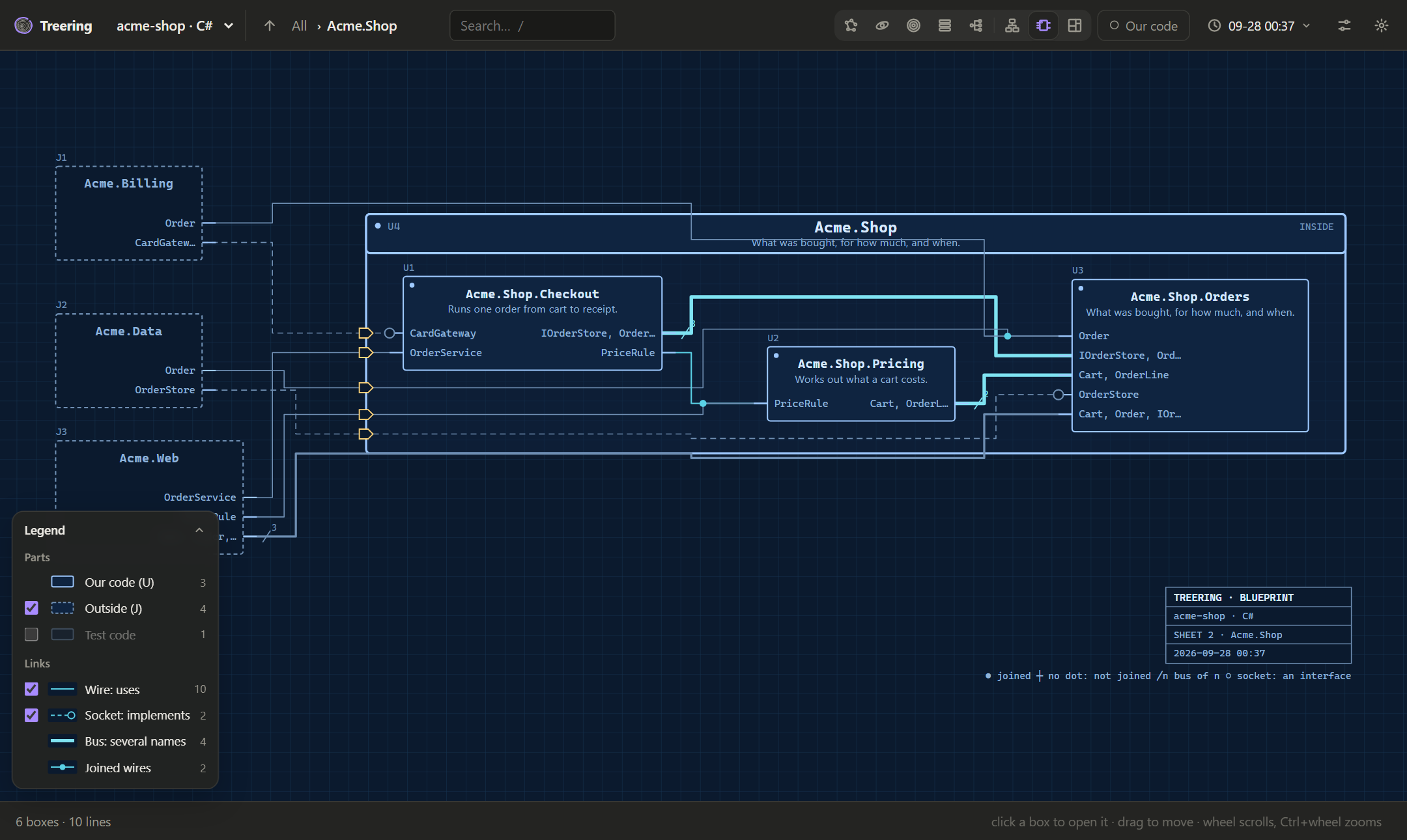 | 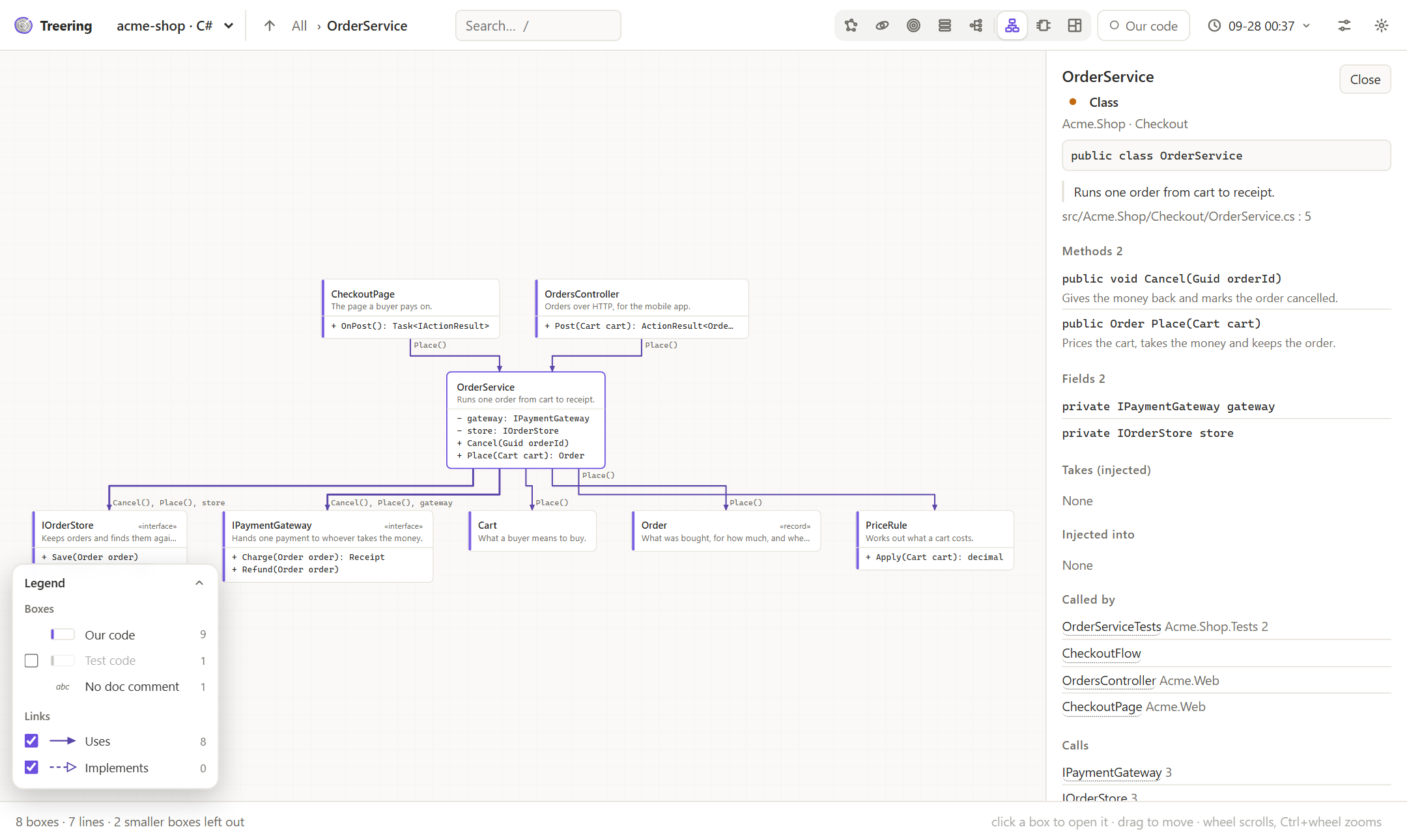 |
| Inside a module. The module you opened frames what it holds; wires cross its edge at sheet ports. | One class. Its fields and methods, the types it works with, and which member ties them. |
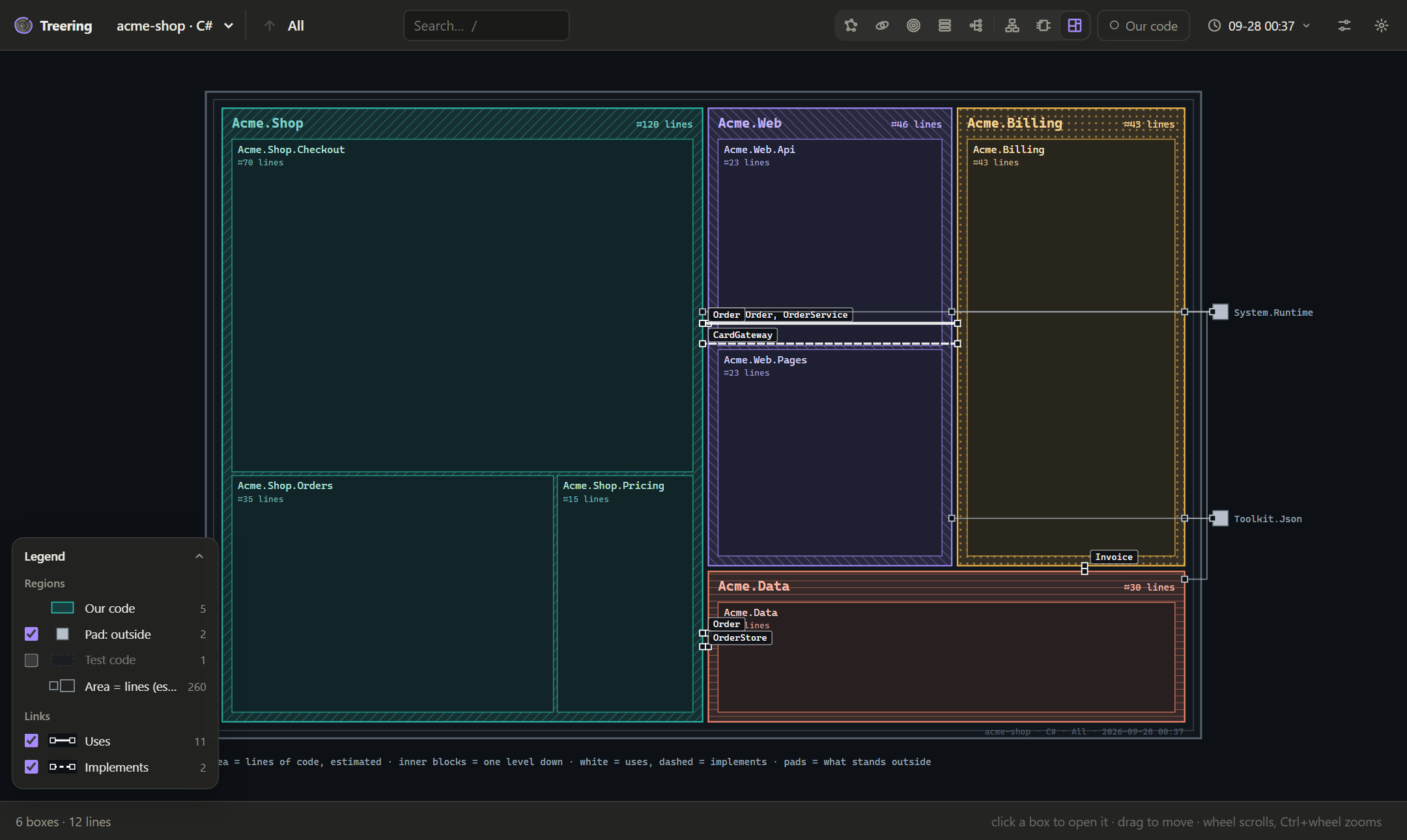 | |
| Chip. Where the weight is: each region as big as its code, libraries as pads on the edge. |
All of these are the sample project that comes with Treering (treering sample), a small made-up shop.
Treering is still in development, and the database format may change between releases. The design notes are in treering-plan.md (in Korean).
Install
Windows (PowerShell):
Linux (x86-64):
Each script downloads the latest build from Releases, checks it against the published checksum, and puts treering on your PATH. On Windows it also adds Treering to the Start menu. Neither needs administrator rights, and running a script again updates Treering. If you'd rather not run a script, download the zip or tarball from Releases and unpack it anywhere.
Then run treering, or open it from the Start menu. It starts the server and opens http://127.0.0.1:7377 in your browser. If Treering is already running, it only opens the browser.
To look around before importing anything, choose Or look around a sample project first on the first screen. It adds acme-shop, a small made-up online shop with a month of history. treering sample adds it from the command line.
Install the indexers
Treering doesn't parse source code itself. It reads SCIP indexes, which each language's indexer produces. Install the indexers for the languages you use:
Import a repository
import looks at which languages the repository contains and runs each indexer with the flags it needs. For C# it indexes the solution at the root, or each project if there's no solution. For TypeScript it indexes each topmost package.json, and for Python each pyproject.toml. The graph is stored in your user folder, never inside the repository, and treering projects lists what you've imported.
treering serve opens the map at http://127.0.0.1:7377. Without a database argument it serves every imported project, and you can switch between them in the menu at the top of the page.
You can also import from the page. Open the project menu, choose Import…, then Choose a folder…. The server opens your system's folder picker (Explorer on Windows, the standard dialog on macOS, zenity or kdialog on Linux), because a browser won't give a page the full path of a folder. You can type the path instead. The import starts when you pick a folder, and the dialog shows each indexer as it runs. If one fails, it tells you why and what to try.
The import and folder endpoints only accept JSON requests sent by the page itself, so another site open in your browser can't start an import or open a window.
Read the map
The map shows modules, namespaces and types as nodes, and the references between them as edges.
- Click a node to go inside it. The node you entered stays on screen as a ring around its contents. Click empty space, right-click the ring, or press Esc to go back up, and the map marks the node you just left.
- Colour shows whose code it is: each of your own modules has a colour, and libraries are grey. Size shows how much a node is used.
- The Shape menu lays out the same graph five ways: Constellation, Orbit, Ring, Layers and Tree. Layers stacks dependencies from top to bottom and keeps cycles together. Tree shows what contains what, one branch at a time.
- The side panel describes what you're inside, or the type you clicked: its members, what it injects and where it's injected, what it implements, its callers and what it calls. Each name in the panel links to that node.
- Press
/orCtrl+Kto search. Picking a result takes you to where it lives. - At and Compare show the graph at one snapshot, or the edges added and removed between two.
- Scope switches between everything and Our code. A symbol counts as yours when the index contains its definition, so libraries drop out without guessing from names. On Acme.Shop this cuts 38 modules to 4 and 829 types to 401.
- Theme offers Light, Dark, Slate, Skyfall and Obsidian, and Language switches between English and Korean.
- If your system is set to reduce motion, the decorative animation stops.
Keep it up to date
update re-indexes only the projects whose files changed. Each changed file goes to its nearest project (.csproj, package.json, or pyproject.toml and setup.py) and that language's indexer, so a repository with several languages updates each part with its own tool. If an indexer is missing, Treering prints the command that installs it.
watch runs update on a timer and adds a snapshot only when something changed, so the history fills in while you work. It starts from the commit recorded in the last snapshot, so you can stop and restart it without losing anything, and it counts uncommitted changes as well as commits.
You usually don't need to run watch yourself: treering serve does the same for every imported project while it runs. Every 10 minutes it re-indexes what changed and adds a snapshot, and if you're looking at the latest snapshot the page moves to the new one by itself. A re-index that leaves the graph as it was adds no snapshot. Turn it off with --no-watch or under Settings on the page, change the period with --watch-minutes N, and pick another port with --port N.
Work with indexes directly
You can run an indexer yourself and load its output. For C#:
Always pass --allow-global-symbol-definitions to scip-dotnet. Without it, symbols don't carry their package name, and once you index projects separately or add snapshots, one symbol turns into several. In one test that recorded 6,784 symbols as added and 6,790 as removed.
To compare over time, load more snapshots:
diff lists the dependencies added and removed between two snapshots, and growth shows when a type's callers increased.
Use it from an agent
This runs a Model Context Protocol (MCP) server over stdio for the projects you've imported. It has six tools: list_projects, find_symbol, callers_of, subgraph, changed_since and snapshots. Each tool takes a project (a name or id from list_projects); left empty, it asks the most recently imported one. They run the same queries as the page, with the same size limits. When a result would be too large, the response says what was left out so the agent can narrow the question and ask again. treering mcp graph.db answers about that one database only.
To add it to Claude Code:
In other hosts, the command is treering with the argument mcp. Each release also carries MCP bundles (treering-win-x64.mcpb, treering-linux-x64.mcpb) for hosts that install MCPB in one step, and is published to the MCP Registry as io.github.RedholeTechnologies/treering.
Performance
On Acme.Shop (4 projects, 632 .cs files):
Related MCP Servers
Reviews
No reviews yet — be the first to share how this listing worked for you.
Frequently Asked Questions about Treering
AllMCPs Directory Badge
Showcase your server listing on GitHub or your project documentation. Embed this dynamic SVG badge to highlight official listing status and live engagement.
Badge Style:
Live Dynamic SVG Preview
Markdown (GitHub README)
[](https://allmcps.com/mcp/treering)HTML Embed
<a href="https://allmcps.com/mcp/treering"><img src="https://allmcps.com/api/badge/treering?style=directory" alt="Treering on AllMCPs" /></a>