Surf README
The full upstream README, mirrored here for reference. Install config, tool schemas, adoption signals, and an original overview live on the Surf listing page.
Stop letting your agent guess
Check the call before it counts. Gecko is open-source and runs on your machine:
one command maps any API — messy, paywalled, or on-chain — into a call graph your agent
checks instead of guesses from, and anything that spends is simulated to a
receipt first.
No wallet, no payment rail, no key held — fifteen mainnet transactions, fifteen exact
cost predictions.





Quickstart · Docs · Architecture · FAQ · Security
Built for the calls your agent must not get wrong. Two axes, either one qualifies: a messy surface (paywalled, drifting, undocumented, on-chain) or a high-stakes action (your agent runs unattended with credentials or money).
What Gecko is
Gecko is an open-source knowledge graph built specifically for AI agents that call APIs. Point it at an OpenAPI spec, a docs site, or a Solana program's IDL and source, and it reads that surface into a graph your agent traverses — every fact tagged with where it came from, and anything it cannot establish flagged rather than guessed.
A specification tells your agent what a call looks like. It cannot tell it whether the call will work. That gap is in every spec, including a perfect one, and it is where agents fail expensively: not on the call that errors, but on the call that is accepted and wrong. Gecko closes it by handing back one specific call — and, for anything that spends, by simulating that call against real state first and returning a receipt.
It is not the agent and not an orchestrator. It holds no key, signs nothing, broadcasts nothing, and stores no response payload — it stores surfaces and correctness metadata, never your data.
Quick start
No install:
Or install once:
Plug into your agent:
Going live is a separate, deliberate step:
Then your agent asks questions, not endpoints:
Why
An OpenAPI says what exists. An IDL says what a program looks like. Neither is enough to act:
- Docs drift. Working integrations broke twice in 2026 from silent layout changes.
- IDLs drop facts. A required Pump.fun account never appears in the IDL at all.
- Agents guess. A wrong guess posts a charge, reverts a transaction, burns fees.
Gecko replaces the guess with a graph:
- Every edge carries provenance —
extractedfrom the surface,recoveredfrom source, or honestlyflaggedas unknown. Never fabricated. - Every action can be verified first — simulated on a $0 mainnet fork to a receipt: pass, or a classified revert, before any spend.
- Every failure teaches — outcomes land in a categorical corpus; a drift series flags when a provider ships a change that breaks a working call.
- Auth is invisible to the agent — keys injected at call time from your keychain. The model never sees a credential.
Under the hood
Most agent-tool layers are thin wrappers. Gecko is a memory substrate, and three of its design choices are deliberately different from the textbook:
| Choice | Why it matters |
|---|---|
| Deterministic semantic memory — lexical retrieval, no vector DB | the graph never "approximately" remembers; BM25 and vectors sit behind evidence gates |
| Self-generated episodic memory — categorical outcomes + a drift series | Gecko re-simulates to create its own episodes; no dependence on your data plane, no payloads stored |
| Typed procedural memory — plans as executable JSON | landing plans and derive orders a builder can run; text loses the join, ours can't |
And the depth is measured, not asserted:
- The overlay artifact. For every auto-comprehended program, Gecko emits the exact
list of facts that could not be derived from any public surface
(
overlays/) — the value of comprehension, quantified per program. - Seven security layers, fail-closed: spec sanitizer · per-tool quarantine · image Skill Guard · SSRF netguard · out-of-band auth anchoring · verdict signing gate · an AST-enforced never-sign boundary.
- The numbers: 2,400+ tests · 4 mainnet programs derivation-proven · 2 live receipt-pairs · −77%/−89% measured context cuts · a 4,500-program catalog listed · 0 auth headers exposed across 14 real specs.
Explore the diagrams: architecture on docs.geckovision.tech (all three views, rendered) · the map in this repo
Proof, not promises
Live, on a mainnet fork, $0:
| Case | Naive path | Gecko |
|---|---|---|
| Pump.fun buy | ❌ reverts — AccountNotInitialized (3012) | ✅ lands — 86,669 CU |
| Pump.fun sell | ❌ transfers the tokens, then reverts — InvalidBondingCurveV2 (6074) | ✅ lands — 50,783 CU |
| Meteora DLMM swap | ❌ reverts — derive-only, no ATA/wrap/bin-array preludes | ✅ wrap → swap → unwrap — 81,964 CU |
| Meteora pool derivation | ❌ stale 3-seed scheme → the wrong pool, silently | ✅ correct 4-seed derivation, differential-proven |
| Docs-only API (no spec) | agent invents endpoints | ✅ draft spec recovered, verified VERIFIED/REFUTED |
The facts behind those passes are not on any surface: a 4th PDA seed the SDK added in 2024, an account the IDL only mentions in prose, a fee field resolved by a refuting simulation. That is the graph your agent traverses.
Use cases
TxLINE (paywalled sports odds) — without vs with Gecko
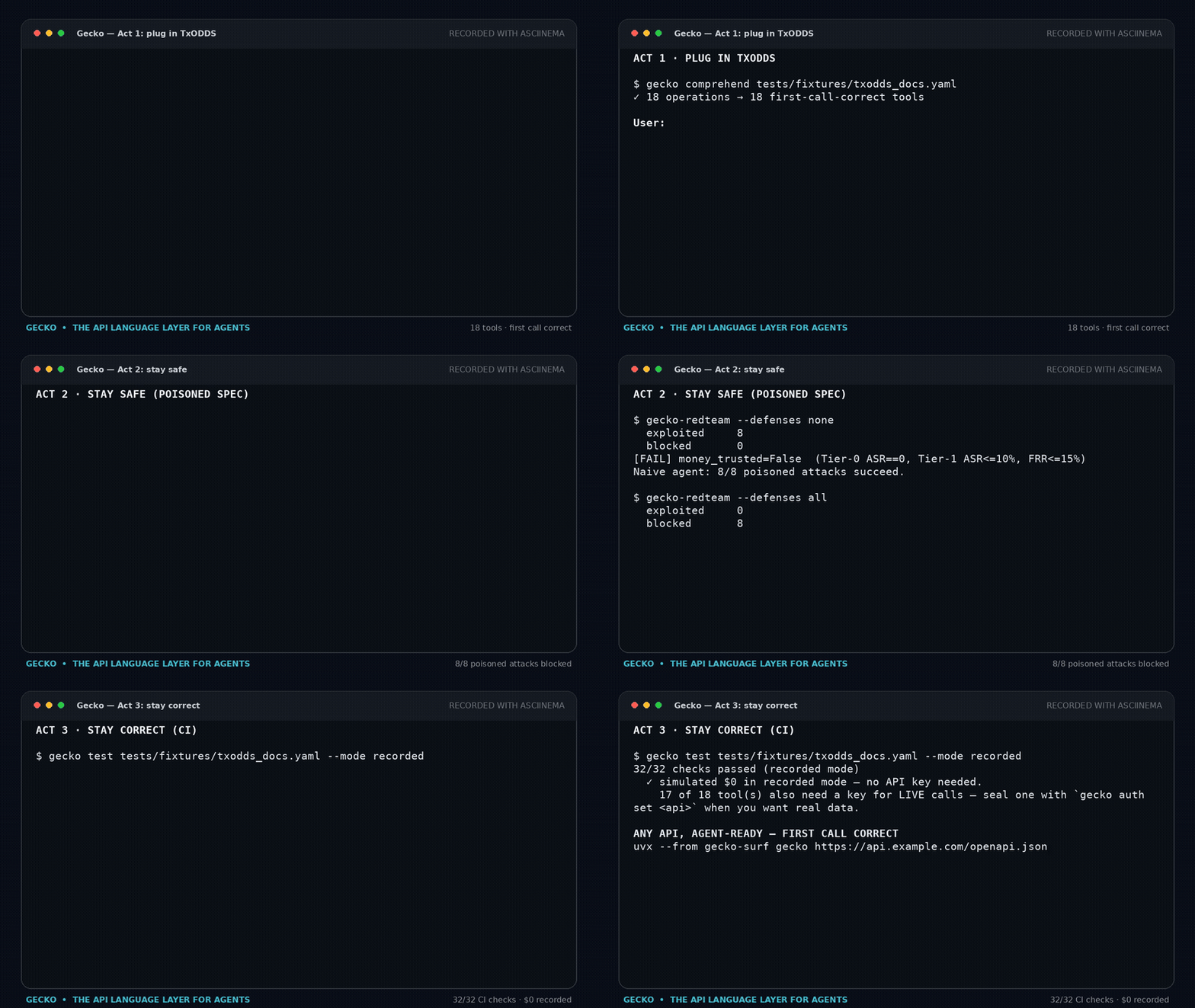 · MP4
· MP4
Cross-API correlation — three APIs, one question
Pegana × Birdeye × Jupiter joined on a declared entity; the agent plans across
surfaces first-try. Try it: gecko graph svg <spec> renders any surface's call graph.
Solana programs — buy a coffee on mainnet
Everything above is a $0 fork. This one is not: real mainnet, real USDC, a real espresso.
let_me_buy is a storefront program on Solana. A merchant
stands up a store and lists products priced in USDC; a buyer scans a QR code and pays.
One account per store — PDA(["receipts", store_name]) — holds the menu, the receipts,
the running count and the merchant's authority.
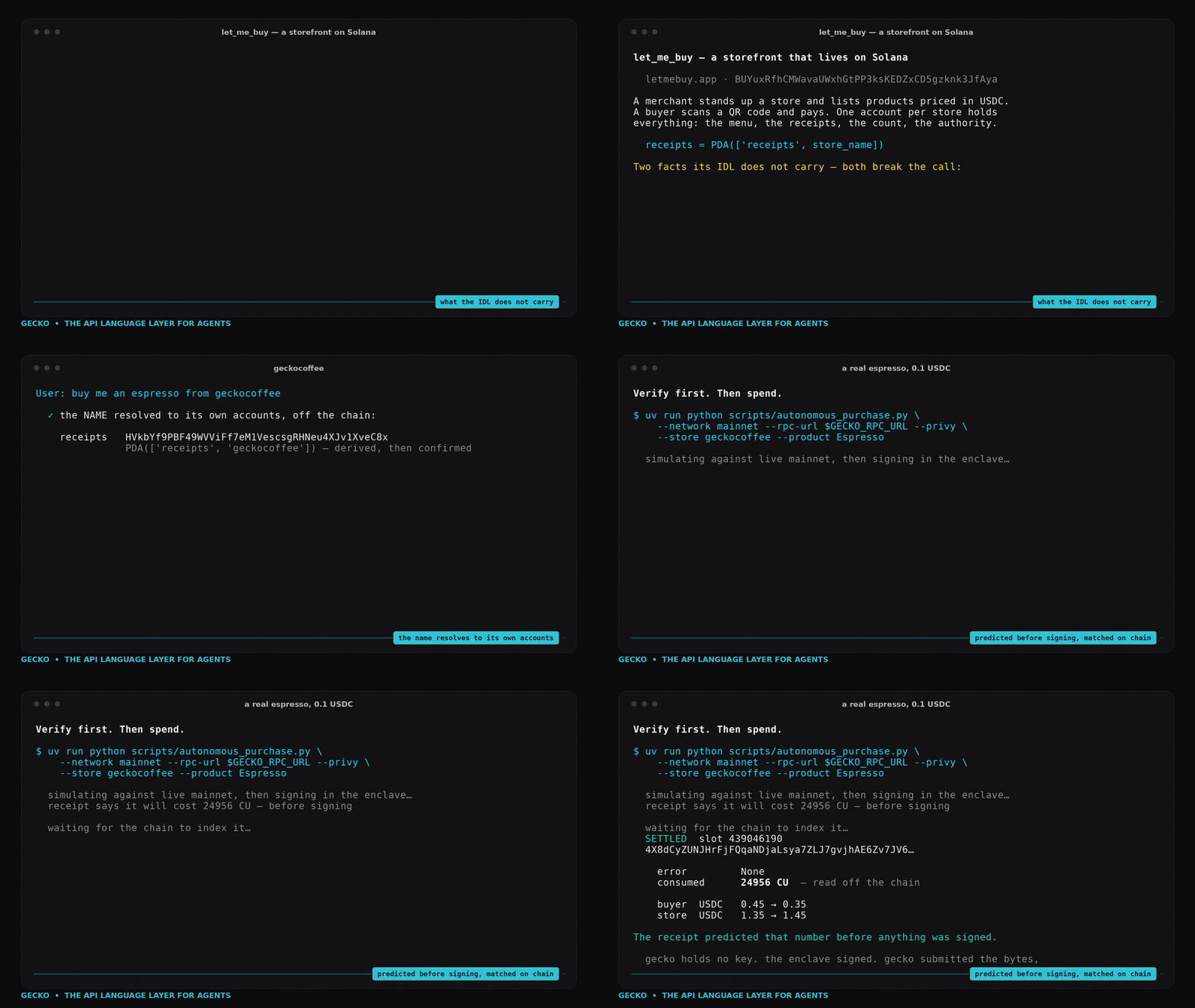
MP4 version — one unedited take. The receipt says 24,956 CU
before anything is signed; the chain charges 24,956 CU
(4X8dCyZU…,
slot 439046190). The key never leaves its enclave.
Two facts the IDL does not carry, and both break the call:
mark_as_delivereddeclares itsreceiptsseed asstore_name, but that instruction's own arguments are_store_nameandreceipt_id. The seed names an argument that does not exist, so a deriver resolving seeds by argument name gets nothing for the one seed that selects the store. Gecko binds by seed value.- In
make_purchasethe store'sauthorityis writable but not a signer. The buyer pays fromATA(signer, mint); the store is credited atATA(authority, mint)— same mint, different owner. Derive both from one owner and you have built a purchase that pays the buyer back. Gecko refuses that plan before a builder is ever asked.
The prediction tracks state, not a memorised constant. Three purchases at this one storefront were charged 23,789 → 24,183 → 24,956 CU; the last two are the same product. Each sale appends a receipt to the store's account, so the program does more work — and the receipt predicted the new number each time it was asked.
Gecko recovers what the surface drops, Orquestra builds the instruction, and the receipt says whether it lands — before any signature.
Architecture
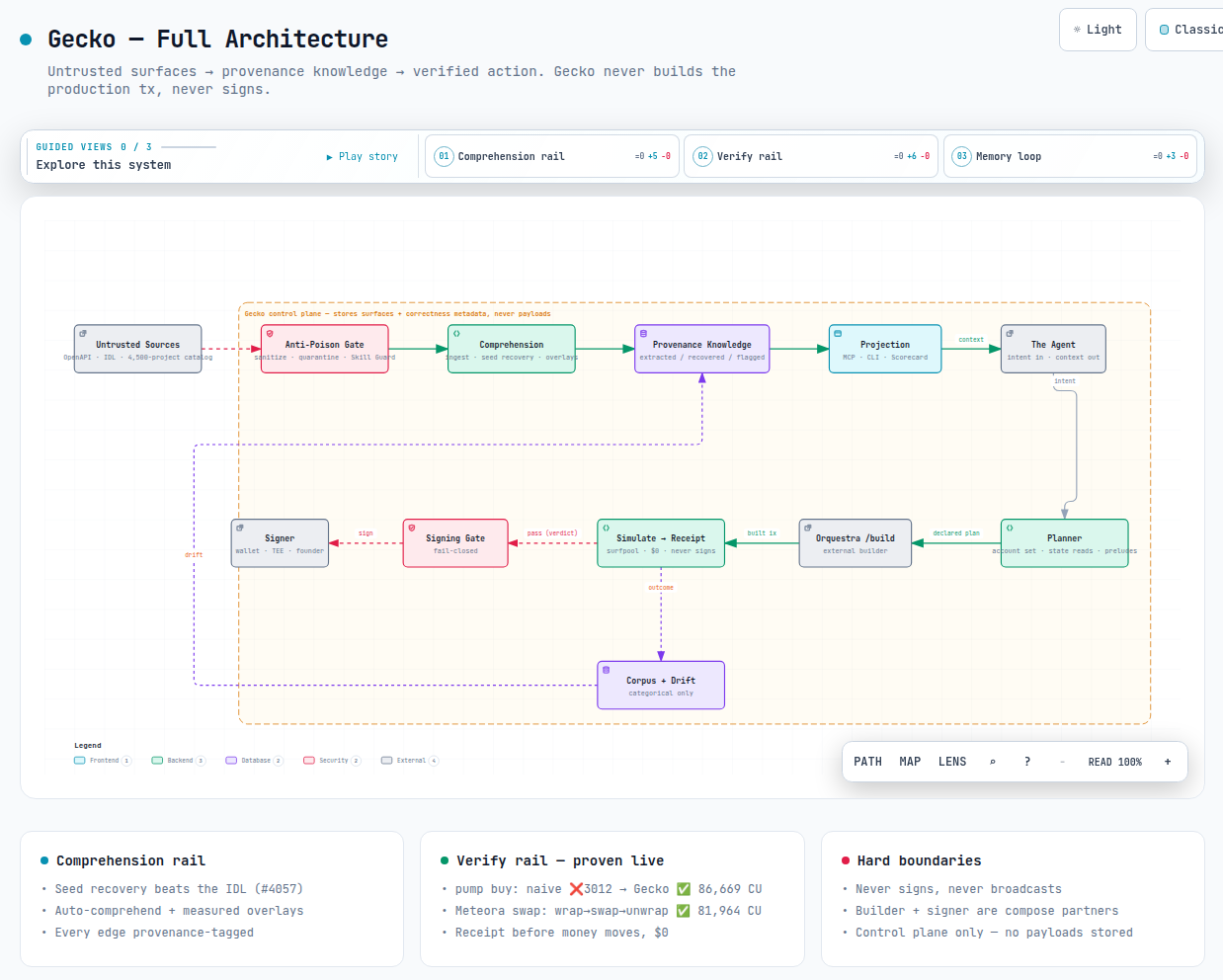
Control plane, never data plane. Gecko stores surfaces + correctness metadata — never response payloads, user data, or secrets.
- Ingest — OpenAPI / docs / IDL / program source → sanitized, quarantine-checked.
- Comprehend — normalized ops, recovered PDA seeds, generated configs + measured overlays.
- Know — the provenance graph (surface, program, cross-API joins).
- Project — question-shaped tools over MCP; auth stripped; −77%/−89% context cuts measured on two real specs.
- Verify — plan → external builder → simulate → receipt → fail-closed signing gate. Gecko never signs, never broadcasts.
- Learn — categorical outcomes → drift series → back into the graph.
Interactive diagrams · llms.txt · Receipt semantics
What you get
| Capability | Entry point |
|---|---|
| Serve any API to agents over MCP | gecko serve <spec> |
| Scorecard: grade + fixable findings + Playground | gecko report <spec> |
| Recover a draft spec from human docs | gecko from-docs <url> |
| First-call-correctness tests for CI | gecko test <spec> |
| The surface graph, rendered | gecko graph svg <spec> |
| Program Surface: recovered seeds + derive plans | gecko orquestra --program <name> |
| find_start: intent → the right starting instruction | gecko orquestra find-start "..." |
| Simulate → receipt on a built transaction | gecko/simulate.py (engine) |
| Embed the SDK | from gecko import AgentApiClient |
| Verify docs claims against reality | gecko verify-docs <spec> |
| Scan a skill image for hidden payloads | gecko scan-image <path> |
Skills
The engine is the product; the skills are how an agent learns to drive it. Six of them ship as one plugin — markdown the agent reads, no executable logic of its own.
| Skill | For | What it does |
|---|---|---|
use-any-api | agent builder | Call an unfamiliar API first-call-correct — point Gecko at OpenAPI or docs, get intent-shaped MCP tools with auth hidden |
read-js-docs | agent builder | Extract the API surface from JS-rendered docs, when curl returns an empty shell |
anti-poisoning | agent builder | Defend against a poisoned spec — one written to route your agent's arguments or exfiltrate your key |
skill-guard | agent builder | Defend against a poisoned artifact — an image or convention page carrying an instruction your agent will follow and your reviewer cannot see |
api-agent-ready | API provider | Make your own API's whole surface agent-usable, alongside whatever MCP you already ship |
x402-payai-setup | API provider | Wire pay-per-call onto your API. You keep 100% — Gecko is not the rail and takes no cut |
The two defense skills are one disease with two deliveries: a poisoned spec aims at
what your agent calls, a poisoned artifact aims at what your agent does. Full
map and status in skills/README.md.
Modes
- Recorded (default): $0, schema-synthesized responses, fully offline. Falsify everything before any live call.
- Live: same code path; credentials injected from your keychain at the edge.
gecko auth set <provider>— deliberate, never implicit.
Hosted
The engine in this repo also runs at mcp.geckovision.tech — comprehended surfaces served over Streamable-HTTP MCP, keys injected server-side. Developers never pay; providers pay a flat price per API. Gecko takes no cut, holds no funds, signs nothing. → docs.geckovision.tech
Repo map
| Path | What |
|---|---|
gecko/ | the engine — ingest, catalog, tools, graphs, simulate, corpus |
gecko/providers/ | program surfaces (Meteora, Pump.fun, Jupiter, ORE, MetaDAO) + configs |
scripts/, gecko/cli.py | thin transport — parse, call the package, format |
skills/ | the agent-facing plugin — six skills, agents, commands |
docs/ | architecture, receipt semantics, specs, benchmarks |
examples/ | forkable starters |
Development
FAQ
Is this a tool-generation wrapper? No. Tool generation is the table stakes. The product is the verified graph (provenance on every edge), the receipt (simulate before money moves), and the drift series (know when a provider breaks you).
Who is it for? Two axes — either one qualifies: a messy surface (paywalled, drifting, undocumented, on-chain), or a high-stakes action (your agent runs unattended with credentials or money). Clean API + a human reviewing the diff? You may not need us — and that's fine.
Does Gecko sign or hold funds? Never. Gecko never signs, never broadcasts, never builds the production transaction — sim-only unsigned assembly is the documented carve-out, AST-enforced at the sign/send boundary. Building belongs to builders (e.g. Orquestra), signing to signers (wallet / TEE / you).
What does Gecko store? Surfaces and correctness metadata. Never payloads, balances, pubkeys-in-outcomes, or secrets. The corpus is categorical, closed-vocabulary, audited.
Vector database? No — retrieval is lexical and deterministic (token-overlap; BM25 and semantic tiers both sit behind evidence gates that flip only on measured recall failure — including one measured negative result on embeddings).
Is it free? The engine is Apache-2.0, complete, self-hostable. The hosted layer is what an API provider buys. Developers never pay.
Contributing
PRs welcome. Run the toolchain above before pushing. Security findings → SECURITY.md.
License
Apache-2.0 — see LICENSE.