Point Gecko at an OpenAPI spec; get first-call-correct, auth-hidden agent tools.
Quick Install
Automated & IDE SetupCopy the AI prompt to install this server into Claude Code, Cursor, or another agent — or use 1-click editor setup below.
Manual Client & Custom JSON ConfigExpand JSON ▾
Client Config & Setup
Choose your client or environment
Target File:
💡 Paste the JSON block into your client's configuration file under mcpServers, then restart the application.
Documentation Overview
Stop letting your agent guess
Check the call before it counts. Gecko is open-source and runs on your machine:
one command maps any API — messy, paywalled, or on-chain — into a call graph your agent
checks instead of guesses from, and anything that spends is simulated to a
receipt first.
No wallet, no payment rail, no key held — fifteen mainnet transactions, fifteen exact
cost predictions.





Quickstart · Docs · Architecture · FAQ · Security
Built for the calls your agent must not get wrong. Two axes, either one qualifies: a messy surface (paywalled, drifting, undocumented, on-chain) or a high-stakes action (your agent runs unattended with credentials or money).
What Gecko is
Gecko is an open-source knowledge graph built specifically for AI agents that call APIs. Point it at an OpenAPI spec, a docs site, or a Solana program's IDL and source, and it reads that surface into a graph your agent traverses — every fact tagged with where it came from, and anything it cannot establish flagged rather than guessed.
A specification tells your agent what a call looks like. It cannot tell it whether the call will work. That gap is in every spec, including a perfect one, and it is where agents fail expensively: not on the call that errors, but on the call that is accepted and wrong. Gecko closes it by handing back one specific call — and, for anything that spends, by simulating that call against real state first and returning a receipt.
It is not the agent and not an orchestrator. It holds no key, signs nothing, broadcasts nothing, and stores no response payload — it stores surfaces and correctness metadata, never your data.
Quick start
No install:
Or install once:
Plug into your agent:
Going live is a separate, deliberate step:
Then your agent asks questions, not endpoints:
Why
An OpenAPI says what exists. An IDL says what a program looks like. Neither is enough to act:
- Docs drift. Working integrations broke twice in 2026 from silent layout changes.
- IDLs drop facts. A required Pump.fun account never appears in the IDL at all.
- Agents guess. A wrong guess posts a charge, reverts a transaction, burns fees.
Gecko replaces the guess with a graph:
- Every edge carries provenance —
extractedfrom the surface,recoveredfrom source, or honestlyflaggedas unknown. Never fabricated. - Every action can be verified first — simulated on a $0 mainnet fork to a receipt: pass, or a classified revert, before any spend.
- Every failure teaches — outcomes land in a categorical corpus; a drift series flags when a provider ships a change that breaks a working call.
- Auth is invisible to the agent — keys injected at call time from your keychain. The model never sees a credential.
Under the hood
Most agent-tool layers are thin wrappers. Gecko is a memory substrate, and three of its design choices are deliberately different from the textbook:
| Choice | Why it matters |
|---|---|
| Deterministic semantic memory — lexical retrieval, no vector DB | the graph never "approximately" remembers; BM25 and vectors sit behind evidence gates |
| Self-generated episodic memory — categorical outcomes + a drift series | Gecko re-simulates to create its own episodes; no dependence on your data plane, no payloads stored |
| Typed procedural memory — plans as executable JSON | landing plans and derive orders a builder can run; text loses the join, ours can't |
And the depth is measured, not asserted:
- The overlay artifact. For every auto-comprehended program, Gecko emits the exact
list of facts that could not be derived from any public surface
(
overlays/) — the value of comprehension, quantified per program. - Seven security layers, fail-closed: spec sanitizer · per-tool quarantine · image Skill Guard · SSRF netguard · out-of-band auth anchoring · verdict signing gate · an AST-enforced never-sign boundary.
- The numbers: 2,400+ tests · 4 mainnet programs derivation-proven · 2 live receipt-pairs · −77%/−89% measured context cuts · a 4,500-program catalog listed · 0 auth headers exposed across 14 real specs.
Explore the diagrams: architecture on docs.geckovision.tech (all three views, rendered) · the map in this repo
Proof, not promises
Live, on a mainnet fork, $0:
| Case | Naive path | Gecko |
|---|---|---|
| Pump.fun buy | ❌ reverts — AccountNotInitialized (3012) | ✅ lands — 86,669 CU |
| Pump.fun sell | ❌ transfers the tokens, then reverts — InvalidBondingCurveV2 (6074) | ✅ lands — 50,783 CU |
| Meteora DLMM swap | ❌ reverts — derive-only, no ATA/wrap/bin-array preludes | ✅ wrap → swap → unwrap — 81,964 CU |
| Meteora pool derivation | ❌ stale 3-seed scheme → the wrong pool, silently | ✅ correct 4-seed derivation, differential-proven |
| Docs-only API (no spec) | agent invents endpoints | ✅ draft spec recovered, verified VERIFIED/REFUTED |
The facts behind those passes are not on any surface: a 4th PDA seed the SDK added in 2024, an account the IDL only mentions in prose, a fee field resolved by a refuting simulation. That is the graph your agent traverses.
Use cases
TxLINE (paywalled sports odds) — without vs with Gecko
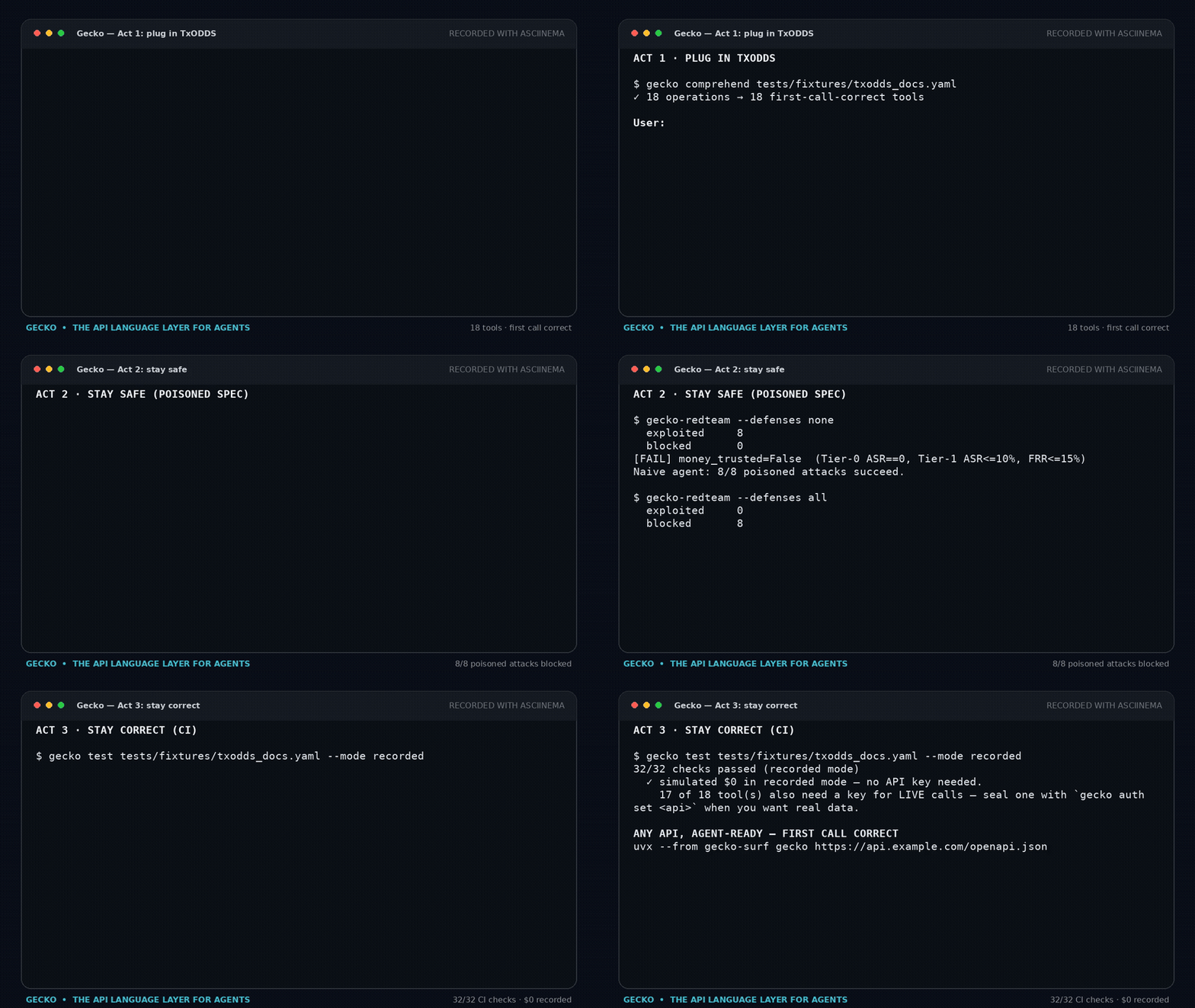 · MP4
· MP4
Cross-API correlation — three APIs, one question
Pegana × Birdeye × Jupiter joined on a declared entity; the agent plans across
surfaces first-try. Try it: gecko graph svg <spec> renders any surface's call graph.
Solana programs — buy a coffee on mainnet
Everything above is a $0 fork. This one is not: real mainnet, real USDC, a real espresso.
let_me_buy is a storefront program on Solana. A merchant
stands up a store and lists products priced in USDC; a buyer scans a QR code and pays.
One account per store — PDA(["receipts", store_name]) — holds the menu, the receipts,
the running count and the merchant's authority.
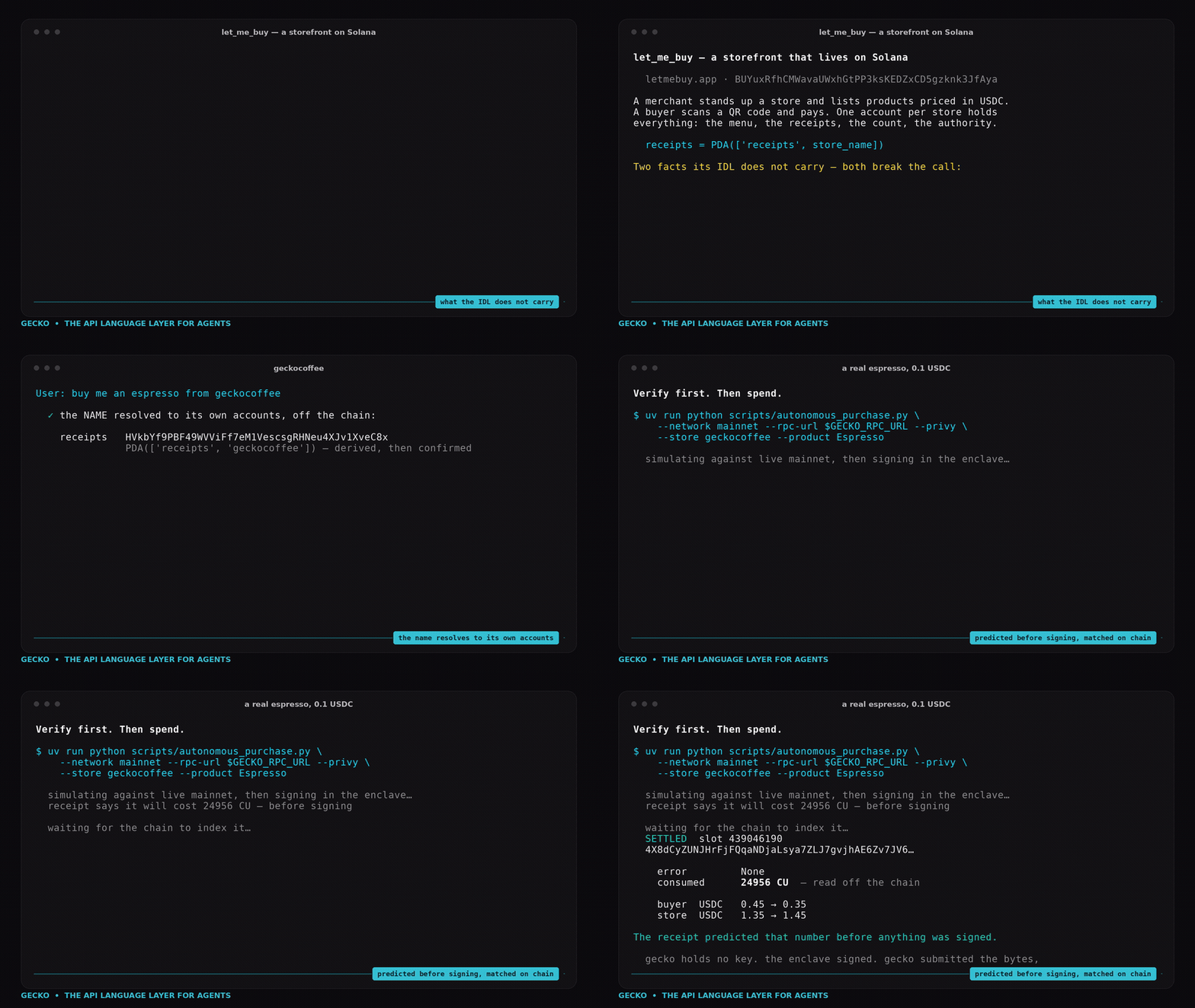
MP4 version — one unedited take. The receipt says 24,956 CU
before anything is signed; the chain charges 24,956 CU
(4X8dCyZU…,
slot 439046190). The key never leaves its enclave.
Two facts the IDL does not carry, and both break the call:
mark_as_delivereddeclares itsreceiptsseed asstore_name, but that instruction's own arguments are_store_nameandreceipt_id. The seed names an argument that does not exist, so a deriver resolving seeds by argument name gets nothing for the one seed that selects the store. Gecko binds by seed value.- In
make_purchasethe store'sauthorityis writable but not a signer. The buyer pays fromATA(signer, mint); the store is credited atATA(authority, mint)— same mint, different owner. Derive both from one owner and you have built a purchase that pays the buyer back. Gecko refuses that plan before a builder is ever asked.
Related MCP Servers
Reviews
No reviews yet — be the first to share how this listing worked for you.
Frequently Asked Questions about Surf
AllMCPs Directory Badge
Showcase your server listing on GitHub or your project documentation. Embed this dynamic SVG badge to highlight official listing status and live engagement.
Badge Style:
Live Dynamic SVG Preview
Markdown (GitHub README)
[](https://allmcps.com/mcp/surf)HTML Embed
<a href="https://allmcps.com/mcp/surf"><img src="https://allmcps.com/api/badge/surf?style=directory" alt="Surf on AllMCPs" /></a>Technical Specs & Signals
CategoryDeveloper Tools
27Quality signal: Emerging · 27/100How this signal is calculated ▾
Server availabilityNot measured
Not scored for repo-hosted servers — we can't reach the running server, only its GitHub page. Hosted MCP endpoints are health-checked live.
Verified ownership8/20
Documentation & tools11/30
Adoption & activity1/15
Community engagement0/10
A guidance signal from public completeness & health data — not a user rating. New listings start lower and rise as they add docs, get verified, and grow adoption. Signals we can't observe for a listing are skipped, not counted against it.
Own this project?
This directory is pre-filled from public sources. Claim via GitHub README, site badge, or DNS TXT to unlock edit access and the Official badge and attach your website — proof is checked automatically, then reviewed by our team.
Free dofollow backlink: add your website and place the AllMCPs badge on it — no claim needed. We detect it automatically and keep it verified as long as the badge stays live.
Claim & get free dofollowShare & Embed
Add our SVG badge (dark/light directory styles) or embeddable widget to your site.