Skills Anywhere README
The full upstream README, mirrored here for reference. Install config, tool schemas, adoption signals, and an original overview live on the Skills Anywhere listing page.
dsh-skills-anywhere
Discover and load skills across your tools. Collect Agent Skills
from local directories and configured Git sources into one catalog, available
through a live DeepSeek Harness
(dsh) provider or a local stdio MCP server.
English | 中文


Check a skill before moving it
Find missing supporting files in the installed folder, then review bundle changes before loading it through MCP. Browser folder check · Three pinned public examples.
Add --fail-on-resource-issues to gate CI. This checks local Markdown link targets;
it does not inspect prose dependencies or execute the skill. Scope and tutorial.
First review, no clone required — Find one missing skill reference, restore it, and verify the CI gate.

Start with your workflow
| Need | Workflow |
|---|---|
| Reuse skills across agent tools | Collect local and Git sources, then load on demand through dsh or local MCP |
| Review changes before loading | Compare instructions and directory manifests; require the reviewed content hash |
| Check which instructions reached an agent | Save MCP load receipts alongside tool calls and task evaluations |
Quick start
Requires Node.js 22.19+ or 24+. The CLI and local MCP server work independently; Git sources also require Git.
Inspect discovered skills:
For an MCP client, use the local server configuration. For DeepSeek Harness, install into your chosen profile:
Start dsh and load with its skill tool or /skill-name. To add a Git source,
run npx dsh-skills-anywhere add anthropics/skills.
Installation details cover release
archives, source checkouts and dsh version requirements.
Check skills in CI. Any repository that keeps SKILL.md files can add the
GitHub Action (0.14.0 and later). Rejected files, repairs and hidden
characters appear as pull request annotations, with a job summary and a JSON
report:
Inputs, outputs and scope. No model key or DeepSeek Harness installation is needed.
Try it in your browser
The homepage opens with an authored resource check. Choose a skill folder to check your own links, then Save result image for a shareable summary of counts and scope. Images omit file names; the JSON report retains the paths needed for review.
Try the interactive Hugging Face playground — explore an example workspace, resolve name clashes, and search beyond the catalog budget. No installation or model API needed. How it works.
Inspect skill instructions, compare directory manifests and share catalog views. Keyboard navigation preserves the selected row and catalog settings. Files opened for local review stay in the browser.
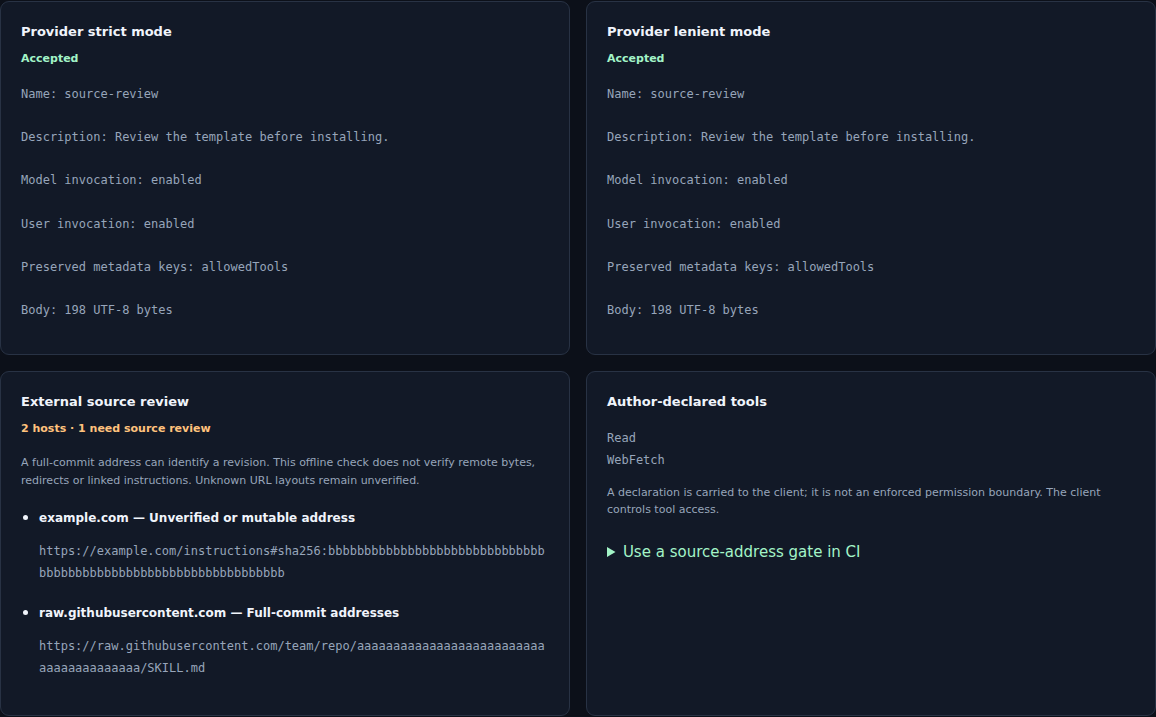
Bring your own SKILL.md. Compare the provider's strict and lenient parsing
locally: inspect repairs, invocation settings and a downloadable check report.
Your file stays in the browser. The same checks are available in the
command line and CI, with file hashes and actionable exit codes.
Reports enumerate recognized source URLs, full-commit address forms and
author-declared tools. Referenced content, script behavior and client
compatibility require separate verification.
How the catalog works
Clients can use different project, user and plugin directories for SKILL.md
files. Skills Anywhere discovers configured sources in place and makes the
resulting catalog available through dsh or an MCP client configured to connect
to its local server. Directory definitions describe discovery paths; the
compatibility matrix records tested protocol
connections separately.
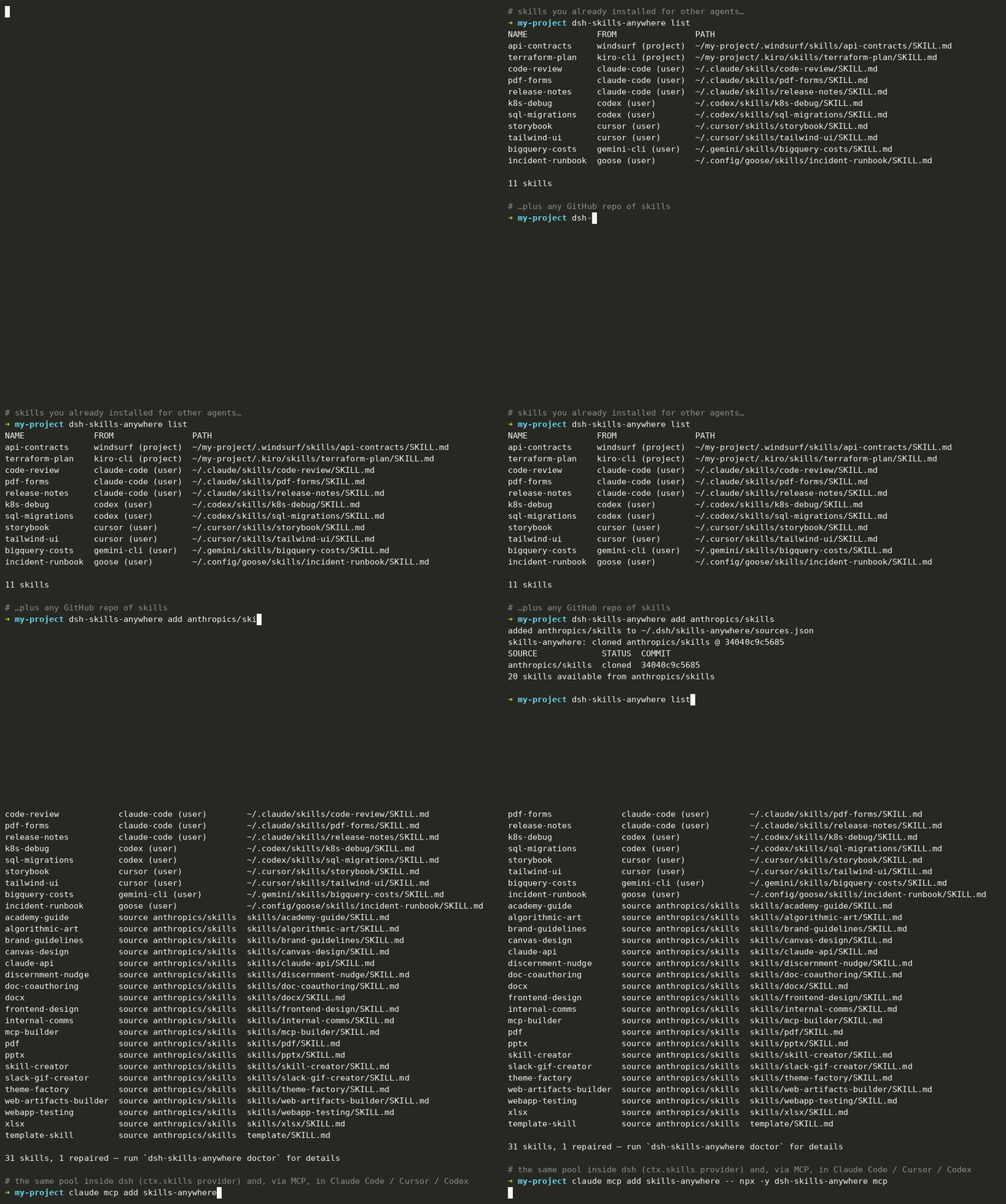
Inside dsh, it registers one extra provider on the built-in ctx.skills registry, so the model's normal skill tool and /name invocation simply see more skills:
- Predefined agent directories. Project and user paths for Claude Code, Codex, Cursor, Gemini CLI, GitHub Copilot, Windsurf, Kiro, Goose, Cline, Kimi CLI, Letta Code and other entries in the directory registry. Over MCP this includes the shared
.agents/skillsconvention, so a client that does not read it itself (Claude Code, for example) still sees skills installed there. - Claude Code plugin marketplaces. The skills nested inside
~/.claude/plugins/marketplaces/*/plugins/*/skills/*, including the official Anthropic marketplace. - Configured Git sources. Select a skill repository, subdirectory, branch, tag or commit. The provider maintains a local checkout and records its resolved commit in a lock file.
- Local files read in place. Existing skills are re-read when loaded, without copying them into each client's directory. Git sources use the managed cache described below.
The catalog budget controls how many skill summaries enter the model's
session catalog: up to 50 by default. Other eligible skills remain searchable
through find_skills and can be loaded on demand. /name invocation is unchanged.
The same pool is available outside dsh through dsh-skills-anywhere mcp.
Configured MCP clients can discover and open
skills through tools and skill:// resources. Client support for tool calls,
resources and the skill's own instructions determines the available workflow.
The provider deduplicates symlinked and byte-identical entries, supports
documented frontmatter repairs, and renames conflicting names such as
discord/configure and telegram/configure. The CLI reports the published
catalog, skipped entries and the reason for each change.
Inspect skill delivery
Successful MCP open_skill calls return a receipt identifying the delivered
instruction body, original SKILL.md and optional bundle. Attach it to a tool
span to review delivered versions alongside task results. The receipt records
delivery; instruction following and permission enforcement are separate checks.
Receipt contract ·
EvalArc Trace Workbench.
Example: review robot evidence
Load a Microduck frame-review skill through MCP, then have your agent verify its recorded joint facts with Robot Reel before writing a review. Interactive skill example (select 04 Review robot evidence) · Local walkthrough · Reusable skill. The browser shows the instructions; your agent's own execution tool runs the read-only verifier. No new simulation or GPU is needed.
Review once, load the same file
MCP open_skill returns the original file's SHA-256. Supply
expected_sha256 from check --json or an earlier open to reject a changed
SKILL.md before its instructions are returned. Fresh author opt-outs apply
immediately, even while discovery is cached. Exact-file workflow.
MCP protocol support: the local stdio command negotiates legacy initialization and the 2026-07-28 protocol opening. Four SDK configurations and the installed npm archive are checked over real subprocess connections. Compatibility matrix and embedding migration.
Review the whole skill directory. Generate a file manifest with
bundle /path/to/skill --json, compare added/removed/changed resources, and
require expected_bundle_sha256 when opening through MCP. The
interactive bundle comparison
shows a script change behind unchanged instructions and compares your own
manifests locally. Directory review and limits.
The digest covers recorded paths and file contents within that directory.
External dependencies and execution permissions need separate review; files
can change after loading.
Installation details and discovery example
Published on npm with build provenance; each GitHub release also includes the same tarball.
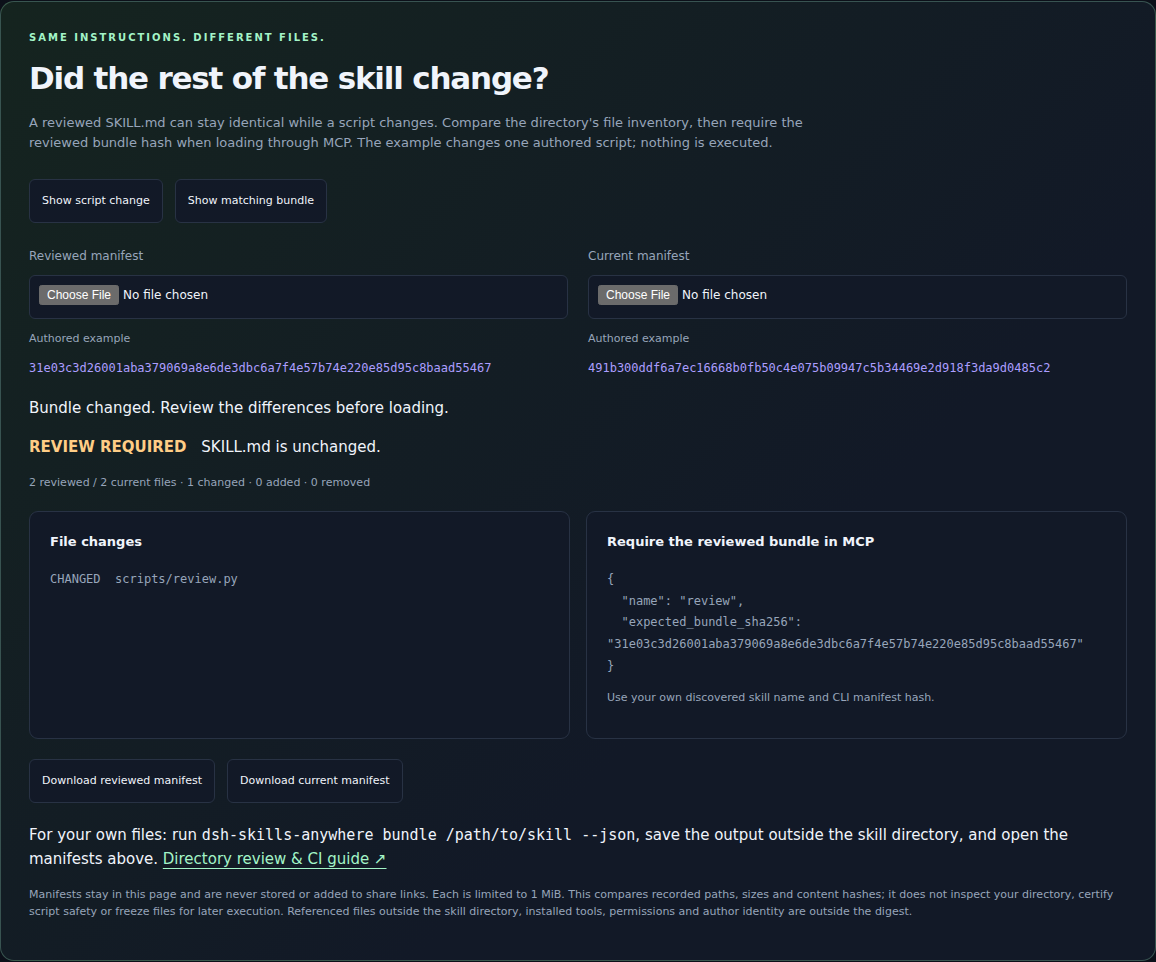
Example discovery output is shown below. Paths and counts depend on the local installation and configured sources:
Install from a git checkout or a release tarball instead of npm
Every GitHub release carries a prebuilt tarball, and both dsh plugin add and npx accept its URL directly (https://github.com/noteflowai/dsh-skills-anywhere/releases/download/v0.16.0/dsh-skills-anywhere-0.16.0.tgz). If you want an unreleased commit:
A git install ships sources, so pnpm has to run this package's prepare build. pnpm 10+ refuses until you allow it: the first add fails and prints the exact key to allow. Copy that key (it includes the commit) into the profile's pnpm-workspace.yaml and run the add again.
Pin a commit (github:noteflowai/dsh-skills-anywhere#<sha>) if you want the install to be reproducible.
Requirements
- DeepSeek Harness
0.1.5-rc.1or newer (the suite runs against0.1.5-rc.1and0.1.5-rc.2), any profile that mounts@deepseek-ai/dsh-skill(the shippedweb,acp,headlessandsdkprofiles all do) - Node.js 22.19+ or 24+
gitonPATHfor git sources (everything else works without it)
What gets discovered
| Where | Example | dsh source label | Default rank |
|---|---|---|---|
| Another agent's project skills | <project>/.claude/skills/*, <project>/.cursor/skills/* | anywhere-project | 250 |
| Another agent's user skills | ~/.codex/skills/*, ~/.cursor/skills/* | anywhere-user | 550 |
| Claude Code plugin marketplaces and the installed-plugin cache | ~/.claude/plugins/marketplaces/*/plugins/*/skills/* | anywhere-claude-plugins | 580 |
| Git sources | anthropics/skills, vercel-labs/agent-skills/skills | anywhere-source | 700 |
Lower rank wins a duplicate name inside the dsh registry. The built-in dsh roots
keep their ranks (.dsh/skills 100, .agents/skills 200, ~/.dsh/skills 400,
~/.agents/skills 500). Precedence follows these values across sources; for
example, an agent's project entry at rank 250 precedes a dsh user entry at 400.
Inside dsh, the built-in .agents/skills and .dsh/skills roots are not scanned again.
The standalone MCP server has no built-in provider beside it, so it also serves the
shared .agents/skills and ~/.agents/skills (the default location for Codex, Amp,
Goose, Zed and Letta Code) at those same ranks, 200 and 500. Embedders of
createSkillsAnywhereServer can pass sharedDirs: false or exclude the agents id.
Run npx dsh-skills-anywhere agents for the full agent table and which directories exist on your machine.
Skill format
The provider reads directories containing SKILL.md and dsh's flat <name>.md
form, using the Agent Skills format.
It parses name, description, disable-model-invocation and user-invocable,
and retains license, compatibility, allowed-tools and metadata.
compatibility and allowed-tools carry the author's declarations; the client
controls runtime requirements and tool permissions. Unknown fields, including
argument-hint and context, are preserved under metadata.frontmatter.
Preserving them does not implement the originating client's behavior.
scripts/, references/ and assets/ are exposed through the skill's resource
directory for the consuming client to use.
In the default lenient mode a missing name falls back to the directory, an invalid name is normalised to kebab-case, and a missing description is derived from the first paragraph. Each repair is recorded and shown by doctor. Set lenient: false to match the strict behaviour of the built-in provider.
Git sources
Sources come from three places, merged in this order: the plugin config.sources, the user file ~/.dsh/skills-anywhere/sources.json, and the project file <project>/.dsh/skills-anywhere.json (commit it to share skills with your team). The CLI edits the last two.
Each repository uses a local checkout at
~/.dsh/skills-anywhere/cache/<host>/<owner>/<repo> (<repo>@<ref> when a
branch, tag or commit is set). Background synchronization runs at startup,
every syncIntervalMs (6 hours by default), and when source configuration changes.
Resolved commits are recorded in ~/.dsh/skills-anywhere/lock.json.
Discovery reads the available cache. A failed refresh retains an existing
checkout; a source that has never synchronized contributes no cached skills.
Successful changes invalidate the catalog without making discovery wait for
network synchronization.
Catalog budget and the find_skills / open_skill tools
dsh publishes every model-invocable skill's name and description into the session, on every request. With marketplaces and a few git sources that is hundreds of lines of context. The provider therefore ranks its skills and marks only the first catalog.limit (default 50) as model-invocable; the remainder is published with model invocation off, which keeps it out of the catalog but still loadable by you with /name.
Two tools, registered by the dsh-skills-anywhere/tools row, make the hidden part reachable for the model:
find_skills(query, limit?)searches every skill by keyword (name, description,whenToUse, origin), catalog or not, and says which matches are listed.open_skill(name)loads any skill by exact name, including ones the budget hid. Skills whose own frontmatter saysdisable-model-invocation: trueare still refused, exactly as the built-inskilltool does.
Author-disabled skills never count against the budget. Which skills stay listed follows the precedence order below, so project-level skills win over user-level, which win over marketplaces and git sources. The tools row needs the tool runtime (ctx.tools); in a profile without one it stays pending and the provider works alone.
CLI
Check before committing. Run npx -y dsh-skills-anywhere@0.16.0 check skills/example/SKILL.md --fail-on-repair. The same parser used in the playground
provides batch file checks, JSON reports with file hashes, and CI exit codes.
Checks read only the named files. In GitHub Actions, uses: noteflowai/dsh-skills-anywhere
selects every tracked SKILL.md and annotates the results.
Commands, GitHub Action and scope.
Validate a recorded skill pick
When a classifier, an LLM or a person picks a skill for a task, route checks
that pick against the skills installed here. route prepare ranks every
discovered skill with the same keyword search as find_skills, drops skills
that open_skill would refuse, and only then keeps the first 8 as a typed
choice request (skills-anywhere-route-request-1). The reserved _none option
means "no listed skill fits" and can never be a skill name. Each candidate
records its origin, SKILL.md path and content hash. Your decider writes a
response; route apply reads it as untrusted data and reports exactly one
outcome. Nothing is loaded, executed or sent over the network.
| Outcome | Exit | Meaning |
|---|---|---|
selected | 0 | Confidence meets the threshold; prints the skill's name, origin and SKILL.md path to open |
no_match | 0 | The decider chose _none at or above the threshold |
abstain | 0 | No confidence reported, or below --min-confidence |
stale | 1 | Since prepare, the chosen skill was deleted, stopped being openable, or its SKILL.md path or content hash changed (edited, or another origin took over the name). Run prepare again |
invalid_input | 2 | Unreadable or non-JSON file, wrong request schema, a choice outside the options, or a confidence that is not a number from 0 to 1 |
An invalid --min-confidence, or --request/--response/--min-confidence
on another command, also exits 2. The default of 0.7 is an uncalibrated
placeholder, so pick a threshold from your own decider's held-out results.
--json prints skills-anywhere-route-result-1 with the outcome, choice,
confidence, threshold and model (provenance only); other response keys are
ignored. Request files contain absolute paths from this machine.
All commands accept --cwd <dir>. For check, it resolves the named files; other
commands use it to pick the project. check --lenient accepts provider repairs;
--fail-on-repair rejects any reported repair in the selected mode.
--fail-on-hidden-characters rejects files with invisible or direction-changing
characters, which every report lists as hiddenCharacters.
The CLI uses the same parsing code as the plugin and never needs dsh running.
Use as an MCP server
dsh-skills-anywhere mcp starts a local
Model Context Protocol server over stdio.
It exposes the same configured sources, deduplication and naming rules through
the following tools. Connect a compatible client using its MCP configuration:
| Tool | What it does |
|---|---|
list_skills | Browse every model-invocable skill with its description and origin (limit, offset) |
find_skills | Keyword search across names, descriptions and origins |
open_skill | Load one skill's instructions plus the directory its scripts and references live in |
Skills are also exposed as skill://<name> resources with completion for clients
that support resource references. The MCP tools and resources exclude skills
whose frontmatter sets disable-model-invocation: true. The server runs
independently of dsh.
The examples below show client configuration. Automated connection checks cover the four SDK configurations and installed package in the compatibility matrix; application-specific behavior depends on the client version and its support for tools and resources.
Claude Code (as a plugin; this repo doubles as a plugin marketplace)
Or register the bare server instead: claude mcp add skills-anywhere -- npx -y dsh-skills-anywhere mcp. Either way, restart Claude Code once so it connects.
Cursor (.cursor/mcp.json or ~/.cursor/mcp.json)
Codex (~/.codex/config.toml)
The MCP registry identifier is
io.github.noteflowai/dsh-skills-anywhere. The repository also includes
Agent Plugin manifests (plugin.json and mcp.json)
for clients that support that format. Follow your client's installation flow.
Add --cwd <dir> when the client starts the server outside your project.
Configured Git sources sync in the background at startup. To embed the server,
import { createSkillsAnywhereServer } from 'dsh-skills-anywhere/mcp' returns
the McpServer and provider; see the
transport and migration guide.
Browse and toggle skills in the dsh web UI
In dsh web, open Settings → Plugins → Plugin configuration. The Skills Anywhere card lists every skill the provider found, grouped by where it lives (agent directories, Claude Code plugins, git sources), with its catalog state — listed for the model, not listed (kept out by the budget or by you) or author disabled — and the name it was renamed to when it collided. Each row offers Pin (always listed), Hide (out of the model catalog, still /name- and find_skills-reachable) and Exclude (dropped from the provider); the catalog budget is editable in place, and a filter box searches names, descriptions and origins.
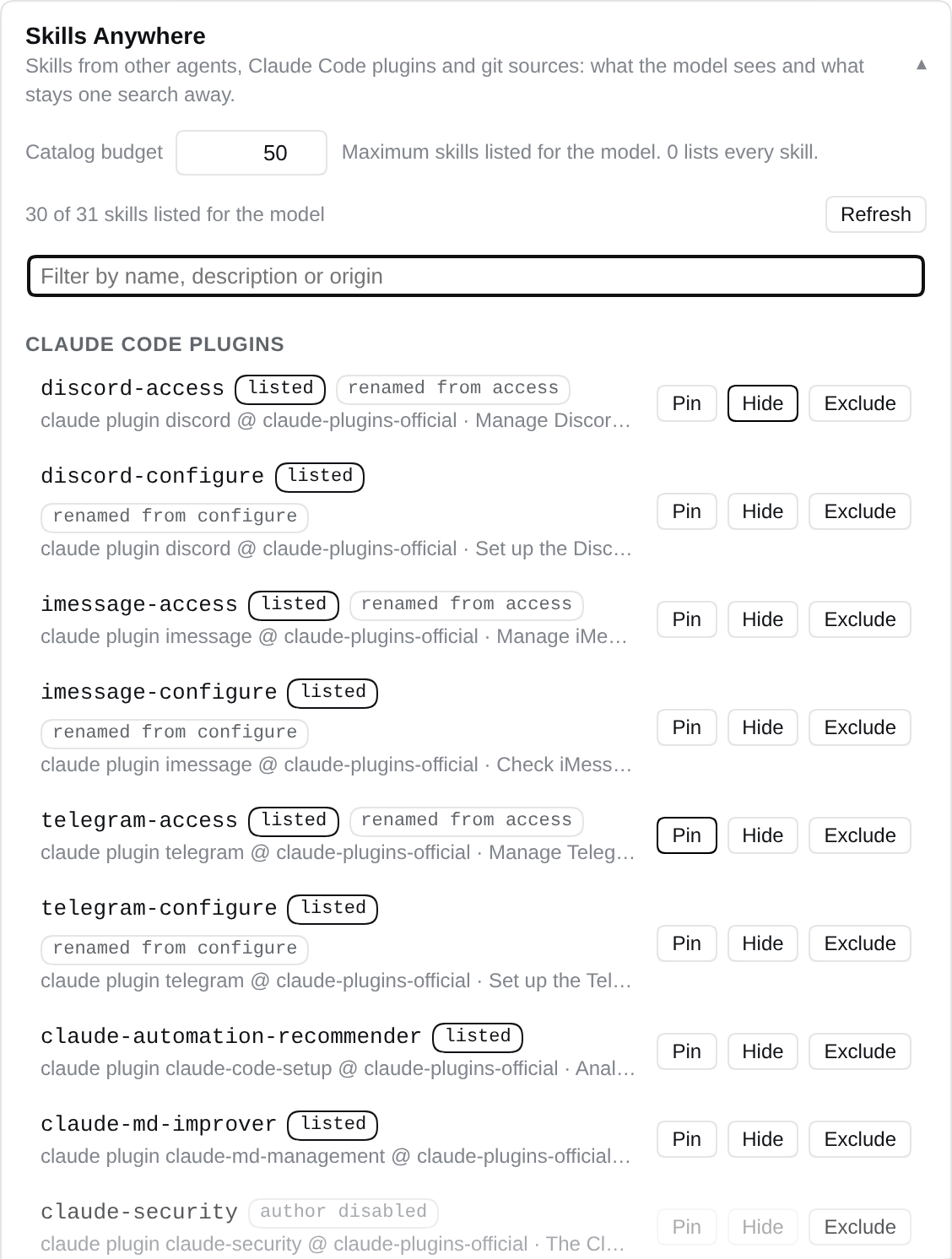
Edits are written to the profile's dsh settings document as the skills-anywhere namespace, layered over catalog and excludeSkills from cordis.patch.yml, and the model catalog follows immediately: no restart, no file editing. The card only appears in profiles that mount dsh's settings service and web server (the shipped web profile does); everywhere else the provider behaves exactly as composed.
Configuration
Override the row in your profile's cordis.patch.yml. A patch replaces the whole config block, so restate every key you care about:
| Field | Default | Meaning |
|---|---|---|
providerName | skills-anywhere | Provider name on ctx.skills |
agents | true | Scan other agents' skill directories |
excludeAgents | [] | Agent ids to skip (see agents command) |
sharedDirs | false in dsh, true for the MCP server | Also scan .agents/skills and ~/.agents/skills, which dsh's built-in provider already reads |
extraProjectDirs | [] | Additional project-relative skill directories |
extraUserDirs | [] | Additional absolute or ~/ skill directories |
claudePlugins | true | Scan Claude Code plugin marketplaces and cache |
sources | [] | Git sources: strings or { repo, ref?, path?, rank? } |
sourcesFiles | true | Also read the user and project sources.json files |
cacheDir | ~/.dsh/skills-anywhere/cache | Where sources are checked out |
sync | true | Clone and refresh git sources at all |
syncOnStart | true | Refresh when the plugin starts and on first use of a project |
syncIntervalMs | 21600000 | Background refresh interval; 0 disables |
syncTimeoutMs | 120000 | Per-git-command timeout |
maxDepth | 5 | Directory depth walked inside sources and marketplaces |
dedupe | true | Collapse symlinked and byte-identical duplicates |
lenient | true | Repair recoverable frontmatter instead of skipping |
watch | true | Watch local roots and refresh the catalog on change |
excludeSkills | [] | Skill names to hide (raw frontmatter name or the published name shown by list); editable at runtime from the web card |
ranks | { project: 250, user: 550, claudePlugins: 580, sources: 700 } | Precedence per group |
catalog.limit | 50 | Skills from this provider listed in the model catalog; 0 = unlimited |
catalog.pin | [] | Names always listed |
catalog.hide | [] | Names never listed (still /name-invocable and searchable) |
dshHome, home | $DSH_HOME / ~ | Path roots, mainly for tests |
The dsh-skills-anywhere/tools row accepts findLimit (default 10), findMaxLimit (50), and find / open booleans to register only one tool.
How precedence and duplicates work
- Roots are scanned in rank order. Within one rank, the agent table order, then path.
- Entries pointing at the same file (symlinks) collapse to the first. Entries with the same name and byte-identical body collapse to the first. Both appear in
doctoras hidden duplicates. - Entries that still share a name but differ are all kept. If one of them is yours (an agent directory) it keeps the bare name and the others are prefixed with their plugin, repository, or agent (
telegram-configure). If every member comes from a marketplace or a git source, all of them are prefixed, so you getdiscord-accessandtelegram-accessrather than a meaningless bareaccess.doctorlists the renames. - The dsh registry then merges this provider's candidates with the built-in ones by rank.
Integration examples and measured outcomes
Use the examples to connect delivery receipts with separately computed task checks. The reports retain instructions, tool results and every delivered program.
| Workflow | Example and evidence | Recorded result |
|---|---|---|
| Compare skill delivery | 27 Qwen3-8B attempts across no skill, direct delivery and MCP, in three engineering profiles | No direct-delivery or MCP attempt fully resolves the task. The no-skill condition resolves 2/3 attempts in the final profile. |
| Continue from a selected session | Funes MCP source example and six continuation attempts, three per condition | All six retrieval calls succeed. All six programs remain unchanged; each condition resolves 0/3 tasks. |
Review independent-source SWE tasks: a separate fixed cohort records 36 attempts on Astropy, pytest and SymPy across four workflow conditions. Direct and MCP preloads deliver identical guidance; an unrelated MCP control matches the prompt length. No attempt obtains native acceptance: 31 have assessable reports and five remain uncertain after upstream infrastructure flags. Eight attempts produce nonempty patches. Methods and offline records keep tool failures, native labels and incomplete usage visible.
Carry the reviewed skill into a new session: a separate six-attempt cohort reuses the predecessor's exact skill bytes through workflow MCP preloads. All six preloads succeed; the memory group retrieves six results. All six programs remain unchanged and no task passes full acceptance. The report connects original pins, delivery receipts, retrieved history and task checks.
Review runtime behavior with the isolated skill-composition fixtures. The report separates file acceptance, service completion and authorization across 32 authored controls and 12 model attempts. No model attempt completes the service task.
These small studies on public tasks evaluate specific workflows; general skill or memory benefits require separate evaluation. The research guide keeps methods, composition controls and separate cohorts together for reproduction.
Security notes
- The plugin reads skill files. It never writes to your agent directories.
- Git sources run
giton your machine at plugin start and on the refresh interval. Pin a commit for anything you do not fully trust, and reviewlock.json. - Loaded skills add instructions to the agent's context. Review instructions and referenced scripts before use; the client controls execution permissions, and loading does not ensure the model follows them.
- Skills are read with Node's filesystem API, not through dsh's sandboxed
ctx.fs; the built-in provider does the same for its bundled root.
Development
Tests run against the real @deepseek-ai/dsh-skill registry and real git repositories in temp directories.
Contributing
Issues and pull requests are welcome. Add a discovery path in
src/agents.ts, cite its source and test directory discovery.
Client integration needs separate protocol and workflow checks.
See CONTRIBUTING.md.
Community listings: Awesome DeepSeek Harness · Awesome Gemini CLI. Publication history and verification.
License
MIT © Note Flow AI