Audit any Shopify store for AI search (GEO/AEO) readiness and generate the fixes. No signup.
Quick Install
Automated & IDE SetupCopy the AI prompt to install this server into Claude Code, Cursor, or another agent — or use 1-click editor setup below.
Manual Client & Custom JSON ConfigExpand JSON ▾
Client Config & Setup
Choose your client or environment
Target File:
💡 Paste the JSON block into your client's configuration file under mcpServers, then restart the application.
Documentation Overview
shopify-geo-audit


Audit any Shopify store for AI-search readiness, then generate the fixes you actually paste in.

No account, no API key, no config. It fetches the storefront, runs a set of checks for the signals that ChatGPT, Perplexity, Gemini and Google's AI Overviews read, scores the store 0-100, and writes paste-ready fixes to ./geo-audit-output/.
Want it on your PATH instead of npx? npm i -g shopify-geo-audit.
Why I built this
I do a lot of Shopify work, and "are we showing up in AI answers?" became a real client question fast. The field goes by a pile of names — GEO, AEO, AI SEO, LLM SEO, answer engine optimization — but the question is the same: when someone asks ChatGPT or Perplexity for product recommendations, is your store citable? The existing tools mostly hand you a dashboard that says you're invisible and stop there. The useful part, the part that takes an afternoon by hand, is producing the actual structured data and config. So I wrote the thing that does that part.
It's deliberately small and offline. One command, runs locally, nothing leaves your machine except the requests to the store you're auditing.
What it checks
Nine checks, weighted by how much they matter for getting cited:
| Check | Weight |
|---|---|
Product JSON-LD (Product/Offer) on product pages | high |
| robots.txt isn't blocking GPTBot / ClaudeBot / PerplexityBot / Google-Extended | high |
Organization + WebSite schema on the homepage | medium |
/llms.txt exists | medium |
| Title, meta description, canonical, Open Graph | medium |
| Product description depth + answer-first lead | medium |
| One H1, sensible H2s | low |
| Image alt text + image schema | low |
sitemap.xml reachable | low |
The result is an SRO Score (Search Readiness for AI): 80-100 strong, 50-79 needs work, below 50 at risk.
The premise — that deliberate changes to your pages measurably move how often engines cite you — comes from the original GEO paper (Aggarwal et al., KDD 2024), which measured visibility gains of up to ~40% from exactly this kind of work.
What it generates
The output isn't a report you read and forget. It's files:
product-jsonld.html— a validProductblock filled from your store's real data, ready for your themellms.txt— a content manifest for your domainrobots-fixes.txt— the exact lines to stop blocking AI crawlerspriority-list.txt— every failing check, ranked, each with a one-line fix
Pass --html and you also get a self-contained report.html you can screenshot or send a client:
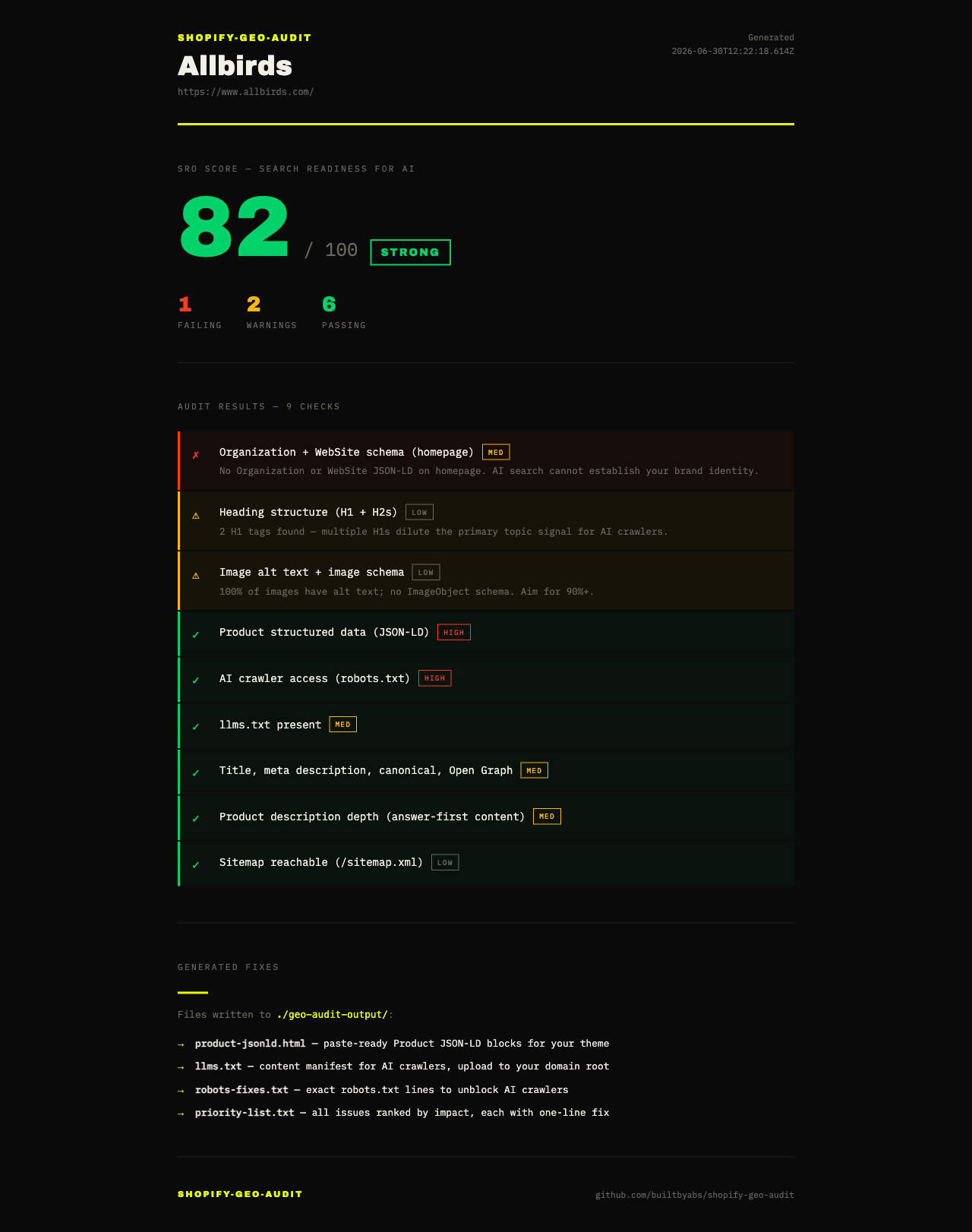
Example
Usage
--json keeps stdout clean so you can pipe it, and --min-score lets CI fail on weak audits:
MCP server
The audit also runs as an MCP tool, so Claude, Cursor or any MCP client can audit a store mid-conversation:
One tool, audit_shopify_store — takes a URL, returns the full results and generated fixes as JSON. Same pipeline as the CLI, nothing else running. The server also ships in the main package as the shopify-geo-audit-mcp binary if you'd rather not pull a second package.
How it works
It's a straight pipeline with the side effects pushed to the edges:
Checks are pure functions (store) => result, one per file, so each is trivially testable and adding a new one is a single module. Fetching is SSRF-guarded (no requests to private or reserved addresses, redirects re-validated each hop) and everything parsed off the network is validated with zod before it's trusted.
Development
FAQ
Is this just SEO with a new name? Overlapping, not the same. A store can rank fine on Google and still hand ChatGPT nothing it can quote — no Product JSON-LD, thin descriptions, a robots.txt that blocks the crawlers. The checks here are specifically about what AI engines parse and cite.
Why Shopify only?
Because Shopify is predictable. Product discovery uses /products.json (with a sitemap fallback), and the generated fixes assume Shopify's theme conventions, so they actually fit instead of being generic advice. It will run against any URL, but on a non-Shopify site the product-level checks won't find much.
Does any of my data leave my machine? No. The only network requests are to the store you're auditing. No telemetry, no account, nothing phoned home.
My score is low. Where do I start?
priority-list.txt in the output folder — it's every failing check ranked by weight, each with a one-line fix. The two highs (Product JSON-LD, robots.txt) are usually an hour of work combined.
Contributing
Adding a check is the easiest contribution: drop a file in src/checks/, add a fixture and a test, wire it into src/index.ts. See CONTRIBUTING.md. Issues and PRs welcome; good first issue is tagged.
And if the tool saved you an afternoon, a star is how other Shopify folks find it.
License
MIT © Abhishek Chauhan
Related MCP Servers
Reviews
No reviews yet — be the first to share how this listing worked for you.
Frequently Asked Questions about Shopify Geo Audit
AllMCPs Directory Badge
Showcase your server listing on GitHub or your project documentation. Embed this dynamic SVG badge to highlight official listing status and live engagement.
Badge Style:
Live Dynamic SVG Preview
Markdown (GitHub README)
[](https://allmcps.com/mcp/shopify-geo-audit)HTML Embed
<a href="https://allmcps.com/mcp/shopify-geo-audit"><img src="https://allmcps.com/api/badge/shopify-geo-audit?style=directory" alt="Shopify Geo Audit on AllMCPs" /></a>Technical Specs & Signals
CategoryFinance & Fintech
27Quality signal: Emerging · 27/100How this signal is calculated ▾
Server availabilityNot measured
Not scored for repo-hosted servers — we can't reach the running server, only its GitHub page. Hosted MCP endpoints are health-checked live.
Verified ownership8/20
Documentation & tools11/30
Adoption & activity1/15
Community engagement0/10
A guidance signal from public completeness & health data — not a user rating. New listings start lower and rise as they add docs, get verified, and grow adoption. Signals we can't observe for a listing are skipped, not counted against it.
Own this project?
This directory is pre-filled from public sources. Claim via GitHub README, site badge, or DNS TXT to unlock edit access and the Official badge and attach your website — proof is checked automatically, then reviewed by our team.
Free dofollow backlink: add your website and place the AllMCPs badge on it — no claim needed. We detect it automatically and keep it verified as long as the badge stays live.
Claim & get free dofollowShare & Embed
Add our SVG badge (dark/light directory styles) or embeddable widget to your site.