Secrets-LE: Zero Hassle Secret Detection
Find hardcoded credentials across your workspace, then redact them in place
API keys, tokens, passwords, private keys — 100% local, nothing leaves your machine




Useful? A star or rating is how other developers find it — ★ GitHub · ★ Open VSX · ★ Marketplace
What it does
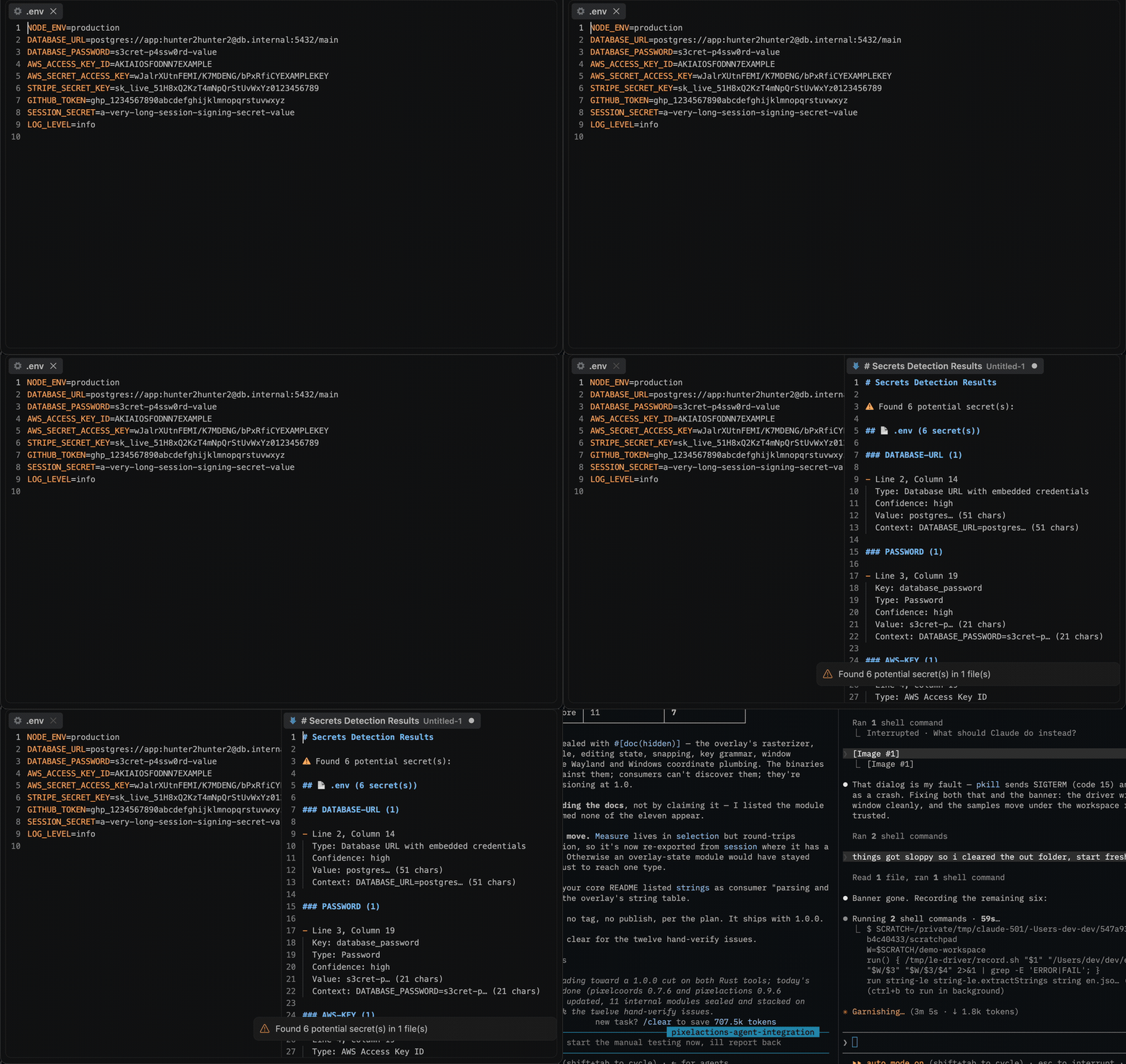
Open a workspace, press Ctrl+Alt+S (Cmd+Alt+S on Mac), and every detected secret lands in a results document — grouped by file, with line/column positions pointing at the value itself. Run Secrets-LE: Sanitize Secrets to replace the secrets in the active file with a placeholder. Works in VS Code and in VS Code–based editors like Cursor and VSCodium (installable from Open VSX).
Detection is regex-based over the full text of each file, so it works on any text format — code, configs, .env files, YAML, JSON, logs. It is a pre-commit safety net, not a guarantee: a scanner built on patterns can miss secrets and can flag non-secrets. Review the results.
Install
| Where | What you get | Install |
|---|---|---|
| VS Code | Detection and in-place sanitising, in your editor | Marketplace |
| Cursor, VSCodium, Windsurf | The same extension | Open VSX |
| A terminal or a CI step | The same run over a whole tree, with exit codes | cargo install secrets-le · crates.io |
| Any MCP agent, via Node | detect_secrets over stdio | npx secrets-le-mcp · npm |
| Zed | The MCP server as a context server | add it by hand (no listing yet) |
Use it from an AI agent
The same engine runs as an MCP server, so an agent can call it directly instead of you running a command.
| Editor | How |
|---|---|
| VS Code 1.101+ | Nothing to install — the extension registers detect_secrets with agent mode |
| Zed | No listing yet — add the MCP server by hand |
| Claude Code | claude mcp add secrets-le -- npx -y secrets-le-mcp |
| Cursor, Windsurf, anything else | point it at npx secrets-le-mcp |
Reports each finding by type, confidence, key name and 1-based position. Values are never returned — previews are truncated and length-annotated, and the context line has the secret masked out, so a finding can be located without the credential leaving the machine it was found on.
The server takes content and returns data — it reads no files and makes no network requests of its own. Published as secrets-le-mcp on npm and as io.github.nolindnaidoo/secrets-le in the MCP registry.
Configuring it by hand — any host with an MCP config file
Most hosts read a JSON config. Add one entry:
-y skips the install prompt on first run. Pin a version if you would rather not track releases — secrets-le-mcp@2.3.1.
Prefer not to go through npx on every launch? Install it once and point at the binary instead:
It speaks MCP over stdio and needs no environment variables, no API key and no configuration of its own. To check it before wiring it into anything:
That prints the tool list and exits — if you see detect_secrets, the server works.
The CLI
The same detection runs from a terminal or a CI step: a Rust CLI in
crate/, sharing one pattern table with the extension
— crate/signatures/patterns.toml —
so the two can never disagree about what counts as a credential.
The exit code is the answer: 0 nothing found · 1 findings · 2 the
question was malformed — so secrets-le . is a CI step as it stands.
It never prints a credential. A scanner's output goes into a CI log, which is archived, often world-readable, and outlives the secret; a scanner that printed what it found would disclose it more widely than the commit would have. Previews are capped at eight characters and at half the value's length, context lines are masked, and there is no flag that changes either. The extension is the half that can fix what it finds; the binary only reports.
What gets detected
Thirty-four patterns, in crate/signatures/patterns.toml — the one table
both frontends load.
| Category | Types |
|---|---|
| Named issuers | Anthropic sk-ant-, OpenAI sk-/sk-proj-, GitHub ghp_/github_pat_, GitLab, Slack xox?-, Stripe sk_live_/sk_test_, Google AIza…, SendGrid, Mailgun, Sentry, npm, PyPI, Docker Hub, HashiCorp Vault, Terraform Cloud, Supabase, Shopify, Square, Azure SAS |
| Cloud credentials | AWS Access Key IDs (AKIA…, no key name needed), AWS Secret Access Keys, Azure account keys, GCP/Google Cloud keys |
| Tokens | Generic tokens, bearer tokens, access/refresh tokens, OAuth tokens, JWTs (key-based or bare eyJ… form) |
| Passwords | password/passwd/pwd values, including compound keys (DATABASE_PASSWORD) |
| Private keys | Multi-line PEM blocks — RSA/EC, OpenSSH, PGP |
| Connection data | Database URLs with embedded user:pass@ credentials, connection strings, session IDs, cookies |
Key-based patterns accept quoted and unquoted keys, so JSON ("apiKey": "…"), YAML (api_key: …), env (API_KEY=…), and code (apiKey = '…') all match.
Intentional non-detections: template placeholders (${VAR}, {{var}}, <your-key>, xxxxxxxx), version numbers and hostnames that merely look dotted (1.2.3 is not a JWT), GCP project ids (identifiers, not credentials), and database URLs without embedded credentials.
Known limitations: detection is pattern-based — obfuscated, split, or unconventionally named secrets are missed; JWTs whose header isn't standard base64 JSON (eyJ…) are missed; a high-entropy string without a recognizable key name or prefix is not reported.
Commands
| Command | Description |
|---|---|
Secrets-LE: Detect Secrets (Ctrl+Alt+S / Cmd+Alt+S) | Scan the workspace and open a results document |
Secrets-LE: Sanitize Secrets | Replace detected secrets in the active file (asks for confirmation first) |
Secrets-LE: Open Settings | Open Secrets-LE settings |
Secrets-LE: Help | Built-in documentation |
Settings
| Setting | Default | Description |
|---|---|---|
secrets-le.detection.sensitivity | medium | low reports everything, medium drops low-confidence matches, high keeps only high-confidence ones |
secrets-le.detection.includeApiKeys | true | Detect API keys and cloud credentials |
secrets-le.detection.includePasswords | true | Detect passwords |
secrets-le.detection.includeTokens | true | Detect tokens and JWTs |
secrets-le.detection.includePrivateKeys | true | Detect PEM private-key blocks |
secrets-le.sanitization.replaceWith | ***REDACTED*** | Replacement text used by Sanitize |
secrets-le.workspace.scanPatterns | ["**/*"] | Glob patterns to scan |
secrets-le.workspace.scanExcludes | node_modules, .git, dist, … | Glob patterns to skip |
secrets-le.workspace.scanMaxFiles | 10000 | Cap on files scanned per run |
secrets-le.safety.enabled | true | Guardrails for very large files |
secrets-le.safety.fileSizeWarnBytes | 1000000 | Skip/refuse files above this size |
secrets-le.dedupeEnabled | false | Collapse identical value+type detections in results |
secrets-le.copyToClipboardEnabled | false | Also copy results to the clipboard |
secrets-le.openResultsSideBySide | true | Open results beside the current editor |
secrets-le.notificationsLevel | important | all = every notification, important = warnings + errors, silent = errors only |
secrets-le.statusBar.enabled | true | Show the status bar item |
secrets-le.telemetryEnabled | false | Local-only event log (see Privacy) |
Languages
Twelve languages besides English:
German · Spanish · French · Indonesian · Italian · Japanese · Korean · Portuguese (Brazil) · Russian · Ukrainian · Vietnamese · Chinese (Simplified)
Both halves are covered — the manifest (command titles, setting names and descriptions) and everything shown while the extension runs (notifications, the status bar, quick-picks and prompts). The extension follows VS Code's display language, so it matches whatever the editor is already set to; no setting of its own.
Privacy & security
- No network access. The extension never sends data anywhere. The
telemetryEnabledsetting only writes events to a local Output Channel you can inspect (Secrets-LE Telemetry). - The MCP server never returns a secret. Its output goes to whatever model called it, so previews are truncated and length-annotated and the surrounding context line is masked, using the same
utils/maskhelpers as the report. There is no argument that turns this off, and the bundle gate fails the build if a value ever appears in a response — verified by making the tool leak on purpose and watching the gate catch it. - Error notifications redact home directories and credential-shaped fragments before display.
- Sanitize always asks for confirmation before editing your file, and edits are normal undo-able document edits.
Documentation
| What | Where |
|---|---|
| What the tool is allowed to say — scope, output contract, refusals, non-goals | crate/SPEC.md |
| How the extension is built and held together — architecture, invariants, toolchain, release | AGENTS.md |
| How the CLI is built and held together | crate/AGENTS.md |
| What changed | CHANGELOG.md · crate/CHANGELOG.md |
| The tool's page, and the other fifteen | letools.dev/tools/secrets-le |
Performance
| Input | Size | Found | Time | Rate | Scan speed |
|---|---|---|---|---|---|
| Source with credentials | 1.97 MB | 40,000 | 132.32 ms | 302,301/sec | 14.9 MB/s |
| Clean source | 1.92 MB | 0 | 70.88 ms | — | 27.2 MB/s |
| Env file | 0.60 MB | 0 | 21.88 ms | — | 27.4 MB/s |
Median of 7 runs after warmup, on Apple M5 Pro, 24 GB RAM, Node 24.3.0. Inputs are generated
by scripts/benchmark.ts rather than checked in, so the sizes above are
exactly what was measured. Reproduce with bun run benchmark.
These are machine-specific and are not asserted in CI — a benchmark that gates a build only tells you how busy the runner was.
Testing
| Metric | Coverage |
|---|---|
| Statements | 91.03% |
| Branches | 79.75% |
| Functions | 95.90% |
| Lines | 91.89% |
248 test cases across 15 files, plus an integration suite that runs
in a real VS Code extension host and an end-to-end test that installs the
built .vsix into a clean profile.
Generated from a real run — coverage/coverage-summary.json and
coverage/test-results.json — by scripts/coverage-readme.js; CI fails if
this section drifts. Reproduce with bun run test:coverage, and the case
count is the one vitest prints.
More from the LE family
Sixteen single-purpose tools for the work in front of every model. Each ships a Rust CLI and an MCP server. One page: letools.dev
Get it out
- String-LE — Extract every string in a codebase, with its position, so a person can read them
- Numbers-LE — Extract every hardcoded number in a codebase, so a person can check them
- Units-LE — Extract every quantity with its unit, normalized, and refuse the ambiguous ones by name
- Dates-LE — Extract every date and timestamp, and the exact instant each one resolves to
- IDs-LE — Extract every UUID, ULID, NanoID, ObjectId and Snowflake, and decode the time inside
- IPs-LE — Extract every IP address, CIDR block and MAC, normalized and classified by scope
- URLs-LE — Extract every URL in a codebase, with its protocol and exact position
- Paths-LE — Extract every file path in a codebase, and say whether it still points at anything
- Colors-LE — Extract every color in a codebase, and say which ones are not in your palette
Check it
- Regex-LE — Find every regex in a codebase, and report which can be driven into catastrophic backtracking
- Versions-LE — Find where one dependency is constrained differently across a repository's manifests
- i18n-LE — Identify the i18n library a project uses, then audit its catalogs by that library's rules
- Scrape-LE — Check whether a page is scrapeable before the scraper is written, and say when it cannot tell
Guard it
- Secrets-LE — Find hardcoded credentials in a codebase, and never print one into the report
- EnvSync-LE — Compare the dotenv files in a tree, and say which keys are missing from which
- Unicode-LE — Find the Unicode that hides meaning — bidi controls, invisibles, homoglyphs, mixed scripts
Each stands on its own: no shared crate, no published core. Where two of them agree, it is because the same answer was right twice.
Contact — nolindnaidoo.com · GitHub · LinkedIn
Also by nolindnaidoo
Rust — pixelcoords and pixelactions are one loop: pixelcoords answers where, pixelactions acts there. Their own tools, their own voice — not part of the LE family.
- pixelcoords — Freeze your screen, mark regions, get pixel-exact coordinates and crops pixelcoords.dev · crates.io · docs.rs
- pixelactions — Consume human-verified coordinates, perform the interaction, confirm it landed pixelactions.dev · crates.io · docs.rs
License
MIT © nolindnaidoo