Ros MCP Server vs Tracepass MCP Server
A side-by-side look at the Ros MCP Server and Tracepass MCP Server MCP servers: transport, auth, tools, quality signals, and the config to install either one in Claude, Cursor, Windsurf or VS Code.
Verdict: choose Ros MCP Server for industrial & iot work; choose Tracepass MCP Server for industrial & iot as a local process. You can also run both side by side in one mcpServers block.
Which MCP server should you choose?
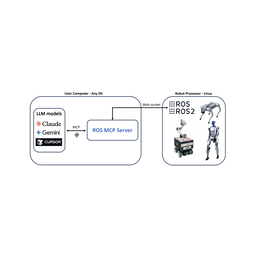 Choose Ros MCP Server when
- You need dedicated capabilities in the Industrial & IoT domain.
 Choose Tracepass MCP Server when
- You need dedicated capabilities in the Industrial & IoT domain.
- You prefer a local stdio subprocess transport.
- Its auth model fits you: API key required.
- You have the keys it needs:
TRACEPASS_API_KEY, TRACEPASS_BASE_URL. - You want tools like
tracepass_products, tracepass_passports, tracepass_passport_fields.
Feature & specification comparison
Rows where the two servers differ are marked.
| Spec | ||
|---|---|---|
| Category | Industrial & IoT | Industrial & IoT |
| Quality signal | 40/100 · Fair | 64/100 · Good |
| Install command | Not confirmed yet | Confirmed |
| Transport | — | Local subprocess (stdio) |
| Auth | Not declared | API key required |
| Pricing | Not declared | Not declared |
| Required env vars | None listed | TRACEPASS_API_KEYTRACEPASS_BASE_URL |
| Verified owner | Community listing | Community listing |
| GitHub stars | 1,504 | 1 |
| Directory activity | 1 views 0 installs 0 upvotes | 3 views 0 installs 0 upvotes |
| Tools | Not listed | 6 |
| Full listing | View Ros MCP Server | View Tracepass MCP Server |
Tools & capabilities
Ros MCP Server tools
No tool names declared yet. Check the project README from the listing page.
Tracepass MCP Server tools 6
tracepass_productsManage the TracePass product catalogue. A product is the catalogue layer — one product can have many passports (one per serialised unit). Products are not billable on their own. Actions (pass via `action`, with `args`): - list — args: { page?, limit? (≤100), category?, status?, search? }. Read-only. - get — args: { id }. Read-only. - create — args: { name, model, category, description? }. `category` is one of: battery, textile, electronics, construction, steel, detergents, paints-coatings, packaging, furniture, tyres, jewelry, toys, fmcg. - update — args: { id, name?, model?, description? }; pass at least one field to change. - create_batch — args: { products: [ { name, model, category, description? }, … ] }, up to 100. Partial-success: the response carries a per-item status, so some items can be created while others error. The whole batch consumes N writes upfront; if that would exceed the daily cap NOTHING is created (429). - archive — args: { id }. Soft-archive a product. Blocked with 409 while any non-archived passport still references it — archive those passports first. This is reversible and is NOT deletion.tracepass_passportsManage Digital Product Passports — create, read, and run lifecycle actions. IMPORTANT: `create` consumes a DPP slot on the account's plan and IS BILLABLE. Creating a passport beyond the included quota incurs a per-passport overage charge; if over quota the tool returns a 402-style message — only re-run with args.confirmOverage=true after the user explicitly agrees to the charge. `archive` is IRREVERSIBLE (the public QR permanently 404s); prefer `suspend` when a change might be undone. Actions (pass via `action`, with `args`): - list — args: { page?, limit? (≤100), productId?, status?, search? }. status ∈ draft|in_review|approved|published|suspended|expired|archived. Read-only. - get — args: { id, format? (summary|full), lang? }. Read-only. - get_by_serial — args: { serial, format?, lang?, gtin? }. Read-only. Addresses the passport by your own serial. A serial is unique only WITHIN a GTIN — if the same serial exists under two GTINs in your account the call returns 409 ambiguous_serial; pass `gtin` (or use the by-id action) to resolve exactly. - compliance — args: { id }. Read-only. Returns a three-tier compliance verdict (compliant | compliant_with_warnings | incomplete) with regulation-cited findings — use to gap-check a passport against the rules for its category, fix the cited fields/parties, then re-check. - registry_readiness — args: { id }. Read-only. Returns { ready, findings[] } — whether the passport would pass the EU DPP Registry's FORMAL submission gate (mandatory fields present, correct formatting, a resolvable public link, item-level granularity via a serial number, and a well-formed commodity code where the category carries one). This is the registry's mechanical pre-submission check, NOT the substantive compliance verdict; a passport can be registry-ready yet not substantively compliant. Battery passports only. - create — args: { productId, gtin, serialNumber, confirmOverage? }. BILLABLE. - suspend — args: { id }. Reversible — public QR shows 'suspended'. - suspend_by_serial — args: { serial, gtin? }. Same as suspend, addressed by your serial. 409 ambiguous_serial if the serial isn't unique in your account — pass `gtin`. - archive — args: { id }. IRREVERSIBLE — confirm with the user first. - archive_by_serial — args: { serial, gtin? }. IRREVERSIBLE, addressed by your serial — confirm first. 409 ambiguous_serial if the serial isn't unique — pass `gtin`. - get_qr — args: { id, format? (svg|png) }. Read-only. - get_qr_by_serial — args: { serial, format? (svg|png), gtin? }. Read-only. Same as get_qr, addressed by your own serial. A serial is unique only WITHIN a GTIN — if the same serial exists under two GTINs in your account the call returns 409 ambiguous_serial; pass `gtin` (or use get_qr by id) to resolve exactly.tracepass_passport_fieldsUpdate field values on a Digital Product Passport. Every change is recorded in the passport's audit trail, tagged as an API-key update. Actions (pass via `action`, with `args`): - update — args: { id, fieldKey, value }. `value` type matches the field's dataType (string, number, boolean, array, object). - update_by_serial — args: { serial, fieldKey, value, gtin? }. Same as update, addressed by your own serial. A serial is unique only WITHIN a GTIN — if it isn't unique in your account the call returns 409 ambiguous_serial; pass `gtin` (or use update by id) to resolve exactly.tracepass_passport_partiesManage the economic-operator parties on a passport — manufacturer, importer, authorisedRepresentative, distributor, recycler, producerResponsibilityOrg. Each party carries a legal name and ideally a validated 13-digit GS1 GLN. Actions (pass via `action`, with `args`): - set — args: { id, role, legalName, gln?, country?, legacyOperatorId? }. Sets or updates one role. - remove — args: { id, role }. Clears one role.tracepass_epcisGS1 EPCIS 2.0 supply-chain events. `export` is included on Starter plans and up; `capture`, `capture_job`, and `query` require the paid EPCIS add-on (those actions return a 403-style message without it). Actions (pass via `action`, with `args`): - export — args: { id }. Export a passport's events as an EPCIS 2.0 JSON-LD document. Read-only. - export_by_serial — args: { serial, gtin? }. Same as export, addressed by your own serial. A serial is unique only WITHIN a GTIN — if it isn't unique in your account the call returns 409 ambiguous_serial; pass `gtin` (or use export by id). Read-only. - capture — args: { events }. `events` is an EPCISDocument, a single event, or an array of events (JSON-LD). Returns a 202 with a captureJobId. - capture_job — args: { jobId }. Poll an async capture job. Read-only. - query — args: { params? }. `params` is a key/value map of standard EPCIS query parameters (EQ_bizStep, GE_eventTime, MATCH_epc, …). Read-only.tracepass_templatesDiscover the regulatory field schema for each DPP category — what a COMPLIANT passport must contain, per the governing EU regulation. Read-only reference data. Use this to advise on requirements before creating products/passports, and to gap-check a draft against the rules. Actions (pass via `action`, with `args`): - list — args: {}. Lists all 13 categories with their field count, required-field count, and governing regulation (name + number + effective/mandatory dates). - get — args: { category }. Full field schema for one category: every field's key, label, dataType, whether it is REQUIRED, its access level (public/restricted/authority), enum options, validation bounds, and — where known — the regulation article/annex that mandates it. `category` is one of: battery, textile, electronics, construction, steel, detergents, paints-coatings, packaging, furniture, tyres, jewelry, toys, fmcg. BATTERY — required-ness is per-category, so `required` alone is the wrong answer. Resolve it in this order: 1. SCOPE FIRST. Only EV, LMT and industrial_gt_2kwh batteries owe a passport at all (Art. 77(1), Reg (EU) 2023/1542). For portable, SLI or industrial_lte_2kwh, NO field is required — do not list mandatory fields for them; say the battery is out of scope. 2. Then `requiredBy[batteryCategory]` where the field carries that map (required | conditional | notApplicable). 3. Then fall back to `required`. The map is keyed ONLY by the three in-scope categories, so skipping step 1 falls through to `required` and invents an obligation the Regulation does not impose. Note also that EV and LMT report state-of-health through MUTUALLY EXCLUSIVE field sets — an EV battery must leave the remaining-capacity cluster empty and an LMT battery must leave stateOfCertifiedEnergy empty, so no single battery ever fills every field.
Ready-to-paste client configs
Paste either block (or both) into your client config, e.g. claude_desktop_config.json or ~/.cursor/mcp.json. We only show a config when the install command is confirmed.
Ros MCP Server
No confirmed install command for Ros MCP Server yet — follow the setup steps linked from its listing page rather than a guessed package name.
Tracepass MCP Server
{
  "mcpServers": {
    "malinoto-tracepass-mcp-server": {
      "command": "npx",
      "args": [
        "-y",
        "tracepass-mcp-server"
      ],
      "env": {
        "TRACEPASS_API_KEY": "YOUR_TRACEPASS_API_KEY_HERE",
        "TRACEPASS_BASE_URL": "YOUR_TRACEPASS_BASE_URL_HERE"
      }
    }
  }
}