Repomap README
The full upstream README, mirrored here for reference. Install config, tool schemas, adoption signals, and an original overview live on the Repomap listing page.
repomap
**A map of your codebase for AI agents: code graph, search, call paths and change impact. No API key.**Code graph · hybrid search · call paths · change impact · an interactive graph UI.
One Rust binary. Local. No API key. MIT.

Live demo · Docs · Quickstart · Tools · Graph UI · Benchmarks · Compare
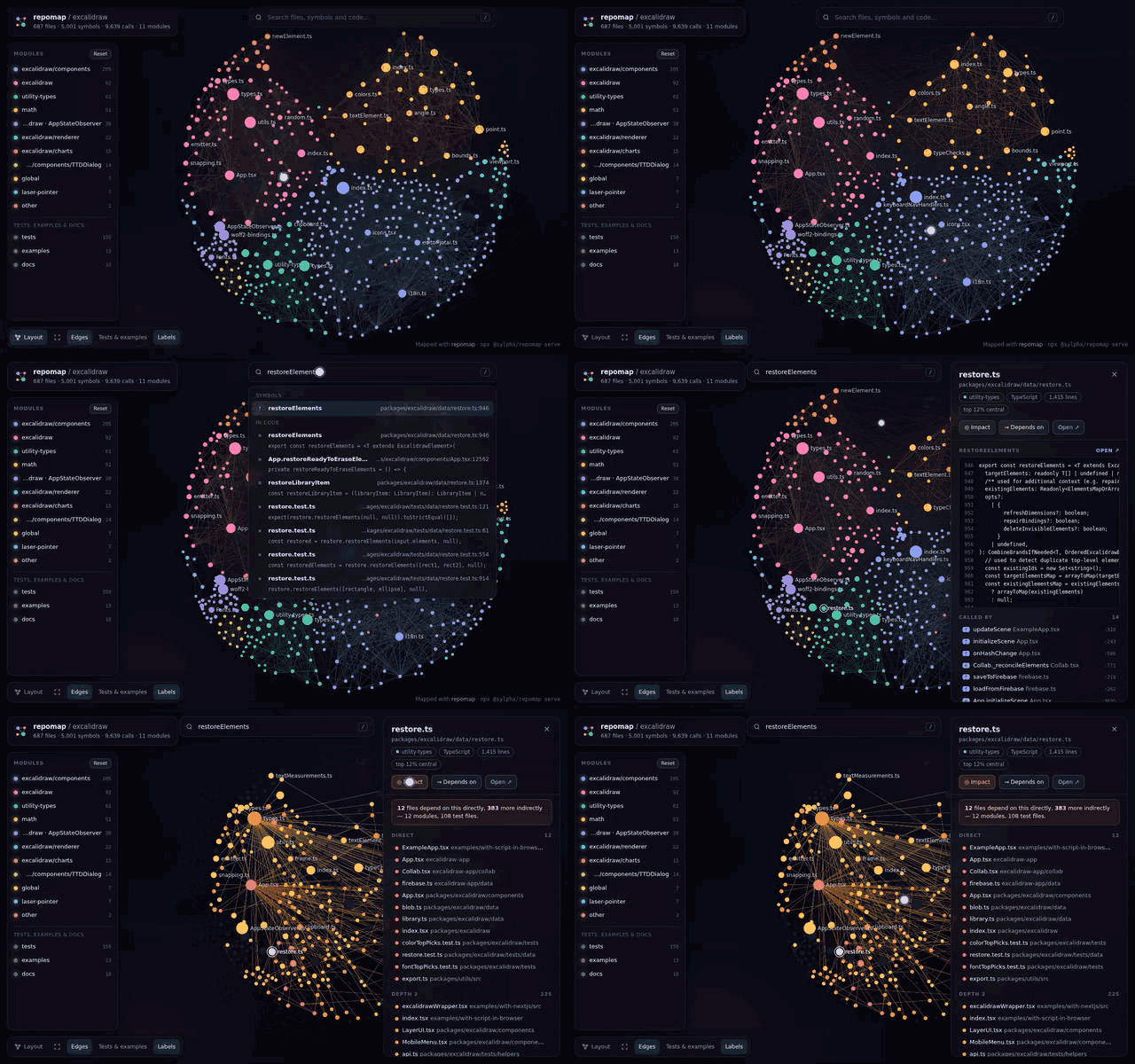
The real UI on excalidraw (687 files, indexed in under half a second): search, a symbol's code and callers, then the blast radius of a change. Try it in your browser, no install needed.
Quickstart
That's it. Add --claude-hooks to also enrich Claude Code's Grep and Glob. setup detects the clients you have, writes their MCP config, and prints every change it made. Run it again and nothing changes. Then ask your agent: "Use repomap to map this repo."
Manual MCP config
Claude Code: claude mcp add repomap -- npx -y @sylphx/repomap mcp
Claude Desktop, one click: download repomap-<version>.mcpb from the latest release, open it, and pick your project folder.
Claude Code plugin: /plugin marketplace add SylphxAI/repomap, then /plugin install repomap@repomap
Codex (~/.codex/config.toml):
Docker (stdio, amd64/arm64):
The server indexes the client's workspace root (or its working directory, or REPOMAP_ROOT). Every tool also takes root.
Why
Agents burn most of their context on grep, ls and reading whole files just to work out where things are. repomap gives them the map up front:
- Where is it? Hybrid search that matches symbol names, the words inside functions and what the code means, with the lines that matched. Ask "where are failed requests retried" or
parseConfig. - What is this? One call returns a symbol's code, callers with call-site lines, callees, subtypes and the tests that reach it.
- How does A reach B? The shortest call path, each hop cited
file:line. - What breaks if I change this? Direct and indirect callers, importing files, modules touched, tests to run, and a risk level. Point it at your
git diffbefore you commit. - What does this repo look like? Modules found from real dependencies (not just folders), the most central files, the most used symbols, and entry points.
All of it comes from a local index: tree-sitter parsing, a resolved import and call graph, PageRank, Louvain communities, BM25 over AST chunks, and a small static code embedding model (33 MB, downloaded once from Hugging Face, then offline). Nothing leaves your machine, and no API is called.
What your agent gets
Six tools, each with an obvious job:
| Tool | Ask it | Returns |
|---|---|---|
map | "Give me the lay of the land" / focus: "src/server" | Modules, central files, key symbols, entry points; an outline with line numbers when focused |
search | "where are failed requests retried", "parseConfig" | Ranked file:line ranges (functions, methods, classes) by keywords, names and meaning, with the matching lines |
context | SessionStore.refresh, src/auth/token.ts, token.ts:42 | Code, callers (with call sites), callees, subtypes, members, imports, importers, tests |
trace | from: handleRequest, to: db.query | Shortest call path, or the call tree above/below a symbol |
impact | target: verifyToken or changed: true | Risk level, callers by depth, importing files, modules, tests to run |
db | table: users, or url_env: DATABASE_URL for a live database | Tables, keys, indexes, and the code (file:line) that queries each table |
Answers are compact text that cites file:line, so they cost few tokens. Pass format: "json" for structured output.
The same commands work in your terminal: repomap map, repomap search "…", repomap context X, repomap trace A B, repomap impact --changed, repomap db.
The graph UI
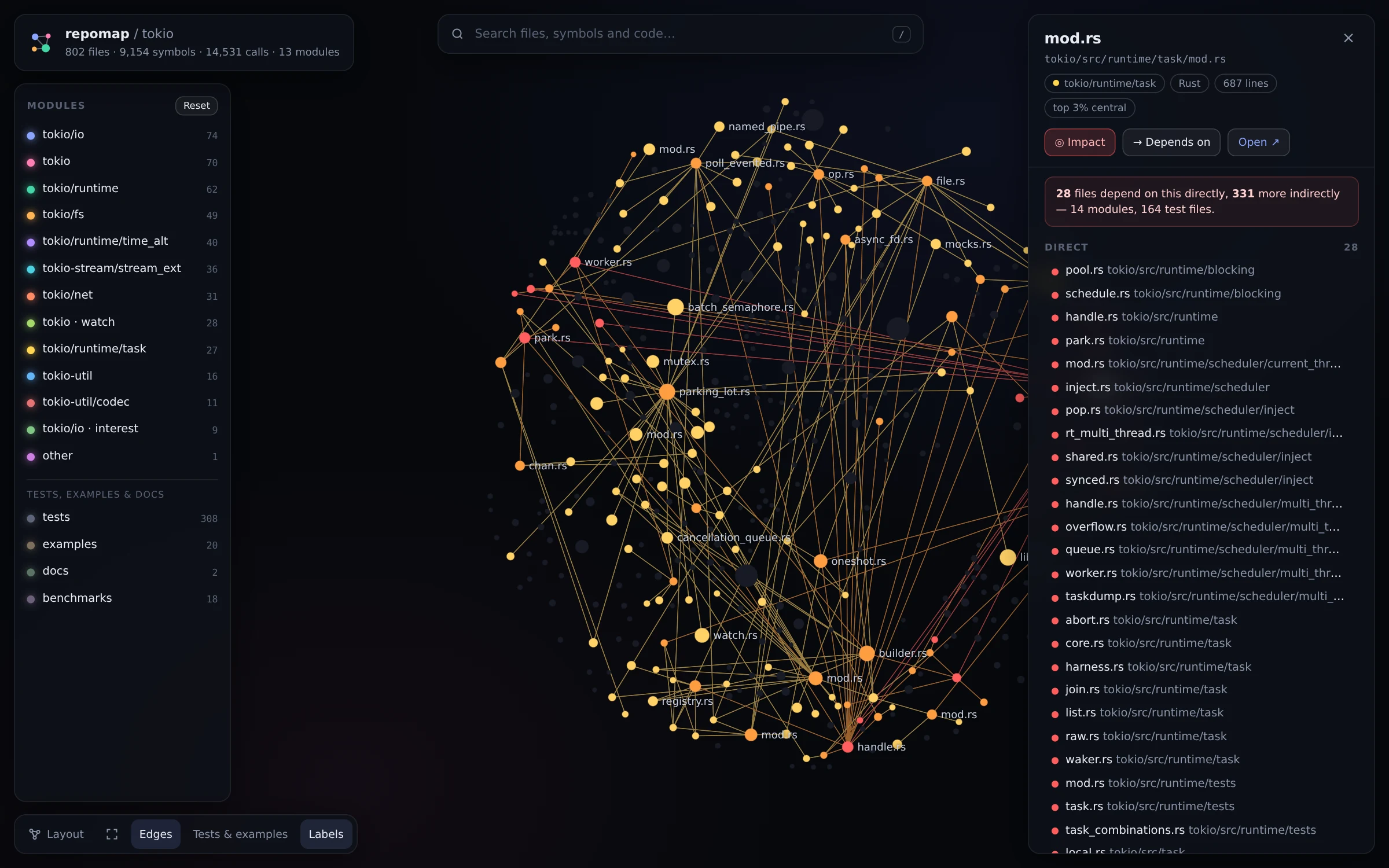 | 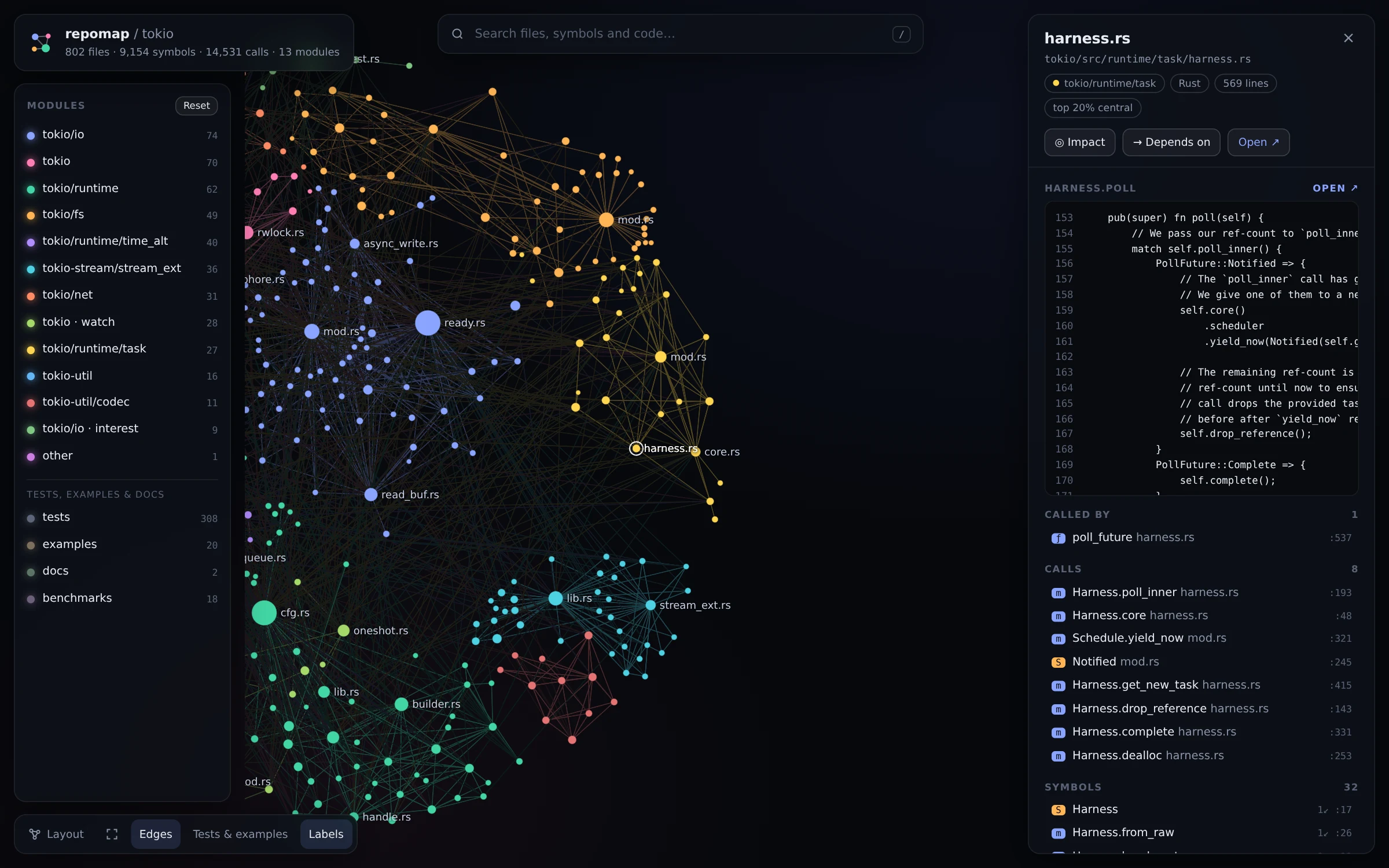 |
| Impact. Select a file and press i: everything that depends on it lights up by depth, with a list you can click through. | Code. Click a symbol to see its source, callers and callees. Open ↗ jumps to your editor or to GitHub. |
- WebGL rendering (Sigma.js) that stays smooth with tens of thousands of files and edges
- Modules coloured and clustered by their real dependencies, file size by PageRank; tests, examples and docs are muted and one click away
- / searches files, symbols and code; d shows dependencies; f fits the view
- Click a module to focus it, Shift-click to hide it; toggle tests, edges and labels
exportwrites one HTML file with deep links (#path/to/file) and GitHub links pinned to your commit. It's a good fit for a README, a wiki or a design review.
Database map
repomap reads your schema from the repository: SQL migrations (applied in order, with down migrations skipped), schema.prisma, Drizzle pgTable/mysqlTable/sqliteTable, SQLAlchemy and Flask-SQLAlchemy models, Diesel table!, and Django models.py (fields, ForeignKey/ManyToManyField, Meta, implicit join tables). It can also introspect a live database. Each table is linked to the code that queries it: raw SQL (FROM users), Prisma (prisma.user.findMany), Diesel (users::table), Django (Post.objects…), and ORM models or tables used by files that import them.
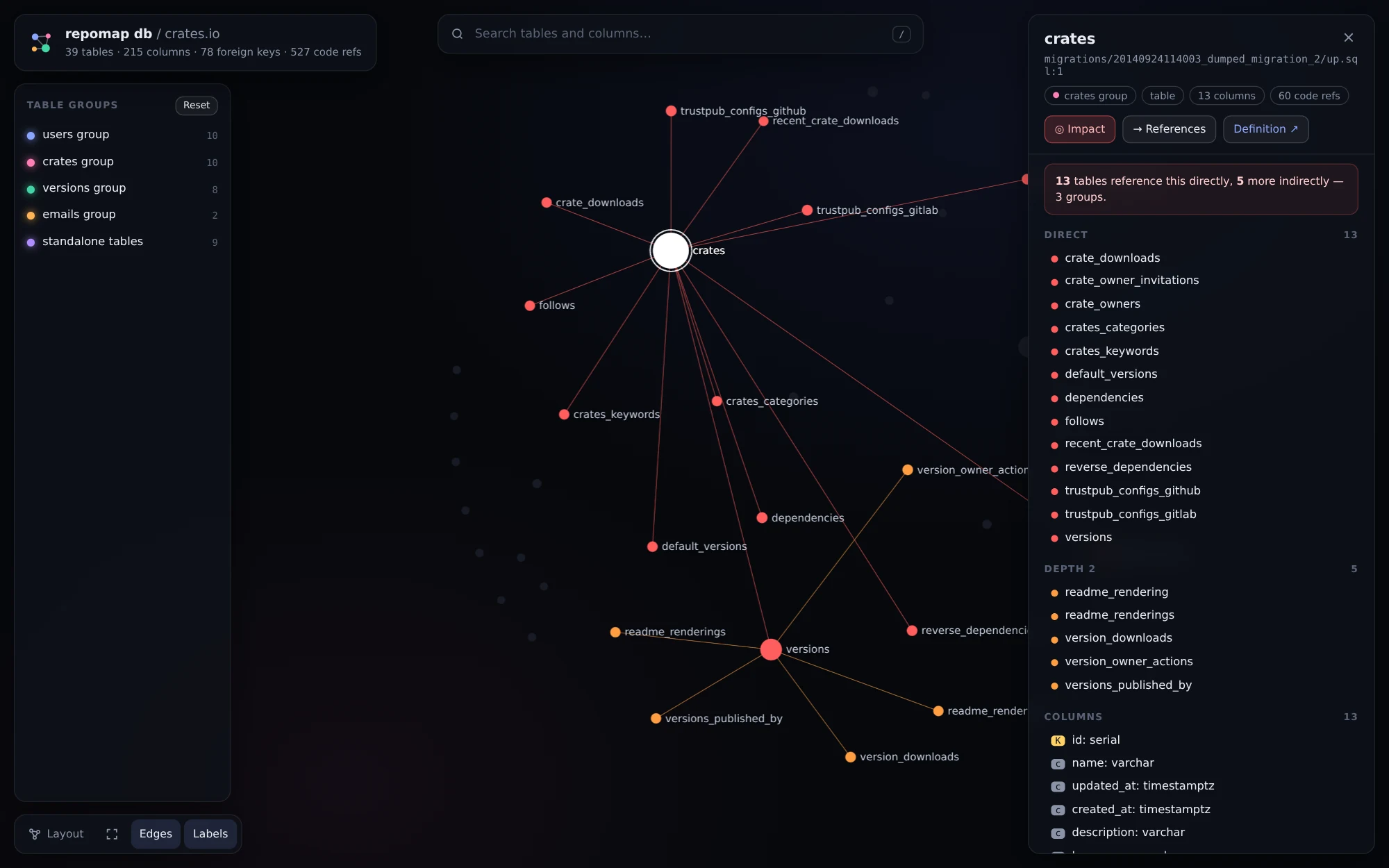
Live connections are strictly read-only:
- Postgres runs in a
READ ONLYtransaction that the server must confirm. - MySQL runs in a
START TRANSACTION READ ONLYtransaction. - SQLite is opened read-only with
query_only.
Only catalog metadata is read, never table rows. The connection string comes from an argument or an environment variable, and it is never stored or printed. Agents get the same data through the db MCP tool; pass url_env rather than the URL itself.
Agent-readiness score
The score rates how well an AI agent can work in the repository, from 0 to 100. It covers eight checks:
- agent instructions (AGENTS.md / CLAUDE.md and how useful they are)
- discoverable build and test commands
- test coverage
- CI
- module boundaries
- file sizes
- docs
- types
Each check that falls short comes with a concrete fix, and the score ends with a badge line for your README. For CI, use --min 70; --update-readme README.md refreshes the badge.
Keep the badge fresh with the GitHub Action:
Claude Code hook
This is opt-in and safe to run again; setup --remove takes it out. It installs a PreToolUse hook: whenever Claude Code runs Grep or Glob, repomap adds where the symbol is defined, who calls it and which module it belongs to. It answers in tens of milliseconds and never blocks the search.
Languages
Parsed with tree-sitter for symbols, calls, imports and inheritance: TypeScript, TSX, JavaScript, Python, Go, Rust, Java, Kotlin, Swift, C, C++, C#, Ruby, PHP. Search also covers Markdown, YAML, TOML, JSON, SQL, shell, Protobuf, GraphQL, HTML/CSS, Vue, Svelte, Scala and more.
Modules are found among your core code only. Tests, examples, docs and benchmarks are grouped separately, so they never name or blur a module.
Import resolution understands relative paths, @/ aliases, npm workspace packages, Python packages and relative imports, Go modules, Rust mod/use/workspace crates, Java/PHP namespaces, C/C++ includes and Ruby require. .gitignore is respected, and so is .repomapignore.
Search that understands the question
On semble's public code-search benchmark (63 repositories, 19 languages, 1,251 questions), repomap's search scores NDCG@10 0.851. semble, a tool built only for search, also scores 0.851 on the same runner. The 137M-parameter CodeRankEmbed model scores 0.839 and plain BM25 0.673. repomap 1.2 scored 0.685.
This needs no GPU, no vector database and no API key. A 33 MB static code model runs on the CPU, next to BM25 and symbol names.
Fast
The index is built in parallel and cached per file, so after the first run only changed files are parsed again. The MCP server keeps the graph in memory and refreshes it when files change.
Measured on a 4 vCPU GitHub-hosted runner (method and full table):
| Repository | Code files | Cold index | Warm index | search p50 | impact p50 |
|---|---|---|---|---|---|
| kubernetes | 11,710 | 13.0 s | 1.9 s | 73 ms | 6 ms |
| vscode | 6,126 | 9.2 s | 1.4 s | 16 ms | 8 ms |
| django | 2,271 | 2.6 s | 0.4 s | 24 ms | 1 ms |
| rust-analyzer | 1,512 | 2.1 s | 0.4 s | 7 ms | 2 ms |
How it compares
| repomap | GitNexus | Serena | claude-context | Aider repo map | |
|---|---|---|---|---|---|
| Licence | MIT | PolyForm Noncommercial | MIT | MIT | Apache-2.0 (inside Aider) |
| Setup | npx … setup, one binary, or a one-click .mcpb | npx, Node | Python + language servers | Vector DB + embedding API key | Part of Aider |
| API key / network | None (model downloaded once) | None for the graph | None | Required (embeddings) | None |
| Code graph (calls, imports, inheritance) | ✅ | ✅ | Via LSP references | — | Ranking only |
| Change impact / blast radius | ✅ incl. git diff | ✅ | — | — | — |
| Call path between two symbols | ✅ | ✅ | — | — | — |
| Search | ✅ names + BM25 + local embeddings | ✅ | ✅ symbols | Semantic (vectors) | — |
| Interactive graph UI | ✅ local + static export | ✅ | — | — | — |
| Claude Code Grep/Glob hook | ✅ opt-in | ✅ | — | — | — |
| Database schema map linked to code | ✅ live (read-only) + migrations/ORMs | — | — | — | — |
| Agent-readiness score + badge | ✅ + GitHub Action | — | — | — | — |
| Module detection | ✅ Louvain | ✅ | — | — | — |
| Edits code | — (read-only) | — | ✅ | — | ✅ |
| Engine | Rust | TypeScript | Python | TypeScript | Python |
Pick Serena if you want LSP-precise refactoring edits. repomap is for understanding and navigating a codebase with zero setup, including semantic search without a vector database or an API key, and a licence you can use at work. Search quality is measured on public benchmarks in Benchmarks.
CLI
Binaries for macOS (arm64, x64), Linux glibc (x64, arm64) and Windows x64 ship as npm optional dependencies. They're also attached to each GitHub release. From source: cargo install --git https://github.com/SylphxAI/repomap repomap.
Migrating from Spine, Locus or CodeRAG
@sylphx/spine, @sylphx/locus and @sylphx/coderag are thin aliases of @sylphx/repomap, and their old tool names still work until 2.0. See the migration guide for the name mapping and how to switch.
Contributing
Issues and PRs are welcome, and new language support is especially useful: add a grammar and a query in crates/repomap-core/src/lang.rs.
Also from Sylphx
- anymd: any file (PDF, Word, PowerPoint, Excel, EPUB, HTML, images) to clean Markdown for AI agents. Rust MCP server + CLI, local.
- lockdocs: exact-version library docs from your lockfile. Local, offline, no rate limits.
- readme-mark: beautiful README images from one URL: banners, shields-compatible badges, icons, stats cards. It serves repomap's agent-ready badge.
Star history
MIT © Sylphx