Codebase map for AI agents: code graph, search, call paths, change impact. Local, no API key.
Quick Install
Automated & IDE SetupCopy the AI prompt to install this server into Claude Code, Cursor, or another agent — or use 1-click editor setup below.
One-click editor setup isn’t available for this listing yet — we don’t have a confirmed install command, and we’d rather show nothing than point your editor at the wrong package or host. Follow the project’s own setup instructions, linked above.
Manual Client & Custom JSON ConfigExpand JSON ▾
No confirmed setup config for this listing yet. We only publish a config block when the install details come from the project itself — its README, its docs, or a verified owner. We haven’t found those for repomap, and we’d rather show nothing than a guess you’d paste into your client. Follow the project’s own setup instructions for the current steps.
Documentation Overview
repomap
**A map of your codebase for AI agents: code graph, search, call paths and change impact. No API key.**Code graph · hybrid search · call paths · change impact · an interactive graph UI.
One Rust binary. Local. No API key. MIT.

Live demo · Docs · Quickstart · Tools · Graph UI · Benchmarks · Compare
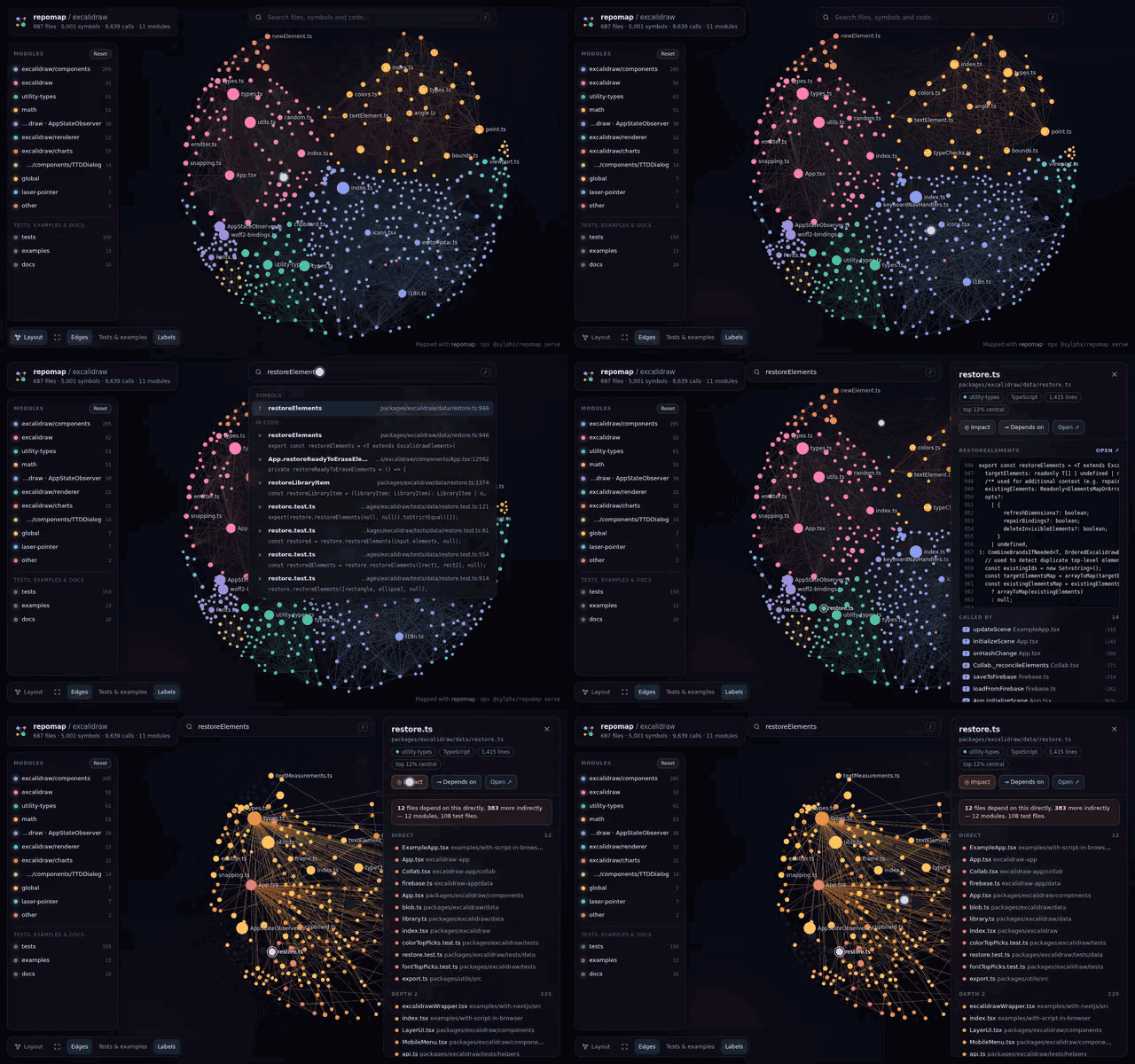
The real UI on excalidraw (687 files, indexed in under half a second): search, a symbol's code and callers, then the blast radius of a change. Try it in your browser, no install needed.
Quickstart
That's it. Add --claude-hooks to also enrich Claude Code's Grep and Glob. setup detects the clients you have, writes their MCP config, and prints every change it made. Run it again and nothing changes. Then ask your agent: "Use repomap to map this repo."
Manual MCP config
Claude Code: claude mcp add repomap -- npx -y @sylphx/repomap mcp
Claude Desktop, one click: download repomap-<version>.mcpb from the latest release, open it, and pick your project folder.
Claude Code plugin: /plugin marketplace add SylphxAI/repomap, then /plugin install repomap@repomap
Codex (~/.codex/config.toml):
Docker (stdio, amd64/arm64):
The server indexes the client's workspace root (or its working directory, or REPOMAP_ROOT). Every tool also takes root.
Why
Agents burn most of their context on grep, ls and reading whole files just to work out where things are. repomap gives them the map up front:
- Where is it? Hybrid search that matches symbol names, the words inside functions and what the code means, with the lines that matched. Ask "where are failed requests retried" or
parseConfig. - What is this? One call returns a symbol's code, callers with call-site lines, callees, subtypes and the tests that reach it.
- How does A reach B? The shortest call path, each hop cited
file:line. - What breaks if I change this? Direct and indirect callers, importing files, modules touched, tests to run, and a risk level. Point it at your
git diffbefore you commit. - What does this repo look like? Modules found from real dependencies (not just folders), the most central files, the most used symbols, and entry points.
All of it comes from a local index: tree-sitter parsing, a resolved import and call graph, PageRank, Louvain communities, BM25 over AST chunks, and a small static code embedding model (33 MB, downloaded once from Hugging Face, then offline). Nothing leaves your machine, and no API is called.
What your agent gets
Six tools, each with an obvious job:
| Tool | Ask it | Returns |
|---|---|---|
map | "Give me the lay of the land" / focus: "src/server" | Modules, central files, key symbols, entry points; an outline with line numbers when focused |
search | "where are failed requests retried", "parseConfig" | Ranked file:line ranges (functions, methods, classes) by keywords, names and meaning, with the matching lines |
context | SessionStore.refresh, src/auth/token.ts, token.ts:42 | Code, callers (with call sites), callees, subtypes, members, imports, importers, tests |
trace | from: handleRequest, to: db.query | Shortest call path, or the call tree above/below a symbol |
impact | target: verifyToken or changed: true | Risk level, callers by depth, importing files, modules, tests to run |
db | table: users, or url_env: DATABASE_URL for a live database | Tables, keys, indexes, and the code (file:line) that queries each table |
Answers are compact text that cites file:line, so they cost few tokens. Pass format: "json" for structured output.
The same commands work in your terminal: repomap map, repomap search "…", repomap context X, repomap trace A B, repomap impact --changed, repomap db.
The graph UI
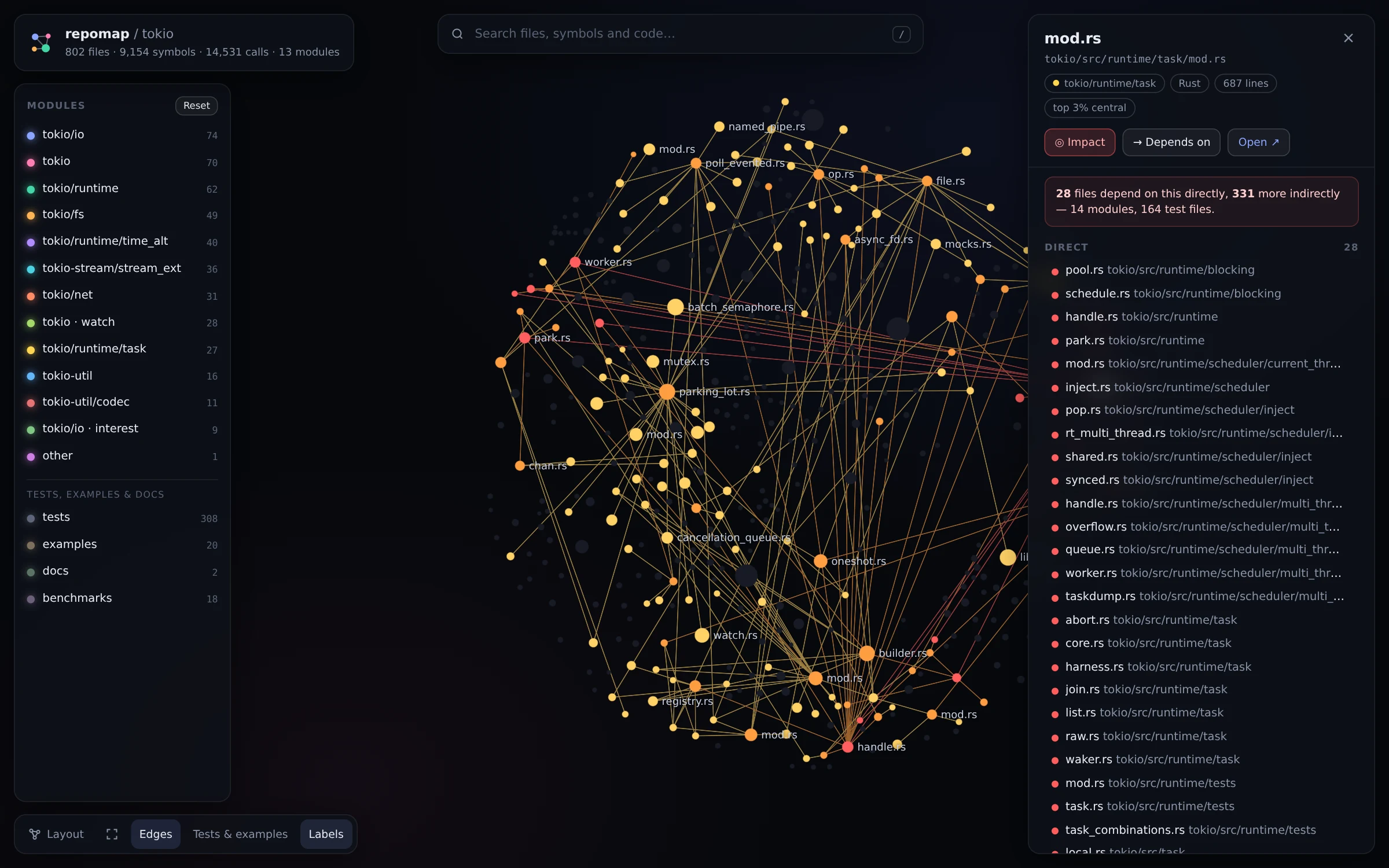 | 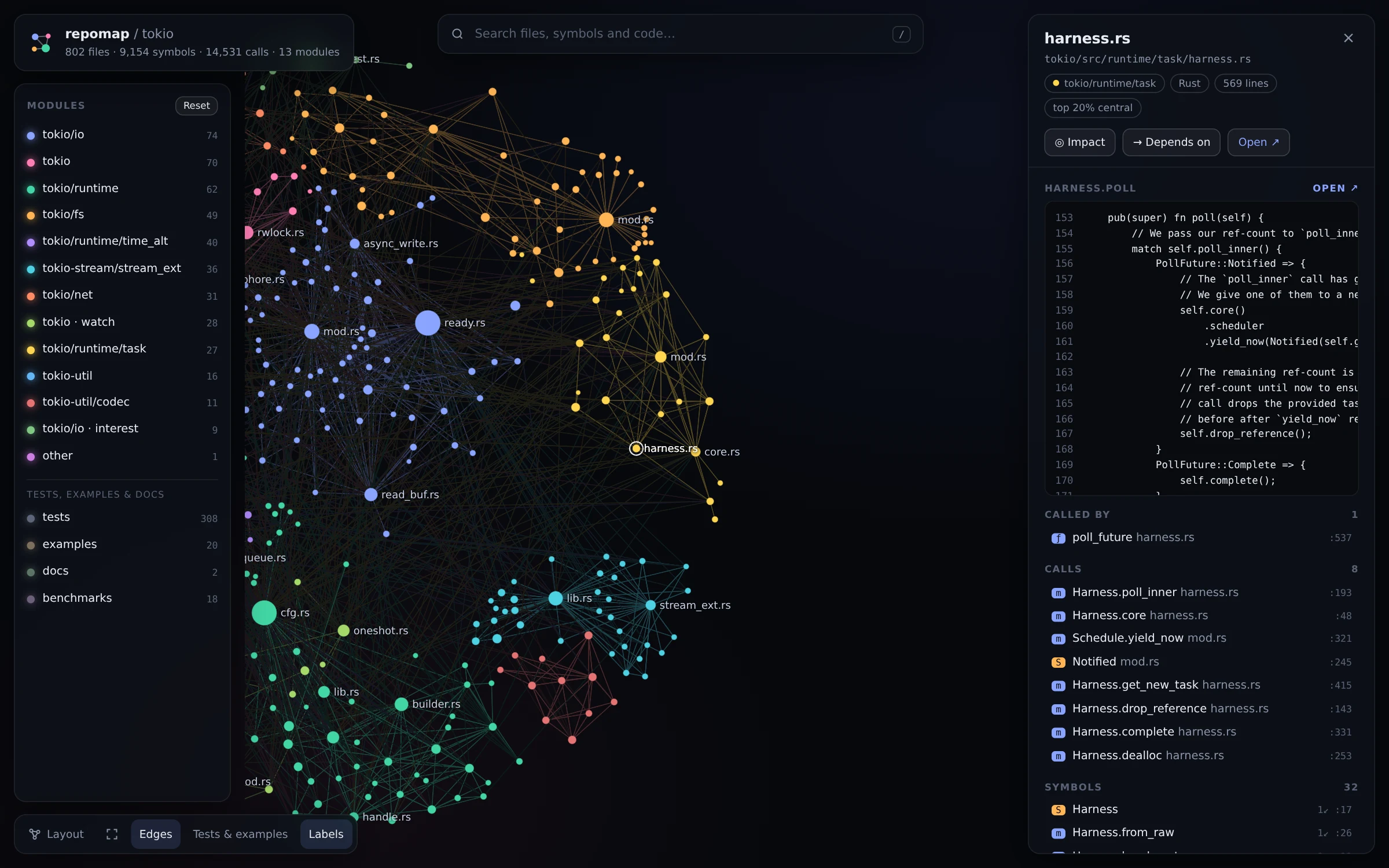 |
| Impact. Select a file and press i: everything that depends on it lights up by depth, with a list you can click through. | Code. Click a symbol to see its source, callers and callees. Open ↗ jumps to your editor or to GitHub. |
- WebGL rendering (Sigma.js) that stays smooth with tens of thousands of files and edges
- Modules coloured and clustered by their real dependencies, file size by PageRank; tests, examples and docs are muted and one click away
- / searches files, symbols and code; d shows dependencies; f fits the view
- Click a module to focus it, Shift-click to hide it; toggle tests, edges and labels
exportwrites one HTML file with deep links (#path/to/file) and GitHub links pinned to your commit. It's a good fit for a README, a wiki or a design review.
Database map
repomap reads your schema from the repository: SQL migrations (applied in order, with down migrations skipped), schema.prisma, Drizzle pgTable/mysqlTable/sqliteTable, SQLAlchemy and Flask-SQLAlchemy models, Diesel table!, and Django models.py (fields, ForeignKey/ManyToManyField, Meta, implicit join tables). It can also introspect a live database. Each table is linked to the code that queries it: raw SQL (FROM users), Prisma (prisma.user.findMany), Diesel (users::table), Django (Post.objects…), and ORM models or tables used by files that import them.
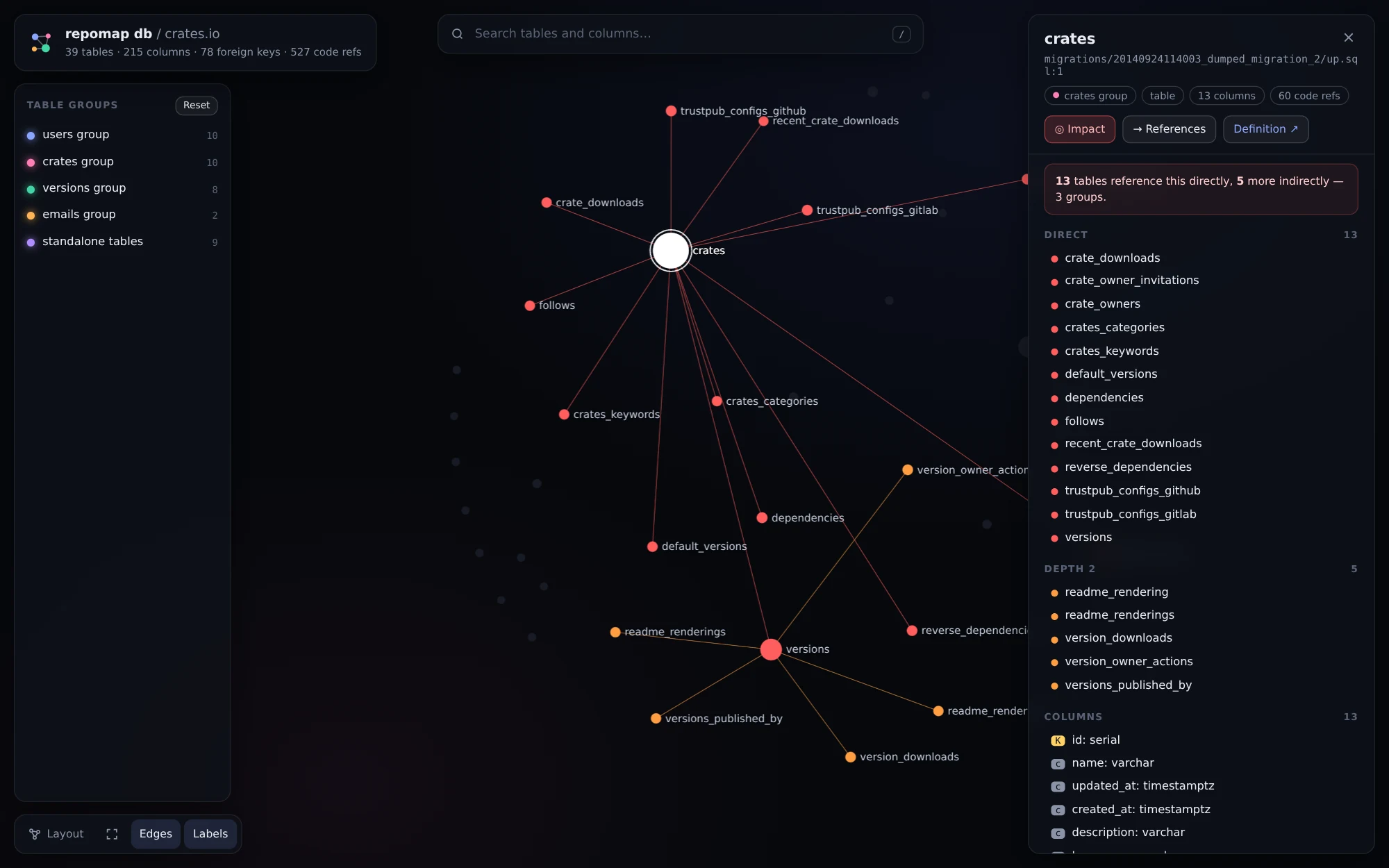
Live connections are strictly read-only:
- Postgres runs in a
READ ONLYtransaction that the server must confirm. - MySQL runs in a
START TRANSACTION READ ONLYtransaction. - SQLite is opened read-only with
query_only.
Only catalog metadata is read, never table rows. The connection string comes from an argument or an environment variable, and it is never stored or printed. Agents get the same data through the db MCP tool; pass url_env rather than the URL itself.
Agent-readiness score
The score rates how well an AI agent can work in the repository, from 0 to 100. It covers eight checks:
- agent instructions (AGENTS.md / CLAUDE.md and how useful they are)
- discoverable build and test commands
- test coverage
- CI
- module boundaries
- file sizes
- docs
- types
Each check that falls short comes with a concrete fix, and the score ends with a badge line for your README. For CI, use --min 70; --update-readme README.md refreshes the badge.
Keep the badge fresh with the GitHub Action:
Related MCP Servers
Reviews
No reviews yet — be the first to share how this listing worked for you.
Frequently Asked Questions about Repomap
AllMCPs Directory Badge
Showcase your server listing on GitHub or your project documentation. Embed this dynamic SVG badge to highlight official listing status and live engagement.
Badge Style:
Live Dynamic SVG Preview
Markdown (GitHub README)
[](https://allmcps.com/mcp/repomap)HTML Embed
<a href="https://allmcps.com/mcp/repomap"><img src="https://allmcps.com/api/badge/repomap?style=directory" alt="Repomap on AllMCPs" /></a>