Regex Le README
The full upstream README, mirrored here for reference. Install config, tool schemas, adoption signals, and an original overview live on the Regex Le listing page.

Regex-LE: Zero Hassle Regex Extraction & Validation
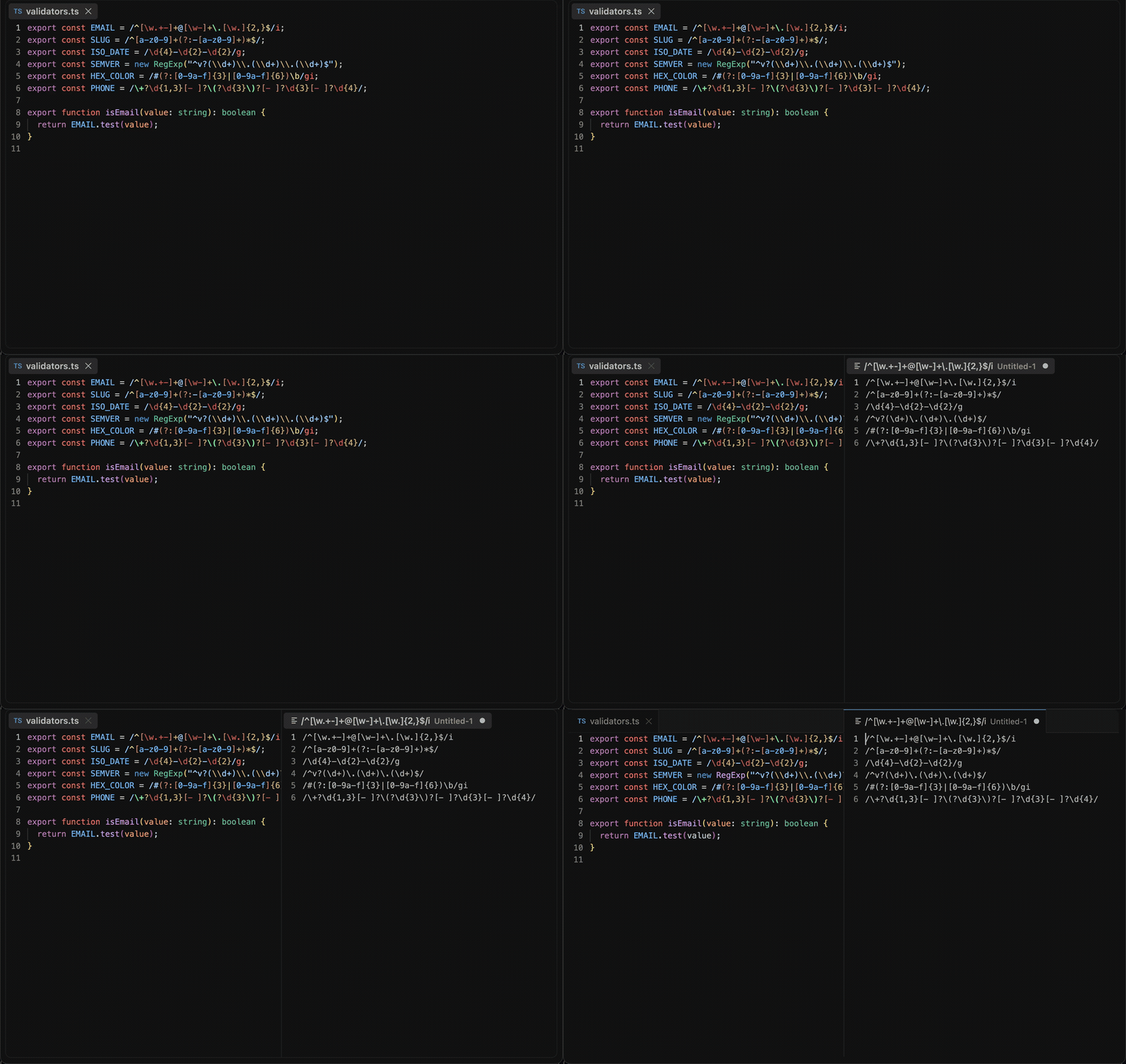
Find, test, and validate the regex patterns in the current file
Literal patterns, RegExp constructors, ReDoS screening




Useful? A star or rating is how other developers find it — ★ GitHub · ★ Open VSX · ★ Marketplace
What it does
Open any file and run one of three commands. Extract lists every regex pattern found in the document. Test (Ctrl+Alt+R / Cmd+Alt+R) runs a found — or manually entered — pattern against the file content and reports matches with real line/column positions and capture groups (named groups included). Validate checks every found pattern for syntax errors and screens it for catastrophic backtracking, reporting the input that causes it. Works in VS Code and VS Code–based editors like Cursor and VSCodium (installable from Open VSX).
Install
| Where | What you get | Install |
|---|---|---|
| VS Code | The lint and the tester, in your editor | Marketplace |
| Cursor, VSCodium, Windsurf | The same extension | Open VSX |
| A terminal or a CI step | The same run over a whole tree, with exit codes | cargo install regex-le · crates.io |
| Any MCP agent, via Node | extract_patterns over stdio | npx regex-le-mcp · npm |
| Zed | The MCP server as a context server | add it by hand (no listing yet) |
Use it from an AI agent
The same engine runs as an MCP server, so an agent can call it directly instead of you running a command.
| Editor | How |
|---|---|
| VS Code 1.101+ | Nothing to install — the extension registers extract_patterns with agent mode |
| Zed | No listing yet — add the MCP server by hand |
| Claude Code | claude mcp add regex-le -- npx -y regex-le-mcp |
| Cursor, Windsurf, anything else | point it at npx regex-le-mcp |
Returns every pattern with its flags, 1-based position and a ReDoS verdict, so "are any of the regexes in this file dangerous?" is one call rather than two. A verdict that reports a blow-up carries the witness that caused it, so an agent can check the finding instead of trusting it.
The server takes content and returns data — it reads no files and makes no network requests of its own. Published as regex-le-mcp on npm and as io.github.nolindnaidoo/regex-le in the MCP registry.
Configuring it by hand — any host with an MCP config file
Most hosts read a JSON config. Add one entry:
-y skips the install prompt on first run. Pin a version if you would rather not track releases — regex-le-mcp@2.4.0.
Prefer not to go through npx on every launch? Install it once and point at the binary instead:
It speaks MCP over stdio and needs no environment variables, no API key and no configuration of its own. To check it before wiring it into anything:
That prints the tool list and exits — if you see extract_patterns, the server works.
What gets extracted
Extraction scans the whole document, so constructors split across lines are found too. The document's language chooses which spellings to look for:
| Language | Form | Example |
|---|---|---|
| JavaScript, TypeScript, Ruby | Literal | /[a-z]+/gi |
| JavaScript, TypeScript | Constructor | new RegExp('\\d{4}-\\d{2}', 'g') — including multiline |
| JavaScript, TypeScript | Bare constructor call | RegExp("x|y", "i") |
| Python | re.compile and friends | re.compile(r'(a+)+') |
| Rust | Regex::new, RegexBuilder::new | Regex::new(r"(a+)+") |
| Go | regexp.MustCompile, regexp.Compile | regexp.MustCompile(`(a+)+`) |
| Java | Pattern.compile, Pattern.matches | Pattern.compile("(a+)+") |
| Ruby | Regexp.new | Regexp.new('(a+)+') |
| PHP | preg_match and friends | preg_match('/(a+)+/i', $s) |
| C# | new Regex(…), Regex.IsMatch and friends | new Regex(@"(a+)+") |
A language nothing recognises is not a refusal — every spelling above is looked for. Naming it buys precision: a Python file is not scanned for bare /…/, so #!/usr/bin/env python stops reading as a pattern.
What is deliberately not extracted:
- Division, dates, and filesystem paths (
a / b,10/29/2025,/usr/local/bin): a/preceded by an identifier, number,),],., or another/is not treated as a regex — after keywords likereturn, it is. That question is only asked where a bare/…/is legal. - Candidates that are not a well-formed regular expression in any of these languages, or with invalid/duplicate flags. Another language's spelling is not a syntax error:
re.compile(r'(?P<word>\w+)+@')is reported as written, and still flagged. - Constructor calls whose pattern argument is a variable or template literal (only literal string arguments are visible to a text scanner).
- Flags, on anything but a JavaScript literal or constructor: every other language sets them with constants, builder methods or an inline
(?i)rather than a string argument. - Anything written in a comment or a string. A JSDoc block explaining a hazard, a commented-out line, a Python docstring with an example — none of them is code, and reporting one fails a build over a sentence. The rule is about where a candidate starts, so
re.compile(r"(a+)+b")keeps its quoted argument while a docstring holding that whole line is prose. Only when the language is known: a document nothing recognises is scanned as written, because a comment rule guessed from the wrong grammar would drop real patterns instead of phantom ones.
Duplicate pattern+flags pairs are listed once. This is lexing by heuristic, not a parser for nine languages: a slash inside a string can still be picked up when its context looks expression-like.
ReDoS screening
Validate (and Test, before running a risky pattern) reports a pattern only when an input was found that demonstrably drives it into catastrophic backtracking — and reports that input alongside it, as the witness.
Your pattern is never run. It is compiled to an automaton, and that automaton is walked the way a backtracking engine walks one — depth-first, every edge in order, a dead end unwound rather than remembered — while the steps are counted. An attack string is built, pumped at two lengths, and measured against a step budget. So a finding is falsifiable: run the witness and watch.
Nothing is reported on the strength of how a pattern is shaped. Shape is a poor predictor in both directions: ^[a-z0-9]+(?:-[a-z0-9]+)*$ looks dangerous and is not, because every iteration must eat a - the inner class cannot produce, while (.*a){20} looks bounded and is not. A separator forcing the split is a fact about strings, so no test on syntax settles it.
Silence is not a clearance. A pattern this cannot read — a backreference, lookaround, syntax it does not parse — comes back as not decided: <reason>, never as safe.
The reports also include a rough performance score based on execution time relative to input size — treat it as a hint, not a benchmark (memory is not measured).
The CLI
The same lint runs from a terminal or a shell pipeline: a Rust CLI in
crate/, sharing one corpus with the extension —
crate/fixtures/ — so the two can never read a
document differently.
Exit codes: 0 nothing vulnerable, 1 at least one finding, 2 the
question was malformed — so regex-le . || exit 1 is a CI gate.
It ports the lint half, not the tester. Running a pattern against your text with JavaScript semantics needs a JavaScript engine, and getting it nearly right would mean the two frontends reporting different matches for the same pattern. Testing is an editor activity; keep it here. The lint needs no engine at all — the ReDoS verdict walks an automaton built from the pattern text, under a step budget — which is what makes it a cheap deterministic CI step.
It reports what it can demonstrate and refuses what it cannot read, exactly as the screening in this extension does.
Commands
| Command | Description |
|---|---|
Regex-LE: Test Regex (Ctrl+Alt+R / Cmd+Alt+R) | Test a found or entered pattern against the file |
Regex-LE: Extract Patterns | List every regex pattern found in the document |
Regex-LE: Validate Regex | Syntax + ReDoS report for every found pattern |
Regex-LE: Open Settings | Open Regex-LE settings |
Regex-LE: Help & Troubleshooting | Built-in documentation |
Settings
| Setting | Default | Description |
|---|---|---|
regex-le.openResultsSideBySide | true | Open results beside the current editor |
regex-le.copyToClipboardEnabled | false | Also copy results to the clipboard |
regex-le.notificationsLevel | silent | all = every notification, important = warnings + errors, silent = errors only |
regex-le.safety.enabled | true | Guardrails for very large files and outputs |
regex-le.safety.fileSizeWarnBytes | 1000000 | Refuse processing above this file size |
regex-le.safety.largeOutputLinesThreshold | 50000 | Refuse result documents above this line count |
regex-le.statusBar.enabled | true | Show the status bar item |
regex-le.telemetryEnabled | false | Local-only event log (see Privacy) |
regex-le.regex.redosDetectionEnabled | true | ReDoS screening in Test/Validate |
regex-le.regex.maxMatchLimit | 1000 | Cap on matches collected per test (10–10000) |
Languages
Twelve languages besides English:
German · Spanish · French · Indonesian · Italian · Japanese · Korean · Portuguese (Brazil) · Russian · Ukrainian · Vietnamese · Chinese (Simplified)
Both halves are covered — the manifest (command titles, setting names and descriptions) and everything shown while the extension runs (notifications, the status bar, quick-picks and prompts). The extension follows VS Code's display language, so it matches whatever the editor is already set to; no setting of its own.
Privacy & security
- No network access. The extension never sends data anywhere. The
telemetryEnabledsetting only writes events to a local Output Channel you can inspect (Regex-LE Telemetry). - Testing a pattern the ReDoS screen rates high-severity asks for confirmation first.
- The MCP server holds the same line. It takes content as an argument and returns data: no filesystem access, no network calls, no telemetry. Your agent already has file-read tools, so duplicating them inside the server would add a path-traversal surface for no capability.
check:mcp-bundlefails the build if the server ever imports something that could reach either. - Error notifications redact home directories and credential-shaped fragments.
Documentation
| What | Where |
|---|---|
| What the tool is allowed to say — scope, output contract, refusals, non-goals | crate/SPEC.md |
| How the extension is built and held together — architecture, invariants, toolchain, release | AGENTS.md |
| How the CLI is built and held together | crate/AGENTS.md |
| What changed | CHANGELOG.md · crate/CHANGELOG.md |
| The tool's page, and the other fifteen | letools.dev/tools/regex-le |
Performance
| Input | Size | Found | Time | Rate | Scan speed |
|---|---|---|---|---|---|
| JS with literals | 1.12 MB | 25,000 | 44.19 ms | 565,679/sec | 25.4 MB/s |
| JS with constructors | 1.27 MB | 25,000 | 41.86 ms | 597,268/sec | 30.3 MB/s |
| Source without regexes | 1.24 MB | 0 | 18.75 ms | — | 66 MB/s |
Median of 7 runs after warmup, on Apple M5 Pro, 24 GB RAM, Node 24.3.0. Inputs are generated
by scripts/benchmark.ts rather than checked in, so the sizes above are
exactly what was measured. Reproduce with bun run benchmark.
These are machine-specific and are not asserted in CI — a benchmark that gates a build only tells you how busy the runner was.
Testing
| Metric | Coverage |
|---|---|
| Statements | 92.32% |
| Branches | 79.83% |
| Functions | 97.94% |
| Lines | 94.56% |
260 test cases across 17 files, plus an integration suite that runs
in a real VS Code extension host and an end-to-end test that installs the
built .vsix into a clean profile.
Generated from a real run — coverage/coverage-summary.json and
coverage/test-results.json — by scripts/coverage-readme.js; CI fails if
this section drifts. Reproduce with bun run test:coverage, and the case
count is the one vitest prints.
More from the LE family
Sixteen single-purpose tools for the work in front of every model. Each ships a Rust CLI and an MCP server. One page: letools.dev
Get it out
- String-LE — Extract every string in a codebase, with its position, so a person can read them
- Numbers-LE — Extract every hardcoded number in a codebase, so a person can check them
- Units-LE — Extract every quantity with its unit, normalized, and refuse the ambiguous ones by name
- Dates-LE — Extract every date and timestamp, and the exact instant each one resolves to
- IDs-LE — Extract every UUID, ULID, NanoID, ObjectId and Snowflake, and decode the time inside
- IPs-LE — Extract every IP address, CIDR block and MAC, normalized and classified by scope
- URLs-LE — Extract every URL in a codebase, with its protocol and exact position
- Paths-LE — Extract every file path in a codebase, and say whether it still points at anything
- Colors-LE — Extract every color in a codebase, and say which ones are not in your palette
Check it
- Regex-LE — Find every regex in a codebase, and report which can be driven into catastrophic backtracking
- Versions-LE — Find where one dependency is constrained differently across a repository's manifests
- i18n-LE — Identify the i18n library a project uses, then audit its catalogs by that library's rules
- Scrape-LE — Check whether a page is scrapeable before the scraper is written, and say when it cannot tell
Guard it
- Secrets-LE — Find hardcoded credentials in a codebase, and never print one into the report
- EnvSync-LE — Compare the dotenv files in a tree, and say which keys are missing from which
- Unicode-LE — Find the Unicode that hides meaning — bidi controls, invisibles, homoglyphs, mixed scripts
Each stands on its own: no shared crate, no published core. Where two of them agree, it is because the same answer was right twice.
Contact — nolindnaidoo.com · GitHub · LinkedIn
Also by nolindnaidoo
Rust — pixelcoords and pixelactions are one loop: pixelcoords answers where, pixelactions acts there. Their own tools, their own voice — not part of the LE family.
- pixelcoords — Freeze your screen, mark regions, get pixel-exact coordinates and crops pixelcoords.dev · crates.io · docs.rs
- pixelactions — Consume human-verified coordinates, perform the interaction, confirm it landed pixelactions.dev · crates.io · docs.rs
License
MIT © nolindnaidoo