Extract regular expressions from code, each with a ReDoS safety verdict.
Quick Install
Automated & IDE SetupCopy the AI prompt to install this server into Claude Code, Cursor, or another agent — or use 1-click editor setup below.
Manual Client & Custom JSON ConfigExpand JSON ▾
Client Config & Setup
Choose your client or environment
Target File:
💡 Paste the JSON block into your client's configuration file under mcpServers, then restart the application.
Documentation Overview

Regex-LE: Zero Hassle Regex Extraction & Validation
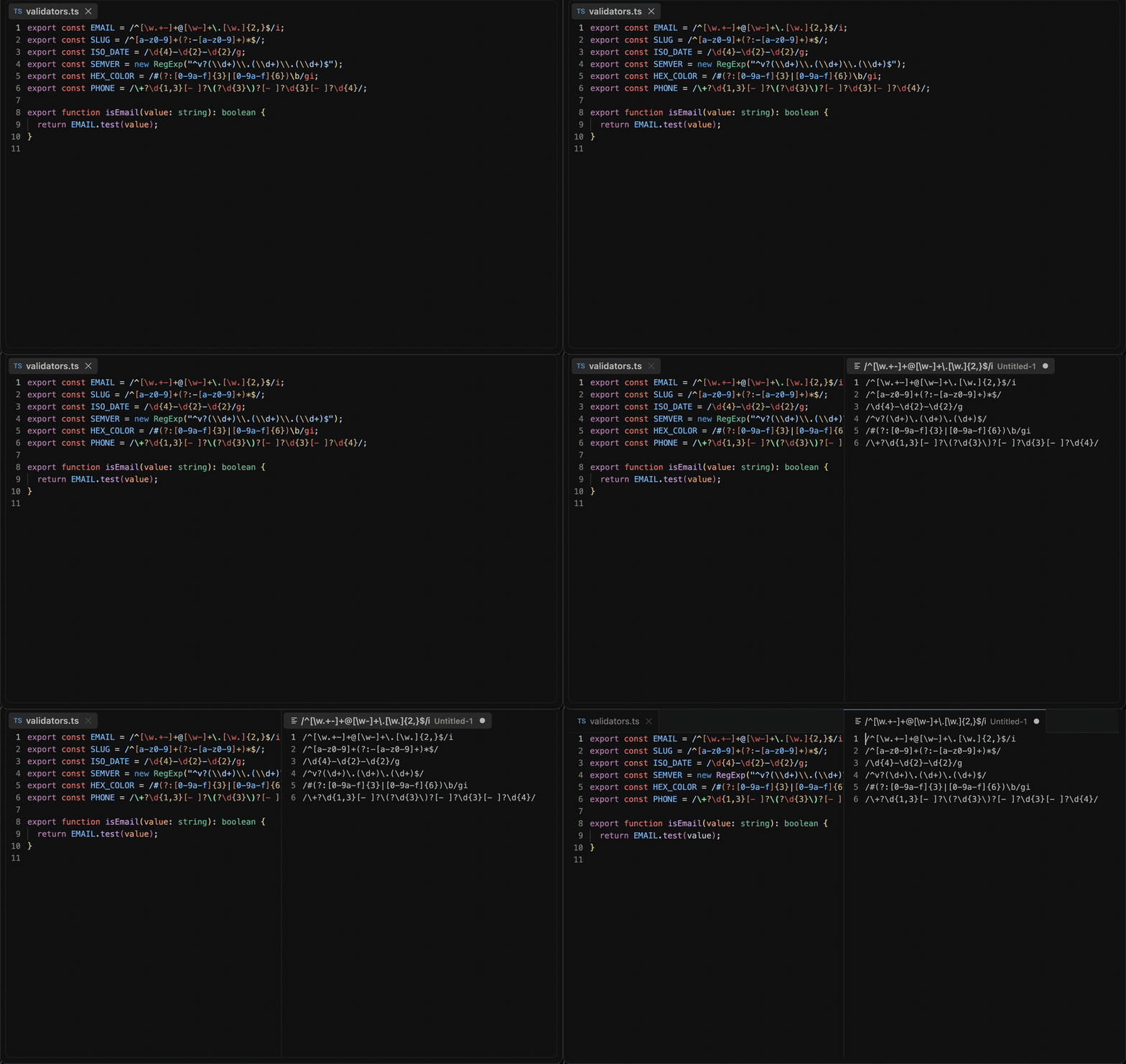
Find, test, and validate the regex patterns in the current file
Literal patterns, RegExp constructors, ReDoS screening




Useful? A star or rating is how other developers find it — ★ GitHub · ★ Open VSX · ★ Marketplace
What it does
Open any file and run one of three commands. Extract lists every regex pattern found in the document. Test (Ctrl+Alt+R / Cmd+Alt+R) runs a found — or manually entered — pattern against the file content and reports matches with real line/column positions and capture groups (named groups included). Validate checks every found pattern for syntax errors and screens it for catastrophic backtracking, reporting the input that causes it. Works in VS Code and VS Code–based editors like Cursor and VSCodium (installable from Open VSX).
Install
| Where | What you get | Install |
|---|---|---|
| VS Code | The lint and the tester, in your editor | Marketplace |
| Cursor, VSCodium, Windsurf | The same extension | Open VSX |
| A terminal or a CI step | The same run over a whole tree, with exit codes | cargo install regex-le · crates.io |
| Any MCP agent, via Node | extract_patterns over stdio | npx regex-le-mcp · npm |
| Zed | The MCP server as a context server | add it by hand (no listing yet) |
Use it from an AI agent
The same engine runs as an MCP server, so an agent can call it directly instead of you running a command.
| Editor | How |
|---|---|
| VS Code 1.101+ | Nothing to install — the extension registers extract_patterns with agent mode |
| Zed | No listing yet — add the MCP server by hand |
| Claude Code | claude mcp add regex-le -- npx -y regex-le-mcp |
| Cursor, Windsurf, anything else | point it at npx regex-le-mcp |
Returns every pattern with its flags, 1-based position and a ReDoS verdict, so "are any of the regexes in this file dangerous?" is one call rather than two. A verdict that reports a blow-up carries the witness that caused it, so an agent can check the finding instead of trusting it.
The server takes content and returns data — it reads no files and makes no network requests of its own. Published as regex-le-mcp on npm and as io.github.nolindnaidoo/regex-le in the MCP registry.
Configuring it by hand — any host with an MCP config file
Most hosts read a JSON config. Add one entry:
-y skips the install prompt on first run. Pin a version if you would rather not track releases — regex-le-mcp@2.4.0.
Prefer not to go through npx on every launch? Install it once and point at the binary instead:
It speaks MCP over stdio and needs no environment variables, no API key and no configuration of its own. To check it before wiring it into anything:
That prints the tool list and exits — if you see extract_patterns, the server works.
What gets extracted
Extraction scans the whole document, so constructors split across lines are found too. The document's language chooses which spellings to look for:
| Language | Form | Example |
|---|---|---|
| JavaScript, TypeScript, Ruby | Literal | /[a-z]+/gi |
| JavaScript, TypeScript | Constructor | new RegExp('\\d{4}-\\d{2}', 'g') — including multiline |
| JavaScript, TypeScript | Bare constructor call | RegExp("x|y", "i") |
| Python | re.compile and friends | re.compile(r'(a+)+') |
| Rust | Regex::new, RegexBuilder::new | Regex::new(r"(a+)+") |
| Go | regexp.MustCompile, regexp.Compile | regexp.MustCompile(`(a+)+`) |
| Java | Pattern.compile, Pattern.matches | Pattern.compile("(a+)+") |
| Ruby | Regexp.new | Regexp.new('(a+)+') |
| PHP | preg_match and friends | preg_match('/(a+)+/i', $s) |
| C# | new Regex(…), Regex.IsMatch and friends | new Regex(@"(a+)+") |
A language nothing recognises is not a refusal — every spelling above is looked for. Naming it buys precision: a Python file is not scanned for bare /…/, so #!/usr/bin/env python stops reading as a pattern.
What is deliberately not extracted:
- Division, dates, and filesystem paths (
a / b,10/29/2025,/usr/local/bin): a/preceded by an identifier, number,),],., or another/is not treated as a regex — after keywords likereturn, it is. That question is only asked where a bare/…/is legal. - Candidates that are not a well-formed regular expression in any of these languages, or with invalid/duplicate flags. Another language's spelling is not a syntax error:
re.compile(r'(?P<word>\w+)+@')is reported as written, and still flagged. - Constructor calls whose pattern argument is a variable or template literal (only literal string arguments are visible to a text scanner).
- Flags, on anything but a JavaScript literal or constructor: every other language sets them with constants, builder methods or an inline
(?i)rather than a string argument. - Anything written in a comment or a string. A JSDoc block explaining a hazard, a commented-out line, a Python docstring with an example — none of them is code, and reporting one fails a build over a sentence. The rule is about where a candidate starts, so
re.compile(r"(a+)+b")keeps its quoted argument while a docstring holding that whole line is prose. Only when the language is known: a document nothing recognises is scanned as written, because a comment rule guessed from the wrong grammar would drop real patterns instead of phantom ones.
Duplicate pattern+flags pairs are listed once. This is lexing by heuristic, not a parser for nine languages: a slash inside a string can still be picked up when its context looks expression-like.
ReDoS screening
Validate (and Test, before running a risky pattern) reports a pattern only when an input was found that demonstrably drives it into catastrophic backtracking — and reports that input alongside it, as the witness.
Your pattern is never run. It is compiled to an automaton, and that automaton is walked the way a backtracking engine walks one — depth-first, every edge in order, a dead end unwound rather than remembered — while the steps are counted. An attack string is built, pumped at two lengths, and measured against a step budget. So a finding is falsifiable: run the witness and watch.
Nothing is reported on the strength of how a pattern is shaped. Shape is a poor predictor in both directions: ^[a-z0-9]+(?:-[a-z0-9]+)*$ looks dangerous and is not, because every iteration must eat a - the inner class cannot produce, while (.*a){20} looks bounded and is not. A separator forcing the split is a fact about strings, so no test on syntax settles it.
Silence is not a clearance. A pattern this cannot read — a backreference, lookaround, syntax it does not parse — comes back as not decided: <reason>, never as safe.
The reports also include a rough performance score based on execution time relative to input size — treat it as a hint, not a benchmark (memory is not measured).
The CLI
The same lint runs from a terminal or a shell pipeline: a Rust CLI in
crate/, sharing one corpus with the extension —
crate/fixtures/ — so the two can never read a
document differently.
Related MCP Servers
Reviews
No reviews yet — be the first to share how this listing worked for you.
Frequently Asked Questions about Regex Le
AllMCPs Directory Badge
Showcase your server listing on GitHub or your project documentation. Embed this dynamic SVG badge to highlight official listing status and live engagement.
Badge Style:
Live Dynamic SVG Preview
Markdown (GitHub README)
[](https://allmcps.com/mcp/regex-le)HTML Embed
<a href="https://allmcps.com/mcp/regex-le"><img src="https://allmcps.com/api/badge/regex-le?style=directory" alt="Regex Le on AllMCPs" /></a>Technical Specs & Signals
CategoryDeveloper Tools
27Quality signal: Emerging · 27/100How this signal is calculated ▾
Server availabilityNot measured
Not scored for repo-hosted servers — we can't reach the running server, only its GitHub page. Hosted MCP endpoints are health-checked live.
Verified ownership8/20
Documentation & tools11/30
Adoption & activity1/15
Community engagement0/10
A guidance signal from public completeness & health data — not a user rating. New listings start lower and rise as they add docs, get verified, and grow adoption. Signals we can't observe for a listing are skipped, not counted against it.
Own this project?
This directory is pre-filled from public sources. Claim via GitHub README, site badge, or DNS TXT to unlock edit access and the Official badge and attach your website — proof is checked automatically, then reviewed by our team.
Free dofollow backlink: add your website and place the AllMCPs badge on it — no claim needed. We detect it automatically and keep it verified as long as the badge stays live.
Claim & get free dofollowShare & Embed
Add our SVG badge (dark/light directory styles) or embeddable widget to your site.