Rawmem README
The full upstream README, mirrored here for reference. Install config, tool schemas, adoption signals, and an original overview live on the Rawmem listing page.
rawmem
rawmem is a tiny local-first evidence ledger for AI and human workflows.
The idea is deliberately small:
Store now, understand later.
AI memory systems often start by summarizing. rawmem starts one layer lower:
append-only raw evidence. A chat turn, a 2px UI tweak, a bug fix, a command run,
a git snapshot, a browser clip, or a coding-agent completion can all become the
same kind of local event.
The hard boundary is simple: capture is not recall. The ledger is a source layer. Review, filtering, MemoryDSL conversion, preference mining, and project rules can be derived later.
Why This Exists
Small facts look noisy alone. Repeated across time and projects, they become patterns:
- "This icon is too small; make it 2px bigger."
- "The AI forgot to update the desktop package again."
- "This project prefers append-only bug records."
- "The same class of boundary bug appeared in three repos."
Disk is cheap. Missing history is expensive.
Install
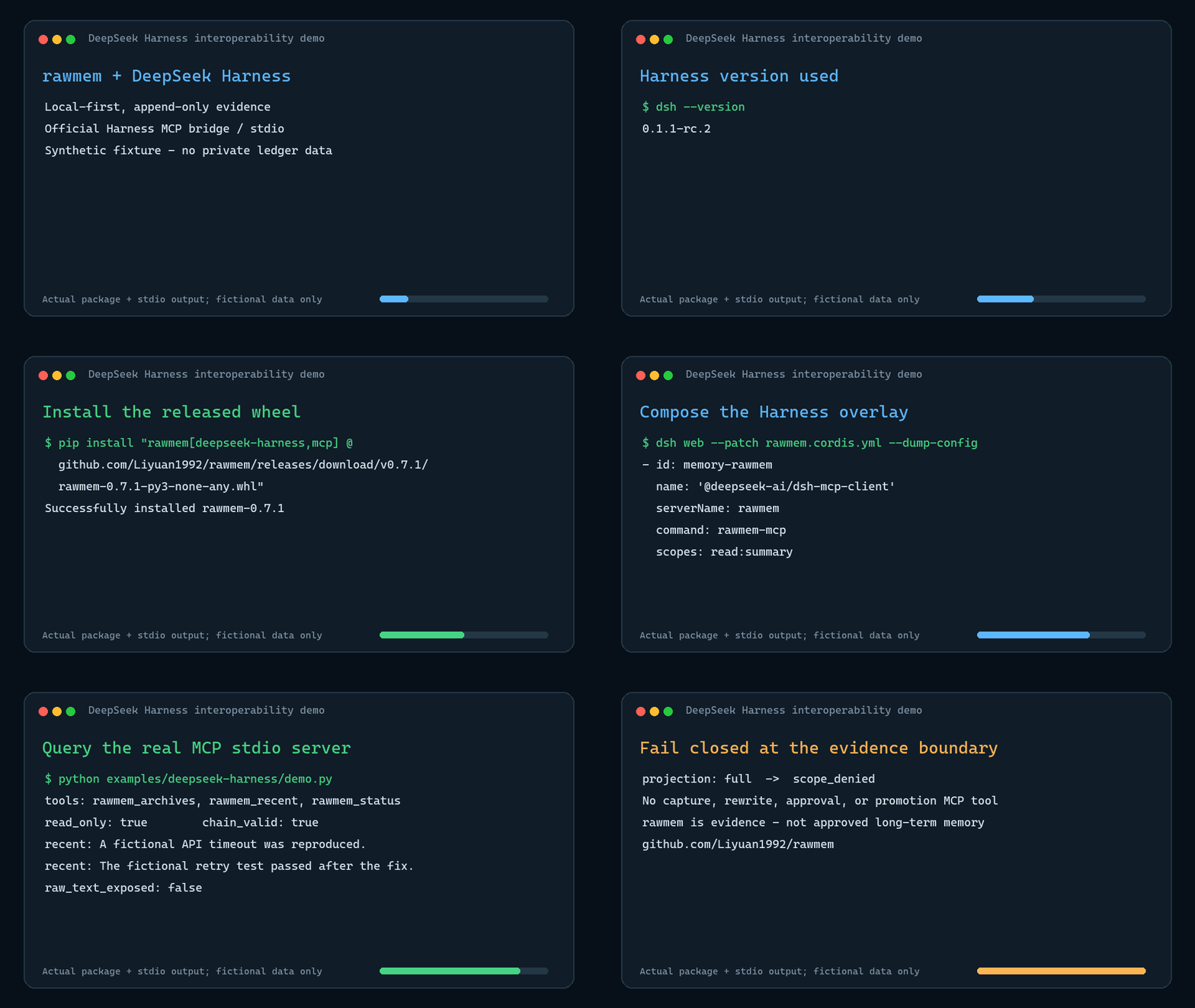
The core runtime has no third-party dependencies. DeepSeek Harness compressed session capture and the MCP server are optional extras:
To install the published v0.7.1 wheel without cloning the repository:
Make sure the user Scripts
directory (e.g. %APPDATA%\Python\Python312\Scripts) is on PATH so rawmem
works from any directory.
One-Time Setup
After this the daemon passively tails Claude Code, Codex, and Cursor sessions,
tails PowerShell history, watches configured directories, and serves the
browser-capture endpoint — with zero per-event action from you. Clipboard
polling is available but disabled by default; enable it explicitly in config
or with rawmem config --include-clipboard.
The guiding principle is passive over self-report: evidence is pulled
from logs other tools already write, not pushed by agents remembering to
report back.
See docs/SETUP.md for the full setup matrix and the browser extension.
For DeepSeek Harness capture plus bounded read-only MCP access, see docs/DEEPSEEK_HARNESS.md.
Commands
Background capture (the primary path):
Preview or remove integrations:
Inspect the ledger:
rawmem export uses the stable rawmem.cursor.v1 contract and never needs to
load the whole ledger. Cursors bind to a ledger identity plus a byte offset and
boundary hash, so truncation, replacement, or rotation is reported explicitly
instead of silently skipping or duplicating evidence. See
docs/LEDGER_PROTOCOL.md.
rawmem verify is strictly read-only: it never creates or refreshes lock/state
sidecars. rawmem seal keeps historical bytes unchanged, records the full
verification report and every accepted previous_hash_mismatch, marks the old
ledger ReadOnly on Windows, and creates a chain-complete active ledger at the
same configured path. Archive reads require --archive; they hash the complete
archive before returning results, default to a body-free metadata projection,
and surface recorded integrity warnings.
Manual and scripted capture:
Current Coverage
| Surface | How | What lands in the ledger |
|---|---|---|
| Claude Code sessions | daemon tailer (zero friction) | user/assistant turns, project, session, branch |
| Codex sessions | daemon tailer (zero friction) | user/assistant turns, project, session |
| Cursor agent transcripts | daemon tailer (zero friction) | user/assistant turns, workspace, session |
| DeepSeek Harness sessions | opt-in daemon tailer (zero friction after setup) | direct user/model turns; tool name/id/status metadata only |
| Shell commands | daemon tailer of PSReadLine history | every completed command line |
| Clipboard | daemon poller (deduped, opt-in) | clipboard text changes |
| Git lifecycle, all repos | setup --global --yes core.hooksPath hooks | commit/checkout/merge/rewrite/push snapshots |
| File changes | daemon watcher | batched created/modified/deleted paths |
| Browser pages | MV3 extension (extension/) + token-protected localhost endpoint | selection or page text, title, URL |
| Any adapter/tool | ingest / POST /capture | JSON event payloads |
| Manual notes | capture / clip / run | raw text, tags, artifacts, command results |
Storage
By default, events are written to:
Use --local to write to the current project's private ledger:
Use --ledger <path> or RAWMEM_LEDGER for an explicit ledger path.
Capture policy is configured under privacy in ~/.rawmem/config.json.
Optional project/path allowlists fail closed, common secret shapes are redacted
before append, and artifacts default to metadata references rather than
embedded content. Daemon status and rawmem doctor expose source coverage,
skipped events, redactions, and cursor health without printing captured text.
.rawmem/ is ignored by Git because raw evidence can contain private text,
paths, command output, and local work context.
Event Shape
Each line is JSON:
The previous_hash / content_hash chain is a lightweight tamper-evidence
mechanism. It is not a security boundary, but it makes accidental rewrites more
visible.
Adapter Strategy
rawmem should not chase every AI tool with one giant integration. The stable
piece is the ledger. Capture adapters can be small and optional:
- CLI wrappers for Codex, Claude Code, shell commands, and build scripts.
- Generic JSON ingest for tools like WorkBuddy, QWork, or custom scripts.
- Git/file watchers for tools that ultimately change a repo.
- Localhost browser capture, bookmarklets, and later browser extensions for web AI chats, issue pages, docs, and web clips.
- App-specific adapters when a tool exposes logs, exports, plugins, or APIs.
- Manual hotkey/clipboard capture as a low-friction fallback.
All adapters should emit the same event schema.
MCP is a query adapter, not a promotion path. rawmem-mcp exposes only
path-free status, bounded recent events, and archive metadata. Summary access
is the default; raw bodies require an explicit read:full scope.
Privacy Principles
- Local first.
- No upload by default.
- No automatic memory promotion.
- Background capture must be opt-in.
- Clipboard polling is off by default.
- Browser capture requires the local token created in
~/.rawmem/config.json. - The extension options page can test daemon connectivity and token acceptance.
- Machine-wide Git hook setup requires
--yes. rawmem uninstallpreserves captured data unless--remove-home --yesis explicit.- Store raw events separately from reviewed or derived memory.
- Prefer allowlists for browser/app capture.
See PRIVACY.md and SECURITY.md before enabling background capture on a daily driver machine.