Crypto backtest statistics: the server owns the trial count, so it cannot be understated.
Quick Install
Automated & IDE SetupCopy the AI prompt to install this server into Claude Code, Cursor, or another agent — or use 1-click editor setup below.
Not yet automatically verified
We haven't yet run this listing's install command through our automated sandbox check. This isn't a red flag — we're steadily working through the catalog.
Manual Client & Custom JSON ConfigExpand JSON ▾
Client Config & Setup
Choose your client or environment
Target File:
💡 Paste the JSON block into your client's configuration file under mcpServers, then restart the application.
Documentation Overview
quant-integrity
Statistical tests for whether a backtest means anything.





This library will not find you a profitable strategy. Its function is to reject them. Everything here exists to answer one question: given how many configurations you tried before reporting this one, does the result survive?
The problem, in one picture
A moving-average crossover on BTC-USD hourly bars. After sweeping parameters, the best configuration returned an annualised Sharpe of 0.95 — and a Probabilistic Sharpe of 0.86, which reads as "probably beats zero".
That is where most backtests stop. Here is the same result next to the bar that 28 attempts actually sets:
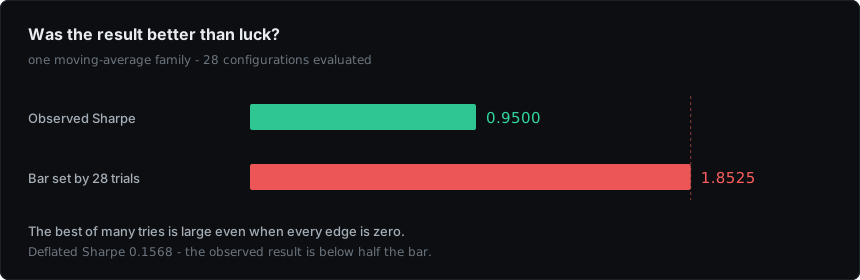
The best of 28 tries is large even when every underlying edge is exactly zero. Against that bar the deflated Sharpe is 0.157. The observed result is not marginal; it is below half of what luck alone produces.
A high PSR with a low DSR is the signature of an overfit search, not a borderline edge.
What the search was actually selecting on
The cause was visible in the trials themselves. Sorting the 28 recorded runs by trade count against Sharpe:
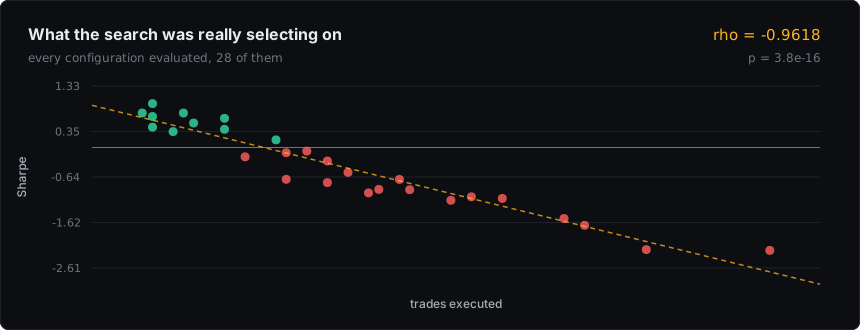
Every configuration that traded less looked better, at ρ = −0.96. That is not a signal being discovered — it is cost drag being measured, plus a slow moving average approximating buy-and-hold in a rising market. The search was not finding an edge. It was finding the configuration that traded least.
And the interval was never tight to begin with
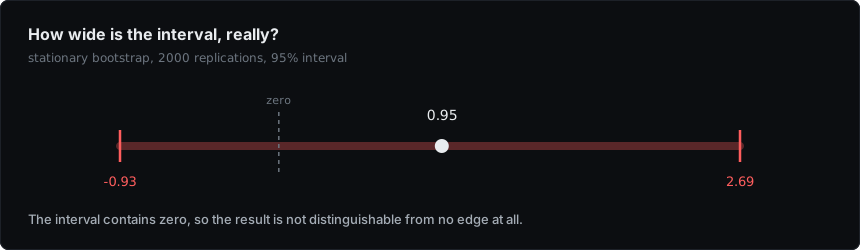
Reported alone, Sharpe = 0.95 implies a precision the data does not support.
Every number above is reproducible
| Trials evaluated | 28 |
| Sharpe (annualised, after costs) | 0.9500 |
| Probabilistic Sharpe (PSR) | 0.8556 |
| E[max Sharpe] under the null, 28 trials | 1.8525 |
| Deflated Sharpe (DSR) | 0.1568 |
| Bootstrap 95% CI on Sharpe | [−0.93, 2.69] — straddles zero |
| Excess kurtosis | 18.61 |
| Spearman ρ(Sharpe, trades) | −0.9618 (p = 3.8e−16) |
| Minimum backtest length | 1.94 years required, 1.25 available |
The trial count is taken from the recorded runs rather than typed in. An earlier version of this page hardcoded 29 while the file recorded 28, and quoted a deflated Sharpe from one and a minimum backtest length from the other.
The figures and this table are generated by the same script from
examples/btc_ma_runs.npz (24 KB, the actual return series and per-trial
results). No server and no account. There is also a longer walkthrough in
examples/btc_ma_postmortem.ipynb.
On one number that is not in this repo. The same specification was later run across a basket rather than a single asset, and pooled to a Sharpe of −1.376 over 10 assets with 3 of them positive. That result lives in the hosted server's ledger, not in this repository — the example file here carries only the single-asset trials, so you cannot reproduce the basket figure from it. It is quoted here because it is the strongest part of the story, and flagged because a number you cannot check should always be labelled as one.
What's in it
| Function | Question it answers |
|---|---|
deflated_sharpe(returns, n_trials) | Does this Sharpe beat what the best of N trials produces by luck? |
probability_backtest_overfitting(matrix) | Does your selection procedure carry information at all? |
combinatorial_purged_cv(...) | Cross-validation splits with purging AND embargo |
stationary_bootstrap_ci(returns) | How wide is the interval really? |
reality_check(family, benchmark) | Is the family's best member better than the benchmark it was chosen over? |
effective_tests(matrix) | How many INDEPENDENT tests does a correlated basket give? |
min_backtest_length(n_trials, ...) | Is your sample even long enough for the search you ran? |
triple_barrier_labels(...), dollar_bars(...) | Labelling and activity-based sampling |
spec_hash(spec) | Content-addressed strategy identity |
verify_attestation(record, key) | Independently check a signed research record |
n_trials means every configuration you evaluated, including the ones you
discarded. Understating it produces a flattering answer. Nothing in this library
can check it — which is exactly the problem the next section is about.
Commercial intent, stated on day one
The statistics in this repository are AGPL-3.0 and free forever. Every method here is published academic work. There is no moat in the arithmetic and no version of this library is crippled to sell you an upgrade — a teaser would fail as a funnel and would forfeit the only thing an integrity tool has.
Hosted attestation is a paid service. Verification is public and lives here. Issuance is not, for the reason below. Saying this up front so nobody can later claim a rug-pull.
Why self-hosting can't attest
A trial count is only meaningful if it cannot be revised downward. But if you run your own ledger, you can edit it. Not through malice, usually — through the ordinary temptation to restart the count after a rewrite, or to not record the sweep that went nowhere. A self-attested integrity record certifies nothing, because the person attesting is the person who benefits.
Verification is public. Issuance is the service.
Anyone can check an attestation with this library and an issuer's public key. No cooperation from the issuer is required, and none of the checking code is withheld. What you cannot do is make one, because a signature is only worth something when the signer is not the beneficiary.
The property that does the work is not any single signature — it is the chain.
verify_chain confirms that, across a sequence of attestations:
- sequence numbers are consecutive, so no record was removed from the middle;
- each references the previous record's digest, so none was altered afterwards;
n_trialsnever decreases.
An outside party can establish all of that without ever seeing the ledger. Someone who edits their own records cannot reproduce it, because they would have to re-sign every subsequent record with a key they do not hold.
That is the whole business: not the arithmetic, which is here and free, but operating an instance that has no stake in the answer. That instance is quant.avasis.ai — an MCP server, so the research runs inside Claude, Cursor, VS Code or any MCP client, and the trial count is kept by the server rather than by the conversation.
Scope
This is a statistical instrument. Deliberately absent, and staying absent:
- No buy, sell or hold signals. No target prices, position sizes or stop levels.
- No model portfolios or allocations.
- No claims about returns, and no examples implying any.
The library takes return series and trial counts and returns statistics about them. It does not know what you are trading and does not offer an opinion on it.
Install and contribute
Python 3.10+. Depends on numpy, scipy and pandas. Fully typed (py.typed).
Contributions require a CLA and a DCO sign-off — see CONTRIBUTING.md, which explains why without apology.
Licence
AGPL-3.0-or-later. See LICENSE and NOTICE.
The network-use clause is deliberate: it means a competitor cannot run a closed hosted fork of this code. It does not restrict you from using the library in your own research, hosted or otherwise, without publishing anything.
Related MCP Servers
Adoption & maintenance
Factual signals from GitHub, npm, and our automated checks — not a rating.
GitHub stars
1
Stargazers on the source repository.
Last commit
3d ago
Most recent push to the default branch.
Reviews
No reviews yet — be the first to share how this listing worked for you.
Frequently Asked Questions about Quant Research
AllMCPs Directory Badge
Showcase your server listing on GitHub or your project documentation. Embed this dynamic SVG badge to highlight official listing status and live engagement.
Badge Style:
Live Dynamic SVG Preview
Markdown (GitHub README)
[](https://allmcps.com/mcp/quant-research)HTML Embed
<a href="https://allmcps.com/mcp/quant-research"><img src="https://allmcps.com/api/badge/quant-research?style=directory" alt="Quant Research on AllMCPs" /></a>Technical Specs & Signals
CategoryFinance & Fintech
40Quality signal: Fair · 40/100How this signal is calculated ▾
Server availabilityNot measured
Not scored for repo-hosted servers — we can't reach the running server, only its GitHub page. Hosted MCP endpoints are health-checked live.
Verified ownership10/20
Documentation & tools16/30
Adoption & activity4/15
Community engagement0/10
A guidance signal from public completeness & health data — not a user rating. New listings start lower and rise as they add docs, get verified, and grow adoption. Signals we can't observe for a listing are skipped, not counted against it.
Supply-chain signal
No high-severity advisories surfaced by our automated scan.
Critical 0High 0Medium 0Low 0
Scanned 4h ago via OSV.dev · quant-integrity (PyPI)
Own this project?
This directory is pre-filled from public sources. Claim via GitHub README, site badge, or DNS TXT to unlock edit access and the Official badge — proof is checked automatically, then reviewed by our team.
Free dofollow backlink: add your website and place the AllMCPs badge on it — no claim needed. We detect it automatically and keep it verified as long as the badge stays live.
Claim & get free dofollowShare & Embed
Add our SVG badge (dark/light directory styles) or embeddable widget to your site.