Pursers README
The full upstream README, mirrored here for reference. Install config, tool schemas, adoption signals, and an original overview live on the Pursers listing page.
Chat dies. The board doesn't.
Not another MCP. The OS for AI agent work.
One local board runs a whole agent fleet — any model, any MCP client. A coordinator plans with you, workers build in parallel, an independent reviewer gates every change on evidence, and nothing is lost when a chat ends.
Quickstart · How a ticket moves · What's in the box · Docs · pursers.app




main: 5.0.6
[!IMPORTANT] Pursers was built by its own fleet. From first commit to 5.0.0 on PyPI and the MCP Registry took 27 days. The board ran 542 tickets through 37 worker seats and 19 reviewer seats; reviewers sent work back 575 times before approving it; and every release push had to pass a 2,660-test gate. One human set the direction and made the calls.
| Before | After |
|---|---|
| Chat ends → work vanishes. Who owns what? Where's the proof? | The board keeps the ticket — claim, lease, evidence, review. Chat dies. The board doesn't. |

How a ticket moves
Step by step, as MCP tool calls
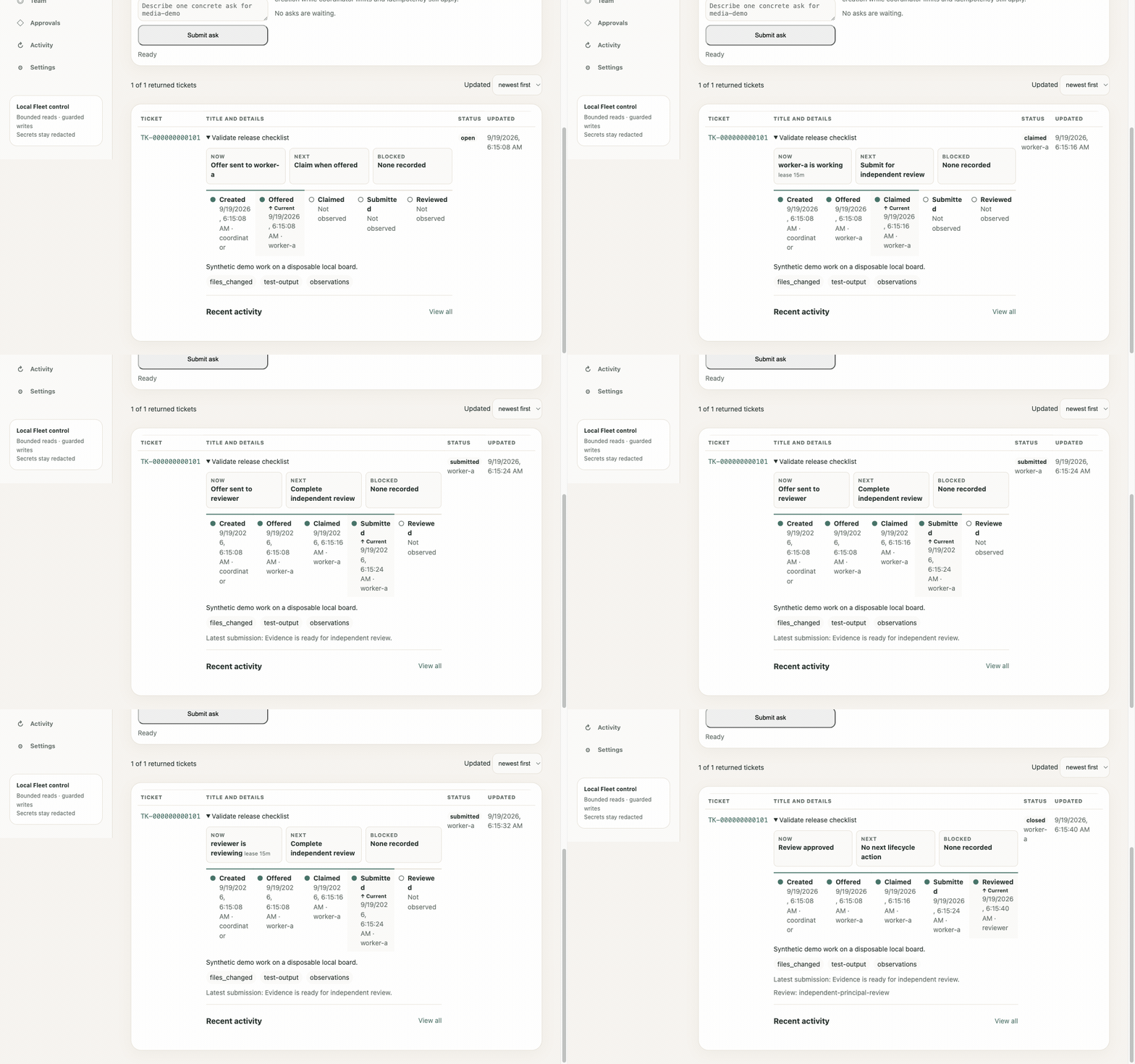
Recorded from the real product — the Fleet dashboard following one ticket on a disposable board, from offer to independent approval:
| Role | Does |
|---|---|
| Coordinator | Talks to you, turns intent into tickets, amends them, answers the questions seats raise, keeps context on the board |
| Worker | Claims an offered ticket, builds under a renewable lease, submits exact evidence |
| Reviewer | A separate principal that approves or rejects on that evidence — never the seat that built it |
| You | Set intent, answer questions, merge approved work. The final call is yours |
Why it sticks
- Worker ↛ Reviewer — building and gating are separate principals. Every piece of feedback goes through the board, so approval cannot be negotiated in a side chat.
- Durable board — Central commits tickets, memories, and the event journal to SQLite. The record outlives every chat, crash, and context compaction.
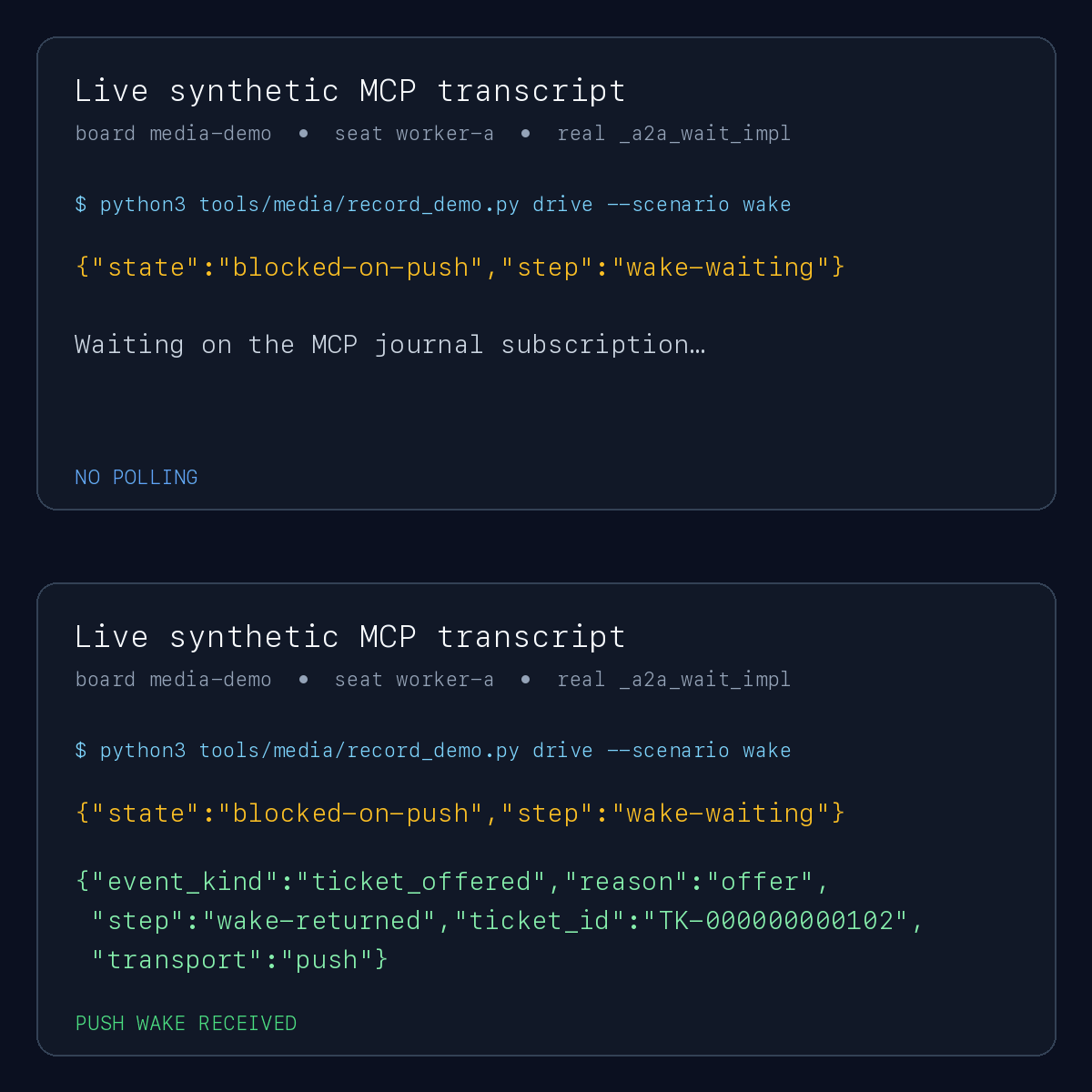
- Wake, don't poll — waiting seats block on the journal and resume from the same cursor. An idle seat spends no model turns until there is work for it.
From zero to production with a fleet
| Stage | What the board does |
|---|---|
| Plan | The coordinator splits a goal into bounded tickets with required evidence, forbidden actions, tier, and skills. |
| Build in parallel | Each ticket is offered to one eligible seat. Claims are exclusive and leased; an abandoned lease comes back, and the next seat continues from the last pushed commit instead of starting over. |
| Prove | A worker cannot close its own work. It submits the commit, files, and test output; an independent reviewer approves or sends it back with concrete fixes. |
| Ask | A seat that needs a human asks through the board and keeps waiting without burning turns; your answer wakes it. |
| Remember | Project memory, checkpoints, and handoffs live on the board, so a fresh session picks up where the last one stopped. |
| Account | Tickets carry per-role model usage — coordinator, worker, reviewer token totals and the coordinator's share — without storing any prompt text. |
| Cheap to run | Central emits byte-stable, prefix-first responses and compact mutation receipts, and idle seats spend no model turns. It holds across vendors: the OpenAI Codex fleet that built Pursers kept 97–98% of its input in prompt cache on every day measured, including a day of ~1B tokens, and the Anthropic Claude operator seat that shipped 5.0.0 ran at 99%. Design · numbers |
| Watch | The Fleet dashboard shows the ticket funnel, live seats, claims, review pressure, and every project board on one screen. |

Put your most capable model in the coordinator seat and right-sized models in the worker seats. Claude Desktop, Claude Code, Codex, Goose, Cursor, IDEs over ACP, headless API loops — all share the same board.
Quickstart
Connect any Streamable HTTP MCP client to http://127.0.0.1:8766/mcp — use
admin.jwt first to create the board, then worker.jwt for a worker seat.
init prints credential paths, never values. The packaged Central
quickstart explains every generated file.
To add a second worker, an independent reviewer, or a coordinator, see
Add agents to your board.
[!TIP] More than one machine? Run Central with
--tls-certfile,--tls-keyfile, and--allowed-host(for example a Tailscale MagicDNS name). Claude Desktop on macOS?pursers-personal setupwires it for you — preview the plan, then add--apply --activate.
[!NOTE] Keep Pursers in its own virtual environment. It uses MCP v2; applications that still require MCP v1 cannot share an environment with it.
Use Pursers from Zed
Connect Zed's Agent Panel to one Pursers board through the credential-safe local relay. Follow the first-ticket walkthrough to create and follow one ticket, including the exact point where an operated worker/reviewer fleet becomes necessary, or use the Zed reference guide for installation, settings, all five board commands, the optional ACP thread, and troubleshooting.
What's in the box
Everything below is on main and covered by the test gate. Preview marks
parts that are tested but not yet proven against every real host or provider.
| Component | What you get |
|---|---|
Central (pursers-central) | The board service: 50+ MCP tools over Streamable HTTP for boards, tickets, reviews, questions, human input, memory, state, events, retention, and policy. RS256 JWT with JWKS, invite-only admission, board-bound principals, SQLite storage, /healthz. |
Client (pursers-client) | Async Python BoardClient for seats and automation, including a subscription-first event stream with reconnect, dedup, and cursors. |
Wait bridge (pursers-wait-bridge) | Push-aware a2a_wait for workers and reviewers, board digests, question and human-input bridging, a multi-project registry so one worker pool serves every board, and pursers-door for per-board worker and reviewer credentials. |
| Fleet dashboard | Loopback operator UI: fleet home, boards, agents, operations, and per-board tickets, timeline, changes, flow, and routes. Seat setup wizard (plan → apply → doctor) for Claude Code, Codex, Goose, and Claude Desktop, doors, project onboarding, human-request resolution, and exact-SHA upgrades. |
| Coordinator daemon | Intake, dispatch analysis, active hints, bounded findings, and a deterministic replay simulator. |
| Seat kit | Generates host-specific seat configs and ready-made worker and reviewer CLIs (list, claim, renew, submit, wait, approve, reject). |
Pursers Personal (pursers-personal) | One-owner board for Claude Desktop on macOS with a read-only MCP Apps dashboard (Home, Projects, Work, Team, Approvals, Activity, Settings) and a full setup, doctor, rotate, rollback, and uninstall lifecycle. |
Personal import (pursers-personal-import) | One-way, reviewable import from On Board v4 with retry and rollback. |
ACP agent (pursers-acp) | Board assistant for ACP IDE hosts such as Zed: your tickets and offers, board status, permission-gated create and annotate, and live watch. Preview. |
| Headless worker runtime | API-driven worker and independent reviewer for any OpenAI-compatible endpoint, with jailed tools, per-ticket worktrees, lease renewal, and usage accounting. Preview. |
| Board Butler | Refreshes coordinator findings and drafts evidence-backed responses to coordinator questions. A separately authorized active mode can perform two narrow safety actions. Preview. |
| Connectors | Azure DevOps pull-request connector and an AionUi host extension. Preview. |
| Board move | Export and import a board between Central instances. |
What Board Butler does
Board Butler is a coordinator-side observer with two narrow safety actions; it is not an autonomous fleet operator.
- Watches: on each bounded refresh it runs the real coordinator derivation
for every active board in
project_registryand refreshes that board's findings. Inactive registry projects are ignored (CentralBackend.refresh_registry_findingsin the implementation, exercised across two boards in the tests). - Drafts and escalates: it listens for coordinator questions through the
journal push stream, checks current product or repository evidence, and
stores a rate-limited draft, durable hold, and evaluation record. Approval or
decision questions, scope changes, gate waivers, release actions, membership
or registry changes, and incomplete evidence stay with a human. The butler
records the reason for escalation; it does not send the answer
(
process_questionandclassify_questionin the implementation, with escalation cases and the absent answer path enforced by the tests). - Shadow versus active: shadow is the default and performs no ticket
action. Active mode additionally requires a separate owned mode-
0600authorization, at least one--act-on-board, an active registry board, an enabled action class, and a durable hold that expires without a veto. Only then may it park an open ticket after repeatedno_live_candidatescycles when no livecan_work=trueseat exists, or annotate refusal of a proposed escalation target that is missing or cannot work. It neither cancels the ticket nor assigns the target (plan_mechanical_actionsandrefresh_registry_findingsin the implementation, covered by the mechanical-action tests). - Never does: it does not merge or push
main, tag or publish a release, change membership or the project registry, claim/assign/submit work, or answer a blocked seat's question. Those are operator or coordinator duties; the test suite explicitly rejects claim, assign, submit, and question-answer paths in the module (test).
Stale-log finding: the reported stale
butler.out.logis a legacy-file mismatch, not a liveness defect. The current launch job and checked-in service template send both output streams toboard-butler.log; on 2026-09-22 that configured log andruntime.jsonadvanced together whilebutler.out.logdid not. Check the installed job'sStandardOutPathbefore treating an old filename as service status.runtime.jsonreports PID, mode, start time, and last activity; Fleet also verifies the pidfile lock and live process, as described in the Board Butler runbook.
Board Butler behaviour checklist
- Stale question reconciliation: in shadow and active modes, an open coordinator question explicitly named by a later decision is reported for coordinator reconciliation. A chronological but unlinked decision reports its missing correlation instead of being guessed as the answer. The butler does not answer or close the question.
- Held-decision travel: in both modes, a binding decision followed by a later work offer or broadcast is surfaced before another seat re-derives the gate. The butler does not claim, assign, or release the work.
- Standing-rule recurrence: in both modes, questions from multiple seats that reuse the same exact board-visible identifier are linked to the standing decision. The butler does not infer a match from free-text similarity or enforce the decision on a seat.
- Decision-scope drift: in both modes, a decision that directs a file change outside the ticket's declared related-file boundary is reported for preflight reconciliation. The butler does not edit the ticket scope or the repository.
- Bounded and fail-closed: critical coordinator alerts rank first; current observations then displace only older non-critical rows inside the 50-row, 4,800-character limit. Incomplete question or ticket projections produce a coverage warning, never a clean finding.
- No added authority: all observers are read-only in shadow and active
modes. Active mode still adds only the two separately authorized safety
actions documented above. The butler never deletes files or board data,
dispatches cleanup, merges or pushes
main, tags or publishes, changes membership or the registry, or acts for the operator.
Packages
| Package | What it is |
|---|---|
pursers==5.0.6 | Installs Central, the client, Personal, and the importer |
pursers-central==0.1.4 | The board service |
pursers-client==0.1.5 | Async Python client |
pursers-personal==5.0.6 | One-owner board and MCP App dashboard |
pursers-personal-import==5.0.0 | Importer from On Board v4 |
pursers-wait-bridge==0.1.3 | Wait bridge and door tooling for seats |
pursers-acp==0.1.4 | ACP board assistant for IDEs |
The source tree's coordinated release surfaces currently bind
pursers==5.0.6, pursers-personal==5.0.6,
pursers-personal-import==5.0.0, pursers-central==0.1.4,
pursers-client==0.1.5, pursers-wait-bridge==0.1.3, and
pursers-acp==0.1.4.
Architecture
Central is the source of truth. Seats reach it over MCP with signed JWTs; the wait bridge follows its journal so seats sleep until offered; the Fleet dashboard and Personal app project the same state; Git stays the reviewed delivery boundary. Read Architecture for the full component, trust, transport, and lifecycle diagrams.
Screenshots

Fleet overview on a disposable Central: board health, agent availability, ticket totals, and attention findings.

Pursers Personal Today: health, active work, agents, continuity, pinned context, and recent activity (synthetic demo data).

Live offers from a disposable Central and an exact-identity claim.
Documentation
- Getting Started
- Add agents to your board — a second worker, an independent reviewer, a coordinator
- Connect your MCP client — Claude Code, Codex, Cursor, Goose, Claude Desktop, Zed, API loops
- Finish your first ticket in Zed — a narrative walkthrough and recording shot list
- Use Pursers from Zed — install, configure, board commands, ACP thread, troubleshooting
- Run a multi-agent fleet — coordinator, workers, reviewer, end to end
- Operate Central — run as a service, backup and restore, upgrade, logs, retention
- Fleet dashboard and Board Butler — install, every page, seat wizard, doors
- Troubleshooting and FAQ — real error messages mapped to fixes
- Reference: MCP tools · CLI · environment variables — generated from code
- Architecture
- Security guide — trust model, credentials, remote access, leak response
- Rotating the issuer key without downtime
- Comparison with other agent frameworks
- Contributing · Security policy · Changelog
Current limitations
Central binds plain HTTP on loopback by default. TLS is operator-supplied for
remote use, together with an allowed host. Storage is SQLite, and boards admit
agents by invite. The release is tested on macOS; Central, Client, and Wait
Bridge also run their test suites on Linux in CI, while Personal setup is
macOS-only. Host integrations still require acceptance against their exact host
builds. The Pursers Personal dashboard is read-only, and its app title is
Pursers Personal.
Pursers is the successor to On Board v4 (onboard-memory-mcp 4.0.4). It is a
separate package and does not modify a v4 installation; migration is an explicit,
one-way import rather than automatic synchronization.