Persistent memory for MCP-compatible agents: memory bank, fact cortex, dreams, graph.
Quick Install
Automated & IDE SetupCopy the AI prompt to install this server into Claude Code, Cursor, or another agent — or use 1-click editor setup below.
Not yet automatically verified
We haven't yet run this listing's install command through our automated sandbox check. This isn't a red flag — we're steadily working through the catalog.
Manual Client & Custom JSON ConfigExpand JSON ▾
Client Config & Setup
Choose your client or environment
Target File:
💡 Paste the JSON block into your client's configuration file under mcpServers, then restart the application.
Documentation Overview
Pseudolife-MCP




简体中文 · 日本語 · 한국어 · Português (BR) · Español
Persistent long-term memory for Claude Code, Codex, and other MCP clients.
An MCP server that gives coding agents a long-term memory that persists across sessions — surviving context compactions and fresh tasks. Your coding agent is the intelligence; this server is its memory on disk.
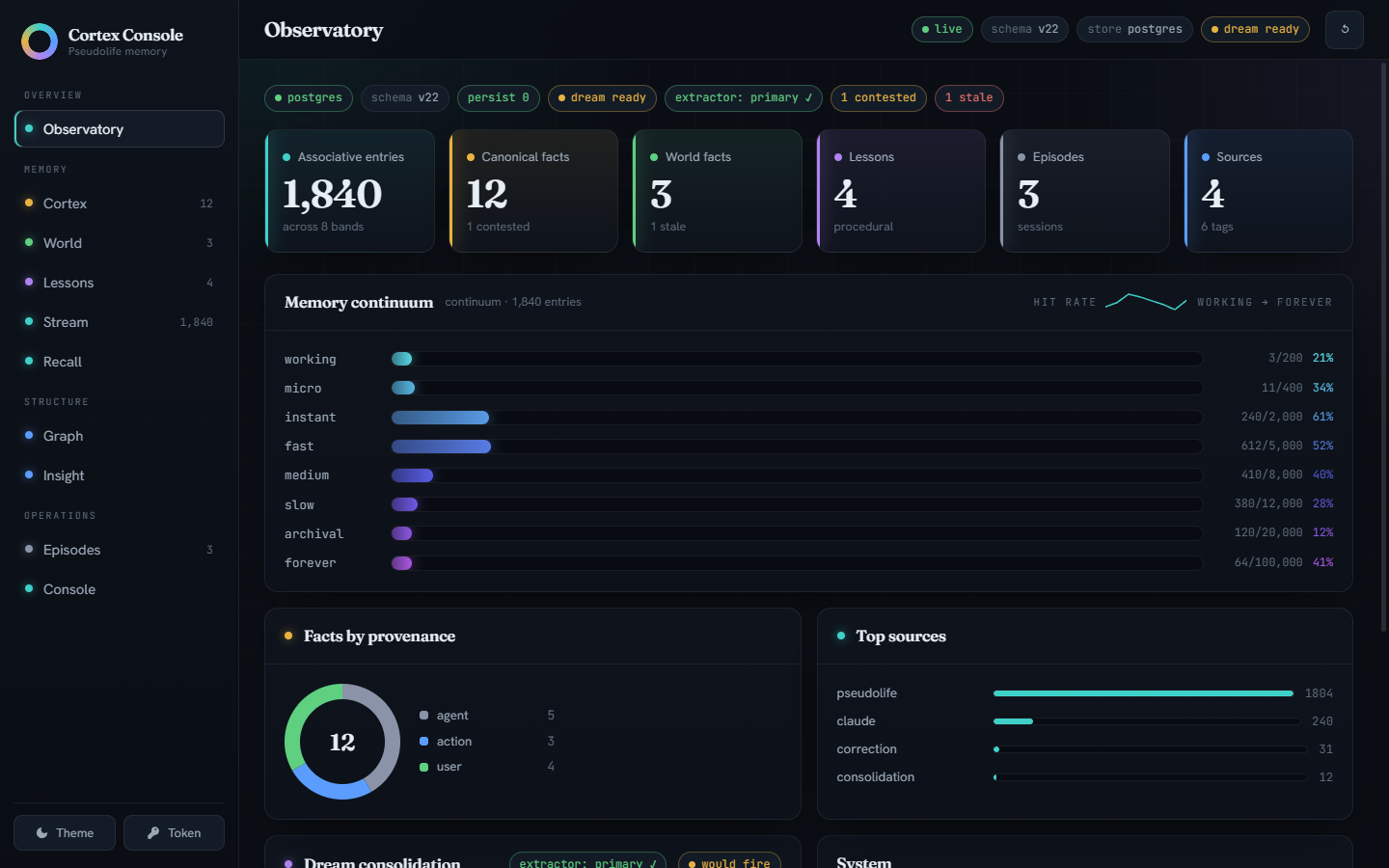
What you get:
- Associative memory with honest forgetting — a flat similarity store ranked by hybrid dense-plus-lexical retrieval, with conflict detection that admits potential updates while preserving earlier source notes; whole-note replacement is explicit. (The measured verdict: a preregistered ablation campaign found the previous 8-band continuum tied a flat store on every gate, so the simpler structure ships; the continuum remains one config line away.)
- Canonical facts, not vibes — one current value per
entity.attributeslot (or a member set, for slots that hold many concurrent values); corrections supersede rather than silently overwrite, and the full version history survives. - Dreams — a bundled local extractor, or any OpenAI-compatible endpoint (a Claude model on your Max plan, a GPT-5.6 model on a ChatGPT plan, LM Studio, Ollama, vLLM), consolidates the memory stream into facts and a knowledge graph while you're not looking.
- Lessons from its own work — successes, dead-ends, and your corrections become do/avoid guidance surfaced at the start of every session.
- A web console to watch it think — the Cortex Console above, plus cited world facts, session episodes, and document RAG.
Measured, with receipts — the full 500-question LongMemEval sweep, all six question types, and every number ships with its committed run artifact:
| LongMemEval oracle, 500 questions | naive RAG | commit-gated cascade |
|---|---|---|
| accuracy, all six question types | 0.688 | 0.690 |
| context tokens per question | ~1210 | ~883 |
| knowledge-update slice (78 of the 500) | 0.859 |
Equal accuracy to naive RAG across the whole benchmark on ~73% of the
context, and better calibrated about what it does not know: on BEAM-100K's
abstention questions the fact spine scores 0.950 against naive RAG's
0.775, unchanged under two independent judges. Read that as calibration,
not recall — in the budget-matched five-arm run of 2026-09-02 (rag 0.725 there;
one replicate, local judge) an arm served no memory at all scores 1.000 on
the same questions, because refusing is the right answer there and an
empty context always refuses. The fact spine loses where an answer has to
be aggregated across sessions. The second claim to survive a judge swap is
a win rather than a wash: re-run on 2026-09-04 with the hybrid arm
budget-matched to the control at 6 turns, the same 500 questions give
hybrid 0.730 against naive RAG's 0.690 under the local judge and
0.736 against 0.694 under claude-opus-5 — paired +0.040 / +0.042,
p 0.015 / 0.013 — bought with more context, ~1229 tokens against the
control's ~1124, not less, and carried mostly by temporal-reasoning
questions. Graded by a local, byte-reproducible judge (the cross-judge check
names its second judge) — compare within rows, never against GPT-judged
leaderboards.
Retired 2026-08-25 (#188): the 0.936 knowledge-update headline. It was measured on the 2026-07-30 bench stack (Qwen3.6-27B answerer and judge). Re-running the same 78 questions after the 2026-08-17 migration to Qwen3.8-27B puts the cascade at 0.846, below the naive-RAG control — which lands on 0.859 on both stacks. The cascade serves the fact-spine answer unless that channel says "I don't know", so it measures the answerer's abstention behaviour as much as the memory: 32/78 abstentions at 46/46 commit precision on the old stack, 22/78 at 0.839 on the new one. The 500-question table above is on the older judge and has not been re-judged, so read its cascade row as an upper bound.
Full tables, the per-type breakdown, both stacks side by side, and every artifact: Benchmarks.
Quickstart
Install and register the lite tier. No Docker, no database to set up, no container runtime:
Codex instead of Claude Code — same shape:
For Codex, finish setup before starting a fresh task. In the existing
[mcp_servers.pseudolife-memory] table in ~/.codex/config.toml, add
startup_timeout_sec = 240, tool_timeout_sec = 240, and required = true.
The shim can wait up to 180 seconds for a cold daemon; Codex's default
startup budget is 10 seconds. required makes missing memory visible at
startup and waits for its initial catalog. These are starting budgets,
not a promise that a first model download fits. The tool budget leaves time for
the shim's 180-second deadline to report a failure before the host cancels it; prewarm with
pseudolife-mcp serve in a terminal if needed.
The MCP handshake delivers compact recall/capture/reflection instructions.
For the complete standing guidance, copy the
bundled memory block into your project
AGENTS.md or ~/.codex/AGENTS.md. For session briefings and per-turn
reminders, follow Codex hooks and verification.
Use one MCP registration and one hook source; an installed plugin may
already provide either. After the daemon is running, execute
pseudolife-mcp doctor from the same environment as the registered command.
It checks the handshake and annotations without calling bank tools.
Then in either coding agent: "remember that my staging box is haze-02" →
the agent calls memory_store; next session, "which box is staging?" →
memory_search finds it. Browse everything at the Cortex Console:
http://127.0.0.1:8765/ui/.
The first session auto-starts the daemon, which provisions an embedded
PostgreSQL 18 (pgvector included, via pg0-embedded) under a stable
per-user data dir and downloads the embedding model (~1.2 GB, one-time).
It is a real Postgres bank, not a cut-down one: pseudolife-mcp backup
writes a standard owner-free pg_dump archive (plus a state archive, 7-day
rotation) that restores into any PostgreSQL 18 target regardless of role —
the Docker tier included — so outgrowing lite is a dump/restore, not a
migration project (backups). For a
tier- and Postgres-version-independent copy, pseudolife-mcp export /
import move the whole bank as portable JSONL
(logical export / import).
Windows needs an ASCII-only data path
(PSEUDOLIFE_MCP_DATA_DIR).
What lite gives you, and the one thing it doesn't
| lite (pip) | durable (Docker) | |
|---|---|---|
| Associative store, hybrid search, supersession, version history | yes | yes |
| Cortex facts, knowledge graph, lessons, world facts, episodes | yes | yes |
Cortex Console, document RAG, pseudolife-mcp backup | yes | yes |
| Dream consolidation filling the cortex on its own | no extractor ships | yes — bundled local CPU sidecar |
| External volumes, health-checked services, deploy/rollback tooling | no | yes |
The gap, stated plainly. Lite ships no extractor, so the dream
pass still runs, prunes, and acknowledges its input batch, but writes no
canonical facts: on this path memory_fact_set is the only cortex
writer. Everything else above works. Nothing about this is silent —
curl http://127.0.0.1:8765/health reports "extractor": "none", and the
stdio shim says the same on stderr at session start.
Any OpenAI-compatible endpoint closes it. The daemon inherits the environment it starts from, so two variables are the whole fix — with a local Ollama:
/health then reports "extractor": "configured". One gotcha: a daemon
that is already running keeps the environment it started with, and the shim
reattaches to it rather than spawning a new one — stop the old daemon
first. A hosted endpoint works too, and costs you the zero-egress
property: memory text leaves the machine. Extractor tiers, quality, and the
trade-offs: Dreaming.
Durable tier — Docker (recommended for a long-lived bank)
Related MCP Servers
Adoption & maintenance
Factual signals from GitHub, npm, and our automated checks — not a rating.
GitHub stars
5
Stargazers on the source repository.
Last commit
2d ago
Most recent push to the default branch.
Reviews
No reviews yet — be the first to share how this listing worked for you.
Frequently Asked Questions about Pseudolife Memory
AllMCPs Directory Badge
Showcase your server listing on GitHub or your project documentation. Embed this dynamic SVG badge to highlight official listing status and live engagement.
Badge Style:
Live Dynamic SVG Preview
Markdown (GitHub README)
[](https://allmcps.com/mcp/pseudolife-memory)HTML Embed
<a href="https://allmcps.com/mcp/pseudolife-memory"><img src="https://allmcps.com/api/badge/pseudolife-memory?style=directory" alt="Pseudolife Memory on AllMCPs" /></a>Technical Specs & Signals
CategoryKnowledge & Memory
11/15 checks healthy over the last 45d
41Quality signal: Fair · 41/100How this signal is calculated ▾
Server availabilityNot measured
Not scored for repo-hosted servers — we can't reach the running server, only its GitHub page. Hosted MCP endpoints are health-checked live.
Verified ownership10/20
Documentation & tools16/30
Adoption & activity5/15
Community engagement0/10
A guidance signal from public completeness & health data — not a user rating. New listings start lower and rise as they add docs, get verified, and grow adoption. Signals we can't observe for a listing are skipped, not counted against it.
Supply-chain signal
No high-severity advisories surfaced by our automated scan.
Critical 0High 0Medium 0Low 0
Scanned 1d ago via OSV.dev · pseudolife-mcp (PyPI)
Own this project?
This directory is pre-filled from public sources. Claim via GitHub README, site badge, or DNS TXT to unlock edit access and the Official badge — proof is checked automatically, then reviewed by our team.
Free dofollow backlink: add your website and place the AllMCPs badge on it — no claim needed. We detect it automatically and keep it verified as long as the badge stays live.
Claim & get free dofollowShare & Embed
Add our SVG badge (dark/light directory styles) or embeddable widget to your site.