Local-first AI video editor: cut by transcript, hang b-roll off phrases, render, then verify
Quick Install
Automated & IDE SetupCopy the AI prompt to install this server into Claude Code, Cursor, or another agent — or use 1-click editor setup below.
One-click editor setup isn’t available for this listing yet — we don’t have a confirmed install command, and we’d rather show nothing than point your editor at the wrong package or host. Follow the project’s own setup instructions, linked above.
Manual Client & Custom JSON ConfigExpand JSON ▾
No confirmed setup config for this listing yet. We only publish a config block when the install details come from the project itself — its README, its docs, or a verified owner. We haven’t found those for proofcut, and we’d rather show nothing than a guess you’d paste into your client. Follow the project’s own setup instructions for the current steps.
Documentation Overview




An AI video editor that proves its cuts. Your recordings in, a finished, mastered film out: cut by transcript, with b-roll, cards, music and captions, and every step an agent can call. proofcut renders on your own machine, then transcribes the render and checks that it says what the edit says.
https://github.com/user-attachments/assets/4153d180-3d7c-4c70-af5f-54d63d0a8bd5
Above: an agent cutting a demo video, unattended. The two runs it was cut from, uncut (silent: the recorder took frames only, and the voice is in the film the agent cut): the workspace (2:26) and Claude Code with the proofcut plugin (3:09).
Why it exists
Most of the work in a narrated video, whether an essay, a tutorial, a screencast or a talk, is bookkeeping. Find the retakes and cut them clean. Put the right footage under each line. Level the music under the voice, caption it, end on a card, render it, master it. An agent can do that bookkeeping now, given an editor it can drive.
What an agent cannot do on its own is know that the file it rendered is the film it meant. ffmpeg, melt and auto-editor all exit 0 on some failures, so a render can drop a line, keep a retake, add a frame of black or carry no captions and still report success. Every check that reads the project rather than the file agrees with it. The usual way to find out is to watch the whole thing.
proofcut is an editor built around that gap. You, or an agent, edit a timeline addressed by the words in it. proofcut renders it on your machine, then transcribes the render, counts its frames, and says where the file and the edit disagree.
Run, not staged
TRIAL.md scores three unattended runs, each handed a goal and no steps, and each passed every one of its checks:
- The demo cut, the one above.
- Real footage. 96 seconds of narration with its fluffed takes left in, plus four clips of film footage. The agent cut it to 45 seconds, chose footage by what each line was about, burned captions, and checked its own render: all 123 expected words heard back.
- A whole film. The demo material plus a score, briefed as a finished film ready to upload. In 192 seconds and $2.27 the agent cut it, laid the music under the voice, ended on a card, mastered it to −16 LUFS, and checked it. The score, the level and the end card were each measured in the delivered file, not taken from the project.
What it can do
One project, and proofcut's own commands from the first import to the delivered file. No NLE finishes the film, and nothing else touches the render. Each stage is one command, and each row links the section of the manual that walks it.
| Stage | Command |
|---|---|
| Bring in the voiceover and footage, and transcribe | import, transcribe |
| Cut retakes and asides by naming their words | cut vo 111:114 |
| Hang b-roll and cards off the lines they belong to | cue add, card new |
| Open cold on a scene, end on a card | head, tail |
| Play the footage's own lines in a gap, or under the narration | hold add, hold under |
| Score it: placed passages, crossfaded, levelled under the voice | music |
| Pull breaths down without cutting them | attenuate |
| Render and master to a loudness target | export --render --loudness -16 |
| Burn in captions, words fading or blurring in, spelled your way | captions --burn, caption-style --reveal, lexicon add |
| Check the render says what the edit says | verify, frames, hold check |
Two video essays of five to six minutes, first finished in Kdenlive, have been rebuilt with these commands alone and measured against the delivered files. One came out the same length to the frame. The other matched all 63 of its voiceover ranges to the millisecond, with the voice aligned to the sample. Both master at the original's −16 LUFS. The measurements are in HISTORY.md.
Beyond those stages:
- Cuts stay addressable. A word's index never renumbers, so
cut vo 111:114names the same words however many cuts came before it, and a cue hung off a phrase stays addressed through every cut around it. - An agent that can look.
shot-sheetdraws the whole picture track as one labelled grid, andfootage-sheetbrowses a clip you haven't cut yet. Both return the image itself over MCP, not a path the agent can't open. - B-roll by description.
describewrites what is on screen in each ~10-second window of footage, so an agent can choose a clip by what a line is about. - Transcript self-checks. Retake seams, invented words, swallowed repeats
and suspect durations are reported when a transcript is attached, and
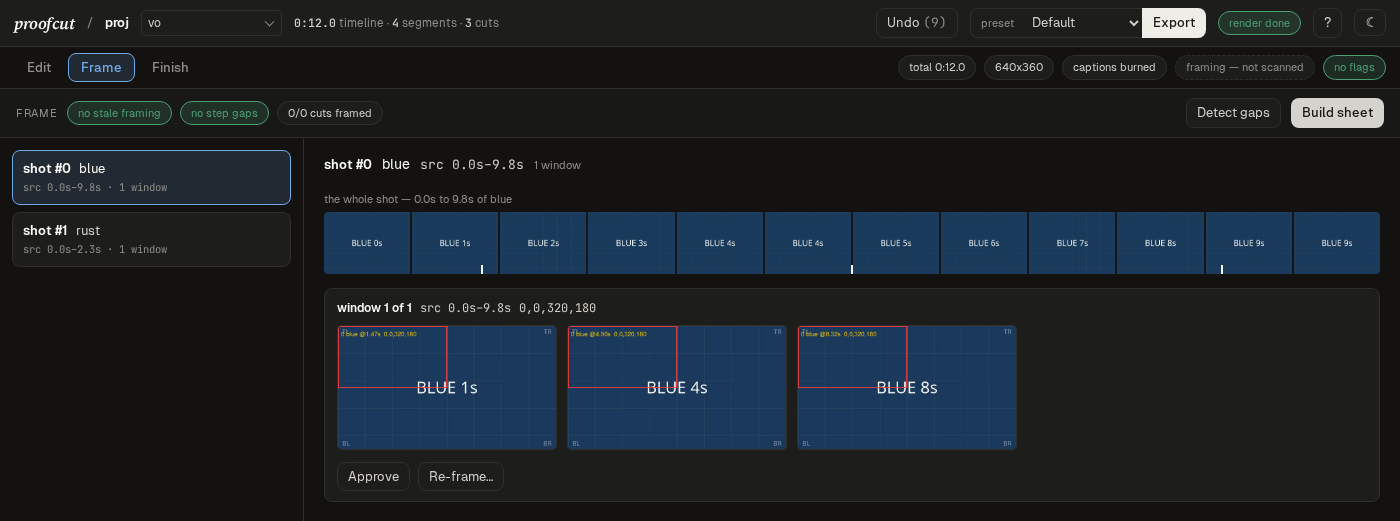
unspokenlets the render itself testify to words nobody said. - Reframing for another aspect. Per-shot crop windows, face-aware
proposals (
reframe-detect), a review sheet, and stacked splits for two speakers. Cards are redrawn at the new frame size, never stretched. - Screen recordings. Named instants (
events) that a crop, a sound or a speed change can hang off, a clip inset into the recording, and a retime for the slow parts. - Animated graphics. A graphic is a web page an agent writes or fills from a template (typing, a highlighter sweep, a letter build, chips), captured frame by frame by a headless browser and placed over a span of words. It animates in, holds as long as the span lasts, and animates out, so a cut never breaks one. Saved graphics carry across projects.
- Stills and stickers. Photos and cut-outs go in once, upright, and play full frame or ride over the film as stickers: placed, sized, turned, framed as a photo card, popping or sliding in. Paste one into the agent's prompt and it is added.
- Built for agents. 132 MCP tools with typed inputs, structured returns and read/write annotations, so Claude Code, Codex or your own agent can drive it and a permission layer can tell a look from a change.
- No lock-in. The timeline is OpenTimelineIO, the manifest is JSON, and
the render is ffmpeg's and MLT's. Export a
.kdenliveor OTIO file and finish anywhere.
How people use it
Tell an agent what film you want. In Claude Code, install the plugin and describe the film: which recording is the voice, what the b-roll is, where the music goes, what it ends on. The agent imports, transcribes, cuts the retakes, hangs footage off the lines it belongs to, scores, masters and checks the render, using proofcut's tools and nothing else. It can look at the picture track as a labelled grid while it works, so it sees what it placed rather than a filename. Every MCP client runs the same server; the plugin is the one that needs no setup.
Cut from a shell, by naming words. Every tool is also a proofcut
subcommand printing JSON, so a cut is a script you can read, re-run and
diff. --plan prints what a range says before anything changes, and undo
walks it back.
Related MCP Servers
Reviews
No reviews yet — be the first to share how this listing worked for you.
Frequently Asked Questions about Proofcut
AllMCPs Directory Badge
Showcase your server listing on GitHub or your project documentation. Embed this dynamic SVG badge to highlight official listing status and live engagement.
Badge Style:
Live Dynamic SVG Preview
Markdown (GitHub README)
[](https://allmcps.com/mcp/proofcut)HTML Embed
<a href="https://allmcps.com/mcp/proofcut"><img src="https://allmcps.com/api/badge/proofcut?style=directory" alt="Proofcut on AllMCPs" /></a>