4,337 pre-production checks: security, performance, scale, integrations, post-launch.
Quick Install
Automated & IDE SetupCopy the AI prompt to install this server into Claude Code, Cursor, or another agent — or use 1-click editor setup below.
Not yet automatically verified
We haven't yet run this listing's install command through our automated sandbox check. This isn't a red flag — we're steadily working through the catalog.
Manual Client & Custom JSON ConfigExpand JSON ▾
Client Config & Setup
Choose your client or environment
Target File:
💡 Paste the JSON block into your client's configuration file under mcpServers, then restart the application.
Documentation Overview
Pre-Production Checklist
Checklists to run before you ship to production.
Built for solo founders and small teams who own the whole stack — the code, the infrastructure, the deploy pipeline, and increasingly the AI agents too — and who don't have a security team to hand it to.
4,352 items across 96 checklists in 5 domains. 88% of them apply to any stack.



→ prodcheck.pages.dev · or in the repo
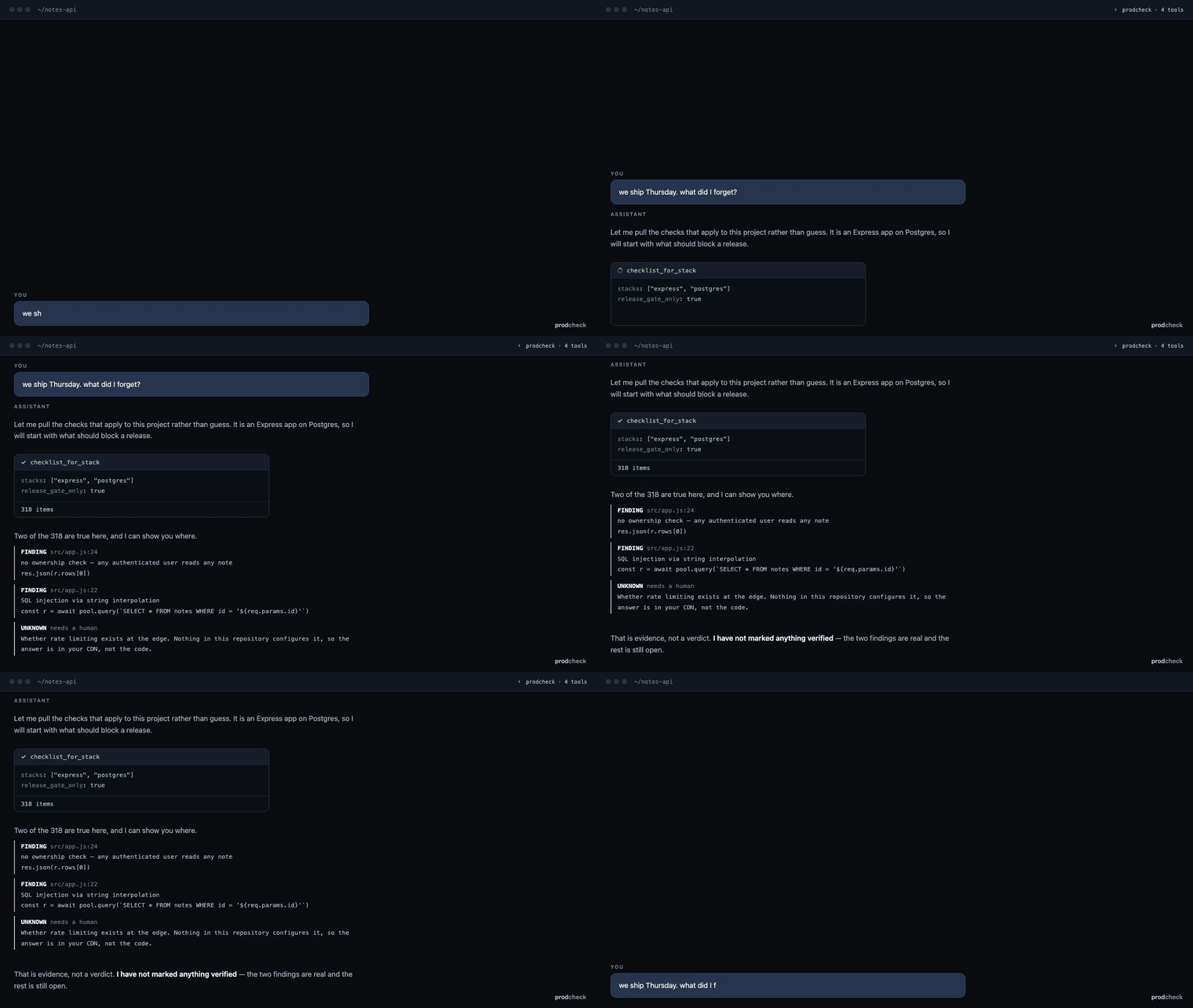
One question, the tool call it makes, and the two things it finds. Sixteen seconds. The longer loop shows what is in the list instead.
Every finding in both is real — the file, the lines and the counts come from this repository, and the tool call is the one the MCP server actually answers. How they are built.
Built and maintained by the team at Arioo — where we ship the kind of product this checklist was written for.
Why this exists
I'm a founder at Arioo. Getting ready to launch, I needed a pre-production security review that covered the whole surface we actually ship: a TypeScript backend, a web app, native clients, a deploy pipeline, and a set of AI agents with real tools attached. Nothing I could find covered more than a fraction of that, so I built the checklist myself.
This repository is the checklist, not a report. It is the set of questions, generalized away from our stack and rewritten as a working document anyone can run against their own product.
Two things made it worth publishing rather than keeping:
Solo founders have no security team. You write the code, configure the infrastructure, set up the pipeline, and then you're also the one who has to decide whether it's safe to launch. There's no one to hand it to, and no obvious place to find out what you should have asked. Most public checklists are either too shallow to catch anything real or written for enterprises with a security function.
AI-assisted development changed the shape of the problem. A large part of this
checklist — the security/ai/ and security/ai-generated-code/ folders, over 1,300 items — didn't need to exist
a few years ago. When you ship an agent with tools, or when a model writes code you review
faster than you'd review a colleague's, you inherit failure modes that standard security
checklists don't cover. Those two folders are the part I couldn't find anywhere else, and
the reason I bothered.
It's published under CC BY 4.0 so you can copy it into your own repo and make it yours. If it catches something before it reaches your users, it did its job.
Start here
If you are not sure which way in, don't choose — copy this into whatever AI assistant you already use (ChatGPT, Claude, Cursor, Copilot, Gemini). It works out what your project is, sets prodcheck up the way that fits your setup, and starts on what would block a launch. If it cannot run commands, it tells you what to run yourself.
Read it on the site instead → · six more prompts →
Or work through it yourself
You are not meant to read this top to bottom. In order of signal-per-minute:
| 1 | Findings that should block release | If any are true, stop and fix them first |
| 2 | The "must not exist" search | A grep list. Fastest real signal in the repo |
| 3 | Authentication & authorization | Where almost every exploitable bug actually lives |
| 4 | Prompt injection | Only if you ship an LLM feature — but then, urgently |
| 5 | Your service as a weapon | The one nobody looks for until the suspension email arrives |
| 6 | Core Web Vitals | If users say it's slow, start here rather than with a score |
| 7 | Before you launch | Six items. One of them is noindex still being on |
| 8 | Can you act at all | Whether you could respond today, if you had to |
Then work section by section. Switching between edge config and database policies costs more than it saves.
Structure
Counts above are what each folder holds. A domain total is larger, because the stack supplements contribute to whichever domain each of their sections extends:
Domains are the top level because that is the question you arrive with: is this about security, or speed, or scale?
security/core/ — applies to you regardless of language
Written originally against a TypeScript stack, but the controls are not
TypeScript-specific and the files no longer pretend otherwise. "Verify CORS does not use
wildcard origins with credentials" is as true in Django as in Express. Everything that
genuinely named a product was moved out to stacks/.
If you write Python, Go, Ruby, PHP, Java, Rust or Elixir: this folder is your checklist, all 1,491 items of it.
Related MCP Servers
Adoption & maintenance
Factual signals from GitHub, npm, and our automated checks — not a rating.
GitHub stars
12
Stargazers on the source repository.
npm downloads
2.6k
Package downloads in the last 30 days.
Last commit
Today
Most recent push to the default branch.
Reviews
No reviews yet — be the first to share how this listing worked for you.
Frequently Asked Questions about Prodcheck
AllMCPs Directory Badge
Showcase your server listing on GitHub or your project documentation. Embed this dynamic SVG badge to highlight official listing status and live engagement.
Badge Style:
Live Dynamic SVG Preview
Markdown (GitHub README)
[](https://allmcps.com/mcp/prodcheck)HTML Embed
<a href="https://allmcps.com/mcp/prodcheck"><img src="https://allmcps.com/api/badge/prodcheck?style=directory" alt="Prodcheck on AllMCPs" /></a>