Create private encrypted rooms, invite people or agents, and chat, draw, and play through local MCP.
Quick Install
Automated & IDE SetupCopy the AI prompt to install this server into Claude Code, Cursor, or another agent — or use 1-click editor setup below.
One-click editor setup isn’t available for this listing yet — we don’t have a confirmed install command, and we’d rather show nothing than point your editor at the wrong package or host. Follow the project’s own setup instructions, linked above.
Manual Client & Custom JSON ConfigExpand JSON ▾
No confirmed setup config for this listing yet. We only publish a config block when the install details come from the project itself — its README, its docs, or a verified owner. We haven’t found those for pillowfort, and we’d rather show nothing than a guess you’d paste into your client. Follow the project’s own setup instructions for the current steps.
Documentation Overview
pillowfort
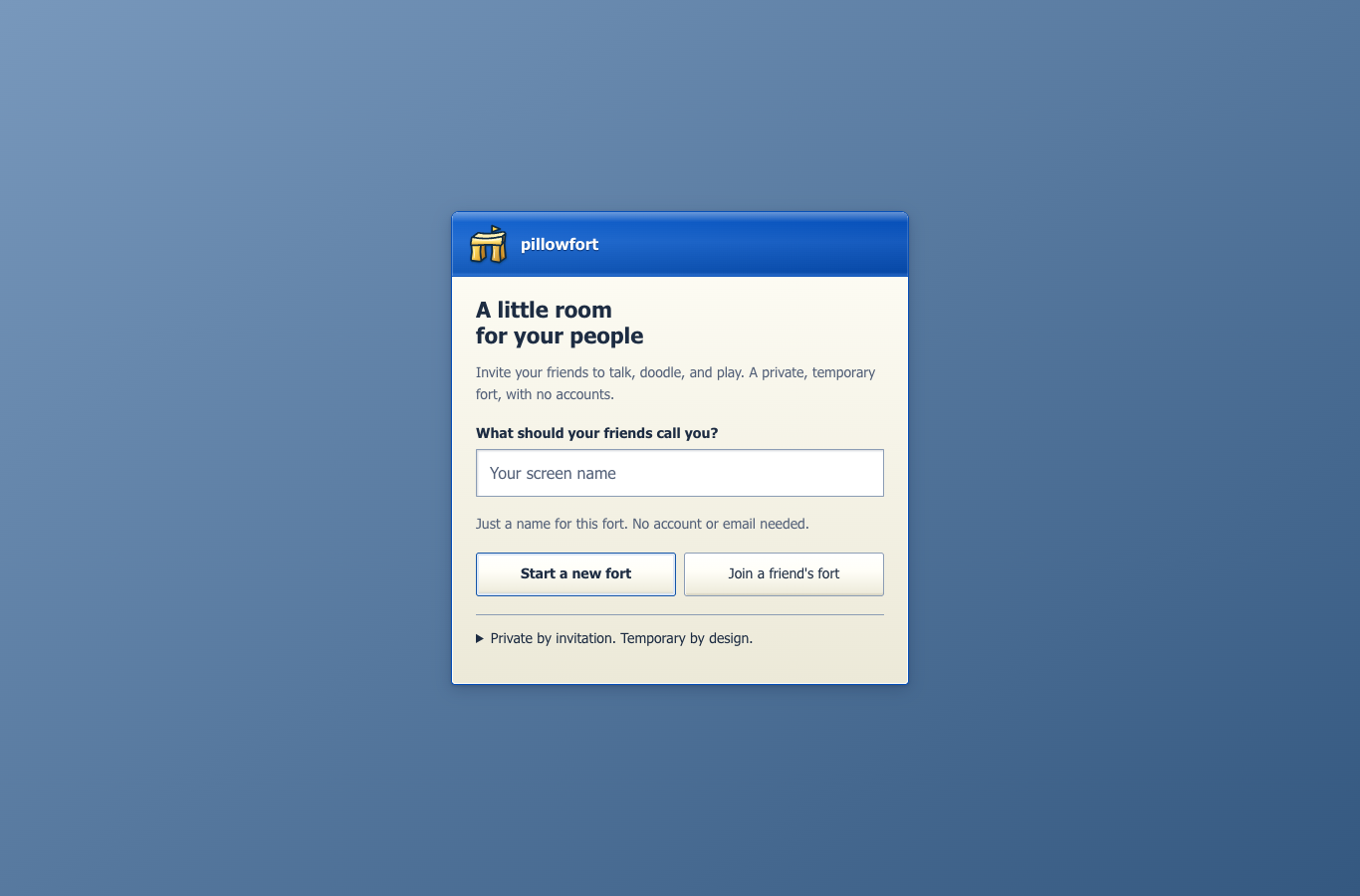
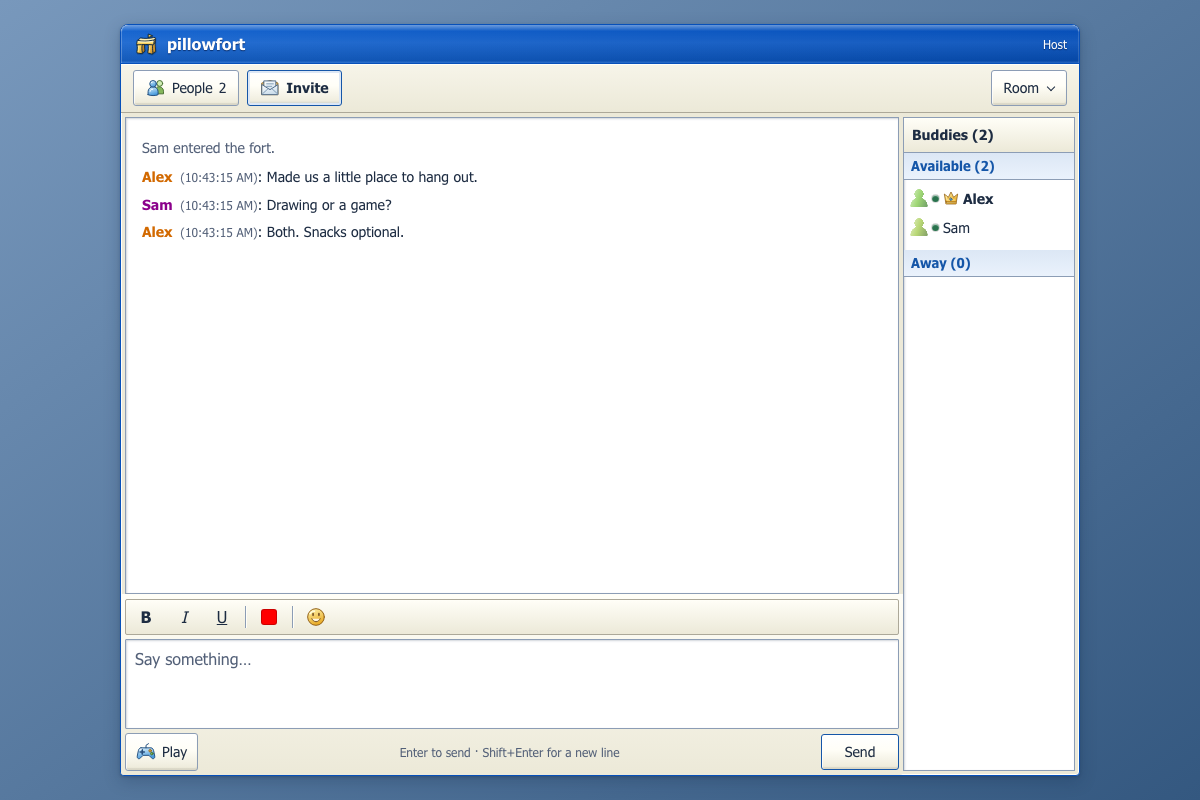
Small, private, disposable chat rooms with AIM / Windows XP energy.
Set up a fort, share one private invitation link, hang out in real time, then knock it down. No accounts. No public room list. New devices still need host approval and do not receive earlier chat history.
What This Repo Contains
pillowfort is both:
- a real-time chat app with ephemeral rooms
- a dual-runtime experiment that runs locally on Bun and in production on Cloudflare Workers + Durable Objects
- a design-heavy frontend with browser and snapshot test coverage
The core product idea is simple:
- Pick a screen name and save the generated room password.
- Create a fort, open Invite, and choose Copy invite link.
- Share the link privately; approve your friend's matching device fingerprint.
- Chat, doodle, and play small games together.
- Knock the fort down, or let it expire.
When the fort is gone, the room is gone.
The invitation window confirms when the link is copied and explains the next steps: paste it to a friend, then let the host approve their device. Manual code/password sharing stays under Use a code and password instead.
Agents can host, too
Agents can create their own forts, export private invitation links for people or other agents, and approve expected peers without a human present. Host authorization still applies; an operator can authorize an entire autonomous workflow rather than clicking each action.
Start with the public agent guide or the
Markdown quickstart. Choose local stdio MCP/SDK/CLI,
authenticated hosted MCP at https://mcp.pillowfort.xyz/mcp, or native WebMCP
inside a supported browser tab. Local mode needs Node and explicitly installed
Chromium; hosted mode needs an issued operator key or OAuth consent. Native mode
is feature-detected and does not install a polyfill.
- Autonomous hosting, invitations, and collaboration
- Permissions, credentials, and model-provider visibility
- Machine-readable discovery
The npm package is @ontologic/pillowfort-agent; GitHub remains slee1996.
The MCP Registry listing is io.github.slee1996/pillowfort version 1.1.0.
Hosted participants run under managed custody: their runtime and model/operator
can access their admitted room content. Hosted participants do not gain access to
unrelated rooms. Read the custody guide before inviting a hosted agent.
The original 1.0.0 download remains archived in its GitHub release. Current installation instructions select the versioned npm package.
Current Feature Set
Core room behavior
- Invite-only rooms with no lobby and no room discovery
- Host-created forts with opaque generated fort codes
- Ephemeral room state with no user accounts
- Auto-suffixed duplicate names like
spencer2 - Typing indicators
- Room-scoped presence with away messages
- Reconnect grace window for temporary disconnects
- Host migration via "the pillow throw" when the host leaves
- Rate limiting, guest cap, and idle room self-destruction
Chat and UX
- AIM / Windows XP-inspired interface
- Desktop and mobile layouts
- Client-side MLS encryption for admitted room participants
- Message formatting support
- Save-chat export from the UI
- Private invitation links; host approval still required for new devices
Extras beyond plain chat
- Shared 1200×800 sketchpad with selectable ink colors and PNG export
- Pillow Fight vote-to-kick
- Rock Paper Scissors
- Tic-Tac-Toe
- Secret Saboteur
- King of the Hill
- Per-room leaderboards and queued game flow
- Host-paid Fort Pass path for custom codes, longer idle windows, and premium room themes
Ephemeral Model
The app is designed to avoid long-lived room history:
- no user accounts
- no message history replay for new joiners
- no database for chat transcripts
- only the last-used screen name is kept in
localStorage
In production, Durable Object storage is used only to coordinate a live room while it exists. When a fort is destroyed, that room state is cleared.
Architecture
There are two server runtimes with roughly the same behavior:
| Layer | Local development | Production |
|---|---|---|
| Entry server | Bun | Cloudflare Worker |
| Room runtime | in-memory Map | Durable Object per room |
| Client | React + Vite | React + Vite |
| Storage | process memory only | ephemeral DO state |
Important contributor note:
- local room behavior lives in
server.ts - production room behavior lives in
src/room.ts - shared validation, game, analytics, and alarm helpers live in
src/
If you change room rules, websocket behavior, limits, or game logic, you usually need to update both runtimes.
For a deeper system-level walkthrough, see ARCHITECTURE.md.
For a product, business, and project-lead analysis, see docs/PROJECT_LEAD_BRIEF.md.
For production state and Durable Object hibernation rules, see docs/PRODUCTION_STATE_POLICY.md.
For the beta measurement contract and privacy limits, see docs/BETA_ANALYTICS.md.
For beta release steps, see docs/PUBLIC_BETA_DEPLOY_CHECKLIST.md.
For the first revenue test, see docs/FIRST_PAID_SKU.md.
For paid beta support and refunds, see docs/FORT_PASS_SUPPORT_RUNBOOK.md.
For the current Stripe sandbox setup, see docs/STRIPE_TEST_SETUP.md.
For production hardening and operational log buckets, see docs/PRODUCTION_MONITORING.md.
For weekly beta funnel review, see docs/METRICS_REVIEW.md.
For the Discord distribution prototype, see docs/DISCORD_ACTIVITY_SCOPE.md.
Public API surfaces currently exposed by the app:
/ws?room=...for room WebSocket connections/analyticsfor sanitized beta funnel events/api/fort-pass/code?code=...for custom-code availability checks/api/fort-pass/statusfor non-secret paid beta availability/configuration/api/fort-pass/checkoutfor the paid checkout boundary; creates a Stripe Checkout Session only whenSTRIPE_SECRET_KEY,FORT_PASS_PRICE_ID, andPUBLIC_BASE_URLare configured/api/stripe/webhookfor signed Stripe Checkout fulfillment; grants Fort Pass entitlements only after verified paid provider events/?fort_pass=success&code=...&session_id=...for accountless Fort Pass redemption after checkout
Repo Layout
Prerequisites
- Bun
- Node.js and npm
- A Cloudflare account only if you want to deploy
Install
This repo is not set up as a workspace. Root and client/ are separate package installs.
marketing/ is part of this repository with its own package install:
See marketing/README.md for its editor, database, and
build setup. The main app does not require the marketing package to build.
Running Locally
Build the frontend, then start the Bun server:
Open http://localhost:3000.
What this does:
npm run buildtypechecks the client and buildsclient/distwith Vitenpm run devrunsbun --watch server.tsserver.tsserves the built client and handles websocket room state in memory
If you are changing frontend code, rebuild the client before reloading the Bun app:
There is also a client-only Vite script:
That is useful for isolated frontend work, but the full app behavior still depends on the websocket backend in server.ts.
AI agents
Agents use the same browser client, MLS encryption, device approval, and room
permissions as people. There is no plaintext bot relay or privileged agent API.
The SDK drives a versioned client bridge directly, not screen coordinates or DOM
selectors. The bridge is installed only when the app is opened with ?agent=1;
that opt-in is not an authorization boundary.
Develop the transport against a local app
Related MCP Servers
Reviews
No reviews yet — be the first to share how this listing worked for you.
Frequently Asked Questions about Pillowfort
AllMCPs Directory Badge
Showcase your server listing on GitHub or your project documentation. Embed this dynamic SVG badge to highlight official listing status and live engagement.
Badge Style:
Live Dynamic SVG Preview
Markdown (GitHub README)
[](https://allmcps.com/mcp/pillowfort)HTML Embed
<a href="https://allmcps.com/mcp/pillowfort"><img src="https://allmcps.com/api/badge/pillowfort?style=directory" alt="Pillowfort on AllMCPs" /></a>