Ontology Atlas README
The full upstream README, mirrored here for reference. Install config, tool schemas, adoption signals, and an original overview live on the Ontology Atlas listing page.
Ontology Atlas

Understand your system as AI agents change its code.
Give agents task context. Inspect the meaning, evidence, and unknowns yourself.
Download for macOS · Windows x64 beta unsigned · Live demo · Guide · Status





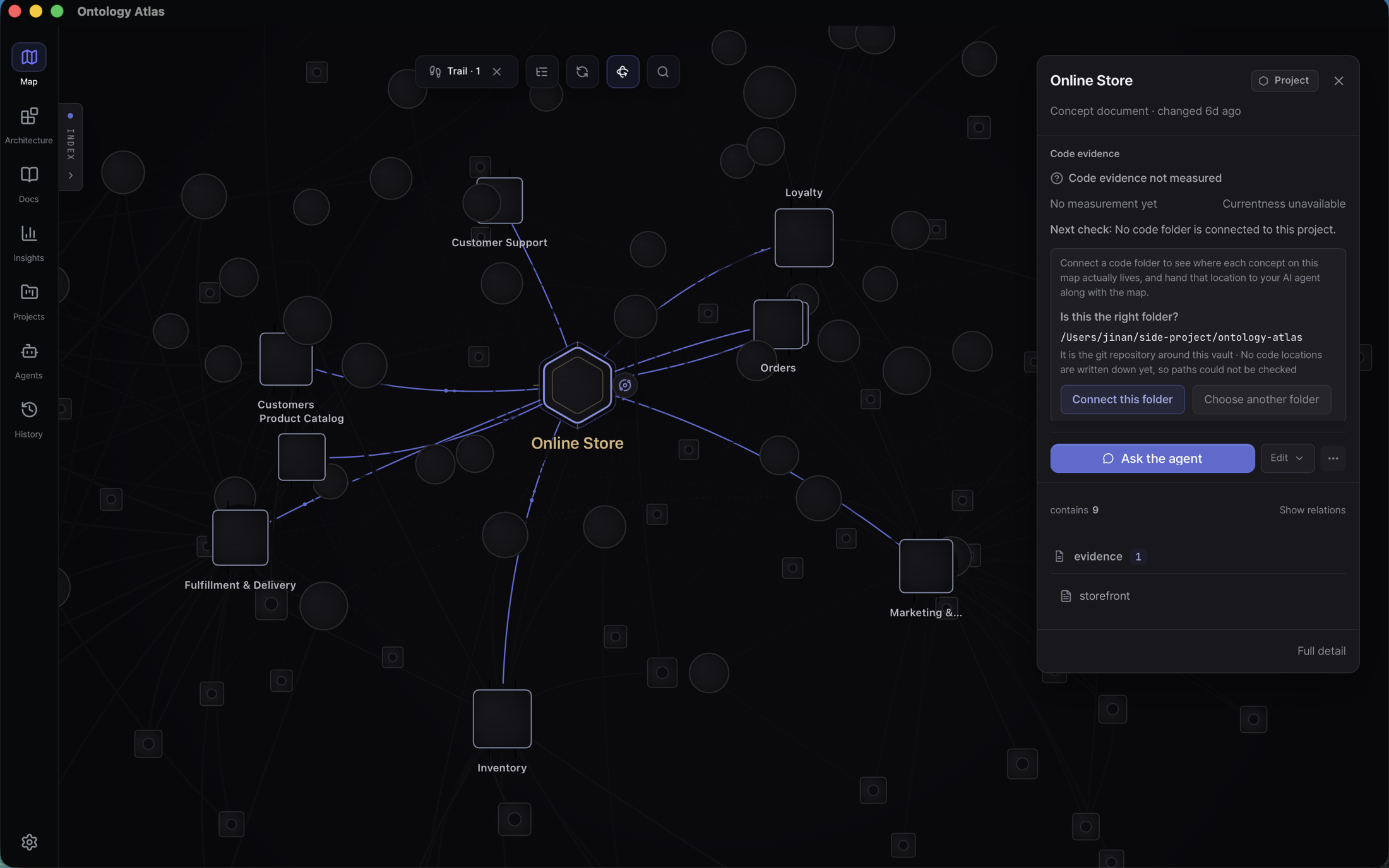
Every screenshot reads samples/storefront, an online store described by Markdown files in this repository.
In 30 seconds
| What | An atlas/ folder of Markdown inside your repository. Each file's frontmatter says what it is (project, domain, capability, element, document) and what it points at. That folder is the whole database. |
| For your agent | Typed task context over MCP: capabilities, code anchors, declared dependencies, evidence, and unknowns. |
| For you | The same records on a map, in documents, and as Git diffs, so you decide which meaning changes to keep. |
| Honest by design | A graph path is a declared relationship, not proof of runtime impact. Missing evidence shows as unknown, never as safe. |
See it
 Map — select a concept; everything unrelated recedes. |  Five views — Flat, Galaxy, Cone, Strata and Neural. |
 Agents — chat with Claude Code or Codex inside the app. |  MCP — one button per agent, then a live connection proof. |
 Library — gather any document, compile cited wiki pages. |  Documents — edit the Markdown that becomes the graph. |
 Architecture — reviewed roles against the imports in code. |  Relation review — see before and after, then confirm. |
 History — the exact Markdown diff before you save. |  Analysis — what to fix next, by measurement, not a score. |
How it works
- Open a folder — the app reads Markdown in place, or starts
atlas/from your code. The path is shown before anything is written. - Connect your agent — one button writes the MCP config; a restart and
mcp-verifyprove the connection is live. - Ask for context —
query_ontologywithoperation: "agent_brief"gives the agent a bounded brief for its task. - Review the meaning — proposed changes arrive as Markdown diffs; you keep, correct, or reject them in Git.
Definition previews preserve complete introductory text; the full document retains exclusions and uncertainties. Local code inspections show the connected folder and offer native permission recovery before reading.
What one node looks like
A path points at code; a slug points at a node. dependencies are directed and
relates is symmetric, so the map never turns similarity into causality. Only
files with kind: join the graph; sources/** and wiki/** pages do not.
Full contracts: what becomes a node? ·
relations ·
vault specification.
Principles
| Local-first | Not a… |
|---|---|
| Your disk is the database; Git is the history. | general-purpose ontology editor |
| No Atlas backend, account, or telemetry. | code index or IDE |
Model and provider transfers are opt-in and logged in .ontology-atlas/llm-audit.jsonl. | automatic acceptance of generated knowledge |
| MCP and CLI read the folder directly, even with the app closed. | RDF/OWL/SHACL implementation (§5.2) |
Extensions are files a git diff shows you, never third-party code. | service, and not on npm |
Measured, honestly: our first benchmark mostly tested vocabulary only Atlas knew. Re-scored, we have not yet measured a difference in answer quality, and Atlas was slower. The correction · benchmark log.
Status — read this before installing
- The download page is the release authority: tag, sizes, checksums, and signing state. GitHub Releases is the second source.
- macOS is Developer ID signed and notarized, with the MCP server inside the bundle.
- Windows x64 is an unsigned beta — SmartScreen may warn, and a managed PC may refuse it. See Security.
- Linux and others run the browser app, or the CLI and MCP server from a source checkout.
- Every release is a plain version; the in-app updater verifies each archive's signature before installing.
Documentation
Use it: hosted guide ·
features · MCP setup ·
CLI reference
Model a vault: what becomes a node? ·
relations ·
specification ·
quality authority map
Understand it: product direction ·
architecture · security ·
decisions
Contributing
Issues and pull requests are welcome; the most useful report points Atlas at a
real repository and shows where it falls short. Read
CONTRIBUTING.md first (external pull requests come from
forks), and AGENTS.md is canonical for people and agents alike.
Start with pnpm checks:changed -- --run; land with pnpm pr:land <number>.
Repository commands
| Command | What it answers |
|---|---|
pnpm agents:check | Each harness's instruction integrity; independent Codex and Claude files need not match |
pnpm backlog · pnpm backlog:check | Current task records and concurrent-state conflicts; append a UUID record per worktree observation (guide) |
pnpm bundle:plan · pnpm bundle:prune | Land several branches as one: plan the merge (which carry work, shared files, trial conflicts) and afterwards prune the component branches main provably contains. See /land-bundle |
pnpm checks:changed | Which gates this change actually needs |
pnpm conflicts:scan | Which open pull requests (and -- --match=<glob> local branches) change the same files as this branch, and whether a trial merge with each conflicts; read-only, one gh call |
pnpm decisions:find <terms> · pnpm decisions:check | The decision record to cite or overturn, and whether this change owes one |
pnpm doc:new -- --type=<kind> --area=<area> --slug=<slug> | A new living document from its template in docs/.templates/, at the path its kind decides |
pnpm docs:check | Docs gates, including pnpm docs:language, pnpm source:language, pnpm changelog:check, pnpm dev-checks:check, pnpm docs:meta |
pnpm docs:meta · pnpm doc:history -- <path> | Whether every living document carries its kind, status and area with pointers that resolve; one document's commits across moves, which is its version |
pnpm docs:move | Moves the documents listed in docs/.moved.json and rewrites every reference; rerun it after merging main into an older branch (-- --check only reports) |
pnpm e2e:durations -- <timings dir> | Rewrites the per-file weights that balance the browser shards from downloaded playwright-timings-* reports |
pnpm e2e:sleeps:check | A change may not add a fixed waitForTimeout to an e2e spec unless a // measurement window: note says why |
pnpm gates:yield -- --runs=200 | Which CI checks ever failed, per distinct run, from the lane reports checks.yml uploads (cached in ~/.cache/atlas-gate-yield); a row with 50+ runs, no failed run and 60+ days of history reads no CI failure, a check to examine rather than delete, since pre-push and pnpm checks:changed catches are not in this data. Reports start with the change that added them |
pnpm gateway:capture -- --base-url=<static export> | Re-shoots the six app screens the download page shows, Korean and English (public/gateway/<screen>.<locale>.png), from a served pnpm build, against this repository's own ontology |
pnpm knip | Dead files, exports and types across every scope |
pnpm lessons · pnpm lessons:check | Shared harness lessons that are open or verified but not yet fixed; record and review them with /harness-retro (records guide) |
pnpm messages:build · pnpm messages:check · pnpm messages:adopt | Compose the ignored messages/<locale>.json from one file per namespace (messages/<locale>/<Namespace>.json), prove it current, and carry a pre-split branch's catalogue edits onto the parts while merging main |
pnpm perf:mcp:memory · pnpm perf:mcp:memory:check | Whether the MCP server keeps memory it should release: heap after two forced collections across 50 repeated calls per tool and across moved Git HEADs, on a generated vault; about a minute, kept out of pre-push |
pnpm pr:ci <n> | Fire CI on a draft now, so a green, disjoint change can take the fast path |
pnpm pr:land --plan <n...> · pnpm pr:land --conduct | Dry-run what a landing would do without writing to GitHub, and run trains until the queue is empty |
pnpm pr:land <n> · pnpm pr:queue | Queue a pull request for the landing train (or merge it on the fast path), and show the queue and the train in flight |
pnpm typecheck | Types across every file, with Next's generated route and page types, so the browser build need not check them again |
Rows stay sorted by command, and the reference's entries by area, so two
branches that each add one land on different lines; pnpm dev-checks:check
names the line to move and -- --fix sorts both.
Development checks is the full gate reference, one
entry per area; map testability owns canvas
performance, readability, contrast, and instrumentation.