Multi-language code analysis for complexity, debt, hotspots, ownership, and defect prediction
Quick Install
Automated & IDE SetupCopy the AI prompt to install this server into Claude Code, Cursor, or another agent — or use 1-click editor setup below.
Manual Client & Custom JSON ConfigExpand JSON ▾
Client Config & Setup
Remote HTTPChoose your client or environment
Target File:
💡 Paste the JSON block into your client's configuration file under mcpServers, then restart the application.
Documentation Overview
Omen
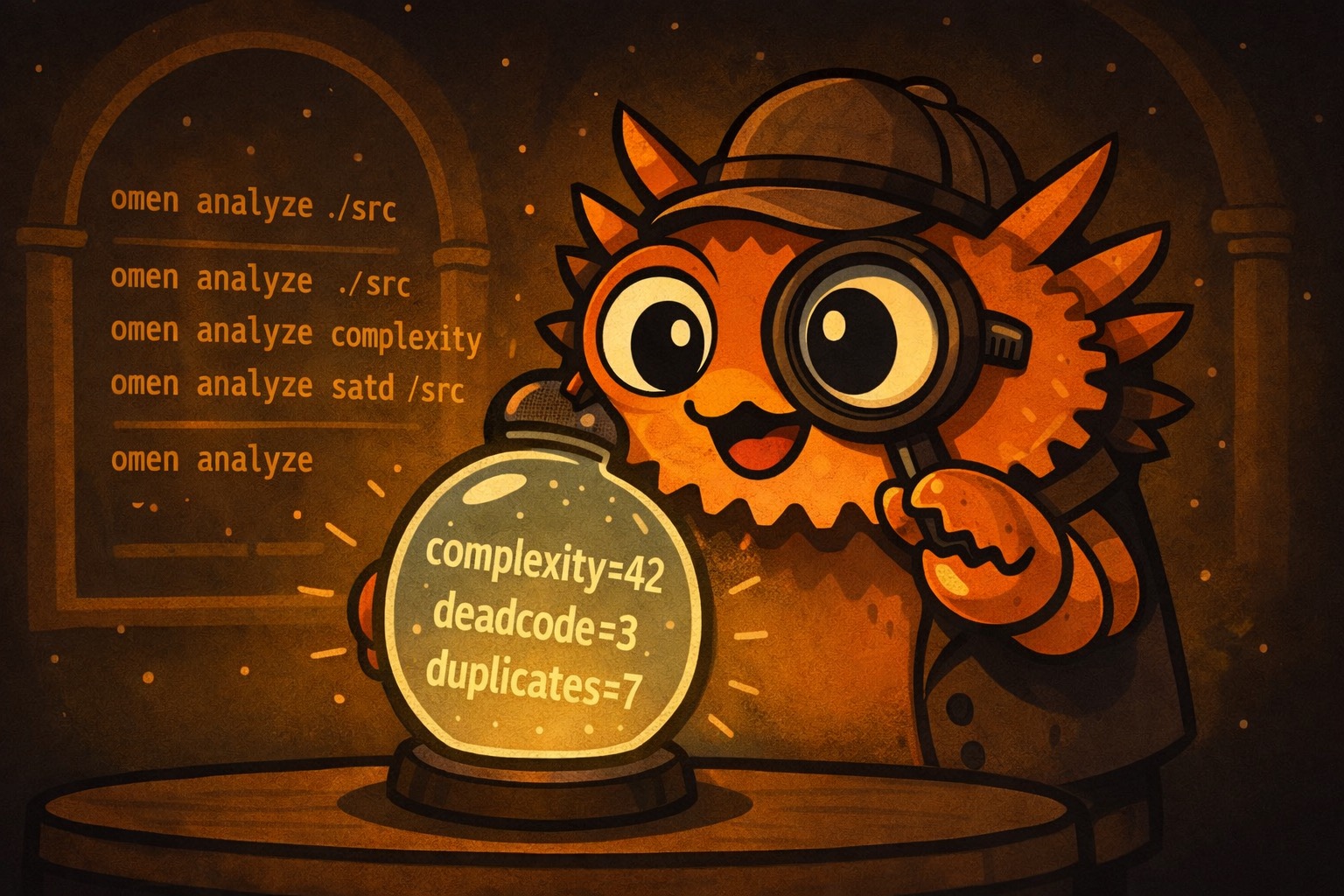





Your AI writes code without knowing where the landmines are.
Omen gives AI assistants the context they need: complexity hotspots, hidden dependencies, defect-prone files, and self-admitted debt. One command surfaces what's invisible.
Why "Omen"? An omen is a sign of things to come - good or bad. Your codebase is full of omens: low complexity and clean architecture signal smooth sailing ahead, while high churn, technical debt, and code clones warn of trouble brewing. Omen surfaces these signals so you can act before that "temporary fix" celebrates its third anniversary in production.
Features
Complexity Analysis - How hard your code is to understand and test
There are two types of complexity:
-
Cyclomatic Complexity counts the number of different paths through your code. Every
if,for,while, orswitchcreates a new path. A function with cyclomatic complexity of 10 means there are 10 different ways to run through it. The higher the number, the more test cases you need to cover all scenarios. -
Cognitive Complexity measures how hard code is for a human to read. It penalizes deeply nested code (like an
ifinside aforinside anotherif) more than flat code. Two functions can have the same cyclomatic complexity, but the one with deeper nesting will have higher cognitive complexity because it's harder to keep track of.
Why it matters: Research shows that complex code has more bugs and takes longer to fix. McCabe's original 1976 paper found that functions with complexity over 10 are significantly harder to maintain. SonarSource's cognitive complexity builds on this by measuring what actually confuses developers.
[!TIP] Keep cyclomatic complexity under 10 and cognitive complexity under 15 per function.
Self-Admitted Technical Debt (SATD) - Comments where developers admit they took shortcuts
When developers write TODO: fix this later or HACK: this is terrible but works, they're creating technical debt and admitting it. Omen finds these comments and groups them by type:
| Category | Markers | What it means |
|---|---|---|
| Design | HACK, KLUDGE, SMELL | Architecture shortcuts that need rethinking |
| Defect | BUG, FIXME, BROKEN | Known bugs that haven't been fixed |
| Requirement | TODO, FEAT | Missing features or incomplete implementations |
| Test | FAILING, SKIP, DISABLED | Tests that are broken or turned off |
| Performance | SLOW, OPTIMIZE, PERF | Code that works but needs to be faster |
| Security | SECURITY, VULN, UNSAFE | Known security issues |
Why it matters: Potdar and Shihab's 2014 study found that SATD comments often stay in codebases for years. The longer they stay, the harder they are to fix because people forget the context. Maldonado and Shihab (2015) showed that design debt is the most common and most dangerous type.
[!TIP] Review SATD weekly. If a TODO is older than 6 months, either fix it or delete it.
Stubs Detection - Incomplete or placeholder implementations left unfinished
SATD is debt a developer chose to keep; a stub is work that was never finished - the kind of thing an agent or human leaves behind mid-task. Omen finds stubs via tree-sitter AST analysis (never plain string matching, so string literals containing trigger words are never false positives) and groups them by pattern type:
| Category | Severity | What it means |
|---|---|---|
not_implemented | High | Explicit not-implemented idioms: todo!(), raise NotImplementedError, throw new Error('not implemented') |
elision | Medium | Comments admitting skipped work: // ... rest of the implementation, // placeholder, // your code here |
empty_body | Medium | A function/method with an empty body that can't legitimately be empty (non-void return type, or an elision comment inside) |
Why it matters: Unfinished work that looks complete (it compiles, it's committed) is more dangerous than code that's obviously missing - nothing signals it needs attention until it's called in production. Stubs feed into the composite health score's debt component alongside SATD, so unresolved stubs lower your repo's score just like unresolved TODOs do.
[!TIP] Add
omen stubs --gate errorto CI to block merges that leavetodo!()orNotImplementedErrorbehind.
Dead Code Detection - Code that exists but never runs
Dead code includes:
- Functions that are never called
- Variables that are assigned but never used
- Classes that are never instantiated
- Code after a
returnstatement that can never execute
Why it matters: Dead code isn't just clutter. It confuses new developers who think it must be important. It increases build times and binary sizes. Worst of all, it can hide bugs - if someone "fixes" dead code thinking it runs, they've wasted time. Romano et al. (2020) found that dead code is a strong predictor of other code quality problems.
[!TIP] Delete dead code. Version control means you can always get it back if needed.
Git Churn Analysis - How often files change over time
Churn looks at your git history and counts:
- How many times each file was modified
- How many lines were added and deleted
- Which files change together
Files with high churn are "hotspots" - they're constantly being touched, which could mean they're:
- Central to the system (everyone needs to modify them)
- Poorly designed (constant bug fixes)
- Missing good abstractions (features keep getting bolted on)
Why it matters: Nagappan and Ball's 2005 research at Microsoft found that code churn is one of the best predictors of bugs. Files that change a lot tend to have more defects. Combined with complexity data, churn helps you find the files that are both complicated AND frequently modified - your highest-risk code.
[!TIP] If a file has high churn AND high complexity, prioritize refactoring it.
Code Clone Detection - Duplicated code that appears in multiple places
There are three types of clones:
| Type | Description | Example |
|---|---|---|
| Type-1 | Exact copies (maybe different whitespace/comments) | Copy-pasted code |
| Type-2 | Same structure, different names | Same function with renamed variables |
| Type-3 | Similar code with some modifications | Functions that do almost the same thing |
Why it matters: When you fix a bug in one copy, you have to remember to fix all the other copies too. Juergens et al. (2009) found that cloned code has significantly more bugs because fixes don't get applied consistently. The more clones you have, the more likely you'll miss one during updates.
[!TIP] Anything copied more than twice should probably be a shared function. Aim for duplication ratio under 5%.
Defect Prediction - The likelihood that a file contains bugs
Omen combines multiple signals to predict defect probability using PMAT-weighted metrics:
- Process metrics (churn frequency, ownership diffusion)
- Metrics (cyclomatic/cognitive complexity)
- Age (code age and stability)
- Total size (lines of code)
Each file gets a risk score from 0% to 100%.
Why it matters: You can't review everything equally. Menzies et al. (2007) showed that defect prediction helps teams focus testing and code review on the files most likely to have problems. Rahman et al. (2014) found that even simple models outperform random file selection for finding bugs.
[!TIP] Prioritize code review for files with >70% defect probability.
Related MCP Servers
Adoption & maintenance
Factual signals from GitHub, npm, and our automated checks — not a rating.
GitHub stars
19
Stargazers on the source repository.
npm downloads
19
Package downloads in the last 30 days.
Last commit
Today
Most recent push to the default branch.
Reviews
No reviews yet — be the first to share how this listing worked for you.
Frequently Asked Questions about Omen
AllMCPs Directory Badge
Showcase your server listing on GitHub or your project documentation. Embed this dynamic SVG badge to highlight official listing status and live engagement.
Badge Style:
Live Dynamic SVG Preview
Markdown (GitHub README)
[](https://allmcps.com/mcp/omen)HTML Embed
<a href="https://allmcps.com/mcp/omen"><img src="https://allmcps.com/api/badge/omen?style=directory" alt="Omen on AllMCPs" /></a>Technical Specs & Signals
CategoryDeveloper Tools
45Quality signal: Fair · 45/100How this signal is calculated ▾
Server availabilityNot measured
Not scored for repo-hosted servers — we can't reach the running server, only its GitHub page. Hosted MCP endpoints are health-checked live.
Verified ownership10/20
Documentation & tools16/30
Adoption & activity8/15
Community engagement0/10
A guidance signal from public completeness & health data — not a user rating. New listings start lower and rise as they add docs, get verified, and grow adoption. Signals we can't observe for a listing are skipped, not counted against it.
Own this project?
This directory is pre-filled from public sources. Claim via GitHub README, site badge, or DNS TXT to unlock edit access and the Official badge and attach your website — proof is checked automatically, then reviewed by our team.
Free dofollow backlink: add your website and place the AllMCPs badge on it — no claim needed. We detect it automatically and keep it verified as long as the badge stays live.
Claim & get free dofollowShare & Embed
Add our SVG badge (dark/light directory styles) or embeddable widget to your site.