Extract numeric values from config files, data files and plain text.
Quick Install
Automated & IDE SetupCopy the AI prompt to install this server into Claude Code, Cursor, or another agent — or use 1-click editor setup below.
Not yet automatically verified
We haven't yet run this listing's install command through our automated sandbox check. This isn't a red flag — we're steadily working through the catalog.
Manual Client & Custom JSON ConfigExpand JSON ▾
Client Config & Setup
Choose your client or environment
Target File:
💡 Paste the JSON block into your client's configuration file under mcpServers, then restart the application.
Documentation Overview

Numbers-LE: Zero Hassle Number Extraction
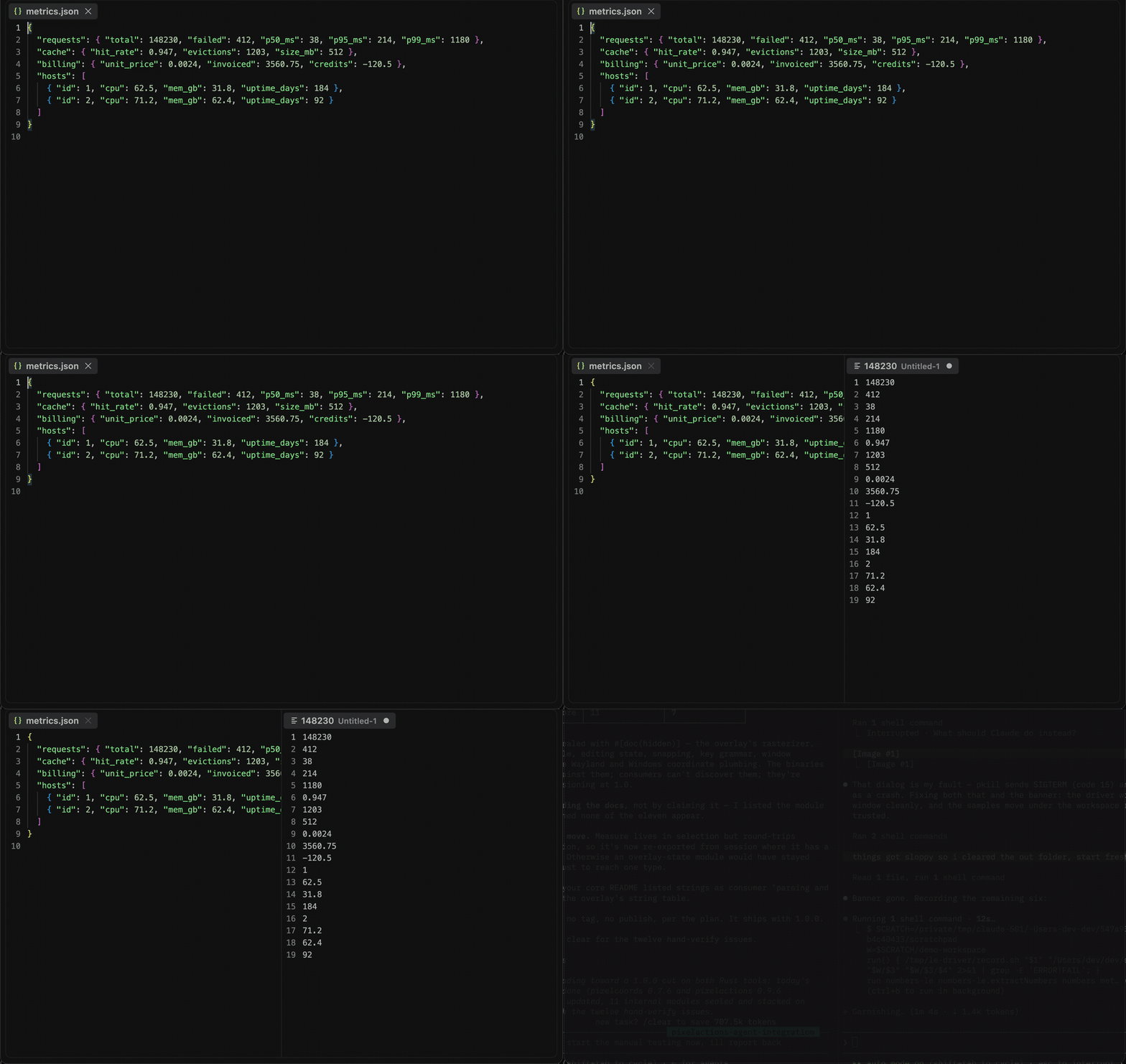
Pull every number out of the current file in one keystroke
JSON/JSONC, YAML, CSV/TSV, TOML, INI, Environment files, and twelve source languages




Useful? A star or rating is how other developers find it — ★ GitHub · ★ Open VSX · ★ Marketplace
What it does
Open a file, press Ctrl+Alt+N (Cmd+Alt+N on Mac), and every numeric value in the document lands in a new editor — deduplicate and sort it from there. Works in VS Code and in VS Code–based editors like Cursor and VSCodium (installable from Open VSX).
- Data validation — pull the numbers out of a config or fixture and eyeball ranges at a glance
- Config audits — compare ports, thresholds, and limits across INI/TOML/.env files
- CSV work — extract everything, one column, or several columns into separate documents
Install
| Where | What you get | Install |
|---|---|---|
| VS Code | The same extraction, in your editor, on a keystroke | Marketplace |
| Cursor, VSCodium, Windsurf | The same extension | Open VSX |
| A terminal or a CI step | The same run over a whole tree, with exit codes | cargo install numbers-le · crates.io |
| Any MCP agent, via Node | extract_numbers over stdio | npx numbers-le-mcp · npm |
| Zed | The MCP server as a context server | add it by hand (no listing yet) |
Use it from an AI agent
The same engine runs as an MCP server, so an agent can call it directly instead of you running a command.
| Editor | How |
|---|---|
| VS Code 1.101+ | Nothing to install — the extension registers extract_numbers with agent mode |
| Zed | No listing yet — add the MCP server by hand |
| Claude Code | claude mcp add numbers-le -- npx -y numbers-le-mcp |
| Cursor, Windsurf, anything else | point it at npx numbers-le-mcp |
Returns the values in document order, capped at 500 by default with meta.truncated. A format is optional — anything unrecognised is scanned as plain text rather than refused.
The server takes content and returns data — it reads no files and makes no network requests of its own. Published as numbers-le-mcp on npm and as io.github.nolindnaidoo/numbers-le in the MCP registry.
Configuring it by hand — any host with an MCP config file
Most hosts read a JSON config. Add one entry:
-y skips the install prompt on first run. Pin a version if you would rather not track releases — numbers-le-mcp@2.3.1.
Prefer not to go through npx on every launch? Install it once and point at the binary instead:
It speaks MCP over stdio and needs no environment variables, no API key and no configuration of its own. To check it before wiring it into anything:
That prints the tool list and exits — if you see extract_numbers, the server works.
Supported formats
| Format | What counts as a number |
|---|---|
| JSON | Number values anywhere in the structure. Quoted numbers ("42") are strings, not numbers, and are never extracted |
| YAML | Number values, including hex/octal int forms and exponents; multi-document (---) streams extract from every document |
| TOML | Integer and float values (dates are not numbers) |
| CSV | Cells whose entire content is numeric — 19.99 counts, 12abc and 1,000 do not. No header inference: every row is data |
| INI | Values whose entire content is numeric (INI values are inherently strings) |
| Environment | Values whose entire content is numeric (PORT=3000 yields 3000; VERSION=1.2.3 yields nothing) |
The shared policy (one heuristics module, applied to every format): only finite numbers are extracted — NaN and inf/.inf never appear in results — and a coerced string must be numeric in full: plain decimals with optional sign, decimal point, and exponent.
Python, Rust, Go, Java, Kotlin, C#, C, C++, JavaScript, TypeScript, SQL and shell are read by a numeric-literal extractor that understands hex 0xFF, binary 0b1010, octal 0o755 and legacy 0755, digit separators 1_000_000 and 1'000, and suffixes 123n, 1.5f, 10u32, 100L — and that knows u32 is a type name, not the number 32. A dialect changes an answer: 0755 is 493 in C, C++, Go and Java, and 755 in Rust, Python 3, Kotlin and C#.
Every finding carries the notation it was written in — decimal, hex, binary, octal, scientific, bigint. For anything left over you can pick a format explicitly or fall back to a plain-text scan (no grammar: v1.2.3 reads as 1.2 and 0.3).
The CLI
The same extraction runs from a terminal or a shell pipeline: a Rust CLI
in crate/, sharing one corpus with the extension —
crate/fixtures/ — so the two can never read a
document differently.
Somebody has to verify that the rate in the code is the rate in the specification. A tax percentage, a retention window, a rounding boundary. In a regulated setting that check is a deliverable, and the person doing it usually has no checkout and never has the editor open.
Numbers are printed exactly as JavaScript prints them — 1e+21, not
Rust's 1000000000000000000000. This tool's whole output is numbers as
text, so the rendering is the contract, and the corpus pins it.
Exit codes follow grep — 0 numbers found, 1 none found, 2 the question was malformed.
Commands
| Command | Description |
|---|---|
Numbers-LE: Extract Numbers (Ctrl+Alt+N / Cmd+Alt+N) | Extract all numbers from the active document |
Numbers-LE: Deduplicate Numbers | Remove duplicate numbers from the results |
Numbers-LE: Sort Numbers | Sort results numerically or by magnitude |
Numbers-LE: Toggle CSV Streaming | Flip csv.streamingEnabled for large CSV files |
Numbers-LE: Open Settings | Open Numbers-LE settings |
Numbers-LE: Help & Troubleshooting | Built-in documentation |
Settings
Related MCP Servers
Reviews
No reviews yet — be the first to share how this listing worked for you.
Frequently Asked Questions about Numbers Le
AllMCPs Directory Badge
Showcase your server listing on GitHub or your project documentation. Embed this dynamic SVG badge to highlight official listing status and live engagement.
Badge Style:
Live Dynamic SVG Preview
Markdown (GitHub README)
[](https://allmcps.com/mcp/numbers-le)HTML Embed
<a href="https://allmcps.com/mcp/numbers-le"><img src="https://allmcps.com/api/badge/numbers-le?style=directory" alt="Numbers Le on AllMCPs" /></a>