260 MCP tools across 49 domains. AI Flywheel, quality gates, research, web scraping.
Quick Install
Automated & IDE SetupCopy the AI prompt to install this server into Claude Code, Cursor, or another agent — or use 1-click editor setup below.
Not yet automatically verified
We haven't yet run this listing's install command through our automated sandbox check. This isn't a red flag — we're steadily working through the catalog.
Manual Client & Custom JSON ConfigExpand JSON ▾
Client Config & Setup
Choose your client or environment
Target File:
💡 Paste the JSON block into your client's configuration file under mcpServers, then restart the application.
Documentation Overview
NodeBench AI
Entity intelligence for any company, market, or question.
Live: nodebenchai.com
npm: npx nodebench-mcp / npx nodebench-mcp-power / npx nodebench-mcp-admin
GitHub: HomenShum/nodebench-ai
New to this codebase? Read docs/START_HERE.md — it
follows one user's question through the code in the order it actually runs, then
.tours/ walks the same path inside the live source in VS Code
(CodeTour extension). docs/codebase/ has the stack,
structure, conventions, integrations, testing and the honest list of known
problems. docs/SIMPLIFICATION_REPORT.md
records what was measured and removed, with the command for every number.
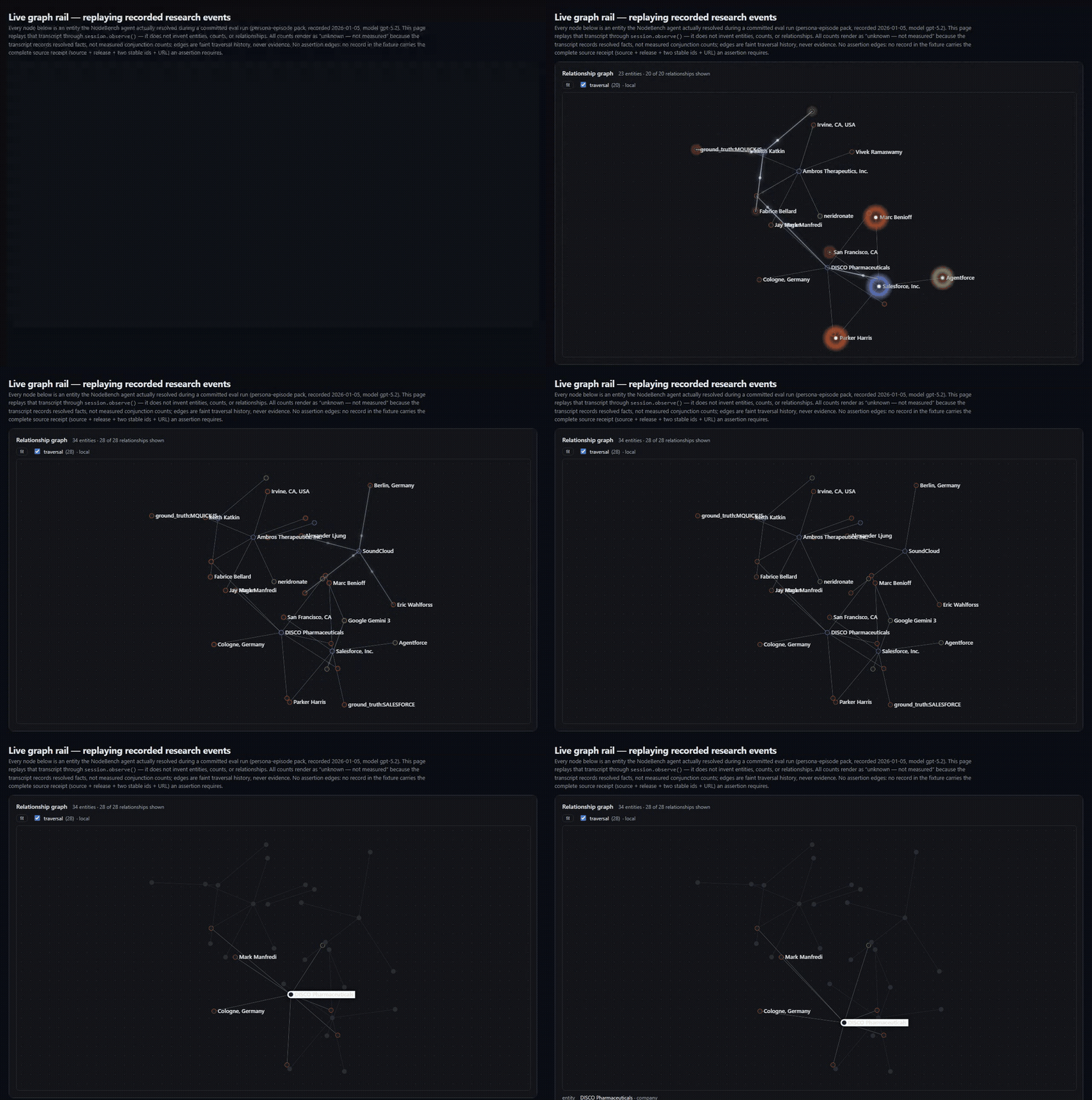
Recorded from demo/graph-rail/ replaying a committed eval transcript (persona-episode pack, 2026-01-05) through session.observe() — recorded events replayed, not re-verified; every label is a literal fixture substring, edges are traversal history, never evidence. Regenerate: node scripts/record-graph-rail-clip.mjs.
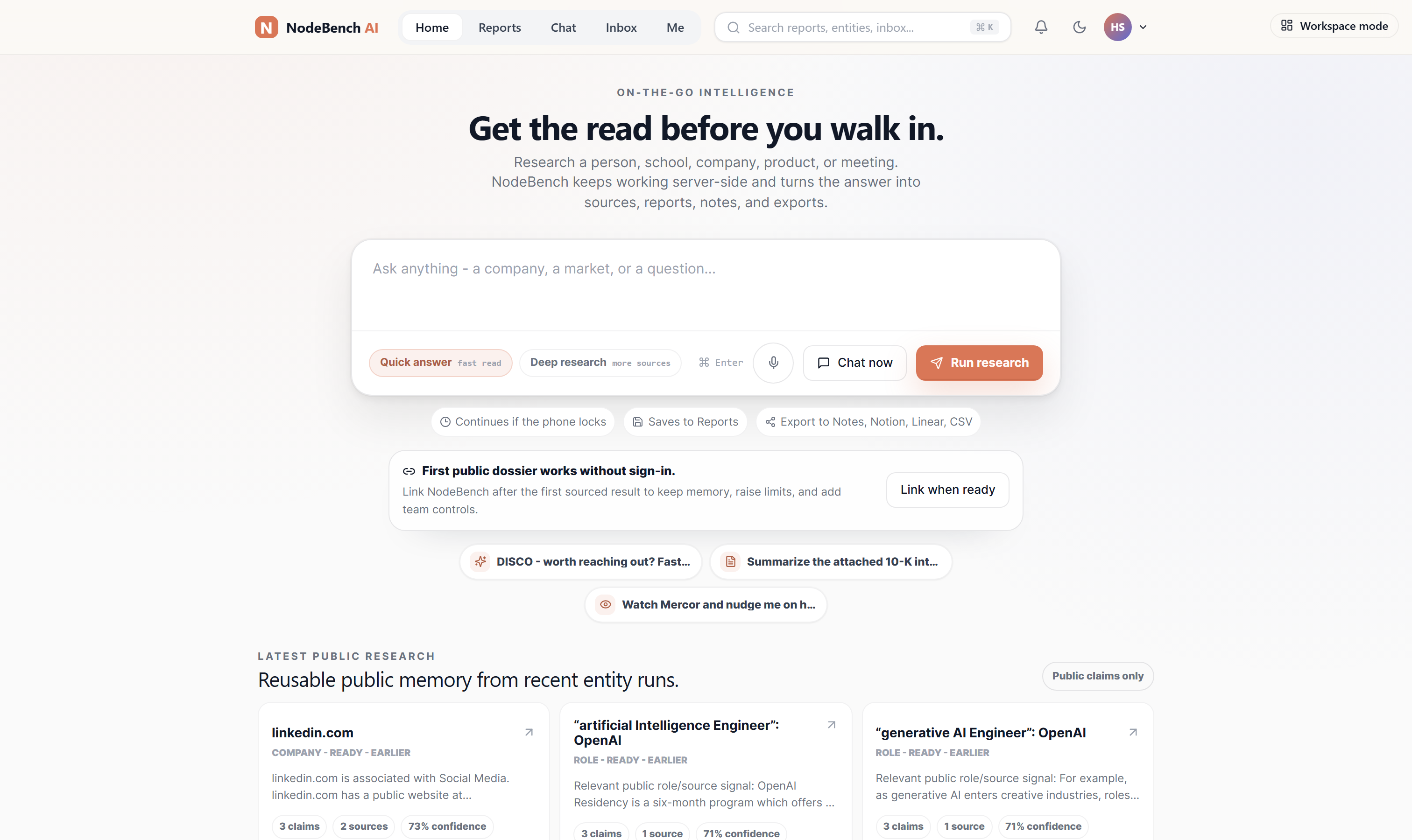
Product
NodeBench is a research and reporting product built around five user-facing surfaces:
Home= start quicklyReports= reusable memoryChat= do the workInbox= captures, nudges, alerts, automations, and unassigned reviewMe= operator context and control
Deep research opens in the separate Workspace surface at nodebench.workspace;
it is not a sixth tab in the operating app.
The core idea is simple:
users do not just need a chatbot that answers once.
They need a system that can:
- take a question, file, URL, or prior thread
- search and synthesize with sources
- turn the run into a reusable artifact
- watch for meaningful change later
- improve the next run from what it learned
Pending Release Candidate: Runtime-Grounded Control Focus
This candidate is not yet merged or deployed. It narrows the reachable product to controls backed by a real runtime capability and makes unavailable state explicit:
- Agents keeps ask, explicit swarm launch, active work, approvals, sources, traces, receipts, exports, and provenance while removing projected metrics, synthetic fallbacks, duplicate actions, and local-only controls.
- Generated code remains copyable and exportable but never executes inside the signed-in app origin. Runtime cards accept successful structured tool output, not assistant prose, guessed search fields, or incomplete/error states.
- Canonical owner-scoped streaming remains; an unreferenced bearer-stream component and HTTP route were removed instead of retained as a second path.
- Home, Reports, Chat, Inbox, and Me use live runtime data, owner-scoped where private, or honest loading, empty, not-found, and unmeasured states instead of reachable product fixtures. Desktop and mobile now share the same Inbox and Me component trees; duplicate queue/profile renders and their hard-coded plan, usage, connector, and local-draft projections were deleted.
- Pipeline launches and schedules require an authenticated server identity, while guest history, detail, bundle, stream, and evaluation reads require an anonymous-session possession credential. Browser-supplied owner keys are no longer an authority boundary, and trusted cron or MCP work stays on internal contracts.
- Authenticated launches consume durable per-owner admission: four units per ten minutes and thirty per day, with composed runs costing two units. Server input bounds and per-owner schedule caps close the remaining cost-abuse path.
- Fresh pipeline attempts and recurring schedule occurrences are isolated by durable attempt identities and execution-generation fences, so retries can resume the same attempt without stale or overlapping workers rewriting it.
- Research distinguishes sources consulted from citations actually bound in the synthesis. Missing, malformed, or unbound evidence cannot be promoted to a verified claim, and chat no longer injects citation markers into prose.
- Operator telemetry and maintenance are deferred until deliberate disclosure and require server-confirmed operator access.
- Task sessions, traces, steps, evidence, approvals, swarms, and operational history are owner-scoped. The unreachable parallel timeline, kanban, hook, and public orchestrator were removed; due diligence retains only a bounded, owner-checked internal task substrate. Unused public due-diligence, investor, demo, and evaluation entrypoints were internalized or removed, and retained job, branch, memo, and catch-path writes require the exact owner chain. Raw orchestrator writes use internal contracts, MCP document and spreadsheet operations require exact object ownership, and a TRACE completion fails closed unless its receipt persists with an exact output hash.
Release evidence is intentionally pending. The source PR must merge through the required CI gates first; a follow-up evidence-seal PR must then record the canonical squash SHA, exact-revision checks, preview assertions, production deployment revision, and direct production browser verification before this section can be described as shipped.
What Shipped
- five-surface web app across
Home,Reports,Chat,Inbox, andMe - separate deep-work Workspace shell at
nodebench.workspace - typed search and reporting pipeline
- hosted public research MCP for external apps and agents:
https://nodebench-mcp-unified.onrender.com?profile=public-research - Pi-AI pipeline lane on
Reportswith code-gen, design-gen, research, composed runs, schedules, streaming previews, eval scorecard, and MCP HTTP bridge - live SSE streaming with saved runtime state
- Convex-backed product state for sessions, reports, entities, nudges, files, and related objects
- shared-context handoff and delegation plumbing
- local and deployed server runtime for search, streaming, voice, and shared context routes
nodebench-mcp,nodebench-mcp-power, andnodebench-mcp-admindistribution lanes- builder-facing Oracle, dogfood, eval, replay, and control-plane infrastructure
Live graph rail on a LIVE Convex backend
The rail inside the product UI

The rail lives in the real product page —
apps/web/src/features/research/components/EntityGraphRail.tsx, mounted in
EntityProfilePage (/#entity/<name>, the grammar digest links emit). It is
fed by the SAME reactive queries the page already holds
(entityContexts.getEntityContext, relationshipGraph.getEntityGraph,
adaptiveEntityQueries.getAdaptiveProfile) — zero new subscriptions. Counts
stay undefined and every edge is traversal: research prose measures nothing.
Regenerate: node demo/graph-rail-live/record-product-rail.mjs (exits
nonzero if the rail is missing, stays under 4 nodes, or fails to grow after
the live write). See docs/GRAPH_INTEGRATION.md for the event taxonomy.
The standalone live viewer
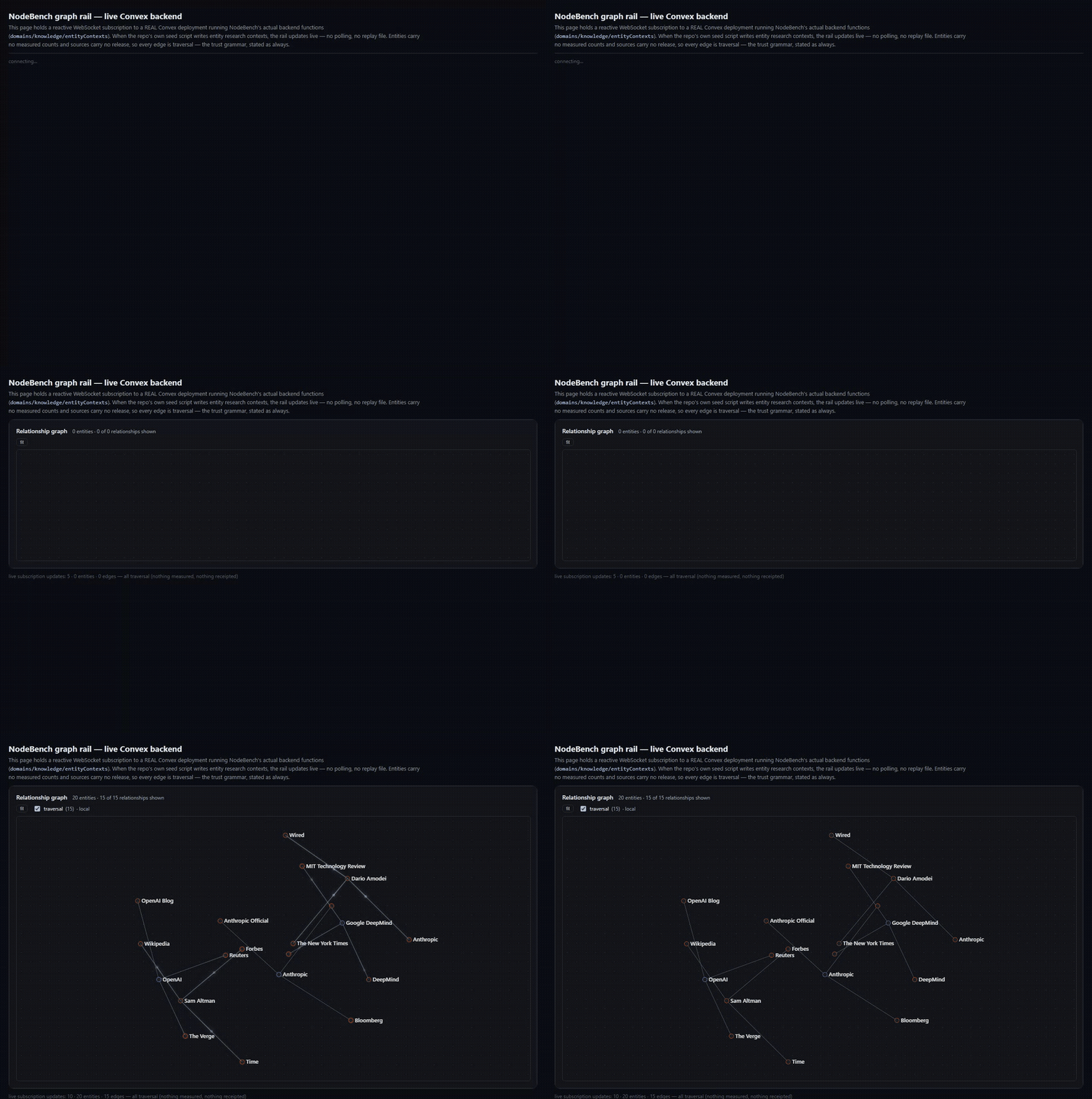
No replay file: demo/graph-rail-live/ subscribes to the real
domains/knowledge/entityContexts:getEntityContext query on an isolated dev
deployment, and the repo's own seed script writes through the real mutation
on camera. All edges traversal — research prose is not a measurement.
Regenerate: node demo/graph-rail-live/record-live.mjs <dev-deployment-url>
(see the script header for the one-time deployment setup).
Live graph rail (recorded events)
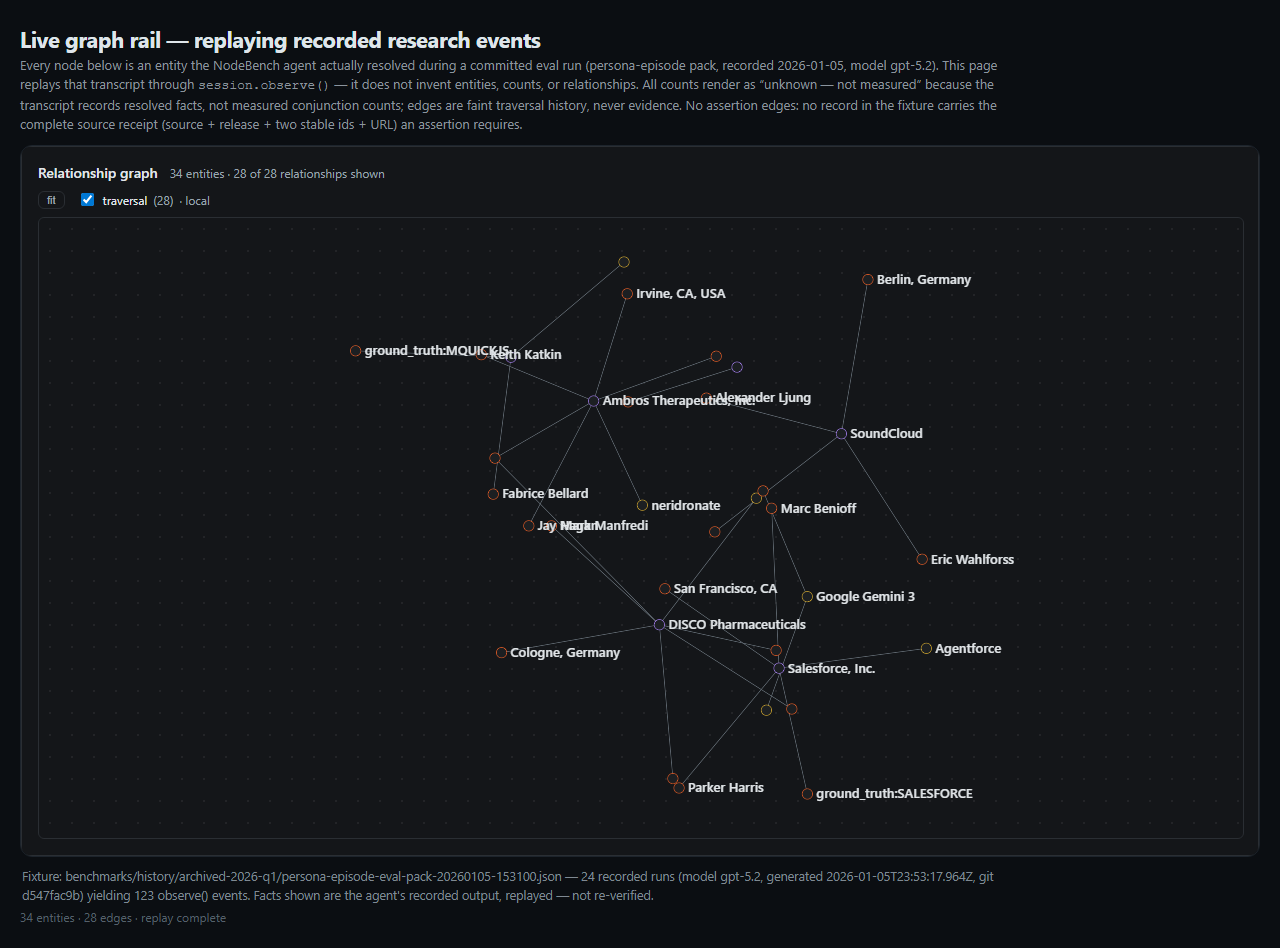
demo/graph-rail/ feeds the NodeGraph Live
renderer (vendored at vendor/nodegraph-live/, pending npm publish) with real
entity-research events from a committed eval transcript
(benchmarks/history/archived-2026-q1/persona-episode-eval-pack-20260105-153100.json)
— it is a replay of recorded events, not a live agent run: every label is a
verbatim string from that fixture, all counts render as unknown because the
transcript holds no measured pair counts, and no assertion edges are drawn
because no record carries a complete source receipt.
node scripts/capture-graph-rail.mjs regenerates the capture and exits nonzero
on an empty rail, any console error, or any rendered label that does not appear
in the fixture.
Hosted Public Research MCP
NodeBench can be used as a public research memory and tool server from any agent or app without forcing signup before the first useful result.
Use the hosted MCP endpoint:
For Gmail/job-match style integrations, use the smaller profile:
Public profiles are anonymous by default, but still metered. Responses include:
Apps should send stable, non-sensitive client headers:
Related MCP Servers
Adoption & maintenance
Factual signals from GitHub, npm, and our automated checks — not a rating.
GitHub stars
14
Stargazers on the source repository.
npm downloads
1.3k
Package downloads in the last 30 days.
Last commit
12d ago
Most recent push to the default branch.
Reviews
No reviews yet — be the first to share how this listing worked for you.
Frequently Asked Questions about Nodebench
AllMCPs Directory Badge
Showcase your server listing on GitHub or your project documentation. Embed this dynamic SVG badge to highlight official listing status and live engagement.
Badge Style:
Live Dynamic SVG Preview
Markdown (GitHub README)
[](https://allmcps.com/mcp/nodebench)HTML Embed
<a href="https://allmcps.com/mcp/nodebench"><img src="https://allmcps.com/api/badge/nodebench?style=directory" alt="Nodebench on AllMCPs" /></a>Technical Specs & Signals
CategorySearch & Data Extraction
14/14 checks healthy over the last 46d
47Quality signal: Fair · 47/100How this signal is calculated ▾
Server availabilityNot measured
Not scored for repo-hosted servers — we can't reach the running server, only its GitHub page. Hosted MCP endpoints are health-checked live.
Verified ownership10/20
Documentation & tools16/30
Adoption & activity9/15
Community engagement0/10
A guidance signal from public completeness & health data — not a user rating. New listings start lower and rise as they add docs, get verified, and grow adoption. Signals we can't observe for a listing are skipped, not counted against it.
Supply-chain signal
No high-severity advisories surfaced by our automated scan.
Critical 0High 0Medium 0Low 0
Scanned 2d ago via OSV.dev · nodebench-mcp (npm)
Own this project?
This directory is pre-filled from public sources. Claim via GitHub README, site badge, or DNS TXT to unlock edit access and the Official badge — proof is checked automatically, then reviewed by our team.
Free dofollow backlink: add your website and place the AllMCPs badge on it — no claim needed. We detect it automatically and keep it verified as long as the badge stays live.
Claim & get free dofollowShare & Embed
Add our SVG badge (dark/light directory styles) or embeddable widget to your site.