Local-first memory for AI coding agents: shell history with exit codes, git diffs, docs, MCP.
Quick Install
Automated & IDE SetupCopy the AI prompt to install this server into Claude Code, Cursor, or another agent — or use 1-click editor setup below.
Manual Client & Custom JSON ConfigExpand JSON ▾
Client Config & Setup
Choose your client or environment
Target File:
💡 Paste the JSON block into your client's configuration file under mcpServers, then restart the application.
Documentation Overview
NexusMem





Your coding agent can read git log. It cannot read the four things you tried last Tuesday that
didn't work.
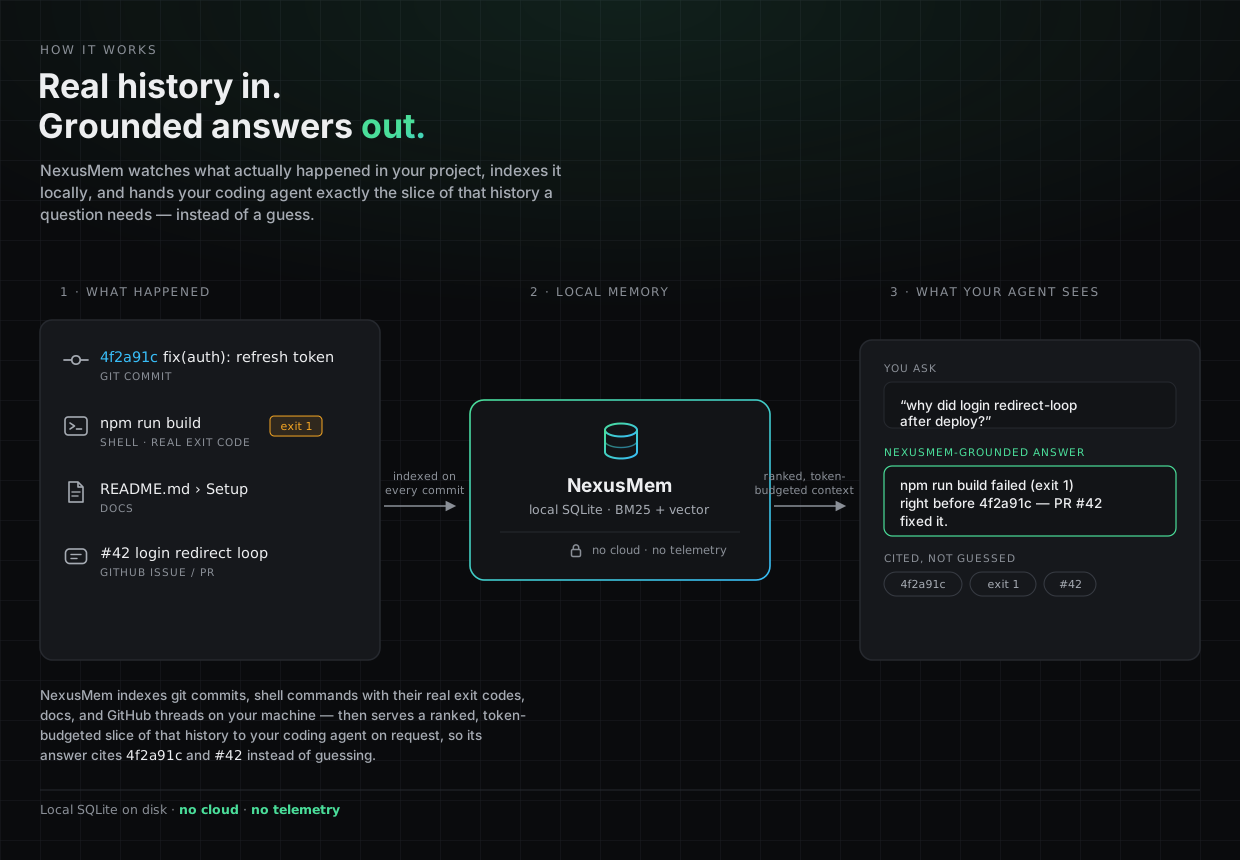
NexusMem records what actually happened on your machine (shell commands and their exit codes, git history down to the patch of each changed file, project docs, optionally your assistant transcripts) into a local SQLite database, and serves back a ranked, token-budgeted slice of it on demand. Everything stays on disk. No account, no cloud, no telemetry.
The shell history is the part worth caring about. Git tells an agent what shipped. Shell history tells it what was attempted, in what order, and which commands exited non-zero. That information exists nowhere else, and it disappears when your terminal scrollback rolls over.
Contents: Try it · Exact shell capture · Failure → fix chains · How retrieval works · Session summaries · GitHub issues & PRs · Use it from an agent · What it costs you · Staleness & provenance · Where it breaks · Commands · Cross-project recall · On disk · Development
Try it
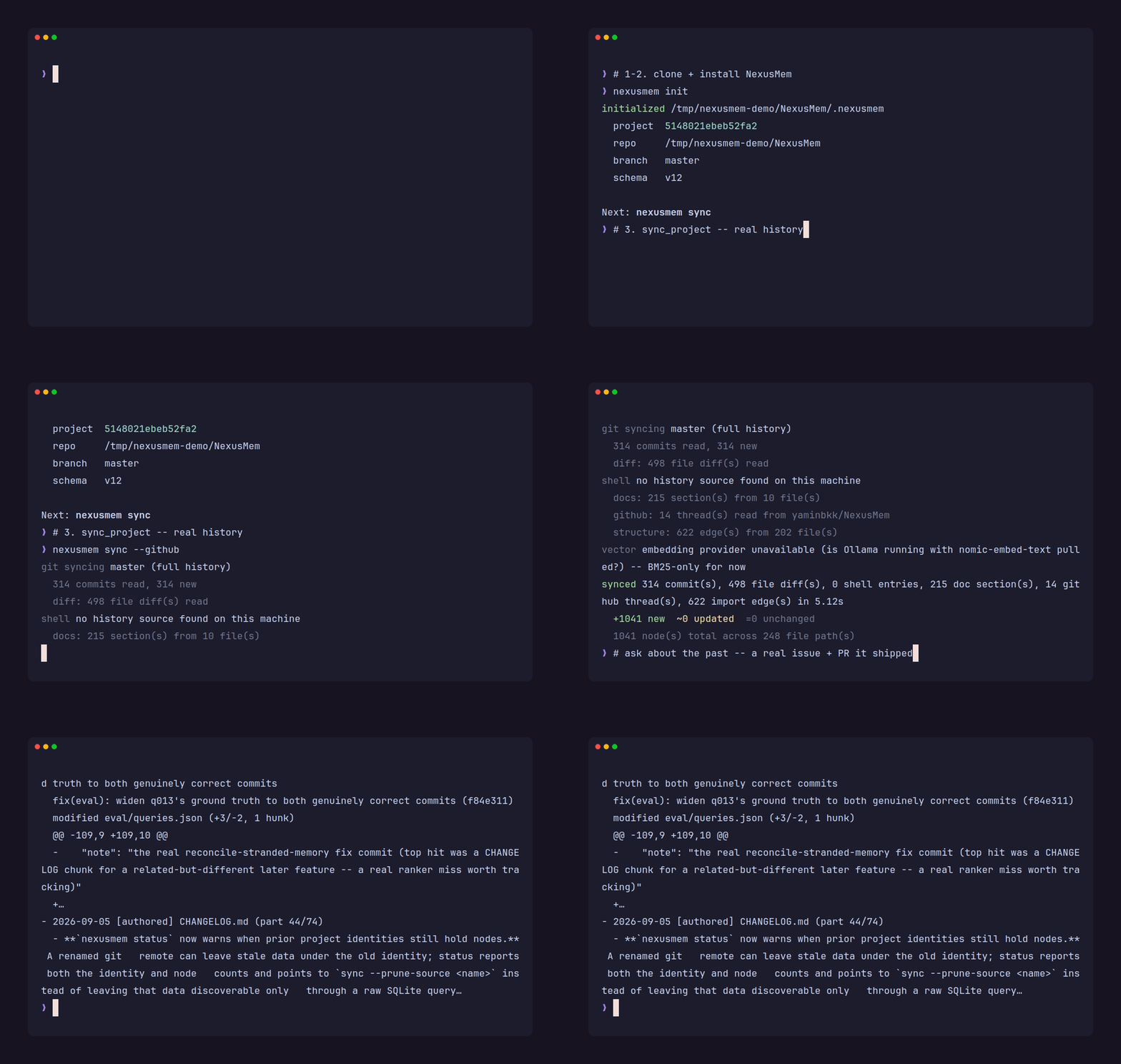
From inside any git repository:
Then ask it something. Real output from this repository, top 2 of 5 hits:
[observed]/[authored] is the provenance tag (see Staleness & provenance)
— a commit is a directly observed event, a doc section is a written claim that could go stale.
A commit and a docs section, ranked against each other, inside whatever token budget you gave it. Nothing was summarized by a model on the way out; the ranker just decided what not to send. (One optional source, session summaries, does run a local model — but at ingest time, never on the way out. What you query is always stored text.)
For a sense of what actually accumulates, here is nexusmem status on this repo after two days:
Sixteen commits. Three hundred and twenty-one shell commands. The commits were already retrievable by any agent with a terminal. The rest was not.
That conversation_turn row only appears because this corpus was synced with --conversation.
Assistant transcripts are the one source that is off by default and stays off until you opt in, since
they are the likeliest place for a pasted credential to be sitting. A default install indexes git
commits, their diffs, shell and docs.
Requirements: Node 22 or newer, and git. Node 20 will not work, because better-sqlite3 ships no
prebuilt binary for it and Node 20 went end-of-life in April 2026. Ollama is optional and only
affects semantic search (see below).
Optional: exact shell capture
Scraped history files (PSReadLine, .bash_history, .zsh_history) give you command text and not
much else. The hook gives you working directory, exit code and a real timestamp:
It wraps your existing PowerShell prompt rather than replacing it, is idempotent, and
nexusmem hook remove undoes it cleanly.
Exit codes are what make this worth installing. A failed command is a stronger signal than a successful one, and without the hook there is no way to tell them apart.
Failure → fix chains (opt-in)
After a normal sync, this walks every failed shell_command (non-zero exit code) and looks for
whatever later resolved it, using two independent heuristics: a later command in the same project
and working directory, exact same normalized text, that exited 0 within 24h (same-command
retry); and, separately, the best full-text match among nearby conversation turns or session
summaries, requiring every significant word of the failing command to appear, not just one
(conversation bridge). A failure can be linked by either, both, or neither.
Both links are surfaced in query results. The conversation-bridge heuristic originally matched on any shared word, and dogfooding against this repo's own real history found it wrong on roughly half its links — a shared word as generic as "npm" was enough to link an unrelated discussion. Requiring every significant word fixed that: re-dogfooded against the same corpus, every resulting link (the full set produced, not a sample) checked out correct on manual review of the full text, not just the summary.
When a linked failure appears in a result set, its fix rides along immediately after it, inheriting
the failure's own relevance score rather than needing to match the query on its own merits. That is
the point: a query about why something failed shouldn't need to separately guess the words used in
whatever fixed it. This works across projects too — query --all-projects chains a failure to its
fix using whichever project's own database recorded the link, since links are always local to the
project they were found in.
How retrieval works
Every source normalizes to the same MemoryNode shape, so a commit, a shell command and a docs
section compete on equal terms. Retrieval runs BM25 over FTS5 and, if an embedding model is
reachable, a vector search over sqlite-vec, fused with Reciprocal Rank Fusion on rank position
only, never raw scores — a BM25 cost and a vector distance live on unrelated, unbounded scales, and
position is the only thing they agree on.
Ranking then multiplies three factors:
relevance comes from the query. signal (a fix: commit outranks a chore:; a failed command
outranks a successful one) and recency are priors that hold before any query exists. Each factor is
floored into [floor, 1] rather than [0, 1], so one weak dimension can't zero out a strong match.
The exponents bound how far signal and recency, together, may overturn relevance: at most a 2× gap
across their whole range, applied jointly rather than per-prior. That's deliberate — the score
multiplies the two priors, so capping each at 2× separately still let the pair overturn 4×, and
that hit hardest on fresh, high-signal commits made during an active working day. The bug that
exposed this: two unrelated same-day fix: commits outranked the docs section that actually answered
the query. See retrieval/rank.ts for the full derivation.
Without Ollama, vector search is skipped and you get BM25 only — fully supported, not a degraded
state; sync and query both succeed and simply do less.
Session summaries (optional, local model)
With sources.session.enabled, each finished session becomes one distilled node next to the raw
exchanges — what was decided and why, rather than forty individual turns. It runs a local Ollama
chat model (qwen2.5:3b by default); nothing is downloaded automatically and nothing leaves the
machine.
That prints the exact prompt a session would produce, after redaction and budget trimming, without calling the model.
Three things bound the cost. A session is only summarized once it has been quiet for
settleMinutes (default 30), so a session in progress is not re-summarized on every sync. The
prompt is hashed, and an unchanged hash skips the model entirely — on this repo a steady-state sync
of 14 summarized sessions takes 0.25s and makes no model calls. And maxSessions (default 10) caps
how many reach the model per run; the rest are reported as queued and picked up next sync.
Related MCP Servers
Reviews
No reviews yet — be the first to share how this listing worked for you.
Frequently Asked Questions about Nexusmem
AllMCPs Directory Badge
Showcase your server listing on GitHub or your project documentation. Embed this dynamic SVG badge to highlight official listing status and live engagement.
Badge Style:
Live Dynamic SVG Preview
Markdown (GitHub README)
[](https://allmcps.com/mcp/nexusmem)HTML Embed
<a href="https://allmcps.com/mcp/nexusmem"><img src="https://allmcps.com/api/badge/nexusmem?style=directory" alt="Nexusmem on AllMCPs" /></a>Technical Specs & Signals
CategoryKnowledge & Memory
27Quality signal: Emerging · 27/100How this signal is calculated ▾
Server availabilityNot measured
Not scored for repo-hosted servers — we can't reach the running server, only its GitHub page. Hosted MCP endpoints are health-checked live.
Verified ownership8/20
Documentation & tools11/30
Adoption & activity1/15
Community engagement0/10
A guidance signal from public completeness & health data — not a user rating. New listings start lower and rise as they add docs, get verified, and grow adoption. Signals we can't observe for a listing are skipped, not counted against it.
Own this project?
This directory is pre-filled from public sources. Claim via GitHub README, site badge, or DNS TXT to unlock edit access and the Official badge — proof is checked automatically, then reviewed by our team.
Free dofollow backlink: add your website and place the AllMCPs badge on it — no claim needed. We detect it automatically and keep it verified as long as the badge stays live.
Claim & get free dofollowShare & Embed
Add our SVG badge (dark/light directory styles) or embeddable widget to your site.