MCP Server Zotero Dev README
The full upstream README, mirrored here for reference. Install config, tool schemas, adoption signals, and an original overview live on the MCP Server Zotero Dev listing page.
MCP Server Zotero Dev
Give your AI assistant superpowers for Zotero plugin development


Architecture · Getting Started · Available Tools
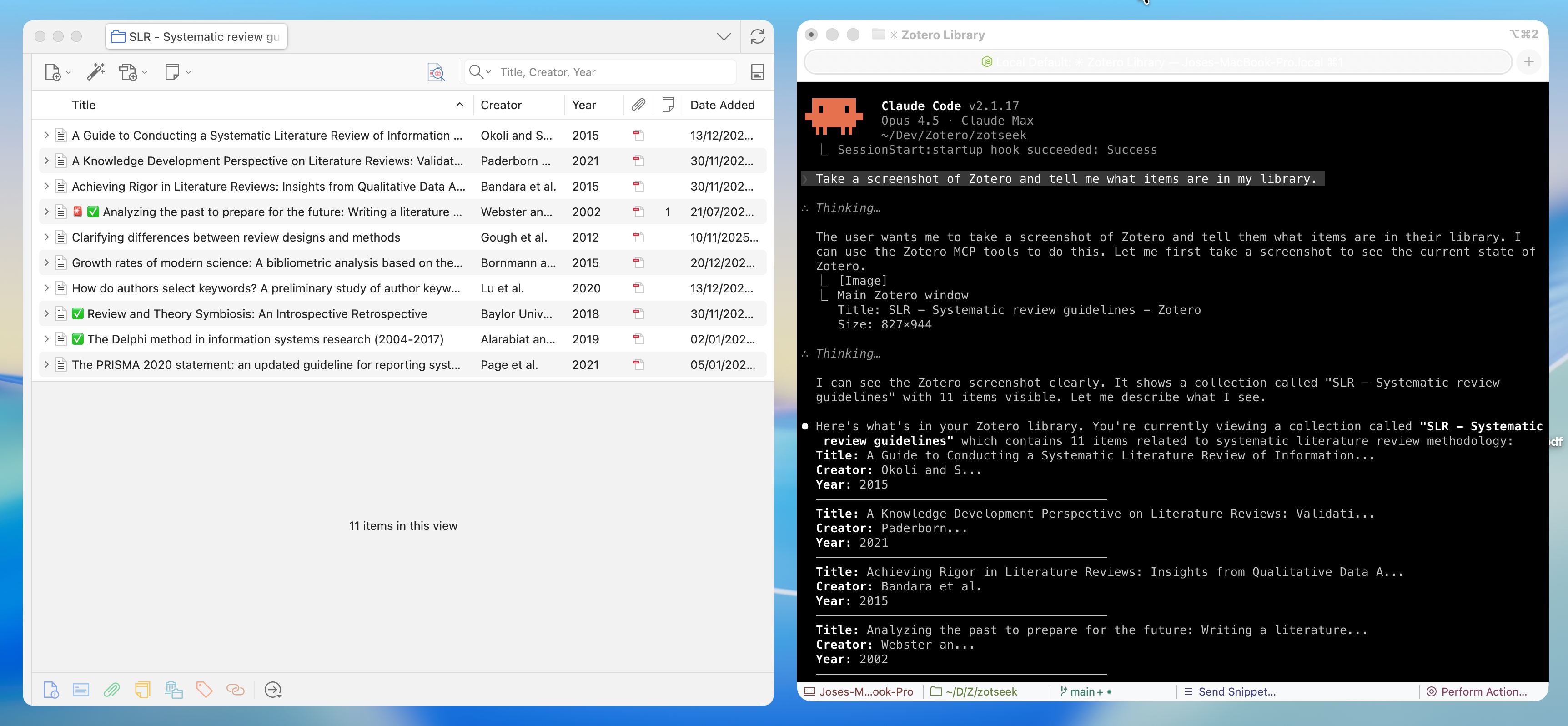
A Model Context Protocol (MCP) server that enables AI assistants like Claude, Cursor, and Windsurf to build, test, and debug Zotero 7, 8, 9, and 10 plugins. Screenshots, DOM state, debug logs, and JavaScript execution give the AI rich context to understand what's happening—and tools to help you fix it.
✨ Features
| Category | Capabilities |
|---|---|
| 🎯 UI Inspection | Screenshots, DOM tree, element finding, computed styles |
| 🖱️ UI Interaction | Click elements and type text (shadow-DOM aware) |
| 💻 JS Execution | Run code in Zotero context, inspect APIs, test snippets |
| 🔧 Build Tools | Scaffold integration for build, serve, hot reload |
| 📋 Logs & Errors | Stream debug output, error console, watch for issues |
| 🗃️ Database | Read-only access to zotero.sqlite for debugging |
| 🔌 Plugin Management | Install, reload, list plugins |
🚀 Quick Start
Prerequisites
- Node.js 20+ and npm
- Zotero 7+ — Works on all Zotero 7, 8, 9, and 10 builds (release, beta, dev)
- For plugin development: zotero-plugin-scaffold
1. Install MCP Server
Use install-mcp to add the server to your AI assistant:
Supported clients: claude-code, cursor, windsurf, vscode, cline, roo-cline, claude, zed, goose, warp, codex
Claude Code
Cursor
VS Code / Copilot
Windsurf
Manual Configuration
Add to your MCP client config:
Version & updates: pin an exact version as shown above. A bare
npx <pkg>(no version) keeps running whatevernpxcached and won't pick up new releases, so always include a version and-y(without-y,npxhangs waiting for an install prompt). Bump the pinned version to upgrade, or use@latestto always fetch the newest at launch (auto-updates, but a bad release would run automatically and it adds a registry check on every start). Note thatinstall-mcpmay write a config without-yor a version, so the manual configuration above is the most robust path.
Restart your AI assistant after adding the configuration.
2. Install MCP Bridge Plugin in Zotero
Download zotero-mcp-bridge.xpi and install:
- In Zotero: Tools → Plugins
- Click ⚙️ → Install Plugin From File
- Select the downloaded
.xpifile - Restart Zotero
This lightweight plugin enables the Remote Debugging Protocol when Zotero starts. It only needs to be installed once and works on all Zotero 7+ builds (release, beta, and dev).
3. Start Developing!
Just open Zotero normally and ask your AI assistant:
"Take a screenshot of Zotero and list installed plugins"
That's it! No special launch flags, no configuration. 🎉
🧰 Available Tools (28 total)
UI Inspection — Screenshots, DOM, styles
| Tool | Description |
|---|---|
zotero_screenshot | Capture window, element, or region screenshots |
zotero_inspect_element | Find elements by CSS selector |
zotero_get_dom_tree | Get DOM structure of a window/panel |
zotero_get_styles | Get computed CSS styles for element |
zotero_list_windows | List all open Zotero windows |
Screenshot Targets: Main window, preferences, PDF reader, dialogs, or any element by selector. Use
highlightSelectorto add a red border before capture.
UI Interaction — Click and type in the Zotero UI
| Tool | Description |
|---|---|
zotero_click_element | Click an element by CSS selector (toolbar/menu button, preference control, list row). Pierces shadow DOM; index picks among multiple matches; mouseEvents synthesizes a full mouse sequence. |
zotero_send_keys | Type text into an input/textarea/contenteditable (focuses it first, fires input/change). Optional clear and pressEnter. |
Resolution tries light DOM first, then pierces open shadow roots (Zotero's XUL custom elements keep internals in shadow DOM). Limitation: cannot dismiss a blocking native modal dialog (
Services.prompt.confirmEx) — its nested modal loop blocks the eval thread these tools run on.
JavaScript Execution — Run code in Zotero context
| Tool | Description |
|---|---|
zotero_execute_js | Execute JavaScript in Zotero's privileged context. Auto-wraps code with top-level return statements in IIFE. |
zotero_inspect_object | Explore Zotero APIs - list methods and properties of any object (e.g., Zotero.Items) |
zotero_open_preferences | Open Zotero's settings window, optionally to a specific pane (built-in or plugin) |
zotero_search_prefs | Search/discover preferences by pattern (e.g., find all prefs containing "debug") |
zotero_get_pref | Get a preference value |
zotero_set_pref | Set a preference value |
Examples:
Zotero.Items.getAll(1),Zotero.Prefs.get('export.quickCopy.setting'),ZoteroPane.getSelectedItems()Tip: Use
zotero_inspect_objectto explore APIs before writing code. Usezotero_search_prefsto discover preference keys.
Build & Scaffold — Integration with zotero-plugin-scaffold
| Tool | Description |
|---|---|
zotero_scaffold_build | Build plugin (dev or production mode) |
zotero_scaffold_serve | Start dev server with hot reload |
zotero_scaffold_lint | Run ESLint on plugin source |
zotero_scaffold_typecheck | Run TypeScript type checking |
Logs & Debugging — Error console and debug output
| Tool | Description |
|---|---|
zotero_read_logs | Read debug output (Zotero.debug) |
zotero_read_errors | Read error console entries |
zotero_watch_logs | Stream logs in real-time |
zotero_clear_logs | Clear log buffer |
Plugin Management — Install, reload, inspect
| Tool | Description |
|---|---|
zotero_plugin_reload | Hot reload your dev plugin |
zotero_plugin_install | Install plugin from XPI path |
zotero_plugin_list | List installed plugins with version/status |
Database Access — Read-only SQLite access
| Tool | Description |
|---|---|
zotero_db_query | Execute SELECT query on zotero.sqlite |
zotero_db_schema | Get table schema information |
zotero_db_stats | Get database statistics (items, attachments, collections, size) |
Note: Database access is read-only and requires Zotero to be closed, or uses a copy of the database.
🏗️ Architecture
Why this approach?
- ✅ Lightweight plugin — Just enables RDP, Firefox DevTools does the rest
- ✅ Zero-config after install — Just open Zotero normally, no special flags
- ✅ Rich AI context — Screenshots, DOM, and logs help the AI understand your plugin's state
- ✅ Hot reload — Integrates with zotero-plugin-scaffold for instant feedback
- ✅ Full Zotero access — Execute any Zotero API in the privileged context
- ✅ Cross-platform — Works on Linux, Windows, macOS
🔧 Environment Variables
| Variable | Description | Default |
|---|---|---|
ZOTERO_RDP_PORT | Remote debugging port | 6100 |
ZOTERO_RDP_HOST | Debugging host | 127.0.0.1 |
ZOTERO_DATA_DIR | Path to Zotero data directory | Auto-detect |
ZOTERO_PROFILE_PATH | Path to Zotero profile | Auto-detect |
🔌 Changing the RDP Port
The bridge listens on port 6100 by default. You only need to change it if you run two Zotero instances at the same time (a normal profile and a development one, say), or if another process already holds 6100.
The port lives on both sides of the bridge, and both have to agree on it.
1. Zotero side — set the plugin preference:
- Settings → Advanced → Config Editor, and accept the warning
- Search for
extensions.mcp-rdp.port - If it doesn't exist, create it: select Number, name it
extensions.mcp-rdp.port, and enter your port - Restart Zotero — the listener only opens at startup
Watch the type. The Config Editor pre-selects Boolean. Creating the preference without switching to Number stores
trueinstead of a port, and Zotero then opens the bridge on a local pipe rather than a TCP port — the debug log reports success while no MCP client can connect.
2. Client side — set ZOTERO_RDP_PORT to the same value in your MCP client config:
Change both or neither. Moving only one side disconnects the bridge: Zotero listens on one port while the client keeps dialing the other.
Actually running two instances
Launching Zotero a second time hands you the window you already have — like Firefox, it forwards to the running instance instead of starting another. A second instance needs its own profile and -no-remote:
Give that profile its own extensions.mcp-rdp.port and the two bridges stay out of each other's way. Verified with 9.0.6 on 6100 and 10.0-beta.22 on 6101 at the same time.
Requires MCP Bridge plugin 1.0.5 or later. In 1.0.4 and earlier,
extensions.mcp-rdp.portwas read under the wrong preference branch and silently ignored, so the bridge stayed on 6100 no matter what you set. If you configured a custom port against an older build, it is stored asextensions.zotero.extensions.mcp-rdp.port— that name still works, but prefer the one above.
Disabling the bridge
Set extensions.mcp-rdp.enabled to false (Boolean) in the Config Editor and restart Zotero. The plugin stays installed but opens no listener, and no MCP client can reach Zotero until you set it back to true.
📸 Screenshot Examples
🧑💻 Development
Project Structure
📚 Resources
- Architecture & Technical Learnings — Deep dive into RDP protocol, actor hierarchy, and common pitfalls
- Zotero Plugin Development — Official docs
- Zotero 10 for Developers — Migration guide for the latest major
- Zotero 7 for Developers — Migration guide
- zotero-plugin-scaffold — Build tooling
- zotero-plugin-template — Starter template
- zotero-plugin-toolkit — API helpers
- Firefox RDP Protocol — Protocol docs
🤝 Contributing
Contributions are welcome. See CONTRIBUTING.md for setup, test conventions and the codebase-specific rules worth knowing before you start.
The short version:
- Follow existing code patterns
- Add tests for new features, and skip rather than fail when Zotero is not running
- Update documentation
- There is no CI, so run
npm run build,npm run typecheck,npm run lintandnpm testyourself, and say in the PR which Zotero version you verified against
📄 License
MIT © introfini
Acknowledgments
- Built for the Zotero plugin developer community
- Integrates with zotero-plugin-scaffold by @windingwind
- Leverages Firefox DevTools RDP for reliable communication