Lightweight browser automation for AI agents: navigate, screenshot, extract, PDF. One small binary.
Quick Install
Automated & IDE SetupCopy the AI prompt to install this server into Claude Code, Cursor, or another agent — or use 1-click editor setup below.
Not yet automatically verified
We haven't yet run this listing's install command through our automated sandbox check. This isn't a red flag — we're steadily working through the catalog.
Manual Client & Custom JSON ConfigExpand JSON ▾
Client Config & Setup
Choose your client or environment
Target File:
💡 Paste the JSON block into your client's configuration file under mcpServers, then restart the application.
Documentation Overview
Kitewright
Browser automation for AI agents as a single small binary. An MCP server (Streamable HTTP + stdio) that gives LLM clients navigate / screenshot / extract — without carrying the Node.js + Playwright stack.
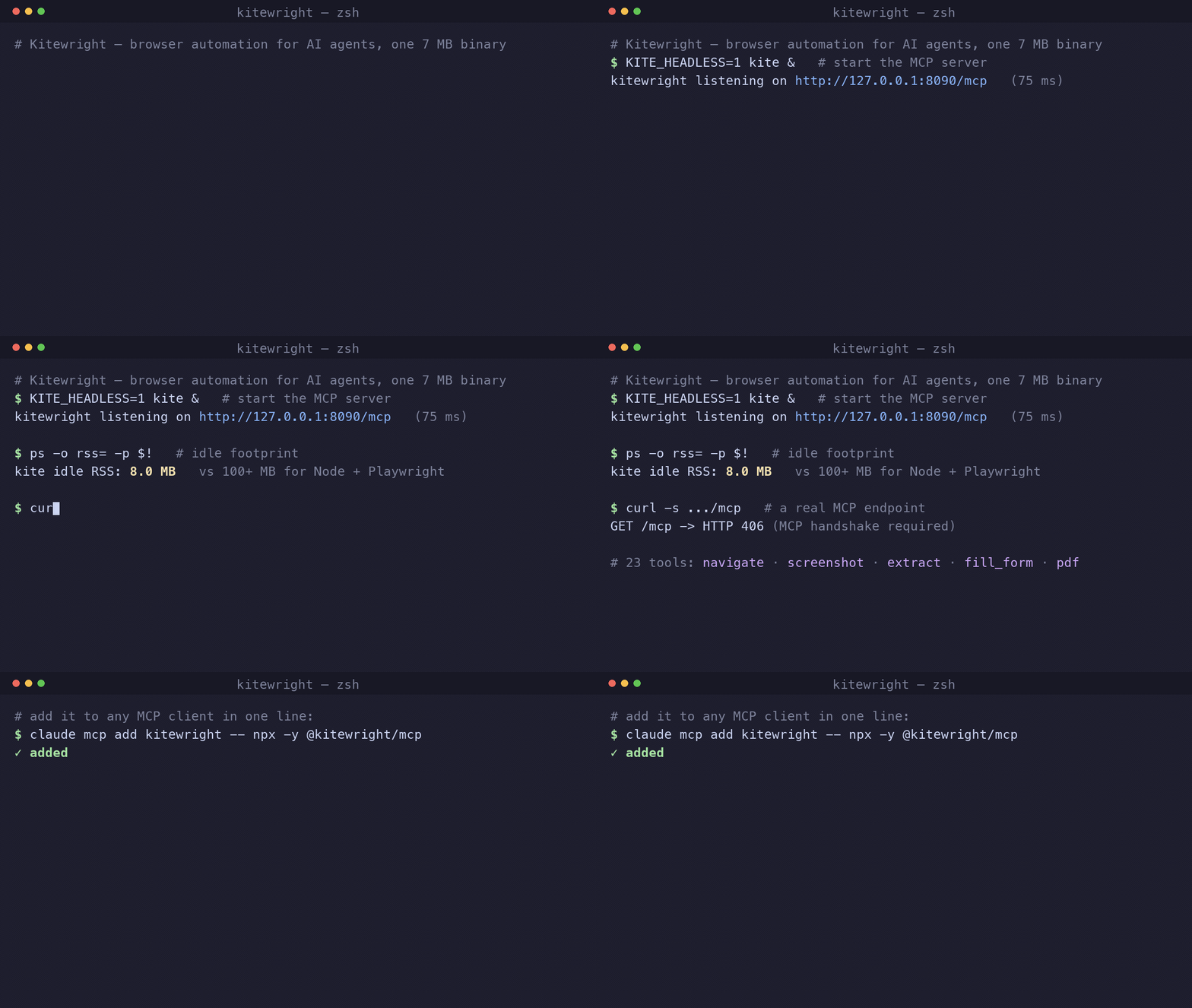
Install in one line:
Why — measured, not claimed
Head-to-head vs @playwright/mcp 0.0.78, same machine, same Chromium headless-shell build, same page (full methodology):
| @playwright/mcp | Kitewright | |
|---|---|---|
| Cold start → listening | 354 ms | 75 ms |
| Server RSS (idle) | 102–125 MB | 7.6 MB |
| Server RSS (after work) | 93 MB | 10.9 MB |
| Distribution | 18 MB pkg + Node.js runtime | 6.9 MB static binary |
| First navigate (incl. browser launch) | 2623 ms | 822 ms (session pre-warming) |
| Warm navigate latency | 80–116 ms | 99–105 ms (tie) |
| Idle behavior | browser kept alive | browser reaped after idle TTL, pre-warmed again on next session |
The browser itself (Chromium) costs the same in any language — warm latency is a tie because both speak CDP to the same browser. The wins are everything around it: startup, distribution, idle footprint, and lifecycle management. The honest gap: playwright-mcp ships ~25 tools today, we ship 21 — closing that is the roadmap.
Reliability — actionability auto-waiting
click / type / fill_form / select_option / hover don't fire blindly. Before acting, the engine polls (100 ms, up to a 5 s per-op budget) until the target element is present, visible (not display:none / visibility:hidden / zero-size), enabled (no disabled / aria-disabled), not covered by another element at its click point, and geometrically stable across two consecutive frames. A settled element passes on the first poll, so this is invisible when things are fine — but when an action can't happen, you get a cause-specific error (not found / not visible / disabled / covered / unstable) instead of a silent misclick or a generic timeout. Transient CDP errors are retried twice. Pass timeout_ms on any interaction tool to override the 5 s per-op budget (e.g. a short timeout to fail fast when you expect an element to already be there).
Performance
External-site latency is network-bound — DNS + TLS + TTFB (~400–600 ms) is a floor no tool beats, and Kitewright does not claim to. What it does attack is every controllable cost around the network:
- Prewarm + warm-context pool. The moment an MCP session initializes, the server launches the browser and fills a small pool of pre-created blank browser contexts (
MCP_CONTEXT_POOL, default 2) in the background. A new session is then handed a ready context+page, so its first navigate pays zero browser-launch and zero context-creation cost. Measured localhost first-navigate: ~31 ms prewarmed vs ~709 ms cold (Apple Silicon; details). The pool drains with the browser on idle-reap and refills lazily on next demand, so idle footprint stays at the ~8 MB baseline. - Lite mode.
browser_navigate {lite:true}(and the default forextract/extract_markdown) blocks images/media/fonts + ad/analytics hosts before the load — 30–70 % faster DOM-ready on heavy pages by skipping the bulk of the bytes. Screenshots/PDF never block resources. - Shared disk cache + connection pre-warm. A stable
--disk-cache-dir(KITE_CACHE_DIR) lets repeat asset fetches hit cache across runs;KITE_PREWARM_URLestablishes DNS+TLS to a known origin during prewarm.
The honest framing: the wins are browser launch, page weight, session start, and connection setup — not the network round-trip to a remote origin.
Architecture
Each MCP session owns one persistent page inside its own Chromium browser context (cookie isolation between agents): log in once, keep clicking. The page and context are closed when the session ends; the browser itself is still reaped after the idle TTL and transparently relaunched on the next call.
Install
The zero-install way — run it straight from npx, like @playwright/mcp:
npx @kitewright/mcp resolves the prebuilt kite binary for your platform (an
optional per-platform dependency, esbuild-style) and starts a stdio MCP server —
no Rust toolchain, no build. See npm/kitewright-mcp.
Prefer the raw kite binary? (npx above is the easy path; these need a Rust toolchain.)
Not yet published to crates.io or Homebrew —
cargo binstall/brewaren't wired up. Usenpx @kitewright/mcp(no toolchain) or thecargo install --gitline above.
Get a browser
Kitewright drives Chromium over CDP but does not embed one. It uses a system
Chrome/Chromium when present, honors BROWSER_EXECUTABLE, and — if neither is
found — falls back to a browser downloaded by kite install:
kite install downloads the current Chrome-for-Testing chrome-headless-shell
build for your platform into $KITE_CACHE_DIR (or the OS cache dir) and the
engine picks it up automatically — no BROWSER_EXECUTABLE needed. Re-running is
a no-op once a build is present. The Docker image already ships Chromium.
Run & connect
kite with no arguments serves MCP over Streamable HTTP (networked, default,
supports auth + many sessions); kite --stdio serves a single session over
stdio for local clients.
HTTP transport — connect from Claude Code:
stdio transport — MCP client config (Claude Desktop, Cursor, …):
Configuration
| Env var | Default | Meaning |
|---|---|---|
MCP_HTTP_BIND | 0.0.0.0:8090 | Listen address |
MCP_AUTH_TOKEN | unset | When set, /mcp requires Authorization: Bearer <token> (401 otherwise). Unset = open access + startup warning |
MCP_RATE_LIMIT_PER_MINUTE | 300 | Per-client-IP request limit (fixed 60s window); 429 when exceeded |
BROWSER_EXECUTABLE | auto-detect | Path to chrome / chromium / chrome-headless-shell. When unset: a system Chrome/Chromium is detected, else a kite install-managed build in the cache dir |
BROWSER_NO_SANDBOX | unset | Set (any value) to pass --no-sandbox (containers) |
KITE_HEADLESS | unset | Kite launches a headed (visible) browser by default so you can watch automation. Set (any value) to run headless — required on servers, CI, and containers with no display, where a headed Chrome fails to launch |
KITE_IDLE_TIMEOUT_SECS | 1800 | Idle seconds before a headless browser is reaped to free memory. Default 30min keeps a session alive across normal pauses (headed never reaps). A reap that does happen is recovered by cookie auto-restore, so an authenticated session survives it. Lower it on a memory-constrained multi-session server |
KITE_ALLOW_SECRET_FILES | unset | Set (any value) to let browser_fill_secret read file:/path secrets from disk. Requires KITE_SECRET_DIR (the directory reads are fenced to) so arbitrary host files can't be read/exfiltrated. env: secrets need no opt-in |
KITE_VIEWPORT | 1440x900 | Default viewport / window size as WIDTHxHEIGHT (Chromium's own default is a cramped 800x600). Adjust at runtime with the browser_resize tool |
MCP_CONTEXT_POOL | 2 | Number of pre-warmed blank browser contexts kept ready so a new session gets an instantly-usable context+page (zero context-creation latency). 0 disables. The pool refills in the background and drains with the browser on idle-reap (it never keeps the process alive) |
KITE_CACHE_DIR | <tmp>/kitewright-cache | Shared on-disk HTTP cache (--disk-cache-dir), stable across launches so repeat asset fetches hit cache. NOTE: per-session isolated contexts (cookie isolation) use an ephemeral cache; this benefits the browser's default context |
KITE_PREWARM_URL | unset | If set, prewarm navigates a throwaway page to this origin to establish DNS+TLS+connection before the first real navigate. No-op when unset |
BROWSER_PREWARM | unset | Set (any value) to launch + pre-warm the browser at server boot (otherwise prewarm fires when an MCP session initializes) |
RUST_LOG | info | Log filter |
Security
Kitewright drives a real browser, so treat the endpoint as privileged. The defaults are safe for local use; harden before exposing it.
Related MCP Servers
Reviews
No reviews yet — be the first to share how this listing worked for you.
Frequently Asked Questions about Kitewright
AllMCPs Directory Badge
Showcase your server listing on GitHub or your project documentation. Embed this dynamic SVG badge to highlight official listing status and live engagement.
Badge Style:
Live Dynamic SVG Preview
Markdown (GitHub README)
[](https://allmcps.com/mcp/mcp-303)HTML Embed
<a href="https://allmcps.com/mcp/mcp-303"><img src="https://allmcps.com/api/badge/mcp-303?style=directory" alt="Kitewright on AllMCPs" /></a>