TinySearch README
The full upstream README, mirrored here for reference. Install config, tool schemas, adoption signals, and an original overview live on the TinySearch listing page.
TinySearch

Spend tokens on answers, not webpages.
TinySearch searches, crawls, and reranks the web locally, then gives your agent only the evidence worth putting in its context.
Documentation · Quick start · Python · Discord










TinySearch is a self-hosted web-research tool for AI agents. It searches the web, reads the best pages, removes low-value content, and returns compact evidence with source URLs.
Your model receives the useful passages instead of paying to process entire webpages.
TinySearch is part of TinySuite, a suite of focused tools designed to make agentic operations cheaper by minimizing token usage through smart retrieval, selection, and context-management techniques.

Choose a tier
| Tier | Use it when | Entry point | Search backend |
|---|---|---|---|
| 1. Python library | You are building with TinySuite or Python | pip install tinysuite-search | DDGS |
| 2. One-command MCP | An MCP client should launch TinySearch for you | uvx --from "tinysuite-search[server]" tinysearch | DDGS |
| 3. Docker + SearXNG | You want the full self-hosted stack and HTTP MCP | docker compose ... up -d | Bundled SearXNG |
Tiers 1 and 2 need no search service. Tier 3 adds a dedicated SearXNG service, persistent model storage, and a network MCP endpoint. See the installation guide for the Docker setup.
The expensive part of agent research is context
A search result is not yet useful evidence. Agents often have to open several pages, ingest navigation and boilerplate, and spend paid input tokens deciding which passages matter.
TinySearch moves that work in front of the model:
That lowers cost in three ways:
- Smaller model context. Only the best-ranked evidence chunks are returned, within a controlled evidence budget.
- No metered search API required by default. TinySearch can search through DDGS without a paid search provider.
- Local retrieval by default. ONNX embeddings and hybrid reranking run on your machine instead of creating embedding API charges.
Search broadly. Read locally. Pay the model only for the evidence that matters.
This is retrieval, not summarization: TinySearch selects the passages worth keeping with local BM25 and embedding rerank, it doesn't run a model over the page to rewrite or condense it. Every returned chunk is the original page text, unedited, so what you cite is what the page actually said. That keeps the pipeline fast and free to run locally, at the cost of not compacting as aggressively as a dedicated reduction model could. A learned reduction step is a direction we may explore later; it isn't part of TinySearch today.
Actual savings depend on the pages, evidence limits, client model, and provider pricing. TinySearch reduces the web content sent to the model; it does not control what the client does with that evidence afterward.
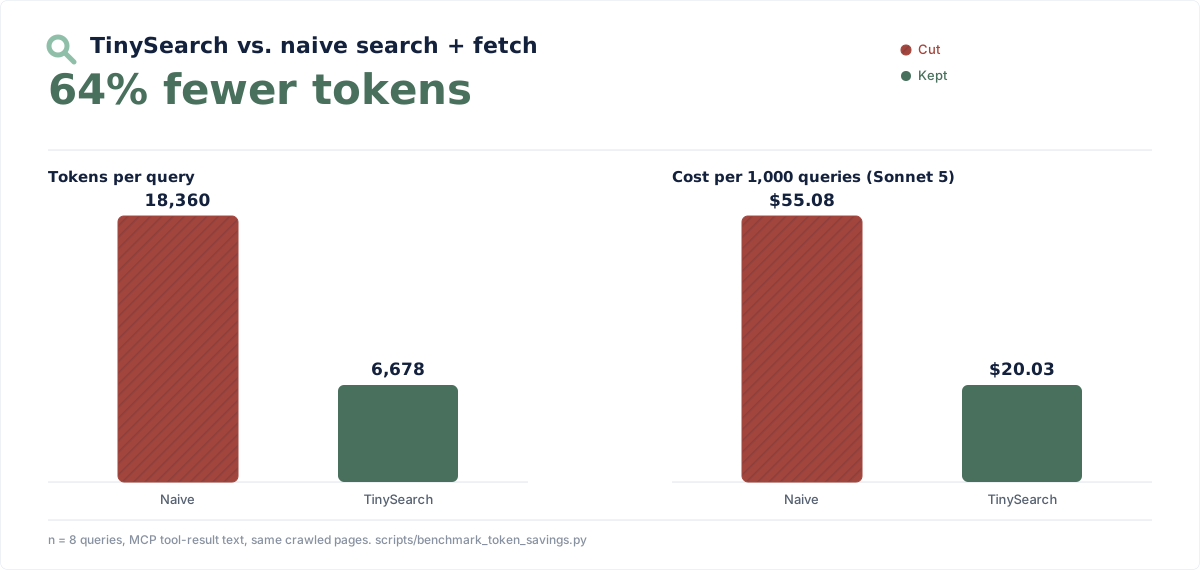
The cost panel uses an illustrative $3.00 per million input-token rate and excludes search, crawling, model output, and downstream agent use.
The naive baseline isn't a strawman product, it's the same pages TinySearch
crawled for each query, fed to the model unfiltered, the way a generic
"search, then fetch the page" tool (a plain web-search-plus-fetch loop, the
kind built into most coding agents) would. Measured against the current
recommended flow (search then scrape_urls) and counted on the actual MCP
tool-result text, TinySearch's primary interface. Reproduce or rerun it
yourself:
Quick start
With uv installed, add TinySearch to any MCP
client:
The client launches TinySearch over stdio when it needs it. No repository clone, hosted account, or paid search key is required.
Fast search starts without Chromium or an embedding model. The first scrape
initializes Chromium; focused scraping also initializes the configured
embedding model. Pre-warm both ahead of time if you will use those workflows:
The MCP and FastAPI servers keep the scraper browser warm between nearby
requests, then close it after browser_idle_shutdown_seconds. Direct Python
calls retain their short-lived, caller-owned lifecycle.
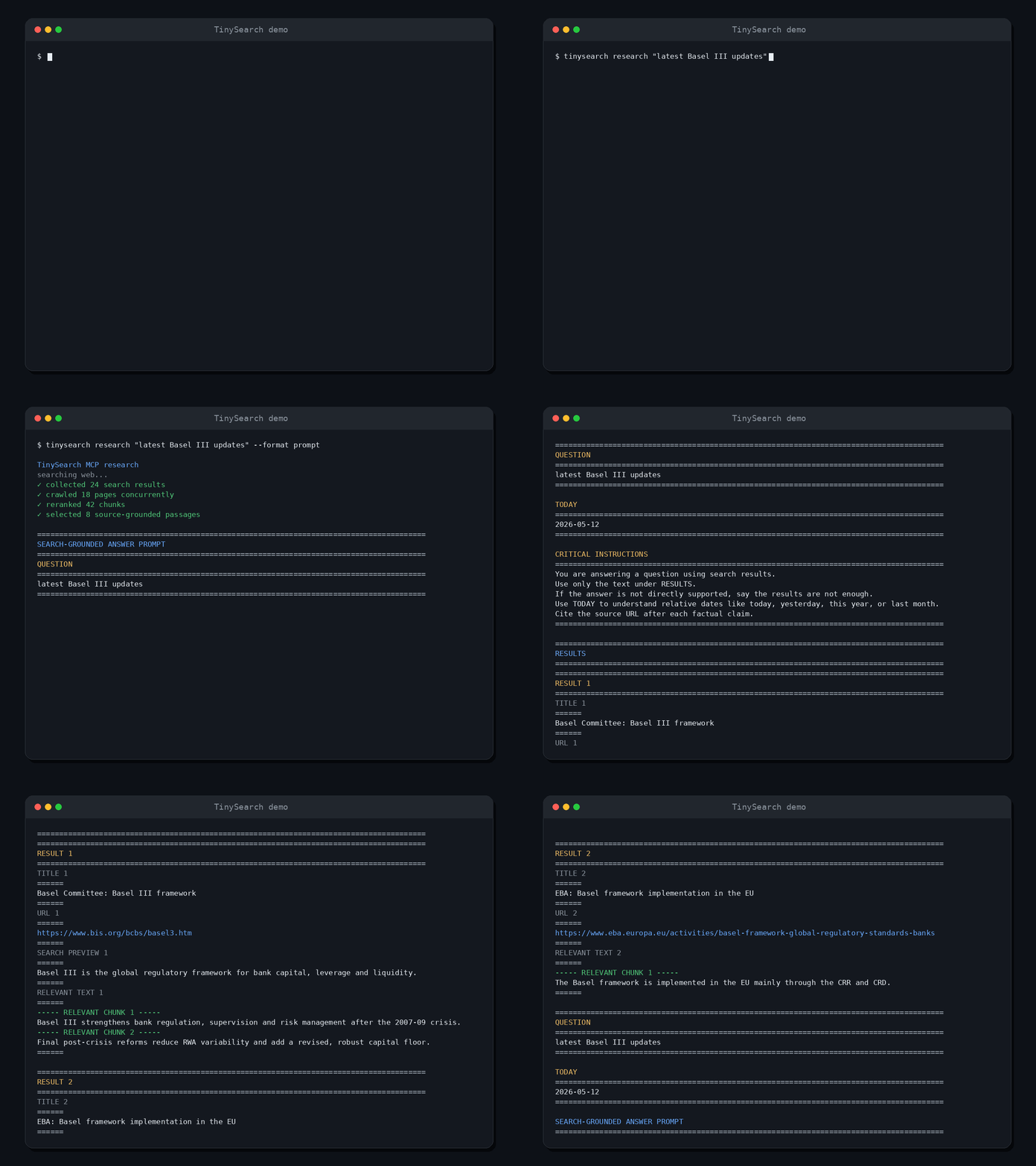
Prefer Docker, a remote MCP endpoint, or a source checkout? Follow the installation guide.
The MCP tools
| Tool | Use it when |
|---|---|
search(items) | You need fast, backend-ordered discovery without crawling or reranking; batch independent subquestions when useful |
scrape_urls(items) | You know one to five pages; each item may use * for its configured clean page-order token budget |
browser_navigate / browser_act | A page needs interaction before it can be read; see Browser automation |
get_current_datetime() | A question depends on the current date or time |
TinySearch deliberately stays focused. It is a retrieval layer, not another agent, chat interface, hosted search product, or permanent web index.
See the complete MCP tool reference for parameters and response contracts.
What your agent gets
TinySearch does not spend another model call writing the final answer. The
recommended flow is search for lightweight discovery, then scrape_urls for
the pages worth reading.
Search returns structured JSON. Use one item for a simple lookup; add multiple
items only for independent subquestions or source strategies. domains is a
hard positive source restriction and accepts a domain plus its subdomains:
Each search item reports its own results and compact backend attempts. A zero
result response is distinct from a blocked, unavailable, or invalid backend.
scrape_urls returns selected Markdown evidence and separate related-link
navigation candidates, each with independent configured token ceilings.
MCP still uses its standard JSON-RPC transport envelope, including
protocol-level errors and optional structuredContent. Python and FastAPI keep
their structured JSON contracts for applications that need to store, inspect,
or transform the evidence.
How it works
searchreturns backend-ordered titles, URLs, previews, upstream dates, and backend outcomes without starting Chromium or an embedding model.scrape_urlsreads one to five known pages concurrently. Omit an item's query or use"*"to keep clean Markdown in page order within the configured token budget.- Supply a focused item query when TinySearch should chunk and hybrid-rank that page before returning evidence.
- The
browser_*tools step in only whenscrape_urlscan't reach the content because it needs interaction. See Browser automation.
Python library
TinySearch also works as a regular Python package:
Optional OpenTelemetry export
TinySearch emits vendor-neutral traces and metrics only when OpenTelemetry is explicitly configured. Normal library, MCP, and FastAPI behavior is unchanged when telemetry is not installed or not configured.
Install the optional exporter support for a standalone MCP server:
The official Docker image includes the same optional support. Set standard OTel variables on either deployment; the common endpoint enables traces and metrics:
http/protobuf is the default and grpc is also supported. Use
OTEL_TRACES_EXPORTER=none, OTEL_METRICS_EXPORTER=none, or
OTEL_SDK_DISABLED=true to disable telemetry. Standard resource, header,
timeout, sampler, and signal-specific endpoint settings are passed through to
the OpenTelemetry SDK; treat OTEL_EXPORTER_OTLP_HEADERS as a secret.
TinySearch exports operation/stage timing, outcomes, counts, backend state, browser use, token counts, and embedding model metadata. It never exports queries, URLs, domains, prompts, documents, snippets, request headers, credentials, configuration paths, raw errors, exception stacks, MCP arguments, or MCP results. Direct Python-library users configure their own OTel provider; TinySearch only auto-configures its standalone MCP and FastAPI server entry points.
The Python API returns stable, JSON-serializable results. search accepts one
to five items and uses the configured per-item result limit. scrape_urls accepts a per-call max_tokens
budget (4,000 by default); omit an item's scrape query or use "*" for
page-order mode. Rendering structured evidence into an LLM prompt is explicit,
so applications can store, inspect, transform, or budget the result first.
The optional FastAPI app mirrors these surfaces. POST /search accepts the
same batch JSON contract.
POST /scrape accepts one to five { "url", "query" } items and always
returns structured per-item outcomes.
POST /browser/navigate and POST /browser/act mirror the two MCP browser
tools and return their accessibility view as { "result": "..." }.
The app also exposes /health, /current_datetime, and read-only /config;
configuration writes require explicit environment opt-in.
Search backends
TinySearch selects a web-search backend from config, so you can start with no search service and add one later without changing code.
"ddgs"(native default): queries theddgspackage's automatic backend selection in-process. No SearXNG deployment required."searxng"(Docker default): queries a self-hosted SearXNG instance. Falls back toddgson backend failure unlesssearch_backend_fallbackis set tofalse."duckduckgo": skips SearXNG and queriesddgsin DuckDuckGo-only mode."auto": tries SearXNG, then falls back toddgson any backend failure.
Set the BRAVE_SEARCH_API_KEY environment variable to add Brave's official
Web Search API as a keyed fallback for the ddgs and duckduckgo backends.
Brave is only consulted when the primary call errors or returns no results.
Full key reference, SearXNG JSON-output setup, and Compose details live in the configuration reference.
Browser automation
scrape_urls is a static fetch. It cannot see content that JavaScript renders
after load, content behind a cookie interstitial, a "load more" control, or a
client-side search UI. For those pages TinySearch drives a real browser.
This costs nothing extra to install. TinySearch already depends on Playwright through Crawl4AI and already installs its Chromium for scraping, so the browser tools reuse the same driver and the same browser: no second runtime, no second browser, no child process.
Two tools: browser_navigate and browser_act, the second folding look,
click, type, wait_for, tabs, and close behind one
action parameter.
That split is deliberate. MCP has no way to group or nest tools -- tools/list
is flat and every schema is re-sent to the model on every request -- so seven
separate browser tools would dominate the server's schema. Publishing the entry
point as its own tool and folding one page session's lifecycle behind a
dispatcher keeps the whole server's schema small across five tools.
There is no separate find tool, because finding is not a sibling of clicking --
it is a filter on the result. Both tools take one find argument, tried as a
regex first (so "a|b" works directly) and falling back to a literal,
case-insensitive substring match for text that isn't valid regex -- narrowing
the return value to the matching nodes and their context instead of the whole
tree. That is what lets one call both act and report: a click that reveals a
table comes back as the table, so the agent never spends a second call
narrowing the first one's answer. An earlier version split this into find
and find_regex; that cost a wasted round trip whenever a model reached for
alternation syntax on the plain-substring parameter and got "no matches"
instead of a hint, so the two were merged.
The model reads a compact accessibility tree where each node carries a stable ref, names one, and TinySearch acts on it with genuine browser input events:
Nothing synthesizes DOM events or invents CSS selectors, and click/type
accept only a ref the model actually observed, never a raw selector.
Three deliberate choices:
- No tool can execute code. There is no
evaluatetool, and none that fills forms, uploads, or drags. A page that injects instructions into its own rendered text has nothing dangerous to reach for, because the capability is absent rather than discouraged. findis the token lever,depththe fallback. Any call that returns a view takesfind, cutting it to the matching nodes and their context. When no filter can name the target,depthreturns a shallower but still valid tree rather than a truncated string -- on a large page ~700 characters versus ~33,000.- Cookies persist, sessions don't. Set
browser_storage_state_pathand a consent banner accepted once is not paid for on every later navigation. Sessions stay isolated, so no browser profile lock is taken and concurrent clients do not conflict. That file is a server-side path, never exposed to a model or over HTTP.
To turn the tools off entirely, set "browser_backend": "off"; they are then
removed from the tool list rather than merely refusing to run.
External browser over CDP
To drive a browser you operate separately, set its Chrome DevTools Protocol endpoint. It is used by both the scrape pipeline and the browser tools:
Server processes also accept TINYSEARCH_BROWSER_CDP_URL. The external browser
owns its executable, profile, proxy, and fingerprint configuration; TinySearch
does not select or install a particular browser backend.
Treat a CDP endpoint as privileged remote control of the browser. Keep it on a
private network or loopback interface, require authentication when it crosses
a host boundary, and do not expose port 9222 directly to the public internet.
When TinySearch itself runs in Docker, localhost refers to the TinySearch
container, so use an endpoint reachable from that container.
browser_backend, browser_cdp_url, and browser_storage_state_path are
operator-managed and cannot be changed through the
HTTP PUT /config endpoint, even when configuration writes are enabled. Set
them in the startup environment (TINYSEARCH_BROWSER_BACKEND and friends) or
the file selected by TINYSEARCH_CONFIG_PATH, then restart TinySearch. HTTP
clients can continue updating other settings by omitting these fields from
their partial update.
Why TinySearch
- No vendor in the loop. No TinySearch account, no required API key, no per-request billing, no analytics service or hosted scraped-data cache. The infrastructure you'd otherwise pay a search API for runs on your machine.
- Source-grounded by construction. Every evidence chunk is the original page text, still attached to its originating URL, so a claim in your agent's answer traces back to one specific passage instead of stopping at "the vendor's model said this."
- Built around token efficiency. Page selection and passage selection happen locally, before content enters model context.
- Useful without paid infrastructure. DDGS search and local ONNX embeddings are the defaults.
- Bring your own stack when needed. SearXNG and OpenAI-compatible embedding providers remain optional.
- Works where agents already work. Use MCP over stdio, Streamable HTTP, Python, FastAPI, or Docker.
Part of TinySuite
TinySuite is a product suite built around one idea: agents should spend tokens on useful work, not operational overhead.
Each tool focuses on a different part of the agent workflow and uses targeted techniques to reduce unnecessary context before it reaches the model. TinySearch handles the web-research layer by turning pages into a small, ranked, source-grounded evidence packet.
Documentation
The README is the product overview. Detailed setup and operational material lives in the TinySuite documentation:
The repository also contains an annotated example configuration at
configs/tinysearch_config.json.
When not to use TinySearch
TinySearch is intentionally lightweight. Use a commercial search API, persistent crawler, or full search index when you need:
- guaranteed search coverage or an SLA
- large-scale or scheduled indexing
- long-term page storage and change history
- enterprise observability and access controls
Development
TinySearch supports Python 3.12 and newer. CI tests Python 3.12, 3.13, and 3.14 across Linux, macOS, and Windows.
Entrypoints
tinysearch.searchandtinysearch.scrape_urls: structured Python APItinysearch.get_current_datetime: structured UTC date and timetinysearch.to_prompt: pure structured-evidence prompt renderertinysearch mcp: stdio MCP server (also the no-argument default)tinysearch serve: Streamable HTTP MCP servertinysearch.servers.fastapi_server:app: optional FastAPI application
Community
Questions, ideas, and bug reports are welcome:
Privacy and license
TinySearch reads public pages and returns selected excerpts to the calling client. Search, crawling, local embeddings, and reranking can run without sending page content to an embedding provider. If you choose an OpenAI-compatible embedding backend, that provider receives the text sent for vectorization.
TinySearch is available under the MIT License. Downloaded model weights remain subject to their respective model-card licenses. See NOTICE for third-party distribution details.