Lumae README
The full upstream README, mirrored here for reference. Install config, tool schemas, adoption signals, and an original overview live on the Lumae listing page.

Lumae
A free Mac screen recorder and screenshot tool for polished software demos,
with an MCP server built in so AI agents can record, edit and export them too.






Download for macOS · Website · MCP guide · Changelog · Feedback
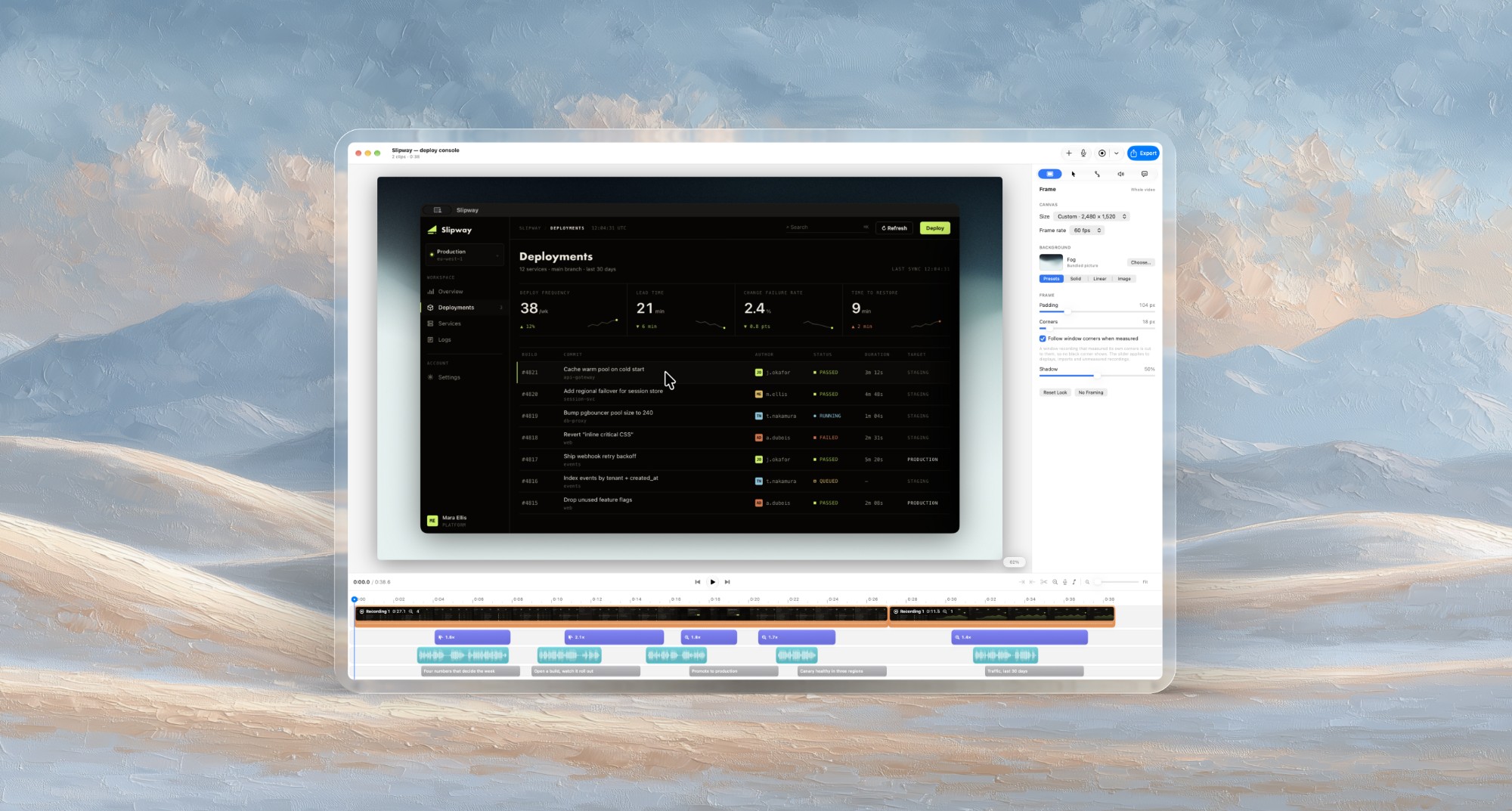
Lumae turns a raw screen recording into a product demo that looks edited by hand. Record a display, a window or an area of your Mac; Lumae zooms in where you clicked, redraws the cursor so it glides, frames the video on a background, and transcribes your voice into captions. Add your camera, a voiceover, music and title cards on one timeline, then export MP4, MOV, ProRes or GIF. Screenshots get the same treatment: capture, annotate, frame, copy.
It is native (SwiftUI, AppKit, ScreenCaptureKit, AVFoundation), everything runs on your Mac, and it is free: no account, no watermark, no export limits.
And because Lumae is also a Model Context Protocol server, Claude Code, Claude Desktop, Codex, Cursor or any MCP client can film a demo, cut it, zoom it, caption it and export it for you, working live in the same editor you use.
Contents
- Install
- Features
- Let an AI agent record and edit your demos (MCP)
- Privacy
- Keyboard shortcuts
- FAQ
- Feedback and support
Install
Disk image. Download Lumae-<version>.dmg from the
latest release, open it and drag
Lumae into Applications. Every build is signed with a Developer ID and notarized by Apple.
Homebrew.
Requirements. macOS 26.0 or later, on Apple silicon or Intel (Lumae is a universal app).
On first launch Lumae asks once for the Screen Recording permission. The microphone and camera are asked for only when you first record with them.
Updates arrive inside the app through Sparkle: Lumae checks once a day, downloads a small signed delta, and installs when you say so. Lumae › Check for Updates… checks right away. Homebrew leaves an installed copy alone, so the app stays the one updater.
Features
Screen recording
- Record a display, a window or an area with Lumae's own selector: drag an area, press Space to pick a window, or take the whole display. Start from the menu bar, the library or a global shortcut in any app.
- System audio and the microphone are one toggle each, and you choose the microphone.
- Film your camera at the same time. It lands on a lane of its own as a bubble: circle, squircle, square or widescreen, any corner, with a ring, a shadow and mirroring. A floating preview shows you on screen while you record, and fades when the pointer comes near it so you can see what you are clicking.
- Keep the recording controls out of the shot. Drag the recording pill anywhere; the next recording opens it in the same spot.
- Retake one clip without touching the rest of the project, or record a new clip onto the end.
Automatic zoom, smooth cursor, motion blur
- Automatic zoom reads the clicks in your recording and zooms in on them. Clicks close together become one move, leading in before the first and holding after the last. Every zoom stays editable: move it, resize it, change its scale, or add your own.
- Zooms can follow the cursor, panning to keep the pointer in view, or be aimed by hand on a focus map of the frame. Set the scale new zooms start at, how long they ease and the shape of the ease (Gentle, Standard or Snappy) once for the whole video.
- A cursor worth watching. Lumae hides the real pointer and redraws it from macOS's own vector artwork: a smoothed path, sharp at any zoom, with a ripple on every click. Choose per clip between that arrow, a touch circle for showing taps, the pointer as recorded, or none.
- Motion blur on zooms and pans, sampled across a virtual shutter the way a camera lens blurs.
Timeline editing
- One timeline for everything: clips, zooms, camera takes, narration, music and captions. Every lane moves, trims, splits (⌘B) and snaps by the same rules.
- Cut, copy and paste anything on the timeline, across lanes and between projects. A pasted recording keeps its drawn cursor and its clicks.
- Title cards. Press T for a title with its own font (Default, Rounded, Serif or Mono), weight, colour and alignment, revealed all at once or by line, word or letter with Fade, Slide, Rise, Focus, Pop or Type, and an exit of its own.
- Pictures on the timeline for an opening or closing card, framed, zoomed and faded like any clip.
- Fades between clips, one at a time or on every cut at once.
- Crop a clip after recording it (C): free, to the canvas, the original shape, 16:9, 4:3 or square. Its zooms keep looking at the same thing, and one click gives the same crop to the other clips of that recording.
- Clip speed from 0.25× to 24× with the pitch kept, for turning a long wait into a few seconds.
- Nondestructive. Edits never touch your media; nothing is re-encoded until you export, every change is one step in Undo, and projects save as you go.
Backgrounds and framing
- Put the recording on a colour, a gradient, one of more than fifty bundled pictures, or an image of your own. Lumae remembers the one you used last and keeps the pictures you add.
- Padding, shadow and corner radius, with corners matched to the recorded window's own, so the frame lands exactly on its edges. A full-screen recording fills the frame with square corners.
- A look per video or per clip. Any clip can depart from the video's look and come back to it in one click.
- Canvas sizes for every destination: 1080p, 720p, 4K, square, vertical 1080 × 1920 for Shorts, Reels and TikTok, or a custom size.
Voiceover, music and captions
- Narrate over the timeline while it plays. The clips' own sound ducks under your voice, and a take lines up with the picture it was recorded against. Each narration segment has its own level and fades.
- A music track with its own level, fades and ducking under narration, so the voice stays on top without riding a slider.
- Captions transcribed on your Mac with Apple's on-device speech recognition, split into lines people can read, every word editable inline. Or write a caption by hand at the playhead (⌥⌘T).
Screenshots and annotation
- Capture a display, a window or an area from a global shortcut, the menu bar or the File menu. Add ⌃ to the shortcut to send the picture straight to the clipboard.
- Annotate with arrows, rectangles, ellipses, highlights, blur, text and numbered steps, and crop. None of it is painted onto the pixels, so every mark stays editable later.
- Frame a screenshot like a video, on the same backgrounds, with padding, corners and shadow.
- Copy Image (⇧⌘C) or export a PNG (⌘E) at the picture's own pixel density.
Export
- H.264 or HEVC in MP4 or MOV, with a Quality of Good, High or Best that means the same look at 720p as at 4K.
- ProRes 422 LT, 422, 422 HQ and 4444 for handing the video to an editor such as Final Cut Pro or Premiere.
- Animated GIF for READMEs, docs and chat, with its own frame rate, palette, dithering and looping.
- The preview and the export share one renderer, so what you see is what you get.
Let an AI agent record and edit your demos (MCP)
Lumae has an MCP server built into the app, so a coding agent or AI assistant can work on your videos directly. Everything an agent does goes through the same editing engine as your own clicks: it happens live in the editor window, it is one step in Edit › Undo, and it saves like anything else.
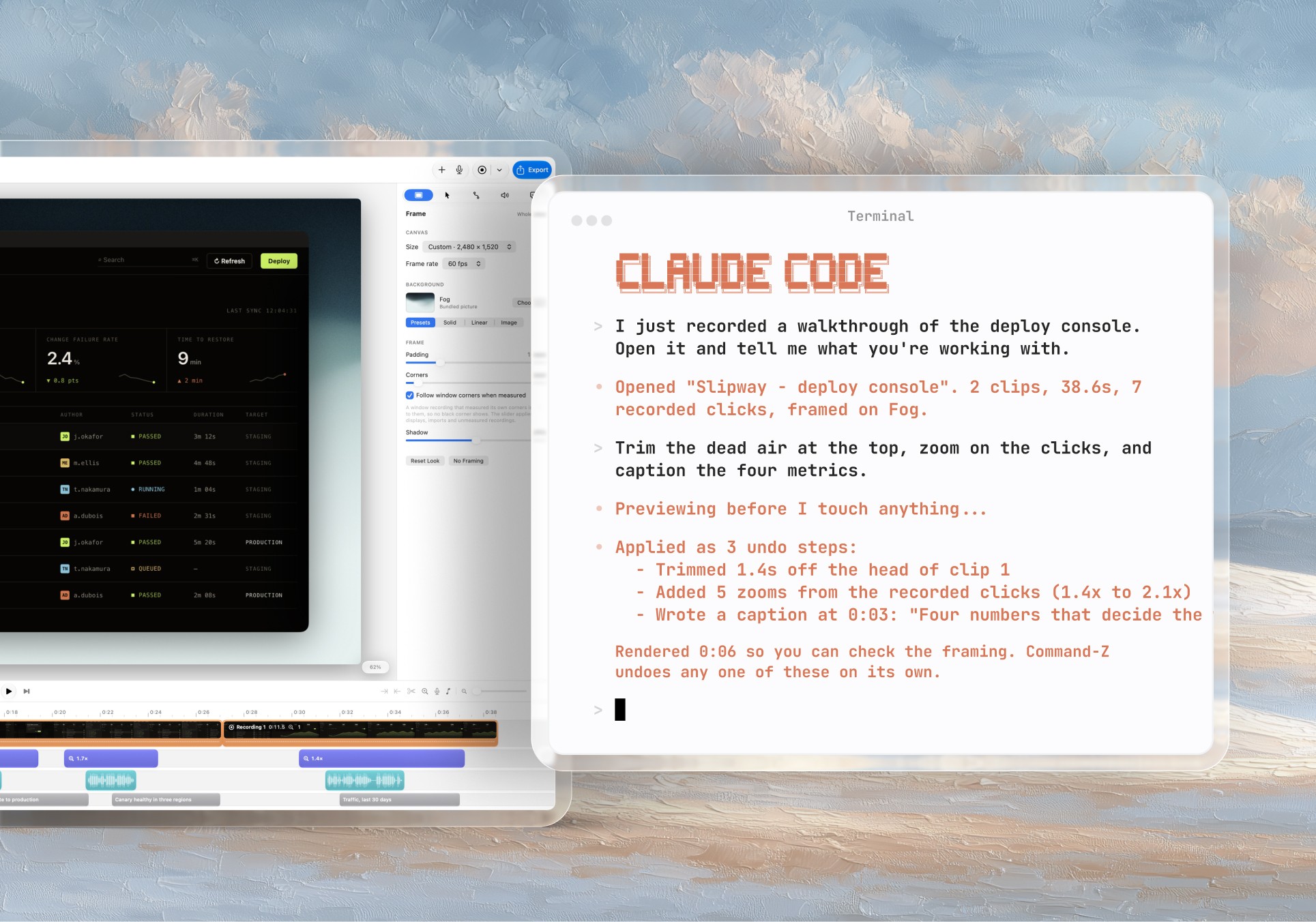
Things you can ask for:
"Record the Safari window while you walk through our sign-up flow, then cut the dead air and zoom in on each click."
"Transcribe my narration, write the captions, and put a title card at the start."
"Fade between every clip, make the background the dark gradient, and export a 1080p MP4."
Connect Claude Code in one line:
Claude Desktop and Cursor take the same entry in their MCP config:
Codex CLI, in ~/.codex/config.toml:
Settings › MCP Server in the app prints each of these with a Copy button, and Lumae does not
need to be running first: it launches when a client connects. Lumae is also listed in the
official MCP Registry as io.github.matlegault/lumae.
What an agent can do
| Tools | |
|---|---|
| Record | list_capture_targets, start_recording, recording_state, stop_recording (optionally trimmed to what happened), perform_gesture (moves, clicks, drags, scrolls and types with a person's pacing, on camera), mark_moment (labels a beat as it happens) |
| Edit | edit_project (every edit the app can make, applied as one undo step), remove_range, split_at, move_item, trim_item, add_zoom_at, auto_zoom, copy_items, import_media, undo, redo |
| See | get_project (the timeline with every click and mark), render_frame, sample_frames, preview_edit (what a change would look like, before it is made) |
| Finish | transcribe (on-device, with word timings), export_project (H.264, HEVC, ProRes or GIF) |
| Projects | list_projects, open_project, create_project |
| Guides | get_skill (demo direction, recording and editing guides written for agents), describe_commands |
Built so you stay in charge
- A recording an agent starts shows the same countdown and floating controls as yours; it is never invisible on the Mac it runs on.
perform_gestureworks only while a recording is running and stops with it. It needs the Accessibility permission, which only you can grant.- The microphone and camera stay off in an agent's recording unless it asks for them.
- An agent's exports are written under
~/Movies, and replace an existing file only when asked to, once the new one is complete. - Nothing about your projects leaves your Mac through MCP except what your client asks for and shows you.
The full guide, with every tool, the recording loop and troubleshooting, is docs/MCP.md.
Privacy
Recording, rendering, captions and transcription all run on your Mac; none of your work is uploaded. Lumae makes two kinds of network request: the daily update check, which reads a small feed from this repository, and anonymous usage statistics (counts, durations and choices, never names, paths, text or pixels), which you can turn off in Settings › Privacy. While an agent is connected they also note which tools it called and the one-line reason it gave for each; the MCP guide lists exactly what.
Projects live in ~/Movies/Lumae as .lumae packages, and screenshots as .lumaeshot packages
in its Screenshots folder: your original media plus a small description of the edits. Older
projects move forward to each new version automatically; a project opened by a newer version
cannot be opened by an older one.
Keyboard shortcuts
| Shortcut | Does |
|---|---|
| ⌥⌘3 | Screenshot of the display |
| ⌥⌘4 | Screenshot of an area or a window (Space picks a window) |
| ⌥⌘5 | Start or stop a recording |
| ⌥⌘6 | Record an area |
| ⌃ added to ⌥⌘3 or ⌥⌘4 | Copy the screenshot to the clipboard |
| T | Add a title card |
| C | Crop the selected clip |
| ⌘B | Split at the playhead |
| ⌥⌘T | Add a caption at the playhead |
The global shortcuts can be changed in Settings › Shortcuts, which can also hand macOS's own ⇧⌘3, ⇧⌘4 and ⇧⌘5 to Lumae.
FAQ
Is Lumae free? Yes. No account, no card, no watermark and no export limits.
Is Lumae a Screen Studio alternative? It does the same kind of work: screen recordings with automatic zoom, a smoothed cursor, backgrounds and motion blur, for product demos, tutorials and launch videos. It also has on-device captions, a camera lane, a music track, title cards, annotated screenshots and an MCP server for AI agents, and it is free. lumae.app compares it feature by feature with Screen Studio, Screen Charm and Tight Studio.
Which Macs does it run on? Any Mac with macOS 26.0 or later, Apple silicon or Intel.
Can an AI agent really record a demo by itself? It can drive the recording, working the app on camera with a person's pacing, and then edit and export the result. What to demonstrate is still up to you, and the permissions stay yours to grant. See the MCP section.
Is Lumae open source? No. This repository holds Lumae's signed releases, its update feed and its MCP guide; the source is private.
Feedback and support
Report a bug, ask a question or suggest a feature at lumae.app/feedback, or open an issue here. Your Lumae and macOS versions, and what you expected to happen, make most bugs quick to fix.
Follow new releases with the release feed, or watch this repository for releases.
This repository holds the disk images, the Sparkle update archives and deltas, the
appcast.xml feed and the .mcpb MCP bundle attached to each
release.