Logic Pro MCP README
The full upstream README, mirrored here for reference. Install config, tool schemas, adoption signals, and an original overview live on the Logic Pro MCP listing page.
Logic Pro MCP Server for Claude, Cursor, and AI Agents

A local Model Context Protocol (MCP) server that lets Claude Code, Claude Desktop, Cursor, VS Code, and custom AI agents control Logic Pro for AI music production: create tracks, write MIDI, operate transport and mixer state, inspect live project data, and verify results.
Install · Watch demo · What it controls
🏆 Selected for Anthropic's Claude for Open Source program
Logic Pro MCP has been officially selected for Anthropic's Claude for Open Source program — recognition from the makers of Claude that this project is open-source work worth supporting. This server is built with Claude, for Claude-powered agents — and is now officially supported by the program.






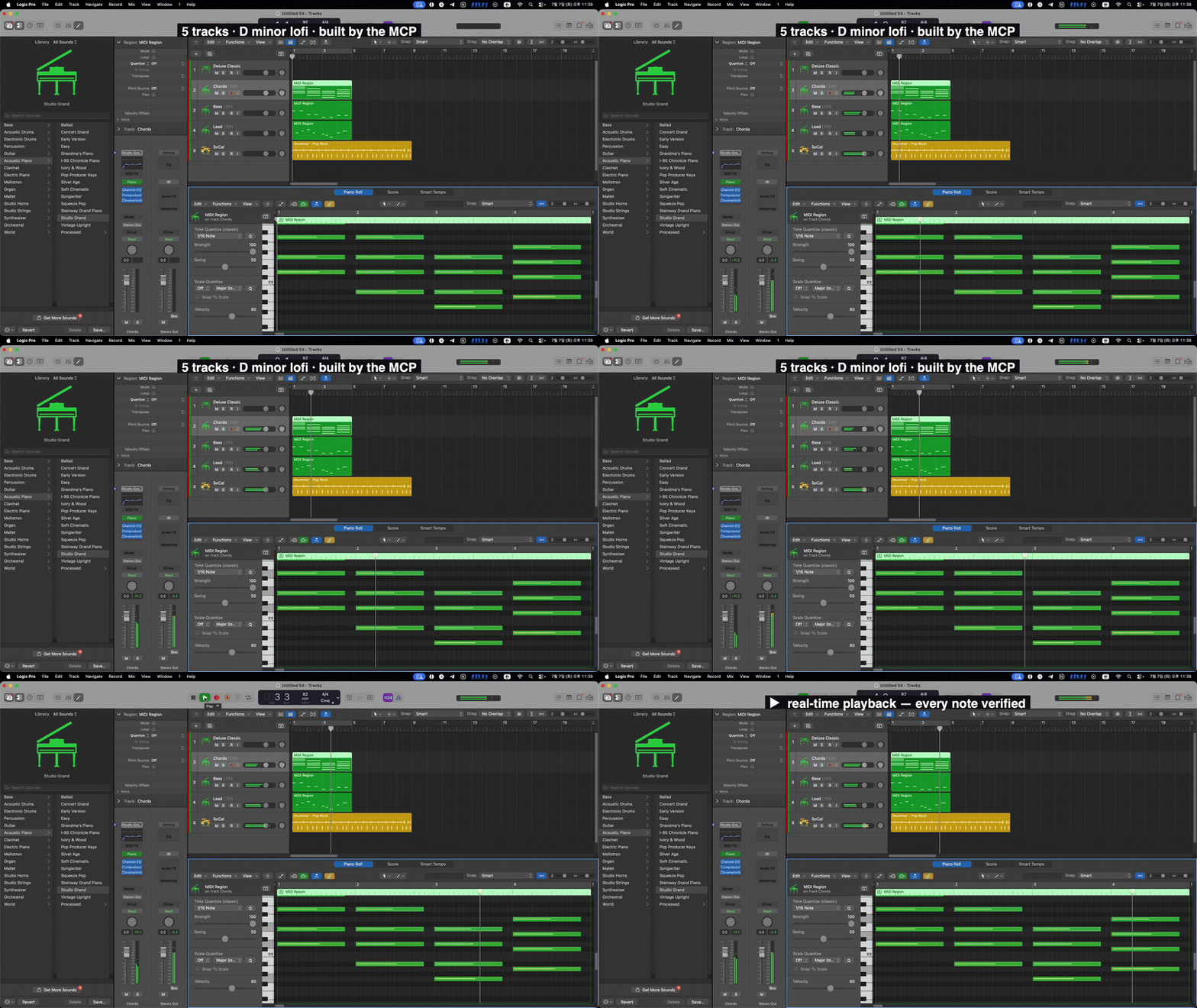
An 82 BPM D-minor lofi loop composed live in Logic Pro 12.3 by the MCP — tempo, three MIDI parts, a Drummer, and playback, all from prompts.
▶ Watch the 36-sec demo (with sound)
Logic Pro MCP Server gives Claude, Cursor, and custom AI agents a structured way to control Logic Pro without brittle keyboard macros. Logic Pro does not ship a first-party API for agentic composition, session setup, mixer operations, or live project readback, so Logic Pro MCP fills that gap by combining 7 native macOS control channels behind one MCP interface, then wrapping every high-risk operation in explicit state, confirmation, and verification contracts.
The result is not "screen automation with prompts." It is a structured server for DAW agents: tools mutate, resources read, evidence is labeled, and uncertain outcomes stay uncertain instead of being reported as success.
At a Glance
| Surface | Current source tree |
|---|---|
| MCP tools | 10 tools covering transport, tracks, mixer, MIDI, edit, navigation, project lifecycle, audio artifact analysis, system health, and verified plugin apply-back |
| Read resources | 18 static resources for health, transport, tracks, mixer, markers, project metadata, project audit/cleanup planning, MIDI ports, MCU state, library inventory, stock plugin/instrument intelligence, Session Players, and workflow skills |
| Resource templates | 12 templates for the generated operation catalog, track, region, mixer-strip, stock plugin detail/search, stock instrument detail/search, Session Player detail, session-plan dry run, and workflow detail/search lookup |
| Control channels | MCU, Accessibility, AppleScript, CoreMIDI, CGEvent, Scripter, MIDI Key Commands |
| Supported Logic Pro | Latest Logic Pro first — desktop Logic Pro (com.apple.logic10, /Applications/Logic Pro.app) and Apple Creator Studio Logic Pro Creator Studio (com.apple.mobilelogic, /Applications/Logic Pro Creator Studio.app). Desktop Logic Pro is the only variant the release qualification matrix covers (shipVariants = [.desktop]), so it is the only one this server claims to control. Creator Studio's bundle ID is recognised so that a machine with both installed is not targeted by accident and so the server can say which one it found — recognising a variant is not the same as qualifying it, and no qualification evidence exists for Creator Studio. Set LOGIC_PRO_BUNDLE_ID to pin the desktop variant when both are installed. Logic Pro 12.3 is the first-class, actively-validated target (macOS 15.6+); older versions down to 12.0.1 are best-effort |
| Verification line | Current source tree: 3917 Swift tests; the last reproducible release build + repo-wide live qualification E2E (every registered operation against real Logic 12.3 with independent readback) ran green on the v3.12.0 release tree (2026-07-21, clean session). The last full strict live E2E ran on the v3.8.0 line (372/373); v3.9.0's two live-only surfaces (MIDI export read-back, Channel EQ verified params) were spike-tested against live Logic 12.3 and honestly deferred — see the CHANGELOG Deferred section. v3.12.0 adds live-verified coordinate-free actuation (menu AXPress toggle proof), consent-gated record-arm auto-setup with functional flip/restore verification, and the locale-neutral modal classifier |
| Release state | Current stable line v3.17.0 — the GitHub Release is built from that tag, and Homebrew installs it once the Formula carries the published tarball's sha256, which the tagged tree cannot contain; previous stable v3.16.0 remains available for pinned installs (note: v3.11.0 Homebrew bounce/export is broken by a packaging omission fixed in v3.12.0 — #427) |
If this project helps you make music with Claude, Cursor, or any MCP client, star the repo. It helps the project reach more Logic Pro users and maintainers.
Want to contribute? Start with the Contributing Guide and the open issues. Many docs, examples, validation tests, and CLI-message improvements do not require Logic Pro.
Why It Exists
Most Logic Pro automation attempts fall into one of three traps:
- Prompt-only recipes that drift away from the real tool surface.
- Keyboard macro automation that can click the wrong target and still look successful.
- Single-channel control that can write to Logic but cannot reliably read what Logic actually did.
Logic Pro MCP uses a different model. It routes each operation to the strongest available channel, exposes live state through MCP resources, and forces callers to handle three outcomes: confirmed, uncertain, or failed.
What It Controls
| Area | What agents can do | Safety/readback model |
|---|---|---|
| Transport | Play, stop, record, locate, cycle, metronome, tempo | CoreMIDI/AX routing with live logic://transport/state readback |
| Tracks | Create, delete, duplicate, select, rename, mute, solo, arm, set instruments | Mutating targets require explicit index/name; uncertain selection fails closed before writes |
| MIDI composition | Generate SMF server-side, import MIDI, send notes/CC/MMC, create virtual ports | .mid imports are constrained to server-managed temp files and must create a live track |
| Mixer | Volume, pan, plugin snapshots, guarded stock plugin insertion | AX writes with same-surface readback for volume/pan (since #83); set_master_volume uses MCU echo; set_send is not exposed (State C command_not_exposed); occupied plugin slots refuse replacement |
| Library | Scan Logic's instrument library and load patches by path | Disk/AX inventory is cached; disk scan dedupes user/app-bundle .patch candidates and resolve_path classifies kind/source/loadable before set_instrument |
| Navigation | Bars, markers, zoom, view toggles | Marker navigation is target-faithful; cold-cache misses return failure instead of "next marker" |
| Project lifecycle | New, open, save, save-as, close, bounce, export plan, quit | Destructive operations require confirmation; dry-run export plans do not open Logic or write artifacts |
Agent-Grade Surfaces
Tools are for actions and local artifact checks. The public write surface is intentionally small: logic_transport, logic_tracks, logic_mixer, logic_plugins, logic_midi, logic_edit, logic_navigate, logic_project, and logic_system. logic_audio is read-only and verifies exported files after Logic writes them.
Resources are for state. Clients should read logic://transport/state, logic://tracks, logic://mixer, logic://project/info, logic://project/audit, logic://project/cleanup-plan, logic://midi/ports, and related resources instead of burning tool calls on polling.
Evidence is separated from claims. The README points to release evidence, current-main verification, and live media artifacts instead of implying that a successful command equals a verified Logic state.
Trust Model
- Honest Contract envelopes: mutating operations return State A confirmed, State B uncertain with a reason, or State C failure with an error.
- Verified plugin apply-back:
logic_plugins.*uses HC v2 (hc_schema: 2) and returns State A only after project identity, target track, physical insert slot, plugin identity, and readback all agree. - Fail-closed targets: dangerous mixer, marker, track, MIDI import, and plugin operations require explicit targets and validation.
- Confirmation levels: destructive/project and plugin insertion flows require explicit confirmation metadata before execution.
- Provenance labels: read surfaces expose source, freshness, and evidence labels instead of forcing clients to guess.
- Installer hardening: Homebrew pins SHA256; the shell installer refuses to run without explicit hash/team pins unless same-origin provenance is explicitly allowed.
- Release honesty:
v3.17.0is the current stable line, and README claims stay tied to shipped artifacts, release-tree tests, or explicitly linked live evidence.
Quick Start
Prerequisites: macOS 14+ for the MCP server, Logic Pro (latest release prioritized — currently 12.3, which Apple lists as requiring macOS 15.6+; older Logic versions down to the 12.0.1 floor are best-effort), and an MCP client that can launch a stdio server. Published GitHub Actions/Homebrew assets are universal (arm64 + x86_64) and do not require Xcode. Bounce/export uses the bundled native CGEvent helper with no third-party click binary.
Logic Pro version policy. Logic Pro MCP tracks the latest Logic Pro release as its first-class target and validates against it (the strict live E2E runs on Logic Pro 12.3). When Apple ships a new Logic Pro version, supporting it is the top priority — the Accessibility/UI tree shifts between releases, so the newest version is where fixes land first. Older versions above the 12.0.1 floor remain best-effort and may lose parity as those UI surfaces change.
The package manifest uses Swift tools 6.0 for compatibility. Current source verification uses Xcode 16.4 / Swift 6.2 in CI.
The current stable line is v3.17.0 (cut 2026-09-25 UTC). Breaking in this release: edit.undo no longer reports a success it cannot prove — it routed a MIDI controller number nothing was bound to, succeeded at the wire, and never reached the rung that posts Cmd+Z, so two inserted plug-ins survived two logic_edit undo calls each answering success: true; it now presses the Edit-menu entry and reads it back, and answers State B noop_unobservable where the surface cannot separate a pop from a no-op. transport.goto_position's menu_state is a reading rather than the constant could_not_be_closed it printed on every path (no safety field changed). The MCU health line stopped rendering the staleness age into channels[].detail — that integer is last_feedback_at — and staleness is evaluated once per payload instead of twice, so one document can no longer contradict itself. The dead --qualify and --verify-promotion CLI flags are gone from the usage text. New: system.setup_control_surface installs and binds Logic's control surface, the precondition every MCU operation was missing — Logic ships with none installed and discards every MCU message until one is, while health reported the channel ready; logic_mixer.insert_plugin takes a configuration naming the channel layout, honoured only when the strip offers it; and the package vends a LogicProMCPKit library product, which this is the first release to carry. Fixed: MCU feedback was decoded from the little-endian memory image of UMP words rather than from the words — measured live, 161 packets in produced 8 misvalued events where a correct read produces 112, which is what echo_timeout_500ms was; MCU display writes (49 SysEx frames per startup burst) never reached the parser at all; insert_plugin refused plug-ins sitting right there on a mono strip because every configured menu path ended in a hardcoded Stereo; observed_track_type answers audio and external MIDI from the channel strip and still refuses the two kinds that strip cannot separate; a closed menu's enabled reading is a stale validation cache and the Go To Position refusal reported it as certain; a typed channel refusal the router walked past now reaches the caller instead of a DEBUG log; the record-arm key-command setup types Apple's own spelling instead of English into every Logic; and region bar parsing is derived from Apple's own row in all ten languages Logic ships. It carries v3.16.0's per-track (stem) audio export, signal-flow graph, verified Controls-view boolean control, and the observed_track_type change that made the header answer unknown. It ships ADHOC-signed universal artifacts when Apple Developer ID credentials are absent, plus SHA256SUMS.txt and RELEASE-METADATA.json for pinned installs. The runtime surface becomes 10 tools / 18 resources / 12 resource templates — the generated read-only operation catalog logic://system/operations ships as the 12th template. Headlines: logic_audio.recommend_eq now names its loudness gate minimum_level, logic_system.refresh_cache reports refreshed: true only after the cache advances, ambiguous AX selection and unprovable plug-in-editor identity fail closed, and logic_plugins.set_eq_band_verified, unflagged spectrum/EQ analysis, and mixer detent receipts are available. It carries v3.14.0's ambiguity-refusing AX locator resolution and per-operation qualification evidence, and v3.12.0's coordinate-free actuation campaign (mute/solo/arm, app-menu items, region selection use AX actions and key commands with observed-effect verification; the external click-tool fallback is retired), consent-gated record-arm key-command auto-setup (system.setup_arm_key), a locale-neutral modal classifier (localized plugin editors and the Drummer Smart Controls pane no longer block unrelated operations, while genuine modals keep blocking), ADR kernel behavior on by default (session-stable target_ref, operation-contract registry with strict params, verified-mutation saga preflight, operation trace), SecureFD-hardened trace-clear/support-bundle paths with a bounded saga lifecycle deadline, and the Homebrew packaging fix restoring bounce/export (logic_variants.py now ships — #427). It keeps the v3.9.0 MCP capability additions (transport.toggle_autopunch, resource subscriptions, workflow prompts, per-tool outputSchema / structuredContent), the v3.9.2 verified-plugin closed-window fix, and v3.10.0 desktop/Creator Studio targeting. The two v3.9.0 live-only surfaces (MIDI export read-back, Channel EQ verified params) remain honestly deferred with spike evidence.
1. Install
The Homebrew formula pins both the release tarball URL and its SHA256; Homebrew itself is a trusted delivery channel with its own signature chain. This is the hardened path for production installs. (On Homebrew older than 6.0 the brew trust step does not exist — skip it.)
For source-tree development, build locally:
2. Register with an MCP client
Claude Code:
Generic MCP client config:
If you built from source, point the command at .build/release/LogicProMCP.
3. Complete Logic Pro setup
Run the local checks:
Then complete the two Logic-side setup steps in docs/SETUP.md:
- Register the
LogicProMCP-MCU-InternalMCU control surface. - Add the bundled Scripter insert if you need plugin-parameter writes.
Logic 12.2+ does not auto-import the legacy Key Commands plist; the bundled preset is staged as a Manual MIDI Learn reference.
4. Test from your agent
Ask the client:
Check Logic Pro MCP health and show all ready channels.
Expected: all 7 channels ready after full setup, or 5 if you intentionally skipped Key Commands and Scripter.
Pinned shell installer
The installer is fail-closed: it refuses to run without explicit LOGIC_PRO_MCP_SHA256 + LOGIC_PRO_MCP_TEAM_ID env pins. It verifies the downloaded LogicProMCP-macOS-universal.tar.gz archive, so copy the SHA from that archive entry in the release's SHA256SUMS.txt:
If you knowingly accept same-origin provenance (hash + Team ID fetched from the same release as the binary), opt in explicitly:
See SECURITY.md §Installer trust model for the trust tiers and threat model.
Using LogicProMCP as a library
The package also exposes the LogicProMCP target as a library product named LogicProMCPKit (#944), so a Swift application can link the same code the server runs instead of driving the server as a separate stdio process. It changes no runtime behavior and no access level: not one public, internal or private modifier moved, no MCP tool or resource was added, and the server and its executables are byte-for-byte the same code. What the pull request touches besides Package.swift is Package.resolved — CI's toolchain resolves a larger transitive graph once the package vends a library — and this file, CHANGELOG.md and the roadmap.
A read-only census for plug-in hosts (#972): AXPluginInstanceIdentity.census(pluginName:identifierPrefix:) returns an AXSnapshot of the Mixer strips whose insert slot names the plug-in (ordinal, name, slot positions) and of the open plug-in editor windows (title, and the first kAXIdentifier under the given prefix), plus diagnostics saying what was found. It composes the existing Accessibility readers and issues no actions. Three outcomes are distinguishable: an empty snapshot with a note, a partial strip read (stripsReadWhole is false, so ordinals are not trustworthy), and a failed editor-window read, which throws CensusError.windowsReadFailed instead of returning zero windows. Measured on Logic Pro 12.3.1 with the Mixer docked in the main window (X); a standalone Mixer window is not found by the current locator.
Dependency setup
Declare from: "3.17.0" — it is the floor that guarantees the product. Every tag up to and including v3.16.0 predates it, and from: accepts anything up to the next major, so a lower floor can resolve, or stay pinned at, a tag without it. Before v3.17.0 was tagged, from: "3.16.0" resolved v3.16.0 itself and failed — measured 2026-09-22 with a consumer package written exactly that way:
After the tag, a fresh resolve of from: "3.16.0" takes the newest matching 3.x tag, but a Package.resolved already pinned to 3.16.0 keeps it until swift package update. Before v3.17.0 is published, branch: "main" is the form that resolves; after it, the version form above is preferred.
The product name is LogicProMCPKit; the module you import is LogicProMCP. A library product cannot share the executable's name: SwiftPM accepts such a manifest but reports "ignoring duplicate product" and drops the library.
What the module exposes today
The public surface is small and deliberate. Almost all of the module, including the Accessibility readers (AXLogicProElements, AXHelpers, AccessibilityChannel), the channels, the state cache, and the dispatchers, is internal and is not reachable through the library. What is public, as of this release:
PluginInspector(inAccessibility/PluginInspector.swift): the plug-in window Setting-menu inspector. Static entry pointsenumerateMenuTree,parsePath,encodePath,resolveMenuPath,selectMenuPath,decodeAUVersion,findPluginWindow,identifyPlugin,openPluginWindow, andclosePluginWindow. Every entry point that touches a window or a menu takes a caller-suppliedPluginPresetProbeorPluginWindowRuntimeof closures; the module ships no public production runtime, so nothing here reaches Logic on its own.- The data types those entry points use:
PluginPresetNodeKind,PluginPresetNode,PluginPresetCache,PluginPresetInventory,MenuHop,PluginMenuItemInfo,ScannerWindowRecord,PluginPresetProbe,PluginWindowRuntime,PluginError,AXUIElementSendable, and the constantmaxPluginMenuDepth. - The Library inventory data model (in
Accessibility/LibraryAccessor.swift):LibraryNodeKind,LibraryNode,LibraryRoot, andTreeProbe. TheLibraryAccessorenum that scans and selects patches isinternal, so only its data model is reachable.
If you need the Mixer, track, or plug-in slot readers from outside the module, that is a separate change; #944 records the plan for a small read-only facade as a follow-up issue rather than part of this product declaration.
Setup Doctor
Getting an agent to reliably drive Logic Pro is mostly a permissions-and-environment problem: TCC grants, the right Logic version, a live document, a registered control surface, no blocking modal. LogicProMCP doctor is a first-class, intent-aware readiness platform built for exactly this — not a boolean "is it installed" check, but a diagnostic that tells you which capabilities are ready, which are blocked, why, and what to do next — and never reports green for something it could not actually verify.
Intent-aware profiles. You are not forced through checks you'll never use. --profile scopes the required set to how you actually drive Logic — core (transport/tracks/AX), mixer, keycmd, legacy-scripter, or full. --client (claude-code, claude-desktop, cursor, vscode, terminal, custom) adds the registration checks that matter for that host. Aggregate status is scoped to the selected profile's required checks, so an MCU-only workflow isn't marked unhealthy for a Scripter gap it will never hit.
Capability readiness, not just check pass/fail. Every check is mapped to the capabilities it gates (track_management, midi_import, mixer_ax, mixer_mcu, keycmd_only_ops, verified_plugin_applyback, project_lifecycle, …). The report tells you "MIDI import is ready; verified-plugin apply-back is blocked by PostEvent" — the language an agent (or an operator) can act on directly.
Causal chain — fix_plan and blocked_by. Failures are ordered into a fix_plan (the next actions, most-unblocking first), and each downstream check names the upstream check that blocked_by it — so you fix the root, not the symptom. The headline restates the single next action.
Honesty is the whole point. A check that could not run (missing capability, unreadable TCC db) is reported as an explicit skipped with a reason — it is never silently folded into a pass. Intentional skips (--skip-channel <MIDIKeyCommands|Scripter> with an optional --skip-note, e.g. you deliberately didn't register Scripter) are recorded and excluded from readiness without faking green. TCC findings are redacted to service/principal/state summaries — no raw local paths in the report.
Permission surface it verifies. --check-permissions folds the four TCC grants a real agent needs and exits non-zero if any is missing: Accessibility, Automation → Logic Pro, Automation → System Events (a separate target — Logic being granted does not imply it), and PostEvent (Input Monitoring, required by the CGEvent bounce/click fallback). The doctor treats these as distinct capabilities because they fail independently: e.g. a -1743 / errAEEventNotPermitted from System Events is a launcher-permission gap (the process responsible for launching the server is denied Automation → System Events), reported as such with the exact fix — not misattributed to Logic.
Strict exit codes (--strict, for CI/agent gating): 0 ok · 1 failed · 2 manual_action_required · 3 degraded. Codes 2/3 are status codes, not usage errors, and sit below the sysexits.h range.
A real (redacted) run on a box mid-setup:
The same run in a terminal prints a grouped, color-coded report with per-check remediation anchors into docs/SETUP.md. Full flag reference and every check's remediation live in docs/SETUP.md; the --json bytes are a stable contract you can assert against in your own onboarding automation.
Architecture at a Glance
MCP clients launch the Swift stdio server. Dispatchers validate tool parameters, ChannelRouter chooses the strongest available macOS channel, resources expose cached/live state, and high-risk writes return explicit confirmed/uncertain/failed envelopes. The core channels are MCU, Accessibility, AppleScript, CoreMIDI, CGEvent, Scripter, and MIDI Key Commands.
Documentation
| Document | Audience | Purpose |
|---|---|---|
| Setup Guide | End users | Install, MCP registration, Logic Pro integration, doctor anchors |
| API Reference | End users, MCP clients | All 10 tools, 18 resources, 12 templates, Honest Contract, verified apply-back |
| Troubleshooting | End users | Common failures and fixes |
| Security Policy | Security reviewers | Threat model, reporting, hardening |
| Changelog | Everyone | Per-release changes |
| Contributing | Contributors | Dev setup, scoped PR workflow, PR verification |
The public docs tree is intentionally scoped: setup, API, troubleshooting, README media, plus public issue PRDs/tickets that explain active or shipped user-visible remediation. Historical release notes, internal PRDs, private ticket boards, spike notes, and local live-evidence work files are kept out of docs/; public release history belongs in CHANGELOG.md, GitHub Releases, merged PRs, and issue history.
Status
Current stable: v3.17.0. Its GitHub Release and the tag-pinned installer URLs above come from the v3.17.0 tag, which Scripts/release-stable.sh creates on the merged cut, so they resolve from the moment that tag exists. Homebrew installs it once the Formula carries that tarball's sha256: a tagged tree cannot contain the hash of the tarball built from it, so the hash lands in its own commit after publication, as it did for v3.16.0. It adds system.setup_control_surface (#884) — the control-surface install every MCU operation silently needed — a configuration parameter on insert_plugin (#871), and the LogicProMCPKit library product (#944); it fixes the MCU UMP decode (#736) and SysEx display path (#856), the mono-strip plug-in insert (#855), edit.undo reporting success it had not earned (#864), and the menu_state constant that cost an outside reporter a root cause (#921). It carries the accumulated v3.6.0 -> v3.16.0 set, restores Homebrew bounce/export by packaging logic_variants.py with an import-closure release gate (#427), ships the coordinate-free actuation campaign and consent-gated arm auto-setup (#413), fixes localized-editor/Smart-Controls modal misclassification (#381, #405), and turns the ADR-002/003/004/005 kernel behavior on by default with SecureFD/saga hardening (#417, #412). Published metadata remains team_id:"ADHOC" / signing:"adhoc" when Developer ID credentials are absent, with universal x86_64 + arm64 artifacts produced by GitHub Actions.
Previous stable: v3.16.0 remains available as the stem-export and signal-flow-graph release; v3.10.0 remains available as the Creator Studio support release; v3.9.2 remains available as the verified plugin parameter write fix release; v3.9.1 and earlier remain available for pinned installs.
Verification
| Gate | Current evidence |
|---|---|
| Full deterministic suite | Current source tree: swift test --no-parallel -> 3917 passed, 0 failed |
| Release build | Current source tree: swift build -c release passed |
| Python E2E syntax | PR #24 verification: python3 -m py_compile Scripts/live-e2e-test.py passed |
| Targeted live plugin proof | Logic Pro 12.2: logic_plugins.insert_verified track=6 insert=6 plugin=Gain returned State A with observed_slot:6, write_source:"ax_exact_slot_popup", and independent get_inventory readback |
| Track/transport readback proof | Logic Pro 12.2: logic://tracks returned source:"ax_live", real names, placeholder_count:0, unknown_type_count:0; cycle toggle/resource roundtrip reflected live UI state |
| Strict live Logic Pro 12.3 | Last full strict live E2E on the v3.8.0 line: 372 passed / 1 skipped / 0 failed (373 total). The v3.9.0 live-only surfaces were spike-tested and honestly deferred (see CHANGELOG Deferred; evidence under docs/spikes/). v3.12.0 keeps the v3.9.2 same-scenario A/B live proof for Compressor threshold and the v3.11.0 targeted live QA set, and adds the v3.12.0 release-tree whole-suite live qualification run (registered-operation independent-readback E2E on a clean Logic 12.3 session, 2026-07-21), a live-verified AXPress menu-item toggle, and the live arm auto-setup A–J matrix from #413 |
| README media | Actual Logic Pro 12.2 capture derivatives are published under docs/media/ |
| v3.12.0 release evidence | GitHub Release, Actions logs, CHANGELOG.md, issues #381/#393/#399/#401/#405/#412/#413/#415/#417/#427, and PRs #407-#428 |
Live E2E defaults to the release binary. Protocol/security assertions run on any host; Logic/CoreMIDI-dependent checks skip unless a real Logic Pro session is visible. Strict mode converts live-gated skips to failures, treats missing project state as a failed cycle roundtrip precondition, and launches the MCP server under a trusted shell/tmux parent so macOS TCC evaluates the same parent context used by live client flows.
API Contracts That Matter
- Honest Contract envelope — every mutating op returns State A confirmed, State B uncertain with
reason, or State C hard failure witherror. See docs/API.md. - HC v2 plugin apply-back —
logic_plugins.get_inventory,set_param_verified, andinsert_verifiedaddstate+hc_schema: 2; State C always carriesverified:false,write_attempted, retry safety, and target identity where relevant. - Fail-closed mutation targets — mixer faders, plugin params, marker delete/rename, track delete/duplicate, and MIDI imports require explicit target parameters.
- Exact-slot plugin insertion —
logic_plugins.insert_verifiedtargets the physical insert index returned byget_inventory, verifies the popup is anchored to that slot, and confirms success only by post-write inventory diff. - Target-faithful navigation —
goto_markerreturnselement_not_foundon a cold cache instead of advancing to the next marker. - 1-based MIDI channel —
send_note,send_cc, andrecord_sequencechvalues accept 1..16 to match Logic's UI. - Bounded raw SysEx —
send_sysexrejects payloads over 1024 bytes before CoreMIDI routing. - Audible-bounce guardrails —
record_sequencerefuses unverified GM Device / External MIDI imports,logic://project/auditmarks External MIDI tracks with MIDI regions as export blockers, andlogic_project.bouncerefuses those blockers before opening the Bounce dialog. - Audit phase split — audit logs distinguish rejected calls, confirmation prompts, and executed route invocations.
- Verified project saves —
project.save_asverifies the target.logicxpackage exists and that existing packages advance modification time. - Live project metadata —
logic://project/infopromotes live transport tempo/sample-rate when available and falls back per-field to saved project metadata. - Side-effect-free reads — resources expose state, metadata, and cached inventory without mutating Logic.
Release & Distribution
Stable production tags use the GitHub Actions release workflow. RELEASE-METADATA.json records the exact signing mode, Team ID, and architectures for each artifact. When Developer ID credentials are absent, releases publish ADHOC artifacts with SHA256 metadata and install validation rather than pretending to be notarized.
Per-release detail lives in CHANGELOG.md. Security and installer trust tiers are documented in SECURITY.md.
Registry Metadata
The repository ships server.json for the official MCP Registry metadata path. It is pinned to the current stable release (v3.17.0) and carries discovery tags for Logic Pro, DAW automation, MIDI, Claude/Cursor MCP clients, and music-production agents. The record is metadata-only because the registry package schema does not yet model Homebrew formulas or GitHub release tarballs as first-class package types. The install authority remains the pinned GitHub Release/Homebrew path above.
Known Limitations
- Tempo typing:
transport.set_tempouses bounded coarse and exact AX slider fallbacks when Logic's inline tempo input does not commit, and fails closed if exact readback still cannot be verified. - MIDI region padding:
record_sequenceregions start at bar 1 and extend to the target bar using inaudible padding; note timing inside the region is exact, but the region can look longer than the phrase. - External MIDI bounce readiness: MIDI regions on GM Device / External MIDI tracks are not accepted as audible-bounce evidence by project audit or
logic_project.bounce. Move or recreate the material on Software Instrument tracks before claiming a verified Logic Bounce. - MIDI Key Commands: Logic 12.2 does not accept the legacy
.plistKey Commands import; manual MIDI Learn remains required for keycmd-only operations. - Markers: marker creation uses Logic's native Navigate menu and verifies the Marker List when it is readable. A closed/unreadable Marker List is reported as unreadable or served from the last readable cache instead of being promoted to a verified empty list.
rename_markerremainsnot_implemented. - Plugin parameter readback:
logic_plugins.set_param_verifiedopens the target insert's plugin window when needed and live-verifies Compressorthresholdthrough that window; arbitrary plugin parameters remain future work and fail closed withunsupported_param_readback.
Development
Source builds require Xcode 16.4+ / Swift 6.2 for the current verified toolchain.
For live attestation on a configured Logic Pro host:
License
MIT. See LICENSE.
Contributing
Bug reports, PRs, and feature discussions are welcome. See CONTRIBUTING.md and the open issues for the dev workflow.
Security vulnerabilities: please do not open a public issue. See SECURITY.md for the private disclosure process.