Zero-config SEO and GEO checker: 21 technical-SEO and generative-engine checks for a live site.
Copy the AI prompt to install this server into Claude Code, Cursor, or another agent β or use 1-click editor setup below.
π‘ Paste into ~/Library/Application Support/Claude/claude_desktop_config.json (macOS) or %APPDATA%\Claude\claude_desktop_config.json (Windows)
Install β’ Quickstart β’ CLI reference β’ Comparison β’ FAQ β’ Contributing
Runs 21 technical-SEO and GEO (generative-engine-optimization) checks against your site, in pure TypeScript or pure Python, with zero Python interpreter, zero headless browser, and zero external toolchain either way.
LLMScout ships as two independent, complementary distributions. Both run the same 21 checks with the same PASS/WARN/FAIL verdicts, so pick whichever fits your toolchain.
Node/TypeScript (npm):
The CLI targets Node 18+ (declared in package.json engines). The two runtime dependencies are cheerio (HTML parsing) and commander (argument parsing): there is no Python interpreter, no pip install, and no Playwright/Chromium download anywhere in the npm install.
[!NOTE] The npm install pulls in
undicias a transitive dependency ofcheerio.npm audithas flagged a high-severity advisory against it in the past;package.json'soverridesblock pinsundici(andjs-yaml/nanoid) to patched ranges to close it. Runnpm auditafter install to confirm your resolved tree is clean.
Python (PyPI):
Zero runtime dependencies -- HTML parsing and HTTP fetching both use only the Python standard library. See python/README.md for the full Python-specific guide.
Then, in any project you want to check:
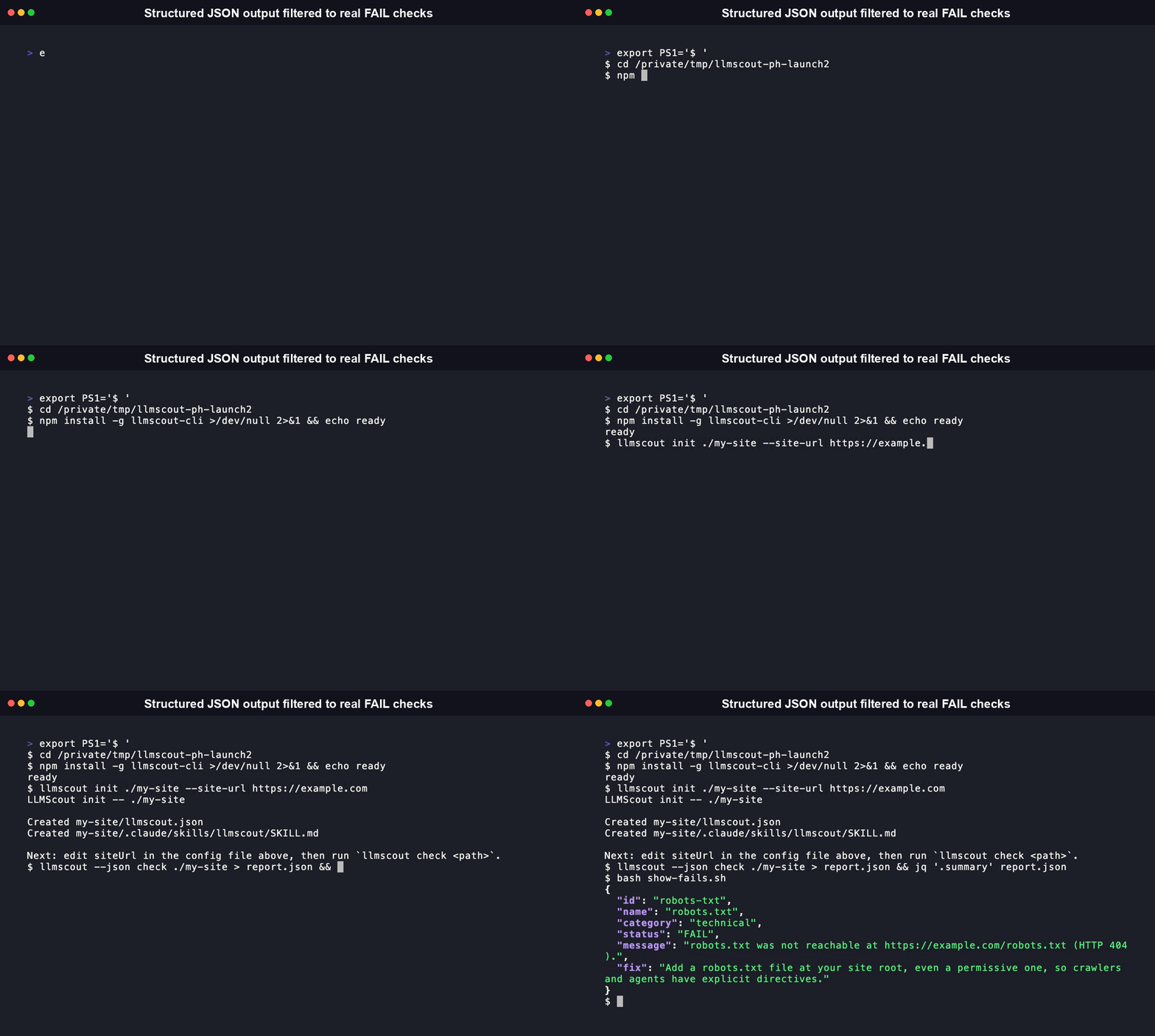
That scaffolds a llmscout.json config and a small Claude Code skill file into the target directory. Set your site URL and run llmscout check ..
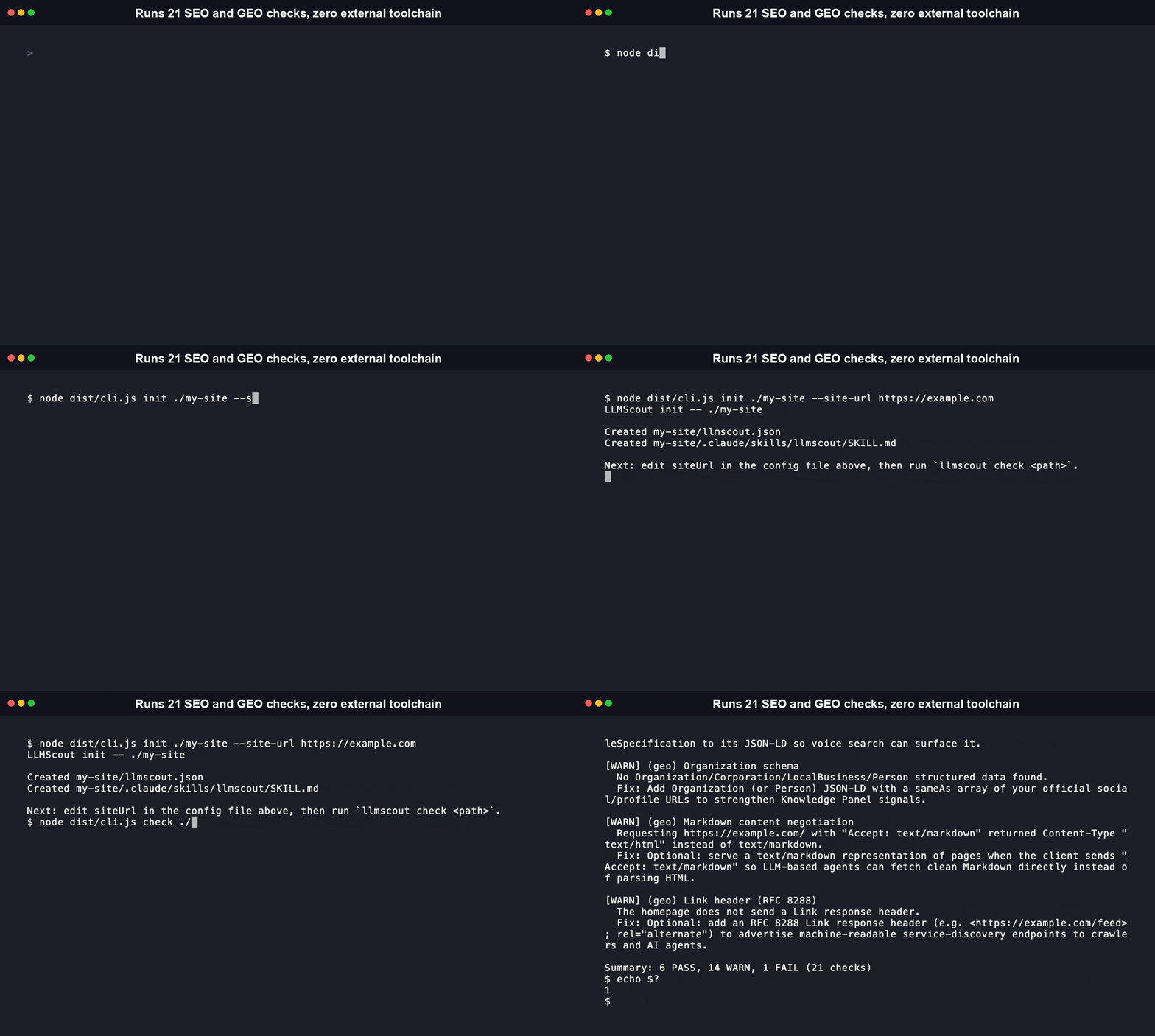
Scaffold a config and run a check against a live site:
Real output from llmscout check against https://example.com:
The same run with --json:

check exits 0 when no check FAILs, 1 when at least one check FAILs (WARN alone does not fail the run), and 2 on a usage error such as a missing or misconfigured llmscout.json.
child_process is never imported anywhere in the TypeScript source; the Python port has zero runtime dependencies. Checks run inside the process instead of shelling out to Python scripts or a headless browser.python3-versus-py -3 shelling and no relative-path script resolution, so the same install runs identically on Windows, macOS, and Linux.src/fetch-utils.ts) rejects any non-http(s) scheme, blocks loopback/private/link-local hosts, follows redirects manually one hop at a time, and bounds the chain at 5 hops and the response body at 10 MiB.llmscout fleet manifest.json runs the full suite across many local client-repo paths in one invocation, and --out-dir writes one auto-named report file per site -- built for agencies checking many client sites at once.--json flag for machine-readable output, so an agent invoking the CLI can parse results programmatically.--user-agent flag to override it.npm test / npm run test:coverage and pytest. The Python distribution has zero runtime dependencies, so there is nothing for a dependency audit to flag. On the npm side, npm audit currently reports one high-severity advisory in undici, a transitive dependency pulled in by cheerio, not in this project's own code.Search traffic is genuinely shifting toward AI-mediated answers, and the shift is recent and well measured, not a hypothetical:
ai-crawler-directives check reports on all seven of the current major training and search bots (GPTBot, OAI-SearchBot, ClaudeBot, Claude-SearchBot, PerplexityBot, Google-Extended, Applebot-Extended) separately, since blocking a company's training bot has no effect on whether its assistant can still retrieve and cite your page live through its own search bot.Accept: text/markdown) as a standards-based way to serve agents a lighter, cleaner representation of a page -- their own benchmark saw an 80% token reduction on one blog post. (Cloudflare, "Markdown for Agents") Worth being honest about the current state: independent analysis across 300,000 domains found that in practice, no major AI crawler currently sends the Accept: text/markdown header to actually negotiate it yet -- they discover Markdown only via direct links. (Dries Buytaert) LLMScout's markdown-negotiation check reports on this without pretending the ecosystem is further along than it is.llms.txt is a real, community-driven convention (created September 2024, adopted by roughly 8-10% of top sites as of mid-2026, including Anthropic, Stripe, Cloudflare, and Vercel) -- but Google's own Gary Illyes has stated publicly that Google does not support it and has no plans to, comparing it to the deprecated keywords meta tag. (Search Engine Journal) LLMScout's llms-txt check reports its presence as informational, never as a required pass -- the tool's job is to report what is actually configured, not to prescribe a policy the evidence doesn't yet support.FAQPage schema itself is not deprecated -- it remains valid markup other engines and AI assistants can still parse for direct-answer extraction -- so LLMScout's faq-schema check still reports on it, just without implying it earns a Google SERP rich result anymore.Each check reports PASS, WARN, or FAIL, with a fix suggestion for anything that is not a clean PASS. A WARN is a missed optimization, not a broken page, and never fails the run on its own.
Check (id) | What it verifies |
|---|---|
Title tag (title) | A <title> exists and is within 10-60 characters. |
Meta description (meta-description) | A <meta name="description"> exists and is within 50-160 characters. |
Canonical tag (canonical) | A <link rel="canonical"> exists and its href is a valid URL (relative hrefs are resolved, not penalized). |
robots.txt (robots-txt) | /robots.txt is reachable and contains at least one User-agent directive. |
sitemap.xml (sitemap-xml) | /sitemap.xml is reachable and valid, with a Sitemap: directive in robots.txt checked as a fallback location. A response that looks like a CDN challenge page (e.g. Cloudflare bot management) gets a distinct message instead of a generic "malformed sitemap" one. |
Heading structure (heading-structure) | Exactly one <h1>, and no skipped heading levels (for example an <h1> followed directly by an <h3>). |
Image alt coverage (image-alt) | <img> tags have an alt attribute (an intentional alt="" for decorative images counts as covered). |
Open Graph tags (open-graph) | og:title, og:description, og:image, and og:url meta tags are present, for rich link previews on social platforms. |
Twitter/X Card tags (twitter-card) | A valid twitter:card meta tag and its required companion fields are present. |
Meta robots directives (robots-meta-directives) | Advanced snippet-control directives (max-snippet, max-image-preview, max-video-preview) are set, and flags an outright noindex. |
Image weight (image-weight) | Each image's actual byte size (via a HEAD request), flagging oversized images that slow page load. |
Redirect chain (redirect-chain) | The homepage's full redirect chain, warning on long chains and failing if the chain dead-ends in an error status. |
Check (id) | What it verifies |
|---|---|
Structured data (structured-data) | JSON-LD <script type="application/ld+json"> blocks exist and parse as valid JSON. |
llms.txt (llms-txt) | An /llms.txt is present at the site root (an emerging, non-standardized convention -- see Why GEO checks matter right now; absence is informational). |
AI crawler directives (ai-crawler-directives) | Reports the robots.txt allow/disallow state for GPTBot, OAI-SearchBot, ClaudeBot, Claude-SearchBot, PerplexityBot, Google-Extended, and Applebot-Extended. This is a report of what is configured, never a recommendation to allow or block. |
FAQ schema (faq-schema) | FAQPage JSON-LD is present (informational; only relevant to pages that actually have an FAQ -- see the note on Google's May 2026 rich-result deprecation above). |
Content extraction friendliness (content-extraction) | Heuristic: the page has heading/paragraph structure an engine can chunk, rather than one large unstructured block. It cannot see content that only appears after client-side JavaScript, by design. |
Speakable schema (speakable-schema) | A SpeakableSpecification is present in JSON-LD, for voice-assistant answer eligibility. |
Organization schema (organization-schema) | Organization/Person JSON-LD with a sameAs array of official profile URLs is present, for Knowledge Panel signals. |
Markdown content negotiation (markdown-negotiation) | Whether the site serves a text/markdown representation when requested via Accept: text/markdown content negotiation. |
Link header (link-header) | Whether the homepage response sends an RFC 8288 Link header for machine-readable service discovery. |
You can run only one category by editing the checks block in llmscout.json ({ "checks": { "technical": true, "geo": false } }).
Transcribed from the tool's own --help output.
| Command | Argument | Options | Purpose |
|---|---|---|---|
init | <path> target directory | --site-url <url> set siteUrl immediately | Scaffold llmscout.json plus a Claude Code skill file. Idempotent: existing files are left untouched. |
check | <path> project directory containing llmscout.json | --out-dir <dir> also write an auto-named report file for this site; (global --json, --user-agent) | Run the selected checks against the configured siteUrl. |
fleet | <config.json> fleet manifest | --out-dir <dir> also write one auto-named report file per site, named from the manifest's name field; (global --json, --user-agent) | Run the full suite against every site in the manifest. |
--json, --user-agent, -V/--version, and -h/--help are the only global options.
| Code | Meaning |
|---|---|
0 | init succeeded, or check/fleet completed with no FAIL. |
1 | check: at least one check FAILed. fleet: at least one site FAILed or errored. |
2 | Usage error: invalid URL scheme, missing/unreadable/invalid llmscout.json, blank siteUrl, missing manifest, or any other configuration error. |
LLMScout ships a Model Context Protocol server so an AI agent (Claude, Cursor, or any MCP-compatible client) can run SEO/GEO checks against a live site directly, without a human invoking the CLI by hand.
Install the extra:
Add it to your MCP client's config (for Claude Desktop, claude_desktop_config.json):
The server exposes one tool, run, that shells out to the published llmscout npm binary with the
given subcommand and arguments plus --json, and returns the parsed JSON result:
Transport is stdio, so there is nothing to host: the MCP client spawns the server as a local
subprocess. Source: python/src/llmscout/mcp_server.py.

fleet is aimed at agencies or teams that maintain several client sites side by side as local repos. You declare each site in one manifest and check them all in a single command:
Add --out-dir ./reports and each site's result is also written to its own auto-named file (client-a.txt, client-b.txt, or .json with --json) -- instead of one combined stdout dump, an agency running this across many client sites gets one distinguishable report per client. Each manifest entry's path resolves against the manifest file's own directory, not the process working directory, so the same manifest works no matter where you invoke it from. Everything is local filesystem access, with no SSH and no remote-execution surface.
Both distributions are also genuinely importable libraries, not just CLIs. The exports below are real (grepped from src/index.ts and python/src/llmscout/__init__.py), and the examples are tested against the published packages, not written from memory.
TypeScript (llmscout-cli on npm):
| Export | Signature | What it does |
|---|---|---|
loadSite | (rawSiteUrl: string, fetchFn?: FetchFn) => Promise<CheckContext> | Validates the URL, fetches the site's resources, and builds a CheckContext in one call. What check and fleet both call internally. |
fetchSiteResources | (siteUrl: URL, fetchFn?: FetchFn) => Promise<SiteResources> | Lower-level: fetches the homepage plus robots.txt/sitemap.xml/llms.txt in parallel, without building a CheckContext. |
buildCheckContext | (resources: SiteResources, fetchFn?: FetchFn) => CheckContext | Builds a CheckContext from resources you already fetched (parses the homepage once with cheerio). |
runChecks | (checks: Check[], ctx: CheckContext) => Promise<CheckResult[]> | Runs a list of checks against one context. A check that throws becomes a FAIL result instead of aborting the run. |
hasFailure | (results: CheckResult[]) => boolean | true if any result's status is "FAIL". |
ALL_CHECKS / TECHNICAL_CHECKS / GEO_CHECKS | Check[] | The full check suite, or just one of the two categories. |
initProject | (targetPath: string, opts?: { siteUrl?: string }) => InitResult | Scaffolds llmscout.json and the Claude Code skill file. Idempotent. |
loadFleetManifest / runFleet | see src/fleet.ts | Load a fleet manifest and run the suite across every site in it. |
safeFetch / assertHttpUrl | see src/fetch-utils.ts | The hardened fetch wrapper described in Features, exported for reuse in a custom check. |
Types: Check, CheckContext, CheckResult, CheckStatus ("PASS" \| "FAIL" \| "WARN"), CheckCategory ("technical" \| "geo"), SiteResources, LLMScoutConfig, FleetManifest. No generated API docs site exists yet; this table and the source's own TSDoc comments are the reference.
Python (llmscout-cli on PyPI):
The Python package mirrors the TypeScript one function-for-function: load_site, run_checks, has_failure, ALL_CHECKS/TECHNICAL_CHECKS/GEO_CHECKS, init_project, load_fleet_manifest/run_fleet, safe_fetch/assert_http_url, load_config/default_config/select_checks, plus the Check, CheckContext, CheckResult, and SiteResources types. Full list in python/src/llmscout/__init__.py's __all__. No generated Sphinx docs exist yet; the module docstring (import llmscout; help(llmscout)) and this table are the reference.
Every cell below is drawn from a verifiable source (a repo file, a package manifest, or an open issue), cited under the table. "Checker" means the tool audits an existing live site; "generator" means it emits SEO/GEO asset files for you to publish.
| LLMScout | claude-seo (AgriciDaniel) | geo-seo-claude (zubair-trabzada) | geo-optimizer-skill (Auriti-Labs) | |
|---|---|---|---|---|
| Requires Python | No | Yes (Python 3.10+) | Yes | Yes (Python 3.9+) |
| Requires Playwright / headless browser | No | Optional (Chromium auto-installed by install.sh for SPA rendering) | Optional, for some checks | Not required for core function |
| Install | npm / PyPI (deps: cheerio+commander or none) | git clone + install.sh / install.ps1, or Claude Code /plugin | git clone + install.sh / install-win.sh | pip install or uvx |
| Cross-platform / Windows out of the box | Yes (no shelling, no path resolution) | Ships a Windows install.ps1, but fresh-install/Windows/path failures are a recurring pattern: issues #137, #138, #139 | Windows install pain is a recurring pattern here too: issues #69, #21, #3 | pip/uv are cross-platform; not verified further |
| AI-crawler bot coverage | 7 bots, training and search crawlers tracked separately (GPTBot/OAI-SearchBot, ClaudeBot/Claude-SearchBot, PerplexityBot, Google-Extended, Applebot-Extended) | Not a dedicated check | Not a dedicated check | Not verified |
| Markdown content negotiation check | Yes (markdown-negotiation) | No | No | No |
| Role | Checker | Checker | Checker + report generator | Checker |
| Coverage | Technical + GEO (21 checks) | Technical + GEO (broad) | GEO-focused | Technical + GEO |
| License | MIT | MIT | Not verified | MIT |
Sources: LLMScout, from this repo's package.json, src/fetch-utils.ts, src/checks/index.ts, and the absence of child_process in src/. claude-seo, from its README install section (Python 3.10+, install.sh/install.ps1, /plugin), its MIT license, and open issues #137/#138/#139. geo-seo-claude, from its README and its own issue tracker (Windows install pain issues #69, #21, #3, all cited above). geo-optimizer-skill, from its README (Python 3.9+, pip install geo-optimizer-skill / uvx, MIT, CLI with audit/fix commands).
Hosted analytics products such as Profound, Peec, and Evertune are a different category (paid, hosted GEO-tracking dashboards, not installable OSS checkers) and are intentionally not in this table.
LLMScout is an independent, open-source command-line tool that checks a website for 21 technical-SEO and generative-engine-optimization issues. It ships as two genuinely independent, feature-equivalent distributions: a TypeScript/Node CLI with two runtime dependencies (cheerio, commander) and zero external interpreter or browser, and a Python CLI with zero runtime dependencies at all. Neither child_process (TypeScript) nor a subprocess call (Python) appears anywhere in either implementation's checks.
It exists to replace the install flow of an existing project, AgriciDaniel/claude-seo, for one specific class of problem. That project is a Claude Code SEO/GEO skill that carries out its checks by shelling out to Python scripts (Playwright-based rendering, pip-installed dependencies) from skill instructions. That external-toolchain-plus-path-resolution chain is the root cause behind a recurring pattern of install/Windows/path bugs filed against it, including three issues (since closed, but each documenting the architectural failure mode this project exists to avoid): #137 (a fresh /plugin install provisions neither the Python dependencies nor Playwright Chromium), #138 (skill instructions hardcode python3, which does not exist on a stock Windows install), and #139 (skills call scripts/*.py through a relative path that does not resolve when the scripts live under the plugin root). The same class of pain shows up independently in zubair-trabzada/geo-seo-claude, another actively used Claude Code GEO skill (issues #69, #21, #3) -- the failure mode is architectural, not specific to one project.
LLMScout is not a fork of either project. It shares no code with them, has a different name, and reimplements the equivalent checks from scratch. The design choice that matters is what it does not do: because the checks run inside the host process rather than by launching an external interpreter and a headless browser, the entire failure class behind those bugs does not exist here. There is no interpreter to provision, no pip install to run beyond the package itself, no browser binary to download, and no relative script path to resolve, so a fresh install behaves the same on every platform. The direct cost of that choice is that the content-extraction check is a static-HTML heuristic and cannot evaluate content that only appears after client-side JavaScript renders. The check documents this limitation in its own output.
Beyond the install-fix wedge, LLMScout's checks track the concrete, evidence-backed direction the GEO space has actually moved since mid-2025 -- see Why GEO checks matter right now for the cited sources behind that claim, including the training-versus-search AI crawler split, Markdown content negotiation, and Google's own documented FAQ-rich-result deprecation.
LLMScout was freshly renamed from its original name, SeoFleet. Both distributions are being republished under the new package name (llmscout-cli on both npm and PyPI) -- see Install for both paths, and the badges above for live version status.
Does LLMScout require Python?
No. The npm distribution is pure TypeScript/Node with two dependencies (cheerio, commander). There is no pip install step and no Python interpreter involved at any point in that path.
Does it use Playwright or a headless browser?
No, in either distribution. Both fetch HTML over http(s) and parse it (cheerio in TypeScript, the standard library in Python). There is no Chromium download and no subprocess call anywhere in either implementation's checks. The trade-off is that the content-extraction check reads static HTML only and cannot see JavaScript-rendered content. It says so in its own result message.
What does "zero-config" mean here, concretely?
llmscout init <path> writes a working llmscout.json and a Claude Code skill file with no prompts. The one value you must supply is your live site URL (via --site-url or by editing the file), because the tool cannot infer a project's public URL from its local files. After that, llmscout check <path> runs with no further configuration; all 21 checks run by default.
Why does LLMScout track training crawlers and search crawlers separately? Because OpenAI and Anthropic actually run them as separate, independently blockable user agents now. Blocking GPTBot (training) has no effect on whether OAI-SearchBot can still retrieve and cite your page live in a ChatGPT answer, and the same split applies to ClaudeBot versus Claude-SearchBot. Reporting them together would hide a real, actionable distinction.
Does LLMScout tell me to add an llms.txt?
No, it only reports whether one exists. llms.txt is a real, growing convention, but Google has stated publicly it does not support it -- see Why GEO checks matter right now for the source. LLMScout reports facts a site owner can act on; it does not take a position on an unsettled question.
Why not just fix claude-seo or geo-seo-claude directly instead of building a separate tool? Their install/Windows bugs share a single root cause: checks are performed by shelling out to an external interpreter-plus-browser toolchain from skill instructions. Patching each symptom leaves that architecture in place. LLMScout removes the architecture instead: with no external toolchain, that class of install and path failure cannot recur. It is an independent reimplementation, not a patch.
Can I run it against many sites at once?
Yes. llmscout fleet manifest.json runs the full suite against every site in a local JSON manifest in one invocation, and --out-dir writes one auto-named report file per site instead of one combined stdout dump -- built for agencies checking many client sites.
Can an agent or script consume the output?
Yes. Pass the global --json flag to any command for structured JSON, including per-check id, status, message, and fix fields, plus a summary object. Exit codes are stable: 0 clean, 1 at least one FAIL, 2 a usage/config error.
Is there a Python version?
Yes -- pip install llmscout-cli installs a genuine, independent Python port (not a wrapper around the Node binary), with zero runtime dependencies. It runs the same 21 checks with the same PASS/WARN/FAIL verdicts as this npm package. See python/README.md.
Can I use LLMScout commercially, or in a closed-source project? Yes. Both distributions are MIT licensed (see LICENSE): you can use, modify, and redistribute LLMScout in commercial and closed-source work, with no royalty and no obligation to open-source anything it checks. The only requirement is keeping the copyright notice and license text if you redistribute the source itself.
See CONTRIBUTING.md for the full guide, covering both the TypeScript and Python codebases. Useful commands for this package:
CI (.github/workflows/ci.yml) runs lint, typecheck, build, coverage, and npm audit --audit-level=high on every push and pull request to main. Issues and pull requests are welcome at https://github.com/RudrenduPaul/LLMScout/issues.
Adding a 22nd check is intentionally small: implement the Check interface (src/types.ts) in a new file under src/checks/, then register it in src/checks/index.ts (and the Python equivalent under python/src/llmscout/checks/, per CONTRIBUTING.md).
MIT. See LICENSE.
Showcase your server listing on GitHub or your project documentation. Embed this dynamic SVG badge to highlight official listing status and live engagement.
[](https://allmcps.com/mcp/llmscout)<a href="https://allmcps.com/mcp/llmscout"><img src="https://allmcps.com/api/badge/llmscout?style=directory" alt="Llmscout on AllMCPs" /></a>