memoryai-agentrustembeddingknowledge-management
Hierarchical AI agent memory engine with automatic decay, promotion, semantic deduplication, and topic clustering in a Rust binary.
Quick Install
Automated & IDE SetupCopy the AI prompt to install this server into Claude Code, Cursor, or another agent — or use 1-click editor setup below.
Not yet automatically verified
We haven't yet run this listing's install command through our automated sandbox check. This isn't a red flag — we're steadily working through the catalog.
Manual Client & Custom JSON ConfigExpand JSON ▾
Client Config & Setup
Choose your client or environment
Target File:
💡 Paste the JSON block into your client's configuration file under mcpServers, then restart the application.
Overview
Use cases
Store and recall agent memories with automatic importance management
Organize knowledge into topic clusters for browsing
Automatically merge semantically duplicate memories
Implement memory decay and promotion based on usage and LLM evaluation
Use semantic search to recall relevant memories
Key features
Three-layer memory lifecycle: buffer, working, core
LLM-based quality gate for memory promotion
Exponential decay with differentiated rates by memory kind
Semantic deduplication and merging of memories
Self-organizing topic tree with LLM-named clusters
Single Rust binary with SQLite storage and no external dependencies
Capabilities & Tool Schemas
Inspect callable tools, capabilities, and parameters exposed to AI agents by Engram Rs.
Extracted Tool Capabilities
Three-layer memory lifecycle: buffer, working, core
LLM-based quality gate for memory promotion
Exponential decay with differentiated rates by memory kind
Semantic deduplication and merging of memories
Self-organizing topic tree with LLM-named clusters
Single Rust binary with SQLite storage and no external dependencies
Documentation Overview
engram-rs



Memory engine for AI agents. Two axes: time (three-layer decay & promotion) and space (self-organizing topic tree). Important memories get promoted, noise fades, related knowledge clusters automatically.
Most agent memory is a flat store — dump everything in, keyword search to get it back. No forgetting, no organization, no lifecycle. engram-rs adds the part that makes memory actually useful: the ability to forget what doesn't matter and surface what does.

Single Rust binary, one SQLite file, zero external dependencies. No Python, no Redis, no vector DB — curl | bash and it runs. ~10 MB binary, ~100 MB RSS, single-digit ms search latency.
Quick Start
What It Does
Three-Layer Lifecycle
Inspired by the Atkinson–Shiffrin memory model, memories are managed across three layers by importance:
- Buffer: Entry point for all new memories. Temporary staging — evicted when below threshold
- Working: Promoted via consolidation. Never deleted, importance decays at different rates by kind
- Core: Promoted through LLM quality gate. Never deleted
LLM Quality Gate
Promotion isn't rule-based guesswork — an LLM evaluates each memory in context and decides whether it genuinely warrants long-term retention.
Automatic Decay
Decay is activity-driven — it only fires during active consolidation cycles, not wall-clock time. If the system is idle, memories stay intact.
Exponential decay follows the Ebbinghaus forgetting curve — fast at first, then long-tail. Memories never fully vanish (floor = 0.01), remaining retrievable under precise queries. When a memory is recalled, it gets an activation boost, strengthening frequently-used knowledge.
| Kind | Decay rate | Half-life | Use case |
|---|---|---|---|
episodic | Fastest | ~35 epochs | Events, experiences, time-bound context |
semantic | Medium | ~58 epochs | Knowledge, preferences, lessons (default) |
procedural | Slowest | ~173 epochs | Workflows, instructions, how-to |
Algorithm Visualizations
| Chart | What it shows |
|---|---|
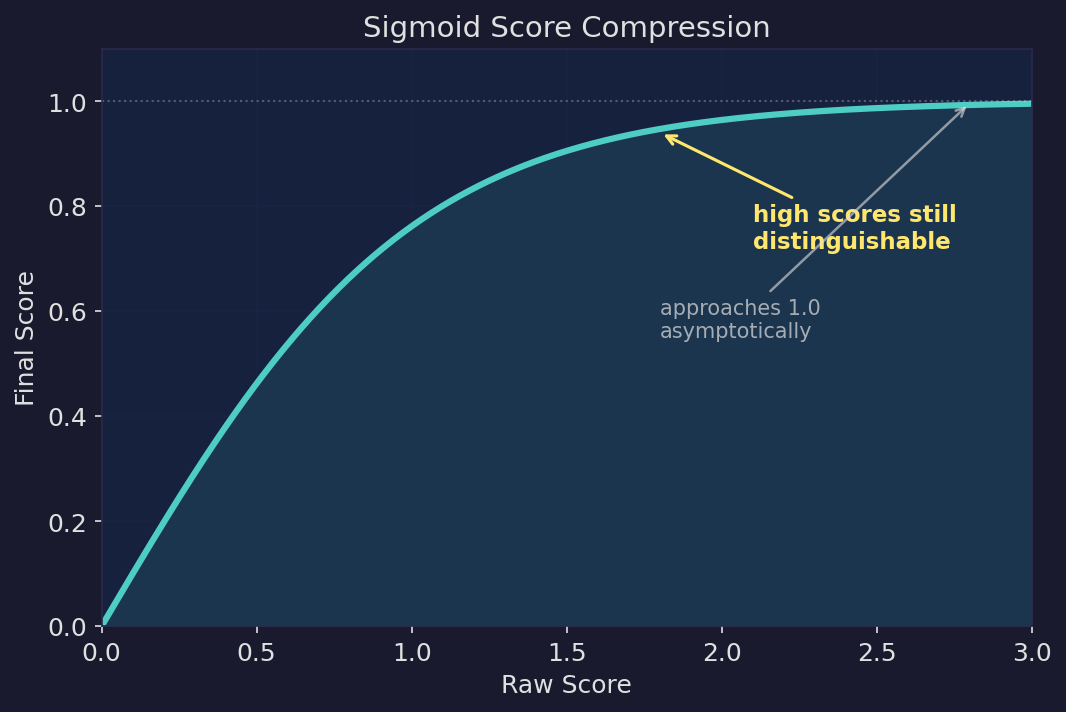 | Sigmoid score compression. Raw scores are mapped through a sigmoid function, approaching 1.0 asymptotically. High-relevance results remain distinguishable instead of being crushed into the same value. |
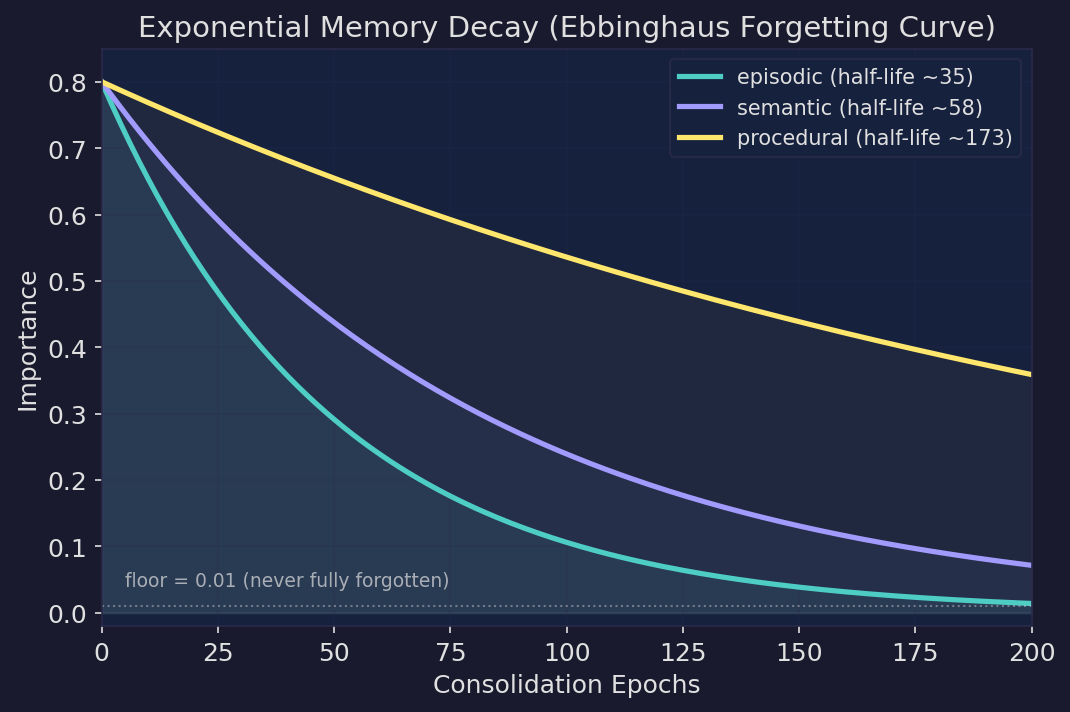 | Ebbinghaus forgetting curve. Exponential decay with kind-differentiated rates — episodic memories fade fastest, procedural slowest. Floor at 0.01 means memories never fully vanish; they remain retrievable under precise queries. |
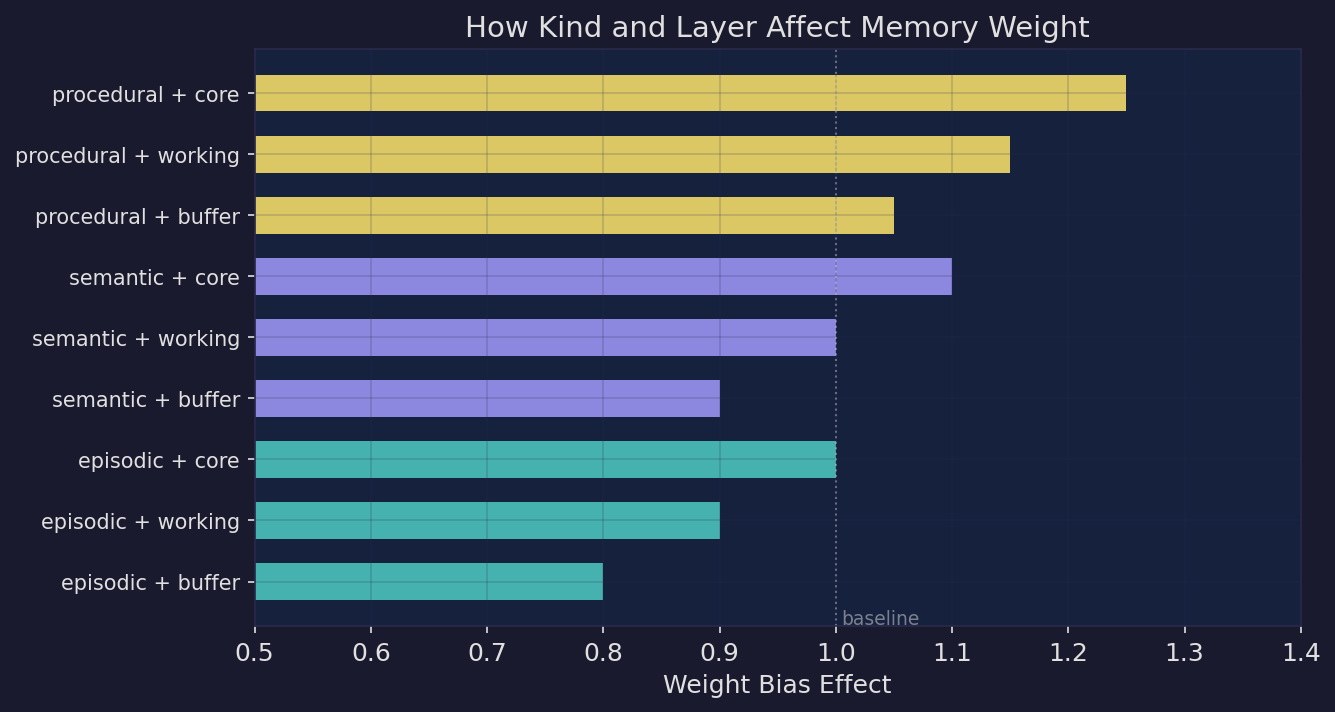 | Kind × layer weight bias. Additive biases adjust memory weight by type and layer. Procedural+core memories rank highest, episodic+buffer lowest — but the spread stays bounded so no single combination dominates. |
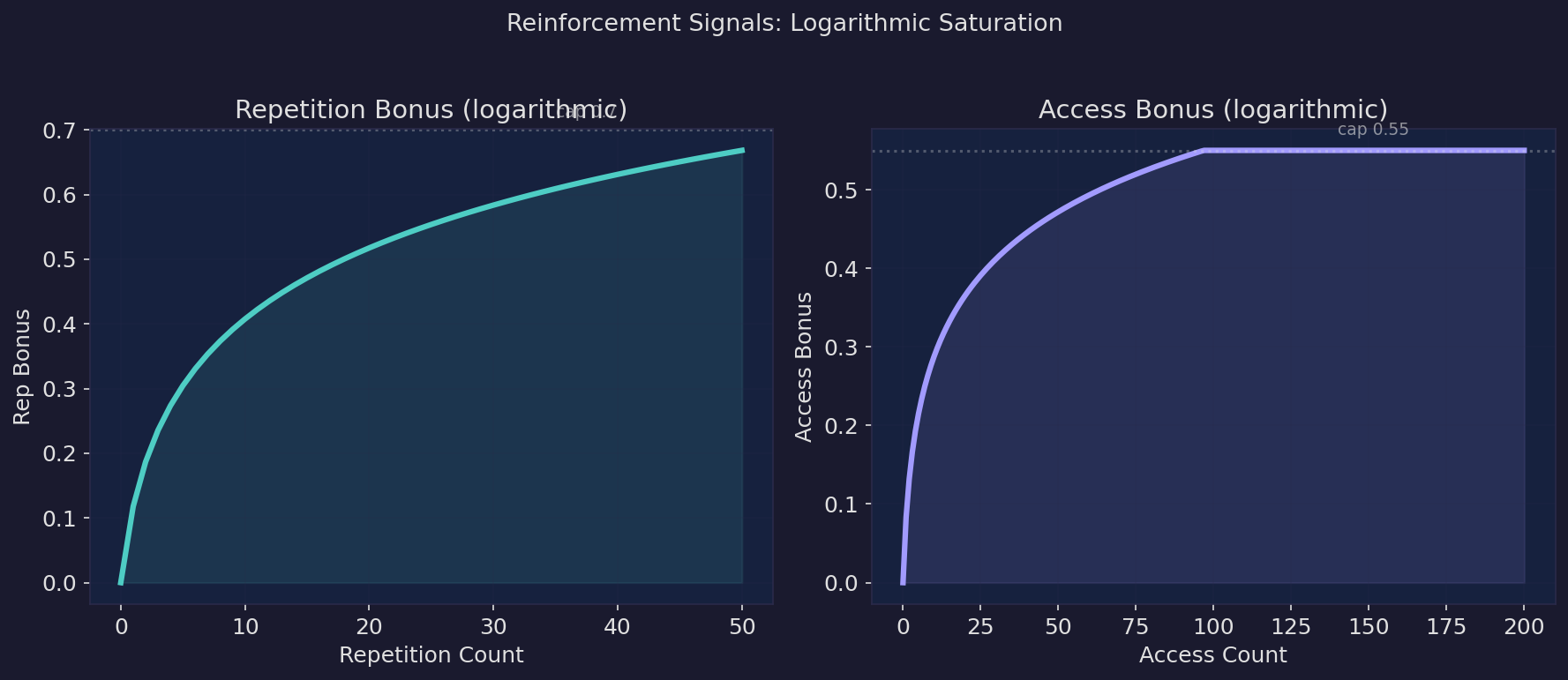 | Reinforcement signals. Repetition and access bonuses follow logarithmic saturation. Early interactions matter most; later ones contribute diminishing returns, discriminating between "used occasionally" and "used daily". |
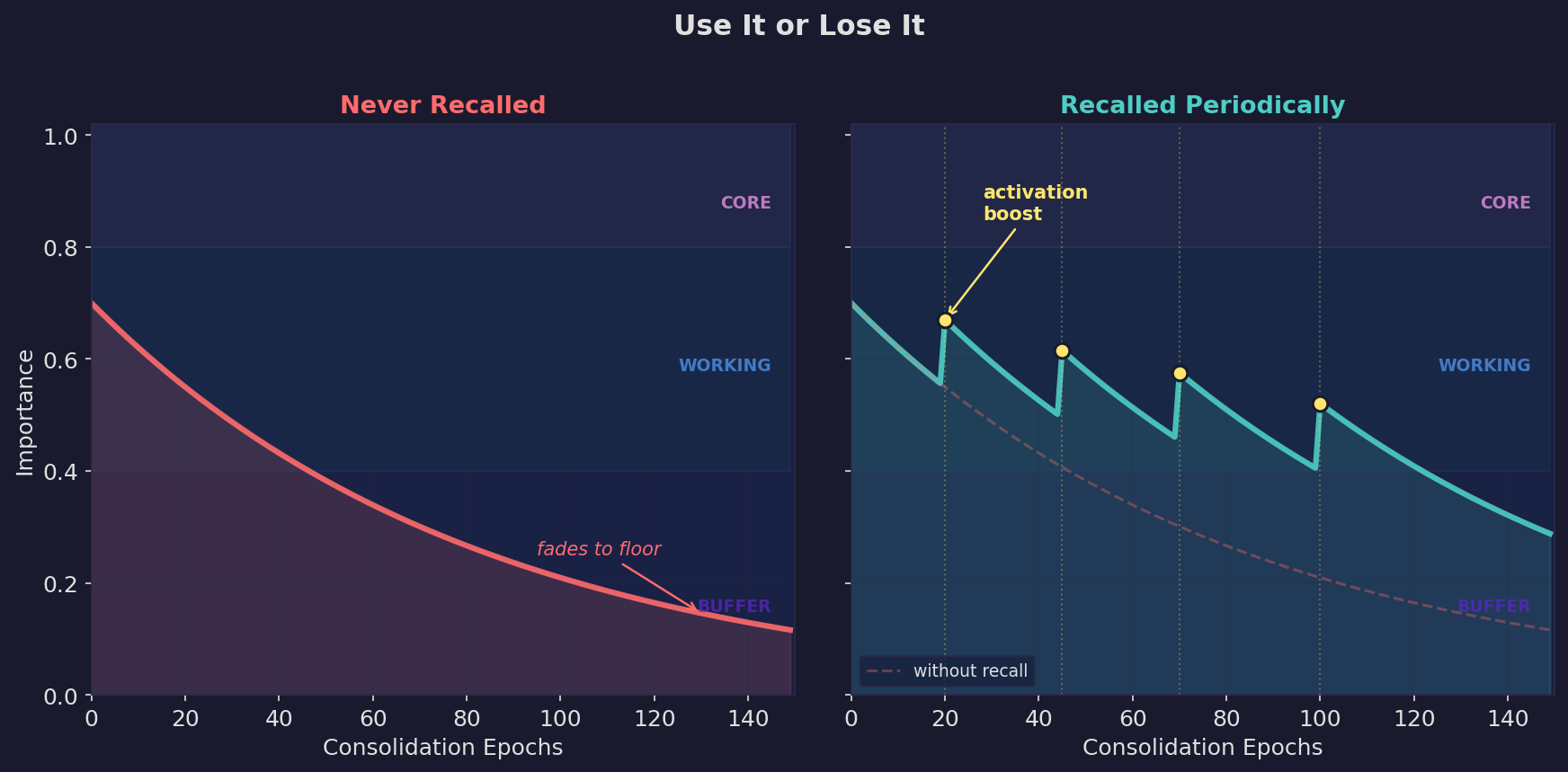 | Use it or lose it. Left: a memory that's never recalled decays into the buffer layer. Right: periodic recall triggers activation boosts that keep the memory in the working layer. Dashed line shows the unrecalled trajectory for comparison. |
Semantic Dedup & Merge
Two memories saying the same thing in different words? Detected and merged automatically:
Self-Organizing Topic Tree
Vector clustering groups related memories together, LLM names the clusters. No manual tagging required:
The problem this solves: vector search requires asking the right question. Topic trees let agents browse by subject — scan the directory, drill into the right branch.
Triggers
Tag a memory with trigger:deploy, and the agent can recall all deployment lessons before executing:
Session Recovery
Agent wakes up, calls GET /resume, gets full context back. No file scanning needed:
| Section | Content | Purpose |
|---|---|---|
| Core | Full text of permanent rules and identity | The unforgettable stuff |
| Recent | Recently changed memories | Short-term continuity |
| Topics | Topic index (table of contents) | Drill in on demand, no full load |
| Triggers | Pre-action tags | Auto-recall lessons before risky ops |
Agent reads the directory, finds relevant topics, calls POST /topic to expand on demand.
Search & Retrieval
Semantic embeddings + BM25 keyword search with CJK tokenization (jieba). IDF-weighted scoring — rare terms get boosted, common terms auto-downweighted. No stopword lists to maintain.
Background Maintenance
Fully automatic, activity-driven — no writes means the cycle is skipped:
Consolidation (every 30 minutes)
- Decay — reduce importance of unaccessed memories
- Dedup — merge near-identical memories (cosine > 0.78)
- Triage — LLM categorizes new Buffer memories
- Gate — LLM batch-evaluates promotion candidates
- Reconcile — resolve ambiguous similar pairs (results cached)
- Topic tree rebuild — re-cluster and name
Topic Distillation — when a topic grows too large (10+ memories), overlapping content is condensed into fewer, richer entries.
Namespace Isolation
Single instance, multiple projects. Use X-Namespace to isolate:
Install
Docker
LLM Configuration
engram-rs works without an LLM — keyword search and rule-based lifecycle still function. Adding an LLM unlocks intelligent features (triage, gate, merge, topic naming):
Two-tier model config — strong model for judgment, lightweight for text processing:
For AI Agents
Add to your agent's system prompt:
Related MCP Servers
Adoption & maintenance
Factual signals from GitHub, npm, and our automated checks — not a rating.
GitHub stars
27
Stargazers on the source repository.
npm downloads
199
Package downloads in the last 30 days.
Last commit
6mo ago
Most recent push to the default branch.
Directory activity
2 views
Config copies, upvotes, and views on AllMCPs.
Reviews
No reviews yet — be the first to share how this listing worked for you.
Frequently Asked Questions about Engram Rs
AllMCPs Directory Badge
Showcase your server listing on GitHub or your project documentation. Embed this dynamic SVG badge to highlight official listing status and live engagement.
Badge Style:
Live Dynamic SVG Preview
Markdown (GitHub README)
[](https://allmcps.com/mcp/kael-bit-engram-rs)HTML Embed
<a href="https://allmcps.com/mcp/kael-bit-engram-rs"><img src="https://allmcps.com/api/badge/kael-bit-engram-rs?style=directory" alt="Engram Rs on AllMCPs" /></a>Technical Specs & Signals
CategoryKnowledge & Memory
PricingBring your own API key (usage-based cost)
11/11 checks healthy over the last 33d
51Quality signal: Good · 51/100How this signal is calculated ▾
Server availabilityNot measured
Not scored for repo-hosted servers — we can't reach the running server, only its GitHub page. Hosted MCP endpoints are health-checked live.
Verified ownership10/20
Documentation & tools23/30
Adoption & activity5/15
Community engagement0/10
A guidance signal from public completeness & health data — not a user rating. New listings start lower and rise as they add docs, get verified, and grow adoption. Signals we can't observe for a listing are skipped, not counted against it.
Supply-chain signal
No high-severity advisories surfaced by our automated scan.
Critical 0High 0Medium 0Low 0
Scanned 27d ago via OSV.dev · engram-rs-mcp (npm)
Own this project?
This directory is pre-filled from public sources. Claim via GitHub README, site badge, or DNS TXT to unlock edit access and the Official badge — proof is checked automatically, then reviewed by our team.
Free dofollow backlink: add your website and place the AllMCPs badge on it — no claim needed. We detect it automatically and keep it verified as long as the badge stays live.
Claim & get free dofollowShare & Embed
Add our SVG badge (dark/light directory styles) or embeddable widget to your site.