GhidrAssistMCP README
The full upstream README, mirrored here for reference. Install config, tool schemas, adoption signals, and an original overview live on the GhidrAssistMCP listing page.
GhidrAssistMCP
A powerful Ghidra extension that provides an MCP (Model Context Protocol) server, enabling AI assistants and other tools to interact with Ghidra's reverse engineering capabilities through a standardized API.
Overview
GhidrAssistMCP bridges the gap between AI-powered analysis tools and Ghidra's comprehensive reverse engineering platform. By implementing the Model Context Protocol, this extension allows external AI assistants, automated analysis tools, and custom scripts to seamlessly interact with Ghidra's analysis capabilities.
Key Features
- MCP Server Integration: Full Model Context Protocol server implementation using official SDK
- Dual HTTP Transports: Supports SSE and Streamable HTTP transports for maximum client compatibility
- 49 Built-in Tools: Comprehensive set of analysis tools with action-based consolidation for cleaner APIs
- 6 MCP Resources: Static data resources for program info, functions, strings, imports, exports, and segments
- 7 MCP Prompts: Pre-built analysis prompts for common reverse engineering tasks
- Result Caching: Intelligent caching system to improve performance for repeated queries
- Async Task Support: Long-running operations execute asynchronously with task management
- Multi-Program Support: Work with multiple open programs simultaneously using
program_name; uselist_binariesProject Path values to disambiguate duplicate filenames - Multi-Window Support: Single MCP server shared across all CodeBrowser windows with intelligent focus tracking
- Active Context Awareness: Automatic detection of which binary window is in focus, with context hints in all tool responses
- Configurable UI: Easy-to-use interface for managing tools and monitoring activity
- Real-time Logging: Track all MCP requests and responses with detailed logging
- Dynamic Tool Management: Enable/disable tools individually with persistent settings
Clients
Shameless self-promotion: GhidrAssist supports GhidrAssistMCP right out of the box.
Screenshots
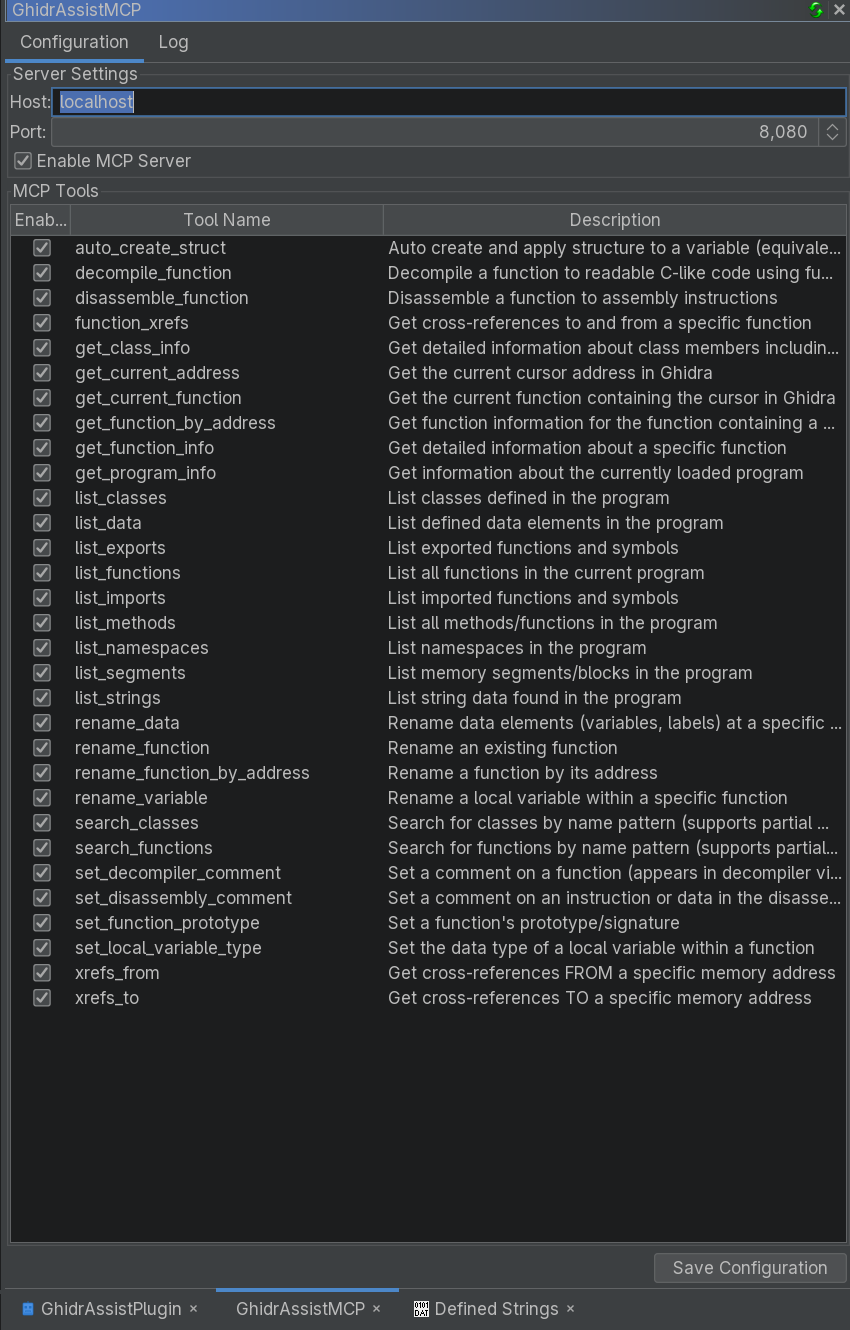
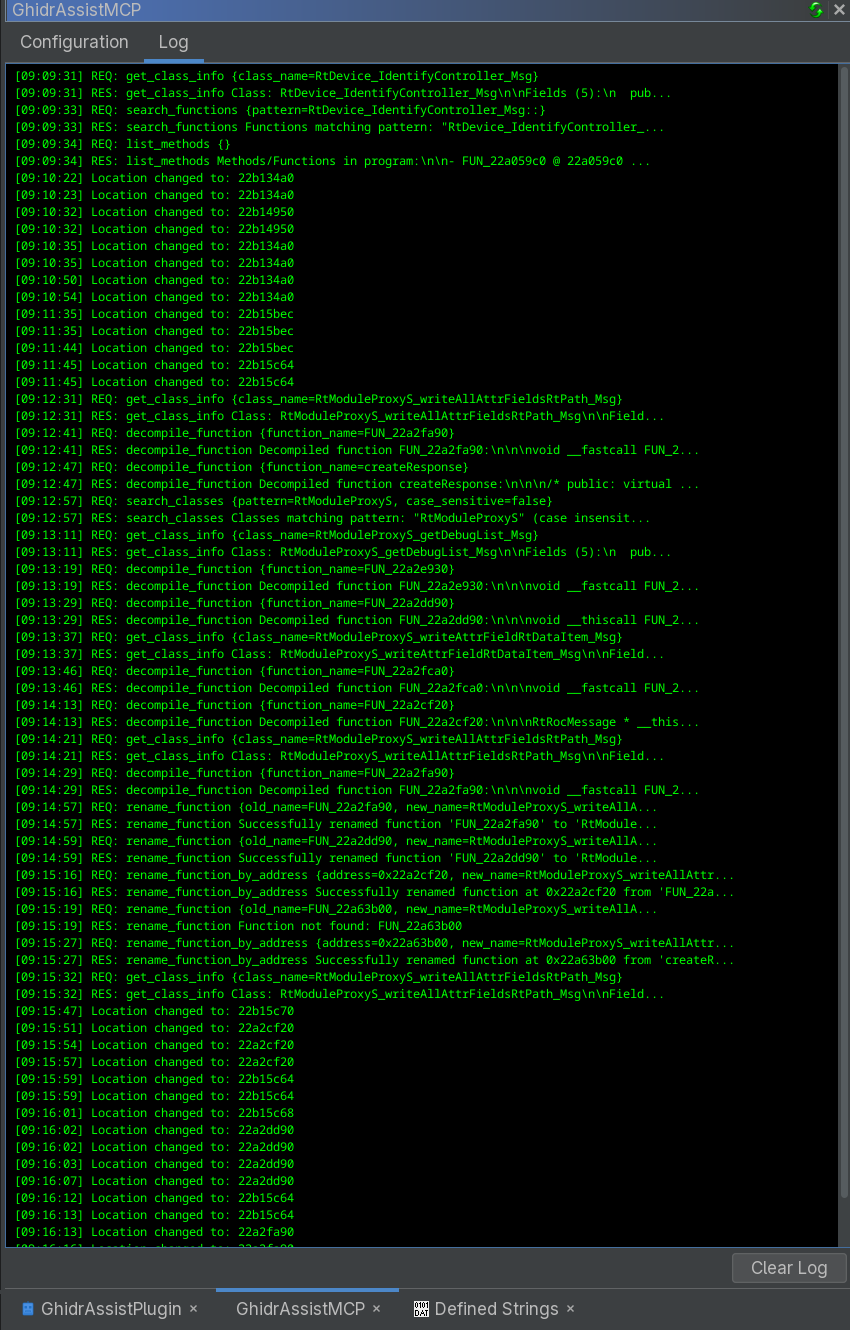
Installation
Prerequisites
- Ghidra 11.4+ (tested with Ghidra 12.1 Public)
- An MCP Client (Like GhidrAssist)
Binary Release (Recommended)
-
Download the latest release:
- Go to the Releases page
- Download the latest
.zipfile (e.g.,GhidrAssistMCP-v1.0.0.zip)
-
Install the extension:
- In Ghidra: File → Install Extensions → Add Extension
- Select the downloaded ZIP file
- Restart Ghidra when prompted
-
Enable the plugin:
- File → Configure → Configure Plugins
- Search for "GhidrAssistMCP"
- Check the box to enable the plugin
Building from Source
Source builds require Java 25 or newer. The included Gradle wrapper pins the supported Gradle release; use it instead of a system Gradle installation.
-
Clone the repository:
-
Point Gradle at your Ghidra install:
- Set
GHIDRA_INSTALL_DIR(environment variable), or pass-PGHIDRA_INSTALL_DIR=<path>when you run Gradle.
- Set
-
Build + install:
Ensure Ghidra isn't running and run:
This copies the built ZIP into your Ghidra install (
[GHIDRA_INSTALL_DIR]/Extensions/Ghidra) and extracts it into your Ghidra user Extensions folder (replacing any existing extracted copy).If you need to override that location, pass
-PGHIDRA_USER_EXTENSIONS_DIR=<path>. -
Restart / verify:
- Restart Ghidra.
- If the plugin doesn't appear, enable it via File → Configure → Configure Plugins (search for "GhidrAssistMCP").
Configuration
Initial Setup
-
Open the Control Panel:
- Window → GhidrAssistMCP (or use the toolbar icon)
-
Configure Server Settings:
- Host: Default is
localhost - Port: Default is
8080 - Enable/Disable: Toggle the MCP server on/off
- Host: Default is
Tool Management
The Configuration tab allows you to:
- View all available tools (49 total)
- Enable/disable individual tools using checkboxes
- Save configuration to persist across sessions
- Monitor tool status in real-time
Headless Mode Quickstart
GhidrAssistMCP can also be started from Ghidra's analyzeHeadless launcher. This is useful when you want MCP access to a program loaded in headless Ghidra without opening the CodeBrowser UI.
First, build and install the extension so Ghidra can load the compiled classes and bundled dependencies:
Set paths for your Ghidra install and extracted user extension. On Linux, Ghidra user extensions usually live under ~/.config/ghidra/<ghidra_profile>/Extensions:
Import a binary and start the MCP server as a headless pre-script:
For a binary that is already imported into the project, use -process instead:
To keep a headless MCP session open after analysis completes, run the server as a post-script with wait mode:
MCP clients can connect to:
The headless MCP server runs inside the analyzeHeadless JVM and uses the loaded currentProgram. The server holds a program consumer while it is running so MCP requests do not race against program database closure. Use wait=true when you want analyzeHeadless to stay open for interactive MCP clients. A harness can also pass completion_file=/workspace/control/session.complete; creating that file closes the MCP server cleanly and lets Ghidra save and exit normally.
Disposable static-analysis labs may pass tool_profile=agent_lab. This enables sandbox-local program export while arbitrary path import and Ghidra scripts remain disabled because they can expose process secrets or spawn processes. The harness owns artifact imports. Unknown profiles are rejected.
Available Tools
GhidrAssistMCP provides 49 tools organized into categories. Several tools use an action-based API pattern where a single tool provides multiple related operations.
Binary & Program Management
| Tool | Description |
|---|---|
get_binary_info | Get basic program information (name, architecture, compiler, etc.) |
list_binaries | List all open programs across all CodeBrowser windows, including Project Path values for unambiguous program_name targeting |
open_program | List/open project programs in CodeBrowser, with optional analysis prompt suppression and analysis-after-open task submission |
close_program | Close an open CodeBrowser program; changed programs require save=true or ignore_changes=true |
import_file | Import a host file into the current Ghidra project and optionally open it (disabled by default) |
project_files | List or delete files/folders in the active Ghidra project; deletion requires confirm=true |
scripts | List/read/create/delete/run Ghidra scripts (disabled by default) |
assemble_code | Assemble instruction text at an address and optionally patch it into program memory |
patch_bytes | Patch raw bytes in program memory at a given address |
export_program | Export the current program to disk (binary or original_file) (disabled by default) |
Security-sensitive tools:
import_file,scripts, andexport_programare disabled by default because they interact with the host filesystem or execute script code. Enable them explicitly in the plugin configuration UI when needed.project_filesdeletes entries from the active Ghidra project database, not the original imported host files, and requiresconfirm=true.
Auto Analysis
| Tool | Description |
|---|---|
analysis_options | List/set/reset Auto Analysis options and save/apply/list/delete option presets for the current program |
analyze_program | Run Auto Analysis on the current program or all open programs; supports full re-analysis, pending-changes analysis, address ranges, and option overrides |
analysis_control | Query Auto Analysis status or request cancellation of queued analysis tasks |
Function Discovery & Analysis
| Tool | Description |
|---|---|
get_functions | List functions with optional pattern filtering and pagination |
search_functions_by_name | Find functions by name pattern |
get_function_statistics | Comprehensive statistics for all functions |
analyze_function | Get detailed function information (signature, variables, etc.) |
get_current_function | Get function at current cursor position |
get_function_stack_layout | Get stack frame layout with variable offsets |
get_basic_blocks | Get basic block information for a function |
create_function | Create/define a function at an address, optionally clearing existing data/code first |
disassemble_at | Disassemble code at an address, optionally clearing existing data/code in the range first |
Binary Information
| Tool | Description |
|---|---|
get_imports | List imported functions/symbols |
get_exports | List exported functions/symbols |
get_strings | List string references with optional filtering |
search_strings | Search strings by pattern |
get_segments | List memory segments |
get_namespaces | List namespaces in the program |
get_relocations | List relocation entries |
get_entry_points | List all binary entry points |
Data Analysis
| Tool | Description |
|---|---|
get_data_vars | List data definitions in the program |
get_data_at | Get hexdump/data at a specific address |
create_data_var | Define data variables at addresses |
get_current_address | Get current cursor address |
Consolidated Tools
These tools bundle related operations behind a discriminator parameter (e.g., action, target, target_type, or format).
get_code - Code Retrieval Tool
| Parameter | Values | Description |
|---|---|---|
format | decompiler, disassembly, pcode | Output format |
raw | boolean | Only affects format: "pcode" (raw pcode ops vs grouped by basic blocks) |
classes - Class Operations Tool
| Action | Description |
|---|---|
list | List classes with optional pattern filtering and pagination |
get_info | Get detailed class information (methods, fields, vtables, virtual functions) |
xrefs - Cross-Reference Tool
| Parameter | Description |
|---|---|
address | Find all references to/from a specific address |
function | Find all cross-references for a function |
include_calls | Include callers/callees (replaces separate call graph tool) |
struct - Structure Operations Tool
| Action | Description |
|---|---|
create | Create a new structure from C definition or empty |
modify | Modify an existing structure with new C definition |
merge | Merge (overlay) fields from a C definition onto an existing structure without deleting existing fields |
set_field | Set/insert a single field at a specific offset without needing a full C struct (use field_name to name it) |
name_gap | Convert undefined bytes at an offset/length into a named byte[]-like field (useful for “naming gaps”; uses field_name) |
auto_create | Automatically create structure from variable usage patterns |
rename_field | Rename a field within a structure |
field_xrefs | Find cross-references to a specific struct field |
rename_symbol - Symbol Renaming Tool
| Parameter | Values | Description |
|---|---|---|
target_type | function, data, variable | What kind of symbol to rename |
batch_rename - Batch Symbol Renaming Tool
Rename multiple symbols in one operation.
comments - Comment Management Tool
| Action | Description |
|---|---|
get | Get comment at an address |
set | Set a comment at an address or on a function |
list | List all comments |
remove | Remove a comment |
variables - Variable Management Tool
| Action | Description |
|---|---|
list | List local variables for a function |
rename | Rename a local variable or a global/data symbol using scope |
set_type | Set data type for a local variable |
set_prototype | Set function signature/prototype |
types - Type Management Tool
| Action | Description |
|---|---|
list | List all available data types |
get_info | Get detailed data type information and structure definitions |
set | Set data type at a specific address, including arrays with array_count or suffix syntax like int[16] |
delete | Delete a data type by name (optionally scoped by category) |
bookmarks - Bookmark Management Tool
| Action | Description |
|---|---|
list | List all bookmarks |
set | Set a new bookmark |
remove | Remove a bookmark |
Search Tools
| Tool | Description |
|---|---|
search_bytes | Search for byte patterns in memory |
Async Task Management
Long-running operations (decompilation, structure analysis, field xrefs) execute asynchronously:
| Tool | Description |
|---|---|
get_task_status | Check status and retrieve results of async tasks |
cancel_task | Cancel a running async task |
list_tasks | List all pending/running/completed tasks |
MCP Resources
GhidrAssistMCP exposes 6 static resources that can be read by MCP clients:
| Resource URI | Description |
|---|---|
ghidra://program/{name}/info | Basic program information |
ghidra://program/{name}/functions | List of all functions |
ghidra://program/{name}/strings | String references |
ghidra://program/{name}/imports | Imported symbols |
ghidra://program/{name}/exports | Exported symbols |
ghidra://program/{name}/segments | Memory segments |
MCP Prompts
Pre-built prompts for common analysis tasks:
| Prompt | Description |
|---|---|
analyze_function | Comprehensive function analysis prompt |
identify_vulnerability | Security vulnerability identification |
document_function | Generate function documentation |
trace_data_flow | Data flow analysis prompt |
trace_network_data | Trace network send/recv call stacks for protocol analysis and network vulnerability identification |
compare_functions | Diff two functions for similarity analysis |
reverse_engineer_struct | Recover structure definitions from usage patterns |
Usage Examples
Basic Program Information
List Functions with Pattern Filtering
Decompile Function (get_code)
Get Class Information (Action-Based)
Search Classes (Action-Based)
Auto-Create Structure (Action-Based)
Find Struct Field Cross-References (Action-Based)
Delete a Data Type
If multiple types share the same name across categories, pass category (or pass a full path in name starting with /).
Set an Array Data Type
Equivalent form:
Create a Function
For overlays or mixed code/data regions where Ghidra defined code as data, clear the existing code unit or an explicit range first:
Rename Function (Action-Based)
Multi-Program Support
When working with multiple open programs, first list them:
Then specify which program to target using program_name. When multiple programs share the same filename, use the Project Path shown by list_binaries:
Multi-Window Support & Active Context Awareness
GhidrAssistMCP uses a singleton architecture that enables seamless operation across multiple CodeBrowser windows:
How It Works
- Single Shared Server: One MCP server (port 8080) serves all CodeBrowser windows
- Focus Tracking: Automatically detects which CodeBrowser window is currently active
- Context Hints: All tool responses include context information to help AI understand which binary is in focus
Context Information in Responses
Every tool response includes a context header:
or when targeting a different program:
Benefits for AI Assistants
- Smart Defaults: When no
program_nameis specified, tools automatically use the program from the active window - Context Awareness: AI knows which binary the user is currently viewing
- Prevents Confusion: Clear indication when operating on a different binary than what's in the active window
- Multi-tasking: Work with multiple binaries without constantly specifying which one to target
Architecture
Core Components
Tool Design Patterns
Consolidated Tools: Related operations are consolidated into single tools with a discriminator parameter:
get_code:format: decompiler|disassembly|pcodeclasses:action: list|get_infostruct:action: create|modify|merge|set_field|name_gap|auto_create|rename_field|field_xrefsrename_symbol:target_type: function|data|variablecomments:action: get|set|list|removevariables:action: list|rename|set_type|set_prototypewithscope: auto|local|globalfor renametypes:action: list|get|set|create_struct|create_enum|create_typedef|deletebookmarks:action: list|set|removexrefs:address|functionwithinclude_callsparameteranalysis_options:action: list|set|reset|save_preset|apply_preset|list_presets|delete_presetanalysis_control:action: status|cancelproject_files:action: list|deletescripts:action: list|get|create|delete|run
Tool Interface Methods:
isReadOnly(): Indicates if tool modifies program stateisLongRunning(): Triggers async execution with task managementisCacheable(): Enables result caching for repeated queriesisDestructive(): Marks potentially dangerous operationsisIdempotent(): Indicates if repeated calls produce same result
MCP Protocol Implementation
- Transports:
- HTTP with Server-Sent Events (SSE)
- Streamable HTTP
- Endpoints:
GET /sse- SSE connection for bidirectional communicationPOST /message- Message exchange endpointGET /mcp- Receive Streamable HTTP eventsPOST /mcp- Initialize Streamable HTTP sessionDELETE /mcp- Terminate Streamable HTTP session
- Capabilities: Tools, Resources, Prompts
Development
Project Structure
Adding New Tools
-
Implement McpTool interface:
-
Register in backend:
Build Commands
Dependencies
- MCP SDK:
io.modelcontextprotocol.sdk:mcp:0.17.1 - Jetty Server:
11.0.20(HTTP/SSE transport) - Jackson:
2.18.3(JSON processing) - Ghidra API: Bundled with Ghidra installation
Logging
UI Logging
The Log tab provides real-time monitoring:
- Session Events: Server start/stop, program changes
- Tool Requests:
REQ: tool_name {parameters...} - Tool Responses:
RES: tool_name {response...} - Error Messages: Failed operations and diagnostics
- Cache Hits: When cached results are returned
Console Logging
Detailed logging in Ghidra's console:
- Tool registration and initialization
- MCP server lifecycle events
- Async task execution and completion
- Cache statistics
- Database transaction operations
- Error stack traces and debugging information
Troubleshooting
Common Issues
Server Won't Start
- Check if port 8080 is available
- Verify Ghidra installation path
- Examine console logs for errors
Tools Not Appearing
- Ensure plugin is enabled
- Check Configuration tab for tool status
- Verify backend initialization in logs
MCP Client Connection Issues
- Confirm server is running (check GhidrAssistMCP window)
- Test connection:
curl http://localhost:8080/sse - Check firewall settings
Tool Execution Failures
- Verify program is loaded in Ghidra
- Check tool parameters are correct
- Review error messages in Log tab
Async Task Issues
- Use
get_task_statusto check task state - Use
list_tasksto see all tasks - Use
cancel_taskif a task is stuck
Debug Mode
Enable debug logging by adding to Ghidra startup:
Contributing
- Fork the repository
- Create a feature branch:
git checkout -b feature-name - Make your changes with proper tests
- Follow code style: Use existing patterns and conventions
- Submit a pull request with detailed description
Code Standards
- Java 25 baseline for builds and runtime validation
- Proper exception handling with meaningful messages
- Transaction safety for all database operations
- Thread safety for UI operations
- Comprehensive documentation for public APIs
- Action-based consolidation for related tool operations
License
This project is licensed under the MIT License - see the LICENSE file for details.
Acknowledgments
- NSA/Ghidra Team for the excellent reverse engineering platform
- Anthropic for the Model Context Protocol specification
Questions or Issues?
Please open an issue on the project repository for bug reports, feature requests, or questions about usage and development.