FCoP README
The full upstream README, mirrored here for reference. Install config, tool schemas, adoption signals, and an original overview live on the FCoP listing page.

FCoP — File-based Coordination Protocol
Keep agent work beyond the conversation.
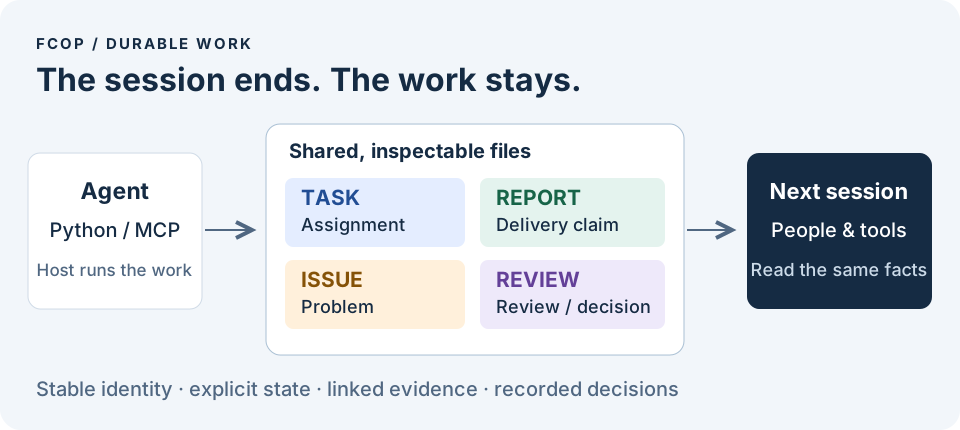
Tasks, deliveries, issues and review decisions become durable files that people, tools and the next agent can inspect. A session can end without taking the work record with it.


Ask AI to install · Manual reference · Architecture series (中文) · Architecture · Papers & citation
Stable version: 4.0.2 — 4.0.2 release. This repository contains the open protocol, the fcop Python implementation and the optional fcop-mcp adapter. Python 3.10+; no model API key is needed for the local example.
Ask your AI to install FCoP
Paste this into Cursor Agent, Codex, or another coding agent with terminal and file access. The agent handles setup and checks the result.
The AI installation guide covers dependencies, client configuration and a real task check. If the client needs approval or a reload, the agent will identify that step. Manual Python/MCP instructions remain below for reference.
Why put work outside the model?
“I have finished” is a statement in a conversation. A teammate still needs to know which assignment was attempted, what was delivered, who reviewed it and what remains unresolved. Keeping those facts only in a chat makes a handoff depend on reconstructing that chat.
FCoP gives formal work a shared representation: Markdown files with structured metadata, stable identities, explicit relationships and recorded state transitions. An agent can write them, a human can open them, and a script can validate them. The filesystem reference implementation needs no database or message broker.
| Record | What it preserves | Why it matters |
|---|---|---|
| TASK | Assignment, participants and lifecycle | The next worker can locate the work and its current state. |
| REPORT | Delivery claim and evidence for an attempt | “Submitted” remains distinguishable from “accepted.” |
| ISSUE | A problem and its context | A blocker survives the session that discovered it. |
| REVIEW | Review, acceptance or authorization facts | Decisions can be checked against the work and evidence they concern. |
Persistence makes a claim inspectable; it does not make the claim true. FCoP checks protocol relationships and gates. Reviewers evaluate the substance of the delivered work, and the host Runtime supplies execution, scheduling and permissions.
Manual installation, Python/MCP examples and CLI reference (optional)
CLI setup, observation and diagnosis; MCP work
4.0.2 provides nine top-level commands: init, status, inspect,
validate, tools, doctor, version, spec and migrate.
Except explicit initialization and migration apply, commands are read-only;
the CLI does not provide task lifecycle write commands.
The fcop package alone sets up and observes workspaces. tools needs the
optional MCP package; when absent it returns a structured unavailable result,
without starting a server or installing packages.
CLI reference · 中文命令参考.
4.0.1 introduced create_branch, inspect_family and merge_branches;
4.0.2 preserves all 49 tools and their signatures. Core owns atomic convergence,
durable idempotency and recovery. Unfinished families return family_digest: null,
merge_ready: false and structured reasons. The caller supplies the semantic conclusion.
See the Branch merge contract and example / 中文合同.
Try it: create once, read from another client
In an activated Python 3.10+ virtual environment, install the published library:
Save this as demo.py and run python demo.py. It writes a real TASK, opens the workspace through a fresh Project instance, then retries the original request.
The example cleans up its temporary directory when it exits. Use your own project directory to retain the files. Retrying create_task with the same operation_id and normalized payload reuses its durable result; changing the payload is a conflict. This guarantee is specifically for task creation.
Continue with the 4.0 setup and version guide for a lasting workspace, lifecycle operations and the authorization needed to complete a task.
Give your agent the same operations through MCP
The optional adapter exposes FCoP to an MCP-capable client over stdio. Install it in the same activated environment:
Add this entry to the client's MCP configuration. Replace both absolute paths; on Windows the command ends in .venv/Scripts/fcop-mcp.exe.
Once connected, initialize a new workspace with init_solo(role_code="ME", protocol_version="4.0"). Use its workspace identity when calling create_task, then inspect the TASK with inspect_task(filename=task_id). Installing an MCP server alone does not initialize a workspace or start an agent team.
49 tools / 12 resources / 4 resource templates. The adapter routes to the same Python Core. Default initialization has no trusted authorization Profile: creation, claim and submission are available, but acceptance, rejection, reopening and archival need an explicitly adopted Profile and an issuer evaluator registered by the trusted host. A role name typed into a request cannot supply that authority.
MCP tool reference · Stable external Python example · Stable external MCP example. The full examples include an educational Profile; a real deployment must supply its own trust policy.
From a delivery claim to an accepted result
Each TASK follows an ordered lifecycle. In 4.0, entering active starts a new attempt, and submission links that attempt's REPORT. Acceptance then binds the review and authorization to the current evidence.
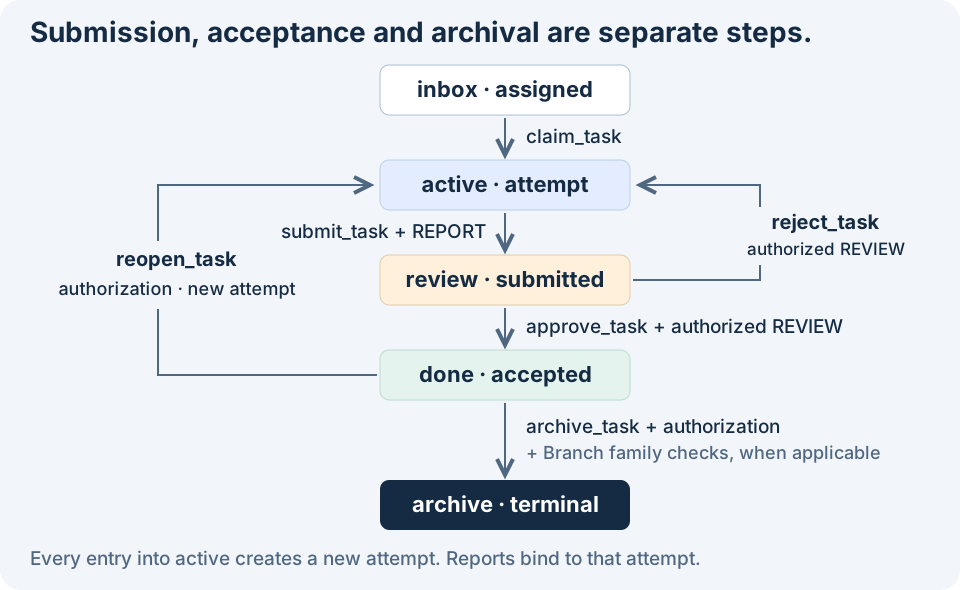
active → done is absent from 4.0. Reopening through reopen_task creates a new attempt for ordinary tasks as well as Branches. An old REPORT cannot satisfy a new attempt's submission gate. See the complete lifecycle and C1–C8 contracts · 中文规范.
Parallel work, with an explicit way to finish
Multiple ordered workflows can advance concurrently. A Branch is an ordinary TASK linked to one Root by branch_of; sibling Branches keep their own attempts, reports and reviews. Your Runtime decides who runs them and when.
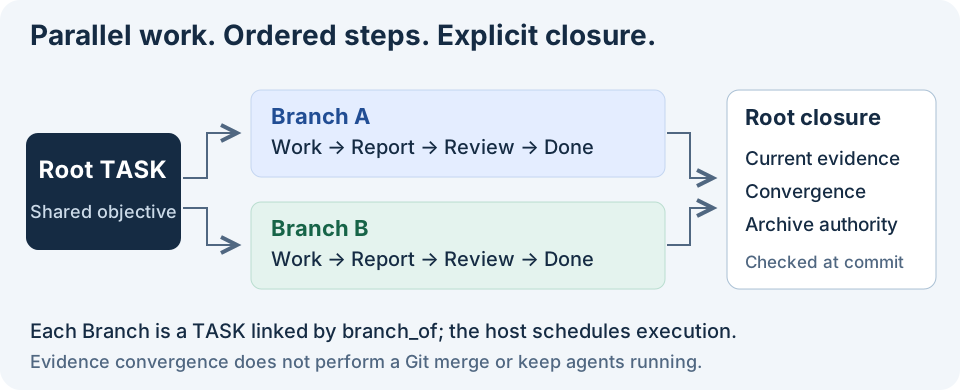
Before a Root with Branches can be archived, FCoP checks completed Branches, their current REPORTs, a matching family_digest, a convergence REVIEW and separate Root archive authorization. A reopened Branch or changed REPORT invalidates stale convergence. Related writes share a short commit boundary; agents do not hold that lock while doing their work. This closes an evidence set; code integration remains the application's responsibility.
A small protocol inside a larger agent system
Another implementation should be able to preserve the same work semantics without copying a particular Python library, MCP tool list or product.
| Layer | Responsibility |
|---|---|
| Core | C1–C8: identity, envelopes, lifecycle, relations, convergence, authorization, create idempotency and atomic recovery. |
| Specification | Define the fields, state transitions, errors and observable behavior. |
| Conformance | Check implementations against those contracts using fixtures, vectors and behavioral tests. |
| Toolkit | Implement and expose the protocol; this repository supplies Python and the MCP adapter. |
| Profile | Supply organizational policy and issuer authority; fixed PM/DEV/QA roles are not universal Core rules. |
| Runtime | Run models and tools, manage sessions, schedule work and provide the user interface. |
Read the design explanation: English · 简体中文. It develops the reasoning behind files, separate delivery and acceptance, parallel work, and the boundaries between FCoP, MCP and a Runtime.
Architecture principles: five full essays in Chinese, published September 10, 2026 and revised against 4.0:
- Work beyond the model context: why files?
- Extracting the minimal FCoP Core
- Separating Core, Specification, Toolkit, Profile and Runtime
- Parallel work through ordered task lifecycles
- How FCoP, MCP, A2A and CodeFlowMu fit together
Series guide (中文) · All five essays (中文)
4.0 also distributes nine bilingual rule modules with versioned manifests and sequential, parallel and repository-development assemblies. Adoption, deployment planning, receipts and rollback are explicit. Host projections use reference or bounded_embed; installing a package does not silently rewrite host rules. Rule distribution contract · 中文契约.
Papers, evidence and citation
These resources are directly accessible; reading the essay collection is optional.
| Resource | Read or cite |
|---|---|
| Architecture whitepaper | English · 中文 — historical research context |
| 3.2.5 archive | Zenodo DOI 10.5281/zenodo.20457285 · OSF DOI 10.17605/OSF.IO/92NWM |
| April 2026 research snapshot | Zenodo DOI 10.5281/zenodo.19886036 · Citation metadata |
| 17 field reports and design essays | Complete index · 中文目录, including original publication and evidence links |
Choose the archive matching the version you studied. The historical DOIs above are not identifiers for 4.0.0; use the versioned release and specification when discussing current behavior.
Three repositories, three entry points
| Repository | Start here for |
|---|---|
| FCoP | Flagship open-source project: protocol, Python library and MCP server; use, implement or contribute to the coordination layer. |
| joinwell52 | Research and communication: AI Agents, digital employees and engineering studies. |
| CodeflowMu-Distribution | Product experience: packaged application and downloads; check its release notes for supported versions. |
FCoP is independently usable under the MIT license. The product distribution has its own licensing and release schedule.
Star FCoP to bookmark the protocol and its implementation. To help it improve, share a reproducible integration issue, an example from your host, or a test of the protocol's public behavior through Issues or a pull request.
Versions and existing installations
- 4.0.0: Release notes · Changelog · Architecture decisions. Publication followed the recorded
FCOP_4_STABLE_RELEASE_READYgate; users install the stable PyPI pair above. - Release candidate: 4.0.0rc1 — retained as a historical prerelease.
- 3.x workspaces: retain their original semantics until explicit migration. Legacy specification EN · ZH.
finish_taskand legacy history tools remain discoverable but reject v4 workspaces. - Legacy installation prompts: EN · ZH, also available at
fcop://prompt/install. These are historical setup material; use the 4.0 guide above for the current version.