knowledge-graphmemorydata-visualizationmcp
Query and update a privacy-walled operational knowledge graph through MCP, with nodes, links, memory, reports, and pathfinding.
Quick Install
Automated & IDE SetupCopy the AI prompt to install this server into Claude Code, Cursor, or another agent — or use 1-click editor setup below.
Not yet automatically verified
We haven't yet run this listing's install command through our automated sandbox check. This isn't a red flag — we're steadily working through the catalog.
Manual Client & Custom JSON ConfigExpand JSON ▾
Client Config & Setup
Choose your client or environment
Target File:
💡 Paste the JSON block into your client's configuration file under mcpServers, then restart the application.
Overview
Use cases
Search a graph for a node by label or ID
Inspect connected nodes and links around an entity
Find the shortest path between two nodes
Store durable facts tied to an agent
Record reports about completed agent work
Key features
Graph statistics and layer-specific counts
Ranked node search by label or ID
Single-node dossiers with fields and data
Depth-limited neighborhood traversal
Shortest-path queries between nodes
Durable memories and agent reports
Capabilities & Tool Schemas (8)
Inspect callable tools, capabilities, and parameters exposed to AI agents by Booboo.
booboo_statsNode/link counts for the whole graph, broken down by layer.
booboo_countCounts alone, without pulling the payload — use when sizing a query.
booboo_searchSearch nodes by label or id (ranked: exact > prefix > substring). Use this first to find a node's id.
booboo_nodeFetch a single node (all fields + data) by its exact id.
booboo_neighborsThe neighbourhood around a node: connected nodes + links out to `depth` hops.
booboo_pathShortest path (chain of nodes) between two node ids; null if unreachable.
Documentation Overview
🐾 Booboo — the unified operational brain



Turn any AI system's data into one living, rooted 3D brain — structure + knowledge + memory + agents + automations fused into a single graph. Query it by REST or MCP, view it in your browser or as a desktop wallpaper, and boot your agents from it in one call.
See it before you install it → booboo.fractionalhq.uk · a live brain in your browser, no signup, nothing to clone.
Named after a dachshund who never forgets where the treats are buried. Fitting, because Booboo is about exactly that: memory and recall — seeing the whole system at once, fetching what's buried, never losing the thread.
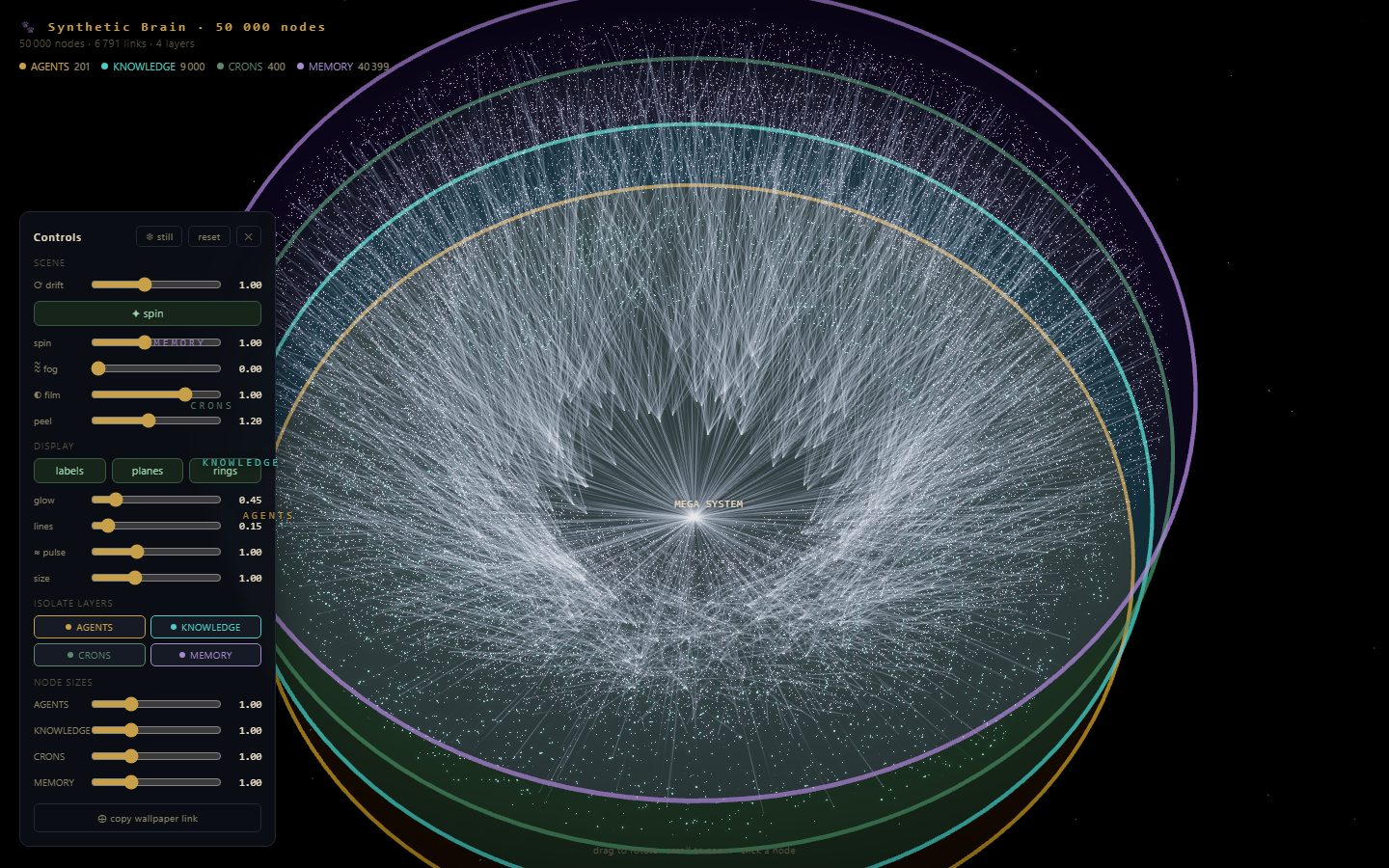 Unretouched:
 booboo view --demo --nodes 50000 — 50k nodes, 4 layers, live in a browser tab, zero console errors. Try it yourself in one command.
Most tools show you one slice: a knowledge graph, an agent flow chart, a memory store, a trace viewer. Booboo fuses all of them into one graph rooted at a single point, so you can see — and query — how the whole system actually hangs together.
Status: alpha — eight packages published:
@booboo-brain/spec(the contract),@booboo-brain/build(config-driven postgres/json adapters),@booboo-brain/serve(REST + MCP query layer),@booboo-brain/viewer(million-node 3D render),@booboo-brain/panel(the organigram),@booboo-brain/vault(wiki-linked markdown export),@booboo-brain/cli(the unifiedbooboocommand), andcreate-booboo(project scaffolder). Per-package semver — see eachpackage.json. MIT.
The one idea
Booboo is a tiny JSON spec at the center, with adapters that feed it and consumers that render/serve/query it:
Emit the JSON → get the viewer, the API, and the MCP server for free. Weird data → a ~50-line adapter, not a fork. See SPEC.md.
Quickstart
One command. No database, no config, no signup. A synthetic brain, running on your machine:
That's the headline flex: a million nodes at 60fps in a browser tab. Drop the count to --nodes 50000 on a modest laptop. See SCALE.md for how it holds up (one draw call over a single point cloud with a custom shader, plus tier-LOD on labels).
If it holds up on your machine, leave a star. There's no marketing behind this repo; stars are how the next builder finds it.
Then point it at your own stack:
Edit booboo.config.yaml to point at your own Postgres/Supabase (a commented example ships in the scaffold). Full reference: docs/CONFIG.md · stuck? docs/TROUBLESHOOTING.md.
Roadmap: a single all-in-one command bundling build + REST + MCP + the 3D viewer together, and an interactive scaffold wizard — tracked in LAUNCH_CHECKLIST.md.
What works today
booboo view serves the @booboo-brain/viewer 3D renderer as a standalone app — any snapshot (or ?n=1000000 synthetic) in your browser, no monorepo. The build engine was
proven on a real 4,469-node production brain assembled straight from Supabase by config alone —
privacy-walled, validated, served. See each package's README for the details.
Connect it to Claude / Cursor (MCP)
booboo mcp speaks MCP over stdio. Point any MCP client at it — no server to host, it runs on demand:
Your agent can now query the whole system — search, neighbors, path, stats — booboo_boot('<agent-id>') returns an agent's rules, memory reach, and reports so it boots from the org, and booboo_remember / booboo_report let it write back durable memories and reports that persist across rebuilds (the live memory system). Point --snapshot/--org at absolute paths if the client's working directory differs.
Tools
| Tool | What it does |
|---|---|
booboo_stats | Node/link counts for the whole graph, broken down by layer. |
booboo_count | Counts alone, without pulling the payload — use when sizing a query. |
booboo_search | Search nodes by label or id (ranked: exact > prefix > substring). Use this first to find a node's id. |
booboo_node | Fetch a single node (all fields + data) by its exact id. |
booboo_neighbors | The neighbourhood around a node: connected nodes + links out to depth hops. |
booboo_path | Shortest path (chain of nodes) between two node ids; null if unreachable. |
booboo_boot (with --org) | An agent's boot slice of the organigram: identity, authority chain, inherited rules, bucket access, skills, children. Call this first, every session. |
booboo_org (with --org) | The full organigram: every agent, the hierarchy, buckets and rule refs. |
booboo_remember | Write a durable memory — one atomic fact, tied to an agent. Appended to the journal beside the snapshot; queryable the same session, survives every rebuild. |
booboo_report | Write a report — what an agent just closed. Lands on the panel's Reports timeline. |
booboo_remember/booboo_reportare on by default — the live half of the memory system. Pass--no-write(orBOOBOO_READONLY=1) for a read-only server (public/locked-down deployments); it still reads the journal but refuses writes.
The Organigram — run your agents like a company
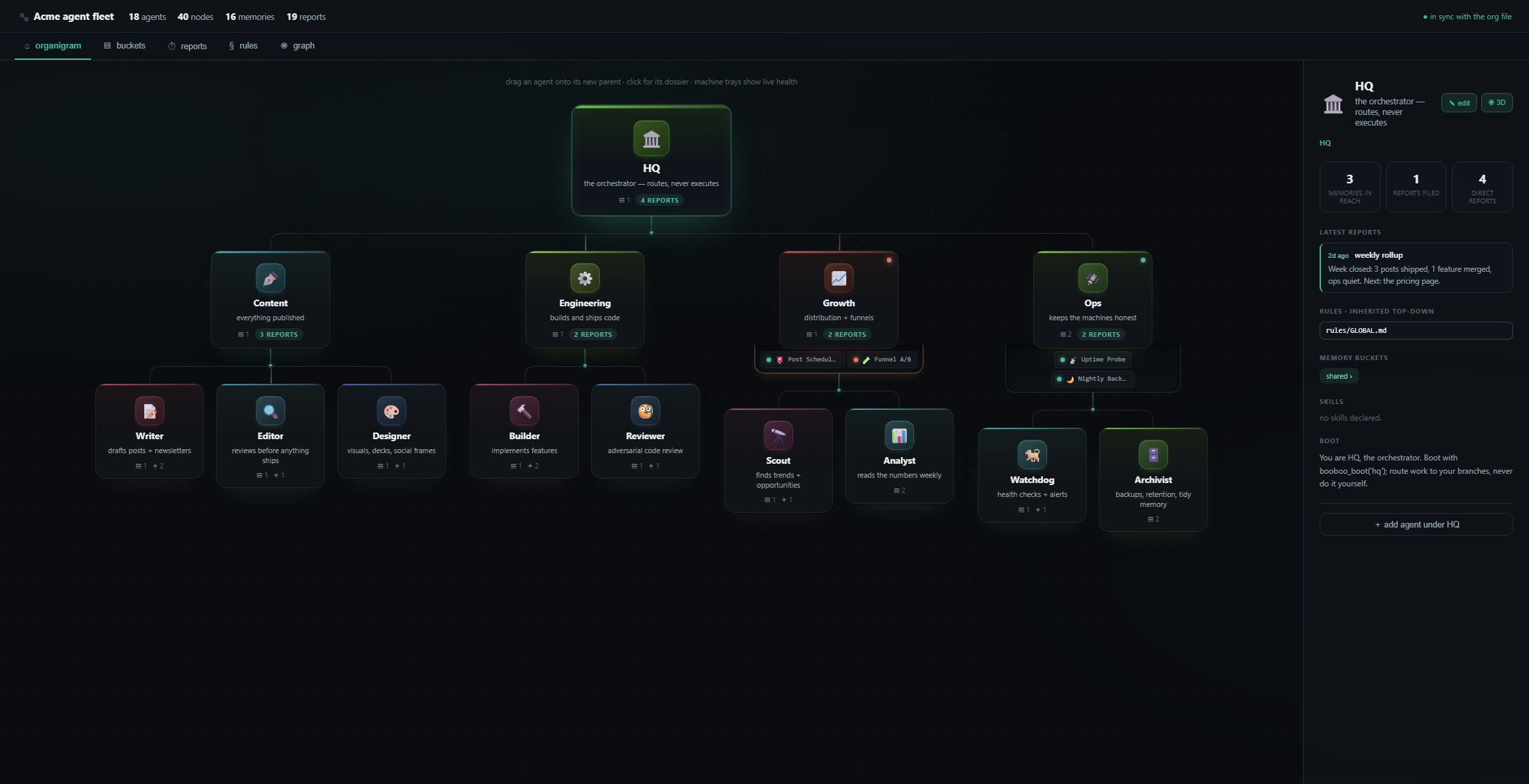
booboo panel opens your agent fleet as a real org chart — and the chart is not a diagram, it's the authority. Every agent is a card: its rules, skills, memory-bucket access, and latest reports. Drag an agent under a new parent, hit apply, and the org file changes — versioned in git, validated before every write (a cycle can never land). Agents that boot with booboo_boot obey the new shape on their next session. Reorganize your company at breakfast; the whole fleet knows by the first coffee.
| the portfolio timeline | memory, bucket by bucket |
|---|---|
 |  |
Five tabs over one org file + one snapshot: organigram (drag-drop hierarchy) · buckets (who remembers what) · reports (what the fleet closed, newest first) · rules (who declares, who inherits) · graph (the 3D brain, embedded). Rules inherit top-down — declare once at a branch, everyone beneath is bound; every dossier shows the inherited stack in boot order.
Reports and buckets fill two ways: live, when an agent calls booboo_remember / booboo_report (durable journal writes, no rebuild), or in bulk from your own tables via config — see docs/CONFIG.md § Wiring fleet reports & memory.
The vault — your brain as plain markdown (Obsidian-ready)
Related MCP Servers
Adoption & maintenance
Factual signals from GitHub, npm, and our automated checks — not a rating.
GitHub stars
1
Stargazers on the source repository.
npm downloads
508
Package downloads in the last 30 days.
Last commit
28d ago
Most recent push to the default branch.
Tools exposed
8
Callable tools this server registers over MCP.
Directory activity
1 views
Config copies, upvotes, and views on AllMCPs.
Reviews
No reviews yet — be the first to share how this listing worked for you.
Frequently Asked Questions about Booboo
AllMCPs Directory Badge
Showcase your server listing on GitHub or your project documentation. Embed this dynamic SVG badge to highlight official listing status and live engagement.
Badge Style:
Live Dynamic SVG Preview
Markdown (GitHub README)
[](https://allmcps.com/mcp/jessedu29260-netizen-booboo)HTML Embed
<a href="https://allmcps.com/mcp/jessedu29260-netizen-booboo"><img src="https://allmcps.com/api/badge/jessedu29260-netizen-booboo?style=directory" alt="Booboo on AllMCPs" /></a>