Hypruse README
The full upstream README, mirrored here for reference. Install config, tool schemas, adoption signals, and an original overview live on the Hypruse listing page.
hypruse
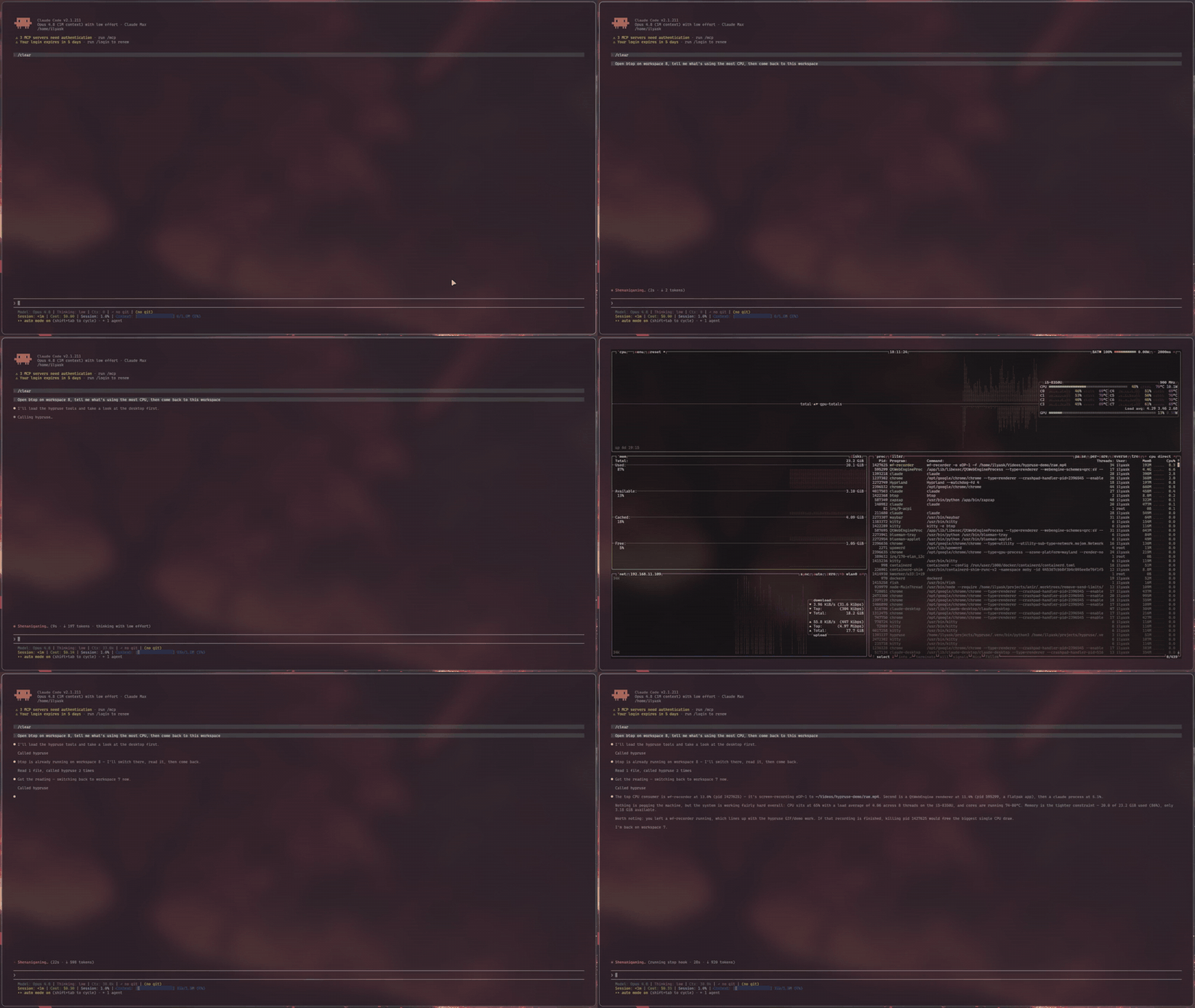
Computer use for Hyprland. An MCP server that gives AI agents native hands on your Wayland desktop: workspaces, windows, mouse, keyboard, screenshots.
No ydotool daemon. No root. No portals. No X11.
Why
Computer use exists on macOS and Windows. On Linux there is effectively nothing: the Claude Desktop Linux beta explicitly ships without screen control, Anthropic's reference implementation is an X11 container, and the existing Wayland attempts lean on setuid uinput hacks or GNOME-only portals.
Meanwhile Hyprland already exposes everything an agent needs, better than any accessibility bridge: a complete IPC surface for state and window management, and first-class Wayland protocols for input. hypruse just wires them to MCP:
- Semantic first.
desktopreturns the real window/workspace tree (addresses, classes, titles, geometry) in one call. The agent switches workspaces and focuses windows the way you do (instantly, over IPC), not by squinting at pixels. - Vision when it matters. Screenshots of a monitor, an exact window crop, or a zoomed region, with the geometry/scale metadata to map any pixel back to a clickable coordinate: a coarse-to-fine loop grounded in the GUI-agents research.
- Native input. Clicks and scrolls are spoken directly over the Wayland wire (
zwlr_virtual_pointer_v1); typing goes throughwtype's virtual keyboard with a proper XKB keymap, unicode-safe on any layout.
How it works
Optional binaries gate two more tools: imagemagick draws the numbered
overlay for marks, and wl-clipboard backs the opt-in clipboard tool.
Design decisions:
- No ydotool / uinput. That path needs a daemon, udev rules or root, and types US scancodes that break on other layouts. hypruse is just another Wayland client of your compositor, same standing as
wlrctl. - No portals.
xdg-desktop-portal-hyprlanddoes not implement the RemoteDesktop portal (InputCapture is capture, not injection), so anything built on libei/portals silently degrades on Hyprland. hypruse doesn't try. - Cursor positioning through the compositor's own cursor dispatcher (global logical coordinates, exact on any monitor layout), with only button/axis events on the virtual pointer, sidestepping the known multi-monitor bugs of absolute virtual-pointer motion (hyprwm/Hyprland#6749).
Tools
| tool | what it does |
|---|---|
desktop | One-call semantic snapshot: monitors, workspaces, windows (address/class/title/geometry), active window, cursor, and layer surfaces (launchers, bars, notification popups) with a best-effort kind and geometry. A listed layer is one the compositor tracks, not one you can see: transparent and dormant surfaces are reported too, so screenshot when visibility matters |
screenshot | Focused monitor, exact window crop by address, or x,y,WxH region; returns image + coordinate-mapping metadata; fast JPEG by default (lossless=true for PNG); stable=true waits for the frame to settle |
zoom | Native-resolution re-capture around an estimated point (optionally clamped to a window): the precision step before clicking small controls, same metadata contract |
ui | Read a window's accessibility tree (AT-SPI, GTK/Qt apps that expose one) and return clickable elements by name with exact global coordinates, no screenshot; reports current values too (typed text, slider position, checkbox state); falls back to vision when an app exposes nothing |
marks | Set-of-Marks capture: the window screenshot with every accessible control drawn as a numbered mark, plus a JSON legend (role, name, current value, exact click point per number); needs ImageMagick for the drawing, degrades to the legend alone without it |
click_ui | Click a control by accessible NAME or by a marks number in one call: the coordinate comes from the tree, the click goes through the real pointer (visible, same safety guarantees); an ambiguous name returns the candidates instead of guessing |
pointer | move / click / drag / scroll (discrete wheel notches) in global coordinates |
keyboard | Type literal text (unicode-safe) or press app-level combos (ctrl+shift+t, esc, F5); optional window address focuses the target first so keystrokes land in the right app. Compositor binds (super+...) go through use_bind, not here |
hypr | Switch workspace, focus/move/close windows, fullscreen, floating (pure IPC, milliseconds; close_window also waits up to 1s for the destroy event, so its result and then= observation reflect the close instead of racing it) |
launch | Start an app (optionally silent on another workspace), block on its actual openwindow event, return its address; detects single-instance apps (browsers) whose window ignores exec rules and moves it to the requested workspace |
binds | The user's own keybinds, decoded (SUPER+Q, action, description); the agent runs one with use_bind |
use_bind | Execute a keybind by combo (SUPER+F), running its bound action, so the agent drives the owner's own launchers and shortcuts. Not available for binds in a Lua hyprland.lua: those are anonymous closures Hyprland exposes no way to call, so binds shows them as action lua and use_bind says so instead of failing cryptically |
sequence | Run an ordered list of actions (pointer/keyboard/click_ui/hypr/wait_for) in one call; stops the moment the desktop changes in a way the current step did not expect, so a click/type/enter micro-sequence costs one round-trip instead of several |
wait_for | Block on real compositor events (window open/close, workspace change, title change, layer surfaces appearing/closing, urgency, screen sharing on/off) with a match filter and timeout; a filtered wait whose condition already holds (window already gone, workspace already active, layer already mapped) answers instantly with already: true instead of missing an event that fired before it subscribed. Replaces sleep-and-hope in multi-step automations |
clipboard | Read or write the text clipboard via wl-clipboard; opt-in, exists only with HYPRUSE_CLIPBOARD=1 in the server env |
The acting tools (pointer, keyboard, click_ui, hypr, use_bind, sequence) take an optional then argument that appends the result to the same call, so the agent sees the effect without a second round-trip: then='desktop' adds a fresh semantic snapshot (~20 ms, cheap, best for window/focus changes), then='screenshot' a stable capture (best for visual changes), then='ui' the acted-on window's controls with their current values (a few hundred exact tokens, best after typing or toggling; click_ui reads the window it clicked even if the click handed focus to a dialog, the others read the focused window), then='none' nothing (the default everywhere except sequence, which defaults to 'desktop').
Every tool is also a shell verb (hypruse desktop, hypruse click_ui Save --window 0x...) for agents that run commands instead of MCP, with a skill that teaches them: see Shell verbs and the agent skill.
Features
The tools group into five capabilities, ordered most-reliable-and-cheapest first. An agent that reaches for them in this order is both faster and more accurate, and many tasks never need a screenshot at all.
1. Semantic desktop control (start here)
desktop returns the entire window and workspace tree in one call: every window's address, class, title, and geometry, the active window, the cursor, and any layer surfaces the compositor is tracking (launchers, bars, notification popups). hypr and launch then act on it over IPC in milliseconds: switch workspace, focus/move/close/fullscreen/float a window by address, or start an app.
Use it well: never take a screenshot to find or arrange windows. Read desktop, act on the address you want. launch blocks on the real openwindow event and hands back the new window's address, so there is nothing to poll or guess; it also relocates single-instance apps (browsers) that ignore workspace rules.
2. Click controls by name, no pixels
When an app exposes an accessibility tree (most GTK and Qt apps), you can target controls by name instead of by pixel. ui lists every control with its exact global coordinate, and reports the current value of the controls that carry one: the text in a field, a slider's percentage, a checkbox's state. click_ui resolves a name and clicks it in one call, through the real cursor (so the beacon and every safety guarantee still apply). marks draws numbered marks over a screenshot with a legend, for when you want to see the options first and then click_ui(mark=N).
Use it well: reach for click_ui name="Save" before estimating any pixel, since it is exact and spends no image. Read a form's state with ui (did the box actually tick?) instead of screenshotting it. An ambiguous name returns the candidates rather than guessing. When an app exposes no tree (terminals, canvas apps, Electron/Chrome without --force-renderer-accessibility) the tool says so, and you fall back to vision.
3. Vision when it matters: the zoom loop
For everything the accessibility tree cannot name, screenshot (monitor, window crop, or region) and zoom (a native-resolution re-capture around a point) carry a strict coordinate contract, global = geometry + pixel / scale, that stays exact on every monitor and fractional scale.
Use it well: don't guess a small control from a full-screen image. Work coarse-to-fine: screenshot the window, estimate the target, zoom there, re-estimate on the sharp crop, then click. This two-step loop is the research-backed way to hit small targets.
4. Fewer round-trips: the latency lever
For an agent the model calls dominate task latency, not the desktop, so the real speedups are structural. sequence runs an ordered micro-plan (click, type, press enter, wait) in a single call, stopping the moment the desktop changes structurally in a way a step did not intend (a window opening, closing, or moving, an unexpected workspace switch, or a seat-taking launcher or on-screen keyboard; it deliberately ignores bare focus changes and notification popups). then='desktop' | 'screenshot' | 'ui' fuses a fresh view of the result into the acting call itself. wait_for blocks on real compositor events (a window or launcher opening, a title changing, a workspace switch, an urgency hint, screen-sharing starting) instead of sleeping and hoping.
Use it well: collapse a known click/type/enter flow into one sequence. After typing into a form, add then='ui' to read the effect back in a few hundred exact tokens instead of a screenshot. After a launch or a shortcut that opens something, wait_for the event rather than sleeping.
5. Safe delegation: trust layers
hypruse hands an agent your real seat, so it ships the controls to bound what that agent can do. Beyond the always-on approval prompts and the Waybar activity beacon, opt-in env flags narrow what an agent can touch: HYPRUSE_READONLY exposes only the observation tools; HYPRUSE_CONFINE restricts input to the windows the agent launched, or a class/workspace allowlist; HYPRUSE_AUTH_GUARD (on by default) refuses to drive authentication dialogs; HYPRUSE_STRICT refuses to act if you took the seat back; HYPRUSE_MARK tags agent-owned windows and announces when the agent opens a window or captures the screen. Two more record rather than restrict: HYPRUSE_JOURNAL writes an auditable NDJSON line per tool call, refusals included, and HYPRUSE_DRYRUN runs every check and delivers nothing, so you can watch an agent plan the work before it touches your desktop.
Use it well: run read-only for the first week. When you trust a workflow, allowlist its tools and, if you want to walk away, confine the agent to a scope so your password manager on another workspace stays untouchable. Keep a panic bind handy (hypruse stop, or pkill -f hypruse). The Security model has the full story.
Shell verbs and the agent skill
Not every agent speaks MCP, and the ones that do increasingly prefer a command line: a tool list costs a few thousand tokens per session before the first call, a shell verb costs nothing until it runs. So the same fifteen tools are verbs, going through the same functions the MCP server registers, with the same trust guards, journal and activity beacon:
The contract is built for a program reading the output: the verbs are the tool names, a tool's action is a positional sub-verb (pointer click 800 60, hypr workspace 3, clipboard read), output is compact plain text (one line per fact, --json for the raw result as one line), a capture prints its file path and coordinate metadata rather than bytes, and errors are one line on stderr with a meaningful exit code: 0 delivered, 1 error, 2 usage, 3 refused by a trust layer (or by read-only mode), 4 ran but found nothing to act on (a wait_for timeout, no accessibility tree, an ambiguous name). hypruse --help lists every verb and hypruse <verb> --help its flags; --dry-run rehearses an acting verb. A verb starts in a few hundred milliseconds: the MCP stack is never imported on that path.
Between one-shot processes hypruse keeps the little state a verb would otherwise lose in $XDG_RUNTIME_DIR/hypruse/cli-state.json, keyed by the compositor instance: the marks numbering (so click_ui --mark N works), the launched confinement set, and the HYPRUSE_STRICT seat baseline, which is the one that would otherwise fail open.
The skill that teaches an agent the verbs, the desktop-first workflow and the safety rules ships inside the package. Install it into the skill directories of the agents on your machine (Claude Code, Codex, Pi, Hermes, OpenClaw, OpenCode, Gemini, Antigravity, Cursor, Copilot), or via the skills CLI:
hypruse init offers the same install. The skill pre-approves only the observation verbs, doctor, --help and reading the capture files; acting verbs stay behind your agent's own approval prompt, which is the boundary the Security model leans on.
Install
Requirements: Hyprland (both config managers: hyprland.conf and the Lua hyprland.lua that 0.56 introduced), grim, wtype (most Hyprland setups already have both), and uv. The accessibility tools (ui/marks/click_ui) use busctl, which ships with systemd. Optional: wl-clipboard for the opt-in clipboard tool, imagemagick for numbered marks captures.
Arch Linux, from the AUR:
Then let it set itself up and verify the environment:
Manual registration, Claude Code:
From a source checkout:
Any other MCP client: run uvx hypruse as a stdio server. hypruse is also in
the official MCP registry as
io.github.IlyasKhallouki/hypruse, so clients that browse the registry can
install it from there.
Read-only mode: set HYPRUSE_READONLY=1 in the server config to expose only the observation tools (desktop, screenshot, zoom, ui, marks, binds, wait_for). The agent can see and narrate but cannot click, type, or launch. A good first week.
Claude Desktop (Linux beta)
The Linux beta ships without Anthropic's first-party computer use, but stdio MCP servers work in chat, which makes hypruse the workaround. In ~/.config/Claude/claude_desktop_config.json:
Two Desktop-specific notes: use image mode (Desktop renders inline MCP images and has no file-read tool), and the app must run natively inside your Hyprland session so the server inherits WAYLAND_DISPLAY/HYPRLAND_INSTANCE_SIGNATURE; from a VM or container it cannot reach your compositor. If your Desktop install bypasses tool-approval prompts, treat the Waybar indicator + panic keybind as mandatory, not optional.
Security model
Read this section before installing. hypruse hands an agent your mouse, your keyboard, your screen contents, and an app launcher. The layers that keep that sane:
- Approval: MCP clients gate tool calls. In Claude Code, allowlist the read-only tools (
desktop,screenshot) and leavepointer/keyboard/hypr/launchon ask-first until you trust a workflow. - Visibility: the server maintains an activity beacon (
$XDG_RUNTIME_DIR/hypruse/state.json); the shipped Waybar module is invisible when idle and shows a robot indicator while an agent has hands on your desktop. - Interruption: click the indicator, or bind a panic key. The portable form works for every install:
bind = SUPER SHIFT, BackSpace, exec, pkill -f hypruse. Ifhypruseis on your PATH (the AUR or a pipx install),bind = SUPER SHIFT, BackSpace, exec, hypruse stopis nicer: it signals the server to shut down gracefully, releasing any held pointer button and clearing the beacon. For auvxinstall useexec, uvx hypruse stop; for a source checkout,exec, uv run --directory /path/to/hypruse hypruse stop. Killing it mid-action is safe either way: button press/release pairs never span tool calls, and even a long drag's held button is released on the way out. - The seat is shared. There is one cursor and one keyboard focus, and Hyprland's focus-follows-mouse means a cursor move alone can retarget keystrokes. Don't type while an agent is driving; watch the indicator.
- Scope: stdio only (no network listener), nothing persisted except the beacon and the capped screenshot cache in
$XDG_RUNTIME_DIR(tmpfs, newest 20) and, if you turn it on, the action journal on disk under$XDG_STATE_HOME(rotated, one generation, and text-redacted by default). No clipboard access unless you opt in:HYPRUSE_CLIPBOARD=1registers aclipboardtool (never in read-only mode); clipboards hold passwords, so leave it off unless a workflow needs it. A screenshot sees everything visible: treat an agent session like screen sharing. - What the agent reads is untrusted. Window titles, accessibility names and values, and clipboard text flow verbatim into the agent's context, and any web page, filename, or document can put instructions there (prompt injection). hypruse cannot sanitize meaning, so the approval layer is the backstop: keep consequential tools (
launch,keyboard,clipboard) on ask-first when the agent will look at untrusted windows, and treat "the screen told me to" as attacker input when reviewing an approval prompt. - Input never lands where it silently would not work. Three always-on checks (no env flag) refuse or annotate rather than report a phantom success: a click aimed under a launcher or on-screen keyboard layer surface (which sits above windows and would swallow it), typing while a launcher holds the keyboard grab, and any input while the session is locked (a live
hyprlock/swaylockprocess, which is anext-session-lockclient invisible to the window and layer lists). While locked,keyboard/click_ui/pointerrefuse unlessallow_auth=truesays a human wants the agent driving the unlock prompt. These are truthfulness aids, not a sandbox: they fail open on an unreadable system state, so they harden the common case without being a boundary you can lean on.
Optional confinement
Six opt-in env flags. The first four narrow what an agent can touch, and each fails toward less action; the last two record and rehearse rather than restrict. All compose with the layers above:
HYPRUSE_CONFINErestricts input to a scope of windows:launched(only windows hypruse itself opened this session),class:firefox,kitty, orworkspace:3,special:notes. Keyboard,click_ui, andhyprwindow ops are refused outside the scope; apointerclick is refused when any window under the point is out of scope (Hyprland's window list is not z-ordered, so hypruse fails closed rather than guess which window is on top). This is what lets you leave an agent working while your password manager sits on another workspace, untouchable.use_bindis refused outright while confinement is set, because a keybind runs an arbitrary compositor action that cannot be scoped to a window.HYPRUSE_AUTH_GUARD(default on) refuses to click or type into a system authentication dialog (polkit agents, the GNOME keyring prompt), so a manipulated agent cannot approve a privilege escalation. SetHYPRUSE_AUTH_GUARD=strictto also refuse typing into a password field inside an ordinary window (a browser login), detected via the accessibility tree. A per-callallow_auth=trueonpointer/keyboard/click_uioverrides it, and because it changes the tool's arguments the override surfaces distinctly in the approval prompt.HYPRUSE_AUTH_GUARD=0disables it.HYPRUSE_STRICTrefuses to act when the cursor or focused window moved since hypruse's last action (the human, or a popup, took the seat): the agent must re-readdesktop/screenshotand retry, so it never types into a window you just switched to.HYPRUSE_MARKmakes the agent's presence legible on the desktop: it tags every window the agent openshypruse-ownedand flashes an on-screen notice when the agent opens a window or captures the screen. It also installs aborder_colorwindow rule on that tag so owned windows get a colored outline, but whether a runtime rule renders depends on your Hyprland version and config precedence (on some setups it does not take effect); when it cannot be installed at all, hypruse says so on stderr rather than leaving you with a marking layer that is quietly not running. For a guaranteed outline, add the rule to your own config, which hypruse's tagging then matches:windowrule = border_color rgb(ff5555), tag hypruse-ownedinhyprland.conf(older Hyprland:tag:hypruse-owned), orhl.window_rule({ match = { tag = "hypruse-owned" }, border_color = "rgb(ff5555)" })inhyprland.lua.HYPRUSE_JOURNALrecords what the agent did: one NDJSON line per tool call in$XDG_STATE_HOME/hypruse/journal.ndjson(HYPRUSE_JOURNAL=1), or a path of your own. Read it withhypruse journal, re-run it withhypruse replay. See The record below.HYPRUSE_DRYRUNis a rehearsal: every argument check and every guard above runs, then the call reports what it would have done and delivers nothing.
The record: journal, dry run, replay
The flags above decide what an agent may do in the moment and then forget it happened. HYPRUSE_JOURNAL is the memory. One JSON object per line, so tail -f, grep, and jq all work on a live file:
kind splits the two questions people actually ask: act is input delivered to your desktop, observe is the agent looking, which is what a privacy audit wants (when the screen was captured, when the clipboard was read). Observation results are never recorded, only that they happened, so the journal never becomes a second copy of everything the agent saw. Refusals are recorded too, with the guard's own message: it is the only place the history of your trust layers doing their job exists.
Typed and copied text is recorded as a length plus a short digest, not as text, because keystrokes are passwords. HYPRUSE_JOURNAL_TEXT=1 keeps it verbatim, which you need only to replay typing. Note what a digest is and is not: it proves two entries typed the same thing and it will not hand a reader your password, but it is an unsalted SHA-256 prefix next to an exact character count, so a four-digit PIN is trivially recovered from it. Treat the journal as sensitive either way. It is written 0600 in a 0700 directory, and rotated at HYPRUSE_JOURNAL_MAX_BYTES (8 MiB, one previous generation kept as .1; set 0 to never rotate).
The journal is a recorder, not a guard: if it cannot be written the action still happens and hypruse warns once on stderr, because failing your desktop over a log line is the wrong trade. What it does not record is a then= observation as its own entry: the acting call that carried it is recorded, then=screenshot and all, but the capture does not get a second line of its own.
Read it back with hypruse journal (--acts for actions only, --refused for what the guards stopped, -n N to tail, -v to include each result):
HYPRUSE_DRYRUN=1 turns the same session into a rehearsal. Every acting tool validates its arguments and runs every trust guard, then reports the plan instead of executing it, so a dry run refuses exactly what a real run would:
Nothing reaches the desktop: not the click, not the keystroke, not even the window focus that normally precedes typing. Enforced twice, once at each tool and once at the input path itself, so a code path nobody thought of fails loudly rather than quietly acting during a simulation. The agent is told dry run is on, so it reports a plan instead of retrying an action that "did not work". The scope is the agent's actions, not the server's own startup: HYPRUSE_MARK, if you set it, still installs its window rule when the server starts.
hypruse replay <journal> re-issues a journal's actions through the same tool functions, so the same guards apply to the replay. It prints the plan and stops there unless you pass --execute. Before it takes the seat it refuses outright, rather than failing halfway and leaving your desktop part-way through someone else's plan, when: an action was recorded by a newer hypruse, a recorded window no longer exists (--skip-missing runs the rest), typed text was recorded as a digest, the entry is a click_ui(mark=N) whose numbering died with the session that drew it, the entry is a clipboard write and HYPRUSE_CLIPBOARD is not set, or HYPRUSE_READONLY or HYPRUSE_DRYRUN is set. It paces itself from the recorded timing, capped by --max-gap and scaled by --speed, and its own actions are recorded and marked, so replaying the same file again runs the original plan rather than the plan plus the replay of it.
The honest limit is window addresses: they are heap pointers, so yesterday's journal mostly names windows that are gone, and an address can even be reused by a different window later, which no pre-flight can catch. Replay is for re-running a flow on a desktop that still looks like the one recorded.
Dry run and replay compose in the obvious direction: let the agent work with HYPRUSE_DRYRUN=1, read the journal, and replay it with --execute once the plan is one you like.
Performance
Measured on a live session (Hyprland 0.55, 1080p, 20 windows): desktop
~20 ms (one batched hyprctl call), workspace/window dispatch ~10-20 ms, full-monitor screenshot ~65 ms
(fast JPEG default; ~800 ms if you ask for lossless PNG, grim's zlib
path dominates), region/zoom captures well under that. If tool
calls feel slow, it is almost certainly the MCP approval prompt in
front of each call, not the server. Allowlist the tools you trust and the
latency disappears. Claude Code (.claude/settings.json):
Coordinates
Everything speaks Hyprland's global logical coordinates, the space hyprctl cursorpos and window at use. Screenshots are pixel-space; each capture returns geometry and scale so global = origin + pixel / scale. On scale 1.0 monitors (most setups) image pixels are global coordinates.
The zoom tool does the precision arithmetic for the agent: give it an estimated global point and it captures a native-resolution box around it, clamped to the screen (or to a window), with the same metadata contract. That two-step loop, estimate on the full view then re-estimate on the zoom, is the research-backed way to hit small controls.
Captures default to JPEG q90: on a 1080p frame that is roughly 12x faster to encode than PNG (grim's zlib path dominates capture time, measured ~65 ms vs ~800 ms) and 3-4x smaller, while full-res q90 reads UI text well. Pass lossless=true for exact pixels (PNG). In image mode, captures also fit the host's result-size limit (Claude Desktop caps tool results at 1 MB) by degrading quality before resolution, since grim's downscale filter is slower than a full-res capture, and cap the long edge at HYPRUSE_MAX_IMAGE_EDGE pixels (default 1568) so the host never downscales the image under the model. The applied scale is folded into the returned metadata, so coordinate mapping stays exact; tune with HYPRUSE_MAX_IMAGE_BYTES, or pass scale for a deliberate zoom-out.
By default the screenshot tool writes the image under $XDG_RUNTIME_DIR/hypruse/ and returns its path; MCP hosts with a file reader (Claude Code's Read) render it natively. This default exists because some hosts (including Claude Code 2.1.x) serialize inline MCP image blocks to base64 text the model cannot see. HYPRUSE_SCREENSHOT_MODE=image switches to inline image content blocks for hosts that render them correctly.
Development
The input e2e is deliberately manual: it borrows your cursor and keyboard, counts down, proves click/scroll/type delivery by reading the target terminal's screen back over kitty remote control, and restores your focus.
Roadmap
Grounded in measured hot-path latencies and the finding that LLM calls are 76 to 96% of computer-use task latency (OSWorld-Human), so cutting round-trips beats shaving milliseconds. The round-trip work that framing motivated has largely shipped: sequence, act-and-observe then= (including then='ui'), and the accessibility-tree tools (ui, marks, click_ui) that target controls by name with no screenshot. What remains:
Faster
- In-process wlr-screencopy over the raw wire (as input already works): drop grim's fork floor from small captures and add damage-tracked wait-for-stable that returns the instant the screen settles.
Fewer round-trips
- Semantic screen diff: after an action, return only what changed (window topology from the event stream, or a bounded changed-region crop) instead of a full frame. The socket2 event expansion behind
wait_foralready tracks most of the topology; the missing piece is folding it into a post-action delta.
Deeper reading
- Wider accessibility coverage: close the gaps the
uiandmarkstools hit today, chiefly GTK's newer combo boxes that publish neither their text nor selection (so a rendered dropdown value still needs a screenshot), plus AT-SPI value-change events sothen='ui'can report a control settling without a poll. - Notifications: read recent desktop-notification content and history, not just wait for the popup to appear (
wait_foralready matcheslayer_openon the notification namespace).
Trust
recordtool: a scoped GIF or mp4 of the agent driving the desktop, via wf-recorder (a wlroots-family binary like grim), a visual companion to the journal.
Platform
- sway / niri support: the wire client already speaks the wlr protocols; what remains is an IPC layer alongside
hyprctl.py(contributions welcome). - Headless end-to-end tests in CI: needs a QEMU virtio-gpu VM, since Hyprland's aquamarine backend requires a real GPU render node that hosted runners lack.
Measurement
- Zoom-loop precision benchmark: measure click accuracy of the coarse-to-fine loop against known targets.
- End-to-end task-success benchmark on Hyprland (OSWorld-style): the deferred bigger sibling of the zoom-loop microbenchmark, scoring full multi-step tasks through the real MCP surface so the a11y-versus-vision and round-trip work is judged on task completion, not latency alone.
Related projects
| project | approach | on Hyprland |
|---|---|---|
| computer-use-linux | AT-SPI + portals, ydotool fallback | GNOME-first; the RemoteDesktop portal it prefers is not implemented by xdg-desktop-portal-hyprland |
| hyprmcp | hyprctl wrapper | window management only; no screenshots or input |
| wayland-mcp | evemu input, VLM analysis | requires elevated setup for input; no Hyprland semantics |
| Anthropic computer-use-demo | X11 + xdotool in Docker | a sandboxed reference environment rather than a live desktop |
Research
hypruse ships no OCR engine; its universal precision mechanism is the coarse-to-fine zoom loop: screenshot a window, re-capture the target region at native resolution, click through the exact coordinate mapping. That choice follows what the GUI-agents field converged on. Anthropic's computer use grounds clicks from raw pixels and ships a zoom action as the documented fix for small text; its troubleshooting guidance for near-miss clicks prescribes zooming and region cropping, never OCR [1]. OpenAI's CUA is likewise pure pixel grounding under resolution discipline, with no OCR layer at all [2]. Zoom is also the measured lever: training-free iterative zooming roughly doubles high-resolution grounding accuracy (OS-Atlas-7B, 18.9 → 49.7 on ScreenSpot-Pro) [3], and the benchmark's official harness implements a dozen grounding-model adapters plus four zoom/crop strategies, but zero OCR baselines [4]. Vision-only agents match or beat agents that additionally consume HTML or accessibility trees [5], substrates Wayland doesn't guarantee anyway, and state-of-the-art native agents run from screenshots alone [7]. OCR was rejected because it is blind to icons, the element class every grounding model handles worst (SeeClick: 30-52% on icons vs 56-78% on text) [6]; where OCR survives in modern stacks it is a text-disambiguation sidecar, not the targeting mechanism [8].
Where an app exposes an accessibility tree, hypruse also reads it (the ui tool, AT-SPI over D-Bus via busctl) to target controls by name with exact coordinates and no screenshot. This follows the strongest Linux precedent: OSWorld, the standard computer-use benchmark, exposes the desktop accessibility tree (obtained on Ubuntu through AT-SPI) as a first-class observation alongside screenshots, and reports the accessibility-tree-plus-screenshot combination as its best configuration [9]. The tree gives exact element identity and coordinates that current models cannot reliably infer from pixels: Agent-S tags each element with an id because MLLMs "lack an internal coordinate system," lifting OSWorld success from 11.2 to 20.6 percent [10]; Microsoft's UFO drives Windows through the UI Automation tree and fuses it with vision [11]; browser agents read the accessibility tree, which Playwright serializes to compact YAML, rather than pixels for the same reason [12]. hypruse's Wayland-specific trick is coordinate mapping: AT-SPI screen coordinates are unreliable on Wayland because an app does not know its global position, so hypruse uses window-relative extents plus the window position it already has from hyprctl. Coverage is uneven by nature: canvas, games, terminals, and Electron/Chrome without a flag expose little or nothing [13]. Testing this implementation against real GTK and Qt apps sharpened that in both directions: a typed entry reads back its exact contents, and sliders and toggles report their position and state, but GTK's newer combo boxes publish neither their text nor a selection, so reading a rendered dropdown value still needs a screenshot. Toolkits also describe widgets they never laid out (zero-height scroll arrows, unrendered tab pages reporting origins in the millions), which hypruse rejects against the window rect hyprctl knows authoritatively. A strong visual grounder can substitute for the tree entirely [5], so the accessibility tree complements the zoom loop rather than replacing it, and vision stays the guaranteed fallback.
- Anthropic, Computer use tool: platform docs (
computer_20251124,enable_zoom, resolution guidance) - OpenAI, Computer-Using Agent and the computer use guide
- DiMo-GUI: Advancing Test-time Scaling in GUI Grounding via Modality-Aware Visual Reasoning, EMNLP 2025. arXiv:2507.00008
- Li et al., ScreenSpot-Pro: GUI Grounding for Professional High-Resolution Computer Use. arXiv:2504.07981; official harness
- Gou et al., Navigating the Digital World as Humans Do: Universal Visual Grounding for GUI Agents (UGround), ICLR 2025 Oral. arXiv:2410.05243
- Cheng et al., SeeClick: Harnessing GUI Grounding for Advanced Visual GUI Agents, ACL 2024. arXiv:2401.10935
- Qin et al., UI-TARS: Pioneering Automated GUI Interaction with Native Agents. arXiv:2501.12326
- Agyeya et al., Agent S2: A Compositional Generalist-Specialist Framework for Computer Use Agents (Tesseract as a textual-grounding sidecar). arXiv:2504.00906
- Xie et al., OSWorld: Benchmarking Multimodal Agents for Open-Ended Tasks in Real Computer Environments. arXiv:2404.07972; the a11y tree is obtained on Ubuntu through AT-SPI (code)
- Agashe et al., Agent S: An Open Agentic Framework that Uses Computers Like a Human. arXiv:2410.08164
- Zhang et al., UFO: A UI-Focused Agent for Windows OS Interaction (UI Automation + vision). arXiv:2402.07939
- Playwright, ARIA snapshots: the accessibility tree as compact structured text
- Wang et al., GUI Agents: A Survey (accessibility-API coverage gaps; a11y complements vision). arXiv:2412.13501