Computer use for Hyprland: semantic desktop state over IPC, plus vision and native input
Quick Install
Automated & IDE SetupCopy the AI prompt to install this server into Claude Code, Cursor, or another agent — or use 1-click editor setup below.
Not yet automatically verified
We haven't yet run this listing's install command through our automated sandbox check. This isn't a red flag — we're steadily working through the catalog.
Manual Client & Custom JSON ConfigExpand JSON ▾
Client Config & Setup
Choose your client or environment
Target File:
💡 Paste the JSON block into your client's configuration file under mcpServers, then restart the application.
Capabilities & Tool Schemas (15)
Inspect callable tools, capabilities, and parameters exposed to AI agents by Hypruse.
desktopOne-call semantic snapshot: monitors, workspaces, windows (address/class/title/geometry), active window, cursor, and layer surfaces (launchers, bars, notification popups) with a best-effort kind and geometry. A listed layer is one the compositor tracks, not one you can see: transparent and dormant…
screenshotFocused monitor, exact window crop by address, or `x,y,WxH` region; returns image + coordinate-mapping metadata; fast JPEG by default (`lossless=true` for PNG); `stable=true` waits for the frame to settle
zoomNative-resolution re-capture around an estimated point (optionally clamped to a window): the precision step before clicking small controls, same metadata contract
uiRead a window's accessibility tree (AT-SPI, GTK/Qt apps that expose one) and return clickable elements by name with exact global coordinates, no screenshot; reports current values too (typed text, slider position, checkbox state); falls back to vision when an app exposes nothing
marksSet-of-Marks capture: the window screenshot with every accessible control drawn as a numbered mark, plus a JSON legend (role, name, current value, exact click point per number); needs ImageMagick for the drawing, degrades to the legend alone without it
click_uiClick a control by accessible NAME or by a `marks` number in one call: the coordinate comes from the tree, the click goes through the real pointer (visible, same safety guarantees); an ambiguous name returns the candidates instead of guessing
Documentation Overview
hypruse
Computer use for Hyprland. An MCP server that gives AI agents native hands on your Wayland desktop: workspaces, windows, mouse, keyboard, screenshots.
No ydotool daemon. No root. No portals. No X11.
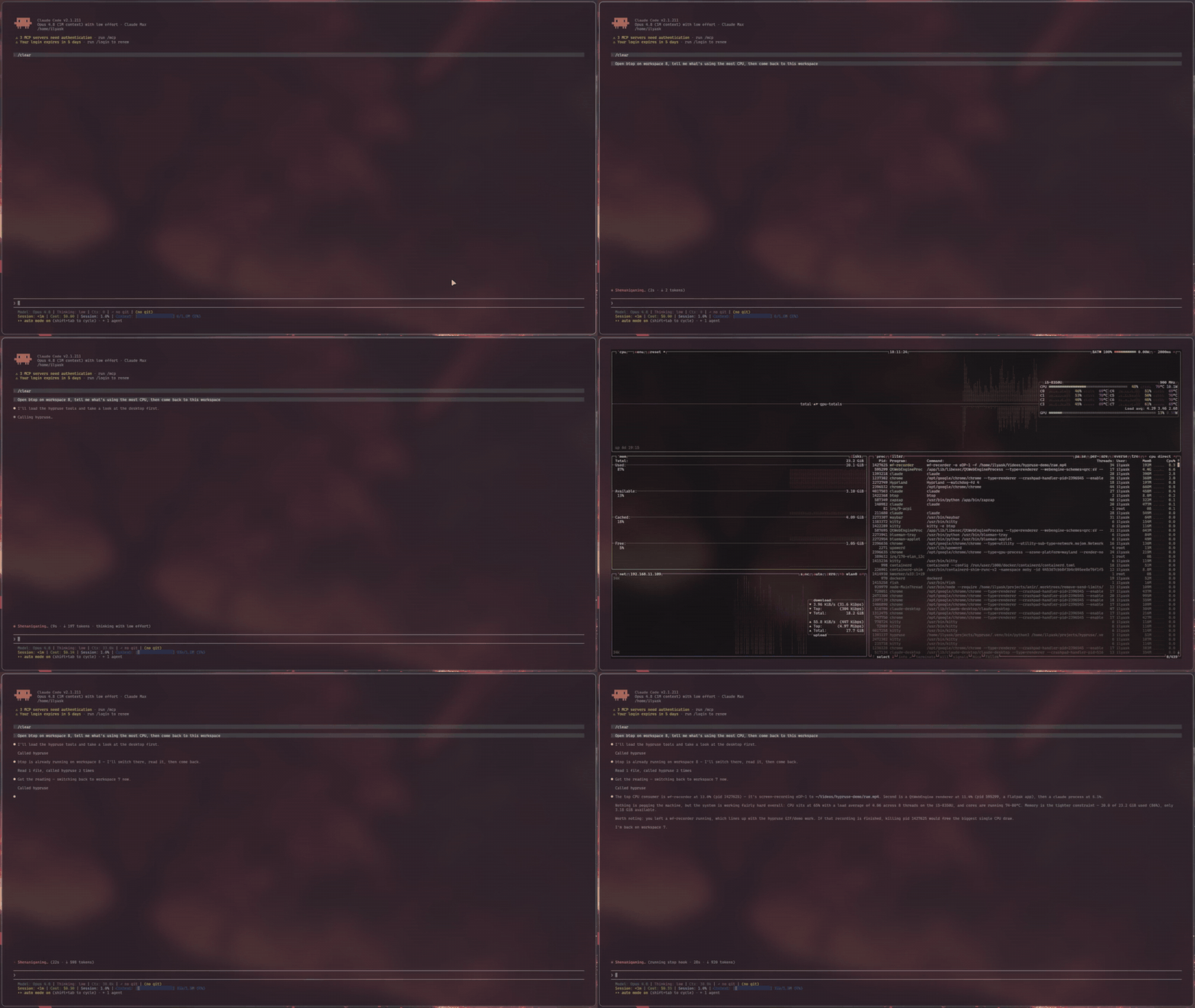
Why
Computer use exists on macOS and Windows. On Linux there is effectively nothing: the Claude Desktop Linux beta explicitly ships without screen control, Anthropic's reference implementation is an X11 container, and the existing Wayland attempts lean on setuid uinput hacks or GNOME-only portals.
Meanwhile Hyprland already exposes everything an agent needs, better than any accessibility bridge: a complete IPC surface for state and window management, and first-class Wayland protocols for input. hypruse just wires them to MCP:
- Semantic first.
desktopreturns the real window/workspace tree (addresses, classes, titles, geometry) in one call. The agent switches workspaces and focuses windows the way you do (instantly, over IPC), not by squinting at pixels. - Vision when it matters. Screenshots of a monitor, an exact window crop, or a zoomed region, with the geometry/scale metadata to map any pixel back to a clickable coordinate: a coarse-to-fine loop grounded in the GUI-agents research.
- Native input. Clicks and scrolls are spoken directly over the Wayland wire (
zwlr_virtual_pointer_v1); typing goes throughwtype's virtual keyboard with a proper XKB keymap, unicode-safe on any layout.
How it works
Optional binaries gate two more tools: imagemagick draws the numbered
overlay for marks, and wl-clipboard backs the opt-in clipboard tool.
Design decisions:
- No ydotool / uinput. That path needs a daemon, udev rules or root, and types US scancodes that break on other layouts. hypruse is just another Wayland client of your compositor, same standing as
wlrctl. - No portals.
xdg-desktop-portal-hyprlanddoes not implement the RemoteDesktop portal (InputCapture is capture, not injection), so anything built on libei/portals silently degrades on Hyprland. hypruse doesn't try. - Cursor positioning through the compositor's own cursor dispatcher (global logical coordinates, exact on any monitor layout), with only button/axis events on the virtual pointer, sidestepping the known multi-monitor bugs of absolute virtual-pointer motion (hyprwm/Hyprland#6749).
Tools
| tool | what it does |
|---|---|
desktop | One-call semantic snapshot: monitors, workspaces, windows (address/class/title/geometry), active window, cursor, and layer surfaces (launchers, bars, notification popups) with a best-effort kind and geometry. A listed layer is one the compositor tracks, not one you can see: transparent and dormant surfaces are reported too, so screenshot when visibility matters |
screenshot | Focused monitor, exact window crop by address, or x,y,WxH region; returns image + coordinate-mapping metadata; fast JPEG by default (lossless=true for PNG); stable=true waits for the frame to settle |
zoom | Native-resolution re-capture around an estimated point (optionally clamped to a window): the precision step before clicking small controls, same metadata contract |
ui | Read a window's accessibility tree (AT-SPI, GTK/Qt apps that expose one) and return clickable elements by name with exact global coordinates, no screenshot; reports current values too (typed text, slider position, checkbox state); falls back to vision when an app exposes nothing |
marks | Set-of-Marks capture: the window screenshot with every accessible control drawn as a numbered mark, plus a JSON legend (role, name, current value, exact click point per number); needs ImageMagick for the drawing, degrades to the legend alone without it |
click_ui | Click a control by accessible NAME or by a marks number in one call: the coordinate comes from the tree, the click goes through the real pointer (visible, same safety guarantees); an ambiguous name returns the candidates instead of guessing |
pointer | move / click / drag / scroll (discrete wheel notches) in global coordinates |
keyboard | Type literal text (unicode-safe) or press app-level combos (ctrl+shift+t, esc, F5); optional window address focuses the target first so keystrokes land in the right app. Compositor binds (super+...) go through use_bind, not here |
hypr | Switch workspace, focus/move/close windows, fullscreen, floating (pure IPC, milliseconds; close_window also waits up to 1s for the destroy event, so its result and then= observation reflect the close instead of racing it) |
launch | Start an app (optionally silent on another workspace), block on its actual openwindow event, return its address; detects single-instance apps (browsers) whose window ignores exec rules and moves it to the requested workspace |
binds | The user's own keybinds, decoded (SUPER+Q, action, description); the agent runs one with use_bind |
use_bind | Execute a keybind by combo (SUPER+F), running its bound action, so the agent drives the owner's own launchers and shortcuts. Not available for binds in a Lua hyprland.lua: those are anonymous closures Hyprland exposes no way to call, so binds shows them as action lua and use_bind says so instead of failing cryptically |
sequence | Run an ordered list of actions (pointer/keyboard/click_ui/hypr/wait_for) in one call; stops the moment the desktop changes in a way the current step did not expect, so a click/type/enter micro-sequence costs one round-trip instead of several |
wait_for | Block on real compositor events (window open/close, workspace change, title change, layer surfaces appearing/closing, urgency, screen sharing on/off) with a match filter and timeout; a filtered wait whose condition already holds (window already gone, workspace already active, layer already mapped) answers instantly with already: true instead of missing an event that fired before it subscribed. Replaces sleep-and-hope in multi-step automations |
clipboard | Read or write the text clipboard via wl-clipboard; opt-in, exists only with HYPRUSE_CLIPBOARD=1 in the server env |
The acting tools (pointer, keyboard, click_ui, hypr, use_bind, sequence) take an optional then argument that appends the result to the same call, so the agent sees the effect without a second round-trip: then='desktop' adds a fresh semantic snapshot (~20 ms, cheap, best for window/focus changes), then='screenshot' a stable capture (best for visual changes), then='ui' the acted-on window's controls with their current values (a few hundred exact tokens, best after typing or toggling; click_ui reads the window it clicked even if the click handed focus to a dialog, the others read the focused window), then='none' nothing (the default everywhere except sequence, which defaults to 'desktop').
Every tool is also a shell verb (hypruse desktop, hypruse click_ui Save --window 0x...) for agents that run commands instead of MCP, with a skill that teaches them: see Shell verbs and the agent skill.
Features
The tools group into five capabilities, ordered most-reliable-and-cheapest first. An agent that reaches for them in this order is both faster and more accurate, and many tasks never need a screenshot at all.
1. Semantic desktop control (start here)
desktop returns the entire window and workspace tree in one call: every window's address, class, title, and geometry, the active window, the cursor, and any layer surfaces the compositor is tracking (launchers, bars, notification popups). hypr and launch then act on it over IPC in milliseconds: switch workspace, focus/move/close/fullscreen/float a window by address, or start an app.
Use it well: never take a screenshot to find or arrange windows. Read desktop, act on the address you want. launch blocks on the real openwindow event and hands back the new window's address, so there is nothing to poll or guess; it also relocates single-instance apps (browsers) that ignore workspace rules.
2. Click controls by name, no pixels
When an app exposes an accessibility tree (most GTK and Qt apps), you can target controls by name instead of by pixel. ui lists every control with its exact global coordinate, and reports the current value of the controls that carry one: the text in a field, a slider's percentage, a checkbox's state. click_ui resolves a name and clicks it in one call, through the real cursor (so the beacon and every safety guarantee still apply). marks draws numbered marks over a screenshot with a legend, for when you want to see the options first and then click_ui(mark=N).
Related MCP Servers
Adoption & maintenance
Factual signals from GitHub, npm, and our automated checks — not a rating.
GitHub stars
26
Stargazers on the source repository.
Last commit
11d ago
Most recent push to the default branch.
Tools exposed
15
Callable tools this server registers over MCP.
Reviews
No reviews yet — be the first to share how this listing worked for you.
Frequently Asked Questions about Hypruse
AllMCPs Directory Badge
Showcase your server listing on GitHub or your project documentation. Embed this dynamic SVG badge to highlight official listing status and live engagement.
Badge Style:
Live Dynamic SVG Preview
Markdown (GitHub README)
[](https://allmcps.com/mcp/hypruse)HTML Embed
<a href="https://allmcps.com/mcp/hypruse"><img src="https://allmcps.com/api/badge/hypruse?style=directory" alt="Hypruse on AllMCPs" /></a>