Shared, project-aware memory for Claude Code, Codex, and other agents with human review.
Quick Install
Automated & IDE SetupCopy the AI prompt to install this server into Claude Code, Cursor, or another agent — or use 1-click editor setup below.
Manual Client & Custom JSON ConfigExpand JSON ▾
Client Config & Setup
Choose your client or environment
Target File:
💡 Paste the JSON block into your client's configuration file under mcpServers, then restart the application.
Documentation Overview
Global Agent Memory
Local-first, project-aware, durable memory for Claude Code, Codex, and other MCP-compatible agents.






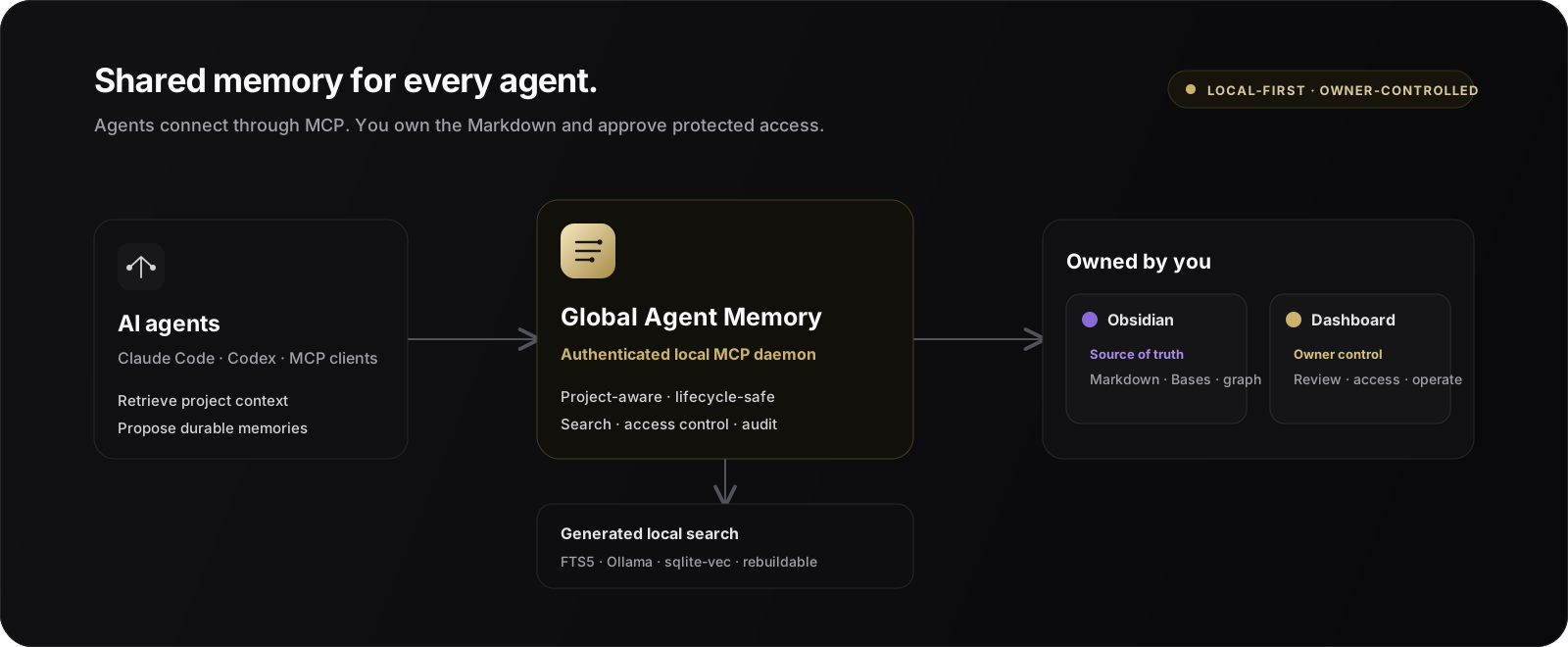
Global Agent Memory gives multiple coding agents one shared, reviewable memory without handing control of your knowledge base to a hosted service. Markdown files are canonical, a hybrid local MCP runtime is the public agent interface, and the dashboard lets a human approve, edit, protect, or remove what agents remember. Agent commands work without a background server. The authenticated localhost server starts on demand for the dashboard and can optionally run continuously for live file watching and shared embedding work.
One Vault. Multiple agents. Human-controlled memory.
Quick start · Obsidian Vault · Dashboard · How it works · Security · MCP contract · Documentation
Why Global Agent Memory?
Coding agents are useful inside a session, but important context is often lost between sessions or fragmented across individual clients. Global Agent Memory provides a durable layer for knowledge such as:
- architectural decisions and project conventions;
- verified workflows and operational runbooks;
- recurring problems and their proven solutions;
- project preferences, entities, and handoff summaries;
- bounded context for a new task or agent session.
Agents propose memories as candidates. A human reviews them before they become durable, controls their visibility, and can later update, supersede, archive, or hard-delete them.
How it compares
| Approach | Shared across agents | Human-reviewable | Project-aware | Owner-controlled access | Portable source of truth |
|---|---|---|---|---|---|
CLAUDE.md / AGENTS.md | Limited | ✓ | ✓ | — | ✓ |
| Basic memory MCP | ✓ | Varies | Varies | Varies | Varies |
| Hosted agent memory | ✓ | Varies | ✓ | Provider-defined | — |
| Global Agent Memory | ✓ | ✓ | ✓ | ✓ | Markdown |
Use project instruction files for compact rules that always belong in a prompt. Use Global Agent Memory when knowledge should be searchable, shared between clients, reviewed by a person, updated over time, or hidden behind explicit permission.
Highlights
- Shared across agents — Claude Code, Codex, and other MCP clients use the same service and immutable memory IDs.
- Project-aware by default — Git roots, remotes, aliases, and the project registry keep retrieval scoped to the active project.
- Markdown is canonical — the Vault remains readable, portable, backup-friendly, and usable with Obsidian.
- Human review workflow — agents create candidates; owners approve, edit, reject, or resolve conflicts in the dashboard.
- Protected and sealed memory — sensitive knowledge can be excluded from ordinary retrieval and placed behind owner-controlled access.
- Hybrid local search — SQLite FTS5 provides keyword retrieval; optional Ollama
embeddings and
sqlite-vecadd semantic ranking. - Offline-friendly — keyword search and lifecycle operations continue when Ollama is unavailable.
- Rebuildable generated state — SQLite, FTS, vectors, queues, and caches can be recreated from Markdown.
- Frozen MCP V1 contract — tools, resources, prompts, envelopes, and compatibility rules are versioned in the repository.
- No required background server: Claude Code, Codex, and CLI commands fall back to the same MCP application services in-process when the optional daemon is offline.
- Local security boundary: when the dashboard or HTTP MCP is active, the server
binds to
127.0.0.1and requires a generated bearer token stored outside the Vault.
Built for real project vaults
The opt-in performance suite creates 10,000 synthetic memories and exercises the same indexing and retrieval paths used by both runtime modes. On the recorded macOS ARM64 baseline, a full rebuild takes 36.5 seconds, warm keyword search P95 is 56 ms, warm hybrid search P95 is 76 ms, and incremental stdio proxy overhead is 1.5 ms. Results vary by machine; the changed-note, search, and proxy budgets run as regression gates. See the methodology and complete baseline.
Three surfaces, one memory system
Global Agent Memory is more than an MCP server. Agents, owners, and knowledge workers use the same canonical memories through three purpose-built surfaces:
| Surface | Designed for | What it provides |
|---|---|---|
| MCP | Claude Code, Codex, and other agents | Project-aware context, search, candidate creation, safe updates, lifecycle actions, and permission requests through a frozen V1 contract |
| Obsidian Vault | Reading, writing, linking, and long-term knowledge ownership | Portable Markdown and YAML, templates, native Bases views, project overview hubs, wikilinks, backlinks, graph navigation, and direct-edit synchronization |
| Local dashboard | Fast owner review and administration | Candidate approval and editing, conflict comparison, visibility classification, protected-access decisions, search, projects, activity, backups, and system health |
The Vault is the durable source of truth. The dashboard is a complementary control plane, and the MCP interface is the safe automation layer used by agents. You can use Obsidian, the dashboard, or both without creating separate copies of your memory.
Dashboard at a glance
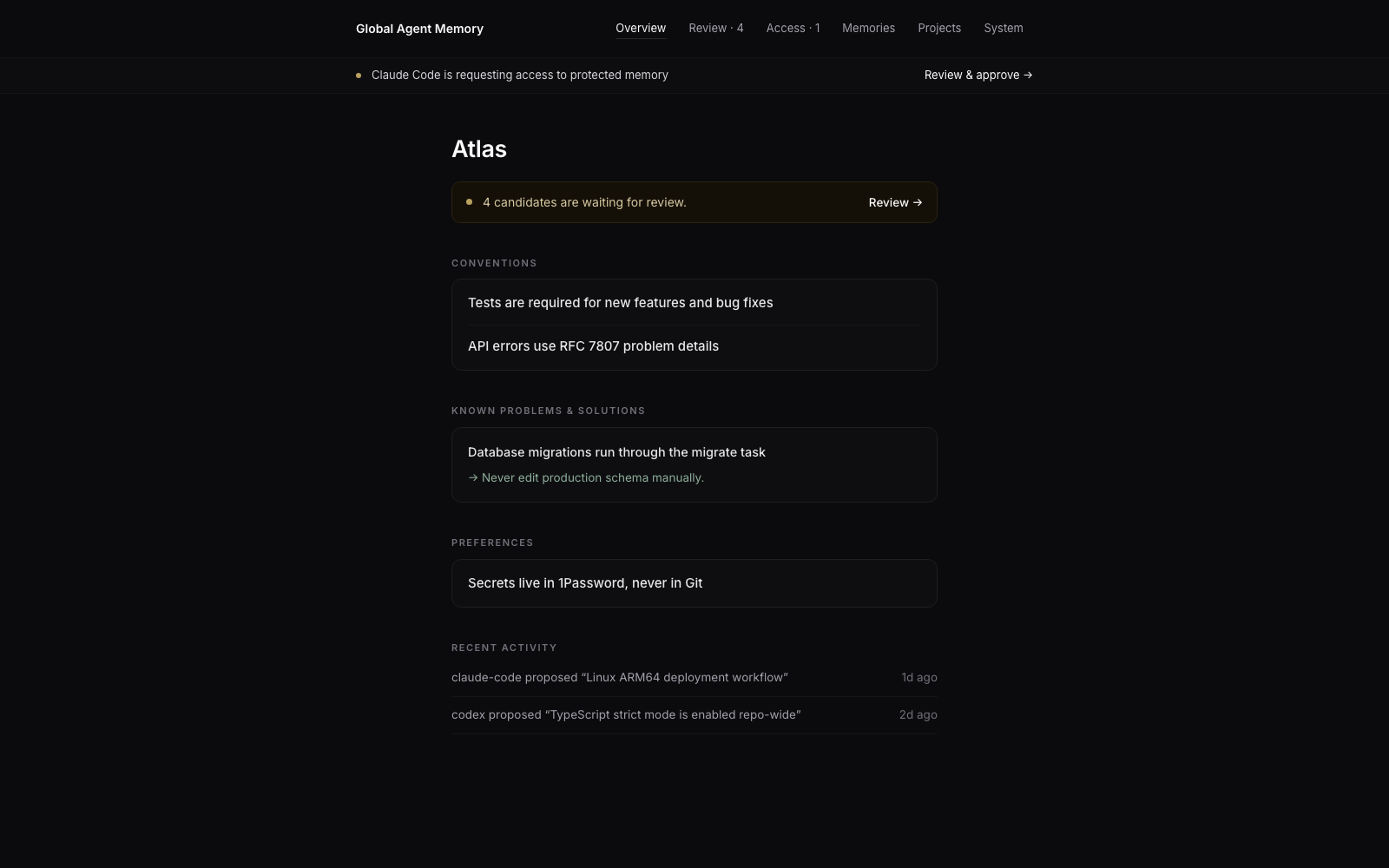
Real dashboard UI with synthetic Atlas project data. No private Vault content is shown.
Quick start
This is the shortest path to persistent memory for Claude Code, Codex, and other MCP clients. The guided installer creates the local service, Obsidian-compatible Vault, dashboard, MCP registrations, and agent skills together.
Requirements
- macOS or Linux
- Python 3.12 or newer
uv- Claude Code or Codex for the managed client integrations
- Optional: Obsidian for browsing the Markdown Vault
- Optional: Ollama for semantic retrieval
1. Install
To install the latest unreleased source, use
uv tool install git+https://github.com/ozankasikci/global-agent-memory.git. For a
local checkout, use uv tool install ..
2. Run guided setup
Setup shows one plan and asks once before it changes anything. It initializes the local Vault, creates the protected token, detects Claude Code and Codex, installs their MCP integrations and skills, verifies healthy clients, and opens the dashboard. Opening the dashboard starts its authenticated localhost server on demand. The command is idempotent, so running it again repairs or updates managed components without replacing unrelated client configuration.
Use flags when you need a non-default setup:
3. Use the installed agent shortcuts
Setup installs five basic shortcuts for each detected client:
| Shortcut | Purpose |
|---|---|
gam-context | Load project-aware context for a task |
gam-search | Find a decision, fact, error, convention, or solution |
gam-remember | Propose explicitly supplied durable knowledge as a candidate |
gam-review | Show the candidate queue without changing it |
gam-dashboard | Open the authenticated dashboard |
In Claude Code, invoke them directly, for example /gam-context fix the upload retry bug.
In Codex, type /skills and choose one, or mention it directly, for example
$gam-context fix the upload retry bug.
4. Open the dashboard again
You can also ask a connected agent:
Open the Global Agent Memory dashboard.
The agent calls memory_dashboard_open and opens the same authenticated local
dashboard.
Manual installation and repair
The individual commands remain available for advanced setups and troubleshooting:
Related MCP Servers
Reviews
No reviews yet — be the first to share how this listing worked for you.
Frequently Asked Questions about Global Agent Memory
AllMCPs Directory Badge
Showcase your server listing on GitHub or your project documentation. Embed this dynamic SVG badge to highlight official listing status and live engagement.
Badge Style:
Live Dynamic SVG Preview
Markdown (GitHub README)
[](https://allmcps.com/mcp/global-agent-memory)HTML Embed
<a href="https://allmcps.com/mcp/global-agent-memory"><img src="https://allmcps.com/api/badge/global-agent-memory?style=directory" alt="Global Agent Memory on AllMCPs" /></a>Technical Specs & Signals
CategoryKnowledge & Memory
27Quality signal: Emerging · 27/100How this signal is calculated ▾
Server availabilityNot measured
Not scored for repo-hosted servers — we can't reach the running server, only its GitHub page. Hosted MCP endpoints are health-checked live.
Verified ownership8/20
Documentation & tools11/30
Adoption & activity1/15
Community engagement0/10
A guidance signal from public completeness & health data — not a user rating. New listings start lower and rise as they add docs, get verified, and grow adoption. Signals we can't observe for a listing are skipped, not counted against it.
Own this project?
This directory is pre-filled from public sources. Claim via GitHub README, site badge, or DNS TXT to unlock edit access and the Official badge and attach your website — proof is checked automatically, then reviewed by our team.
Free dofollow backlink: add your website and place the AllMCPs badge on it — no claim needed. We detect it automatically and keep it verified as long as the badge stays live.
Claim & get free dofollowShare & Embed
Add our SVG badge (dark/light directory styles) or embeddable widget to your site.