Shared memory & coordination for AI coding agents — a blackboard, not an orchestrator.
Quick Install
Automated & IDE SetupCopy the AI prompt to install this server into Claude Code, Cursor, or another agent — or use 1-click editor setup below.
Manual Client & Custom JSON ConfigExpand JSON ▾
Client Config & Setup
Choose your client or environment
Target File:
💡 Paste the JSON block into your client's configuration file under mcpServers, then restart the application.
Documentation Overview
Octopus Blackboard
A shared memory and coordination layer for AI coding agents.
Agents do not need another boss. They need a shared blackboard.
Part of Octopus Core — the open infrastructure stack for governed AI. One job per repo, along the agent lifecycle: Scout · Observe · Experience · Blackboard · Workstate · Runtime · Replay — with Inspect governing every stage. The whole stack rides one root primitive — Evidence, the canonical, tamper-evident atom that is the root category everything is built on.
This repo — Blackboard · Coordinate: Shared cognition for coding agents.
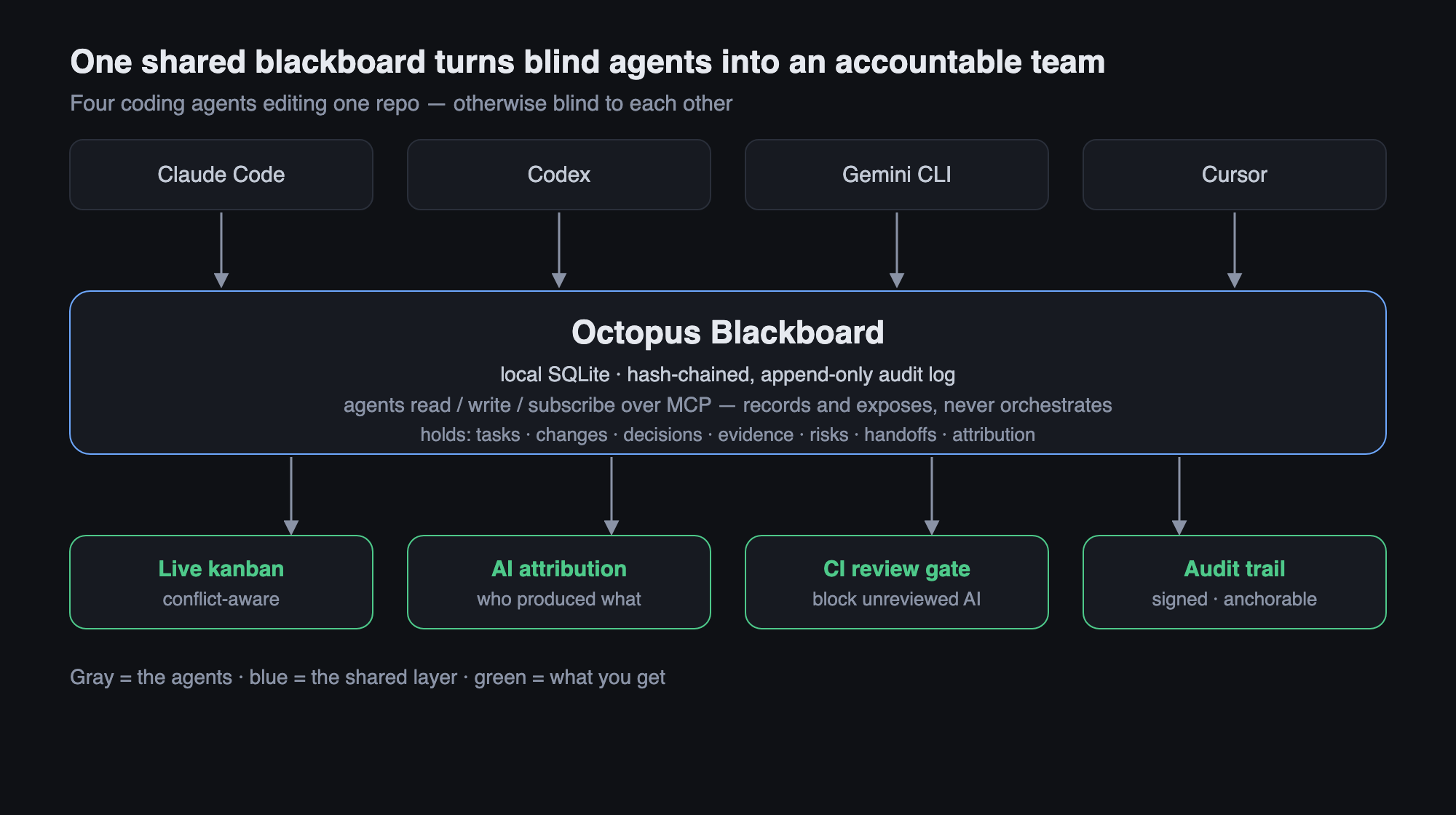
Claude Code, Codex, Gemini CLI, Cursor, and your local agents all work on the same repo — but they are blind to each other. One refactors auth while another rewrites the same file. Context is scattered across CLIs. Nobody can replay what happened.
Octopus Blackboard is not an orchestrator. It does not schedule agents, trigger them, or decide anything on their behalf. It is a passive, local-first shared memory that answers six questions:
Every agent only needs to be able to read the board, write the board, leave messages, and attach evidence. That's the whole contract.
Why
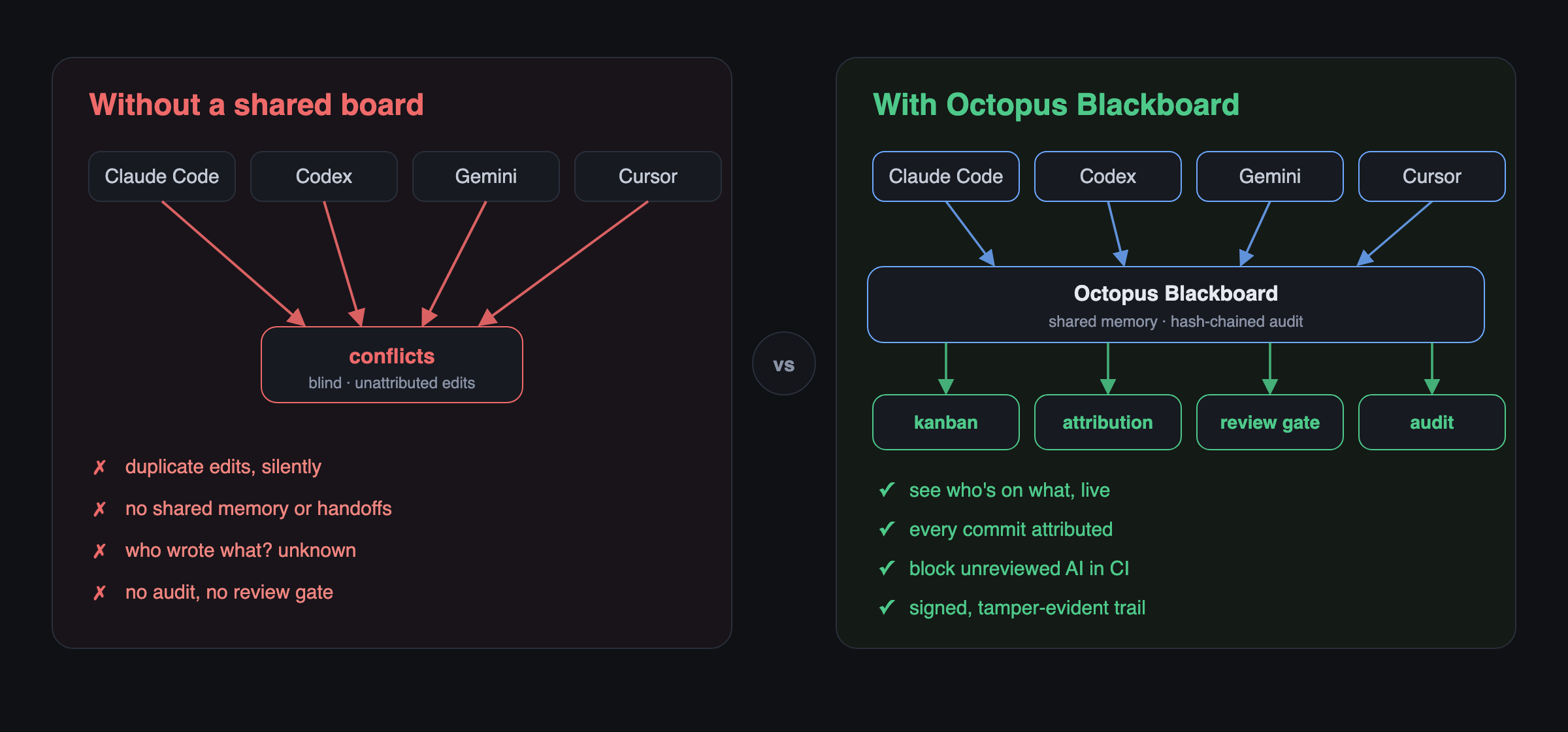
Enterprises are not primarily afraid that agents aren't smart enough. They are afraid that:
- Multiple AI tools edit the same code simultaneously
- Context is scattered across different CLIs
- There is no shared memory, no audit, no handoff
- There is no conflict awareness and no way to replay
The blackboard cuts straight through this. Every write appends a
tamper-evident, hash-chained entry to an append-only timeline, so the
entire history is auditable and replayable — and any after-the-fact edit to an
earlier entry breaks verification.
Get Started in 2 Minutes
Blackboard is the easiest way into the Octopus stack — pure coordination memory that works today with just Claude Code and Cursor, no orchestrator required. One command sets everything up:
That single command: creates the local board (.octoboard/) if it isn't there,
auto-detects your MCP client (.claude/ → Claude Code, .cursor/ → Cursor,
… otherwise a generic snippet), prints the exact paste-ready config for it,
and proves the board works with one write + one read.
Then just:
- Paste the printed config block into the file it names.
- Reload your MCP client (restart it, or reopen the project).
- You're done. Ask your agent to call
board_status, thenboard_note "hello"— that's your first board action, on a shared, tamper-evident timeline.
Re-running quickstart is always safe: it never clobbers an existing board or
its history. New to the idea of adopting a coordination layer first? See
Why adopt Blackboard first.
Install
Requires Node ≥ 22. The board is a single SQLite file under .octoboard/,
discovered by walking up from your working directory (like .git).
See it in action
examples/two-agents.sh plays out the flagship
scenario — Claude Code and Codex sharing one board on the same repo: a claim
conflict, a live same-file collision, a decision, attribution, a handoff that
lands in the other agent's inbox, an AI review, the human-approval CI gate
(blocked → passes), the accountability scorecard, blame→narrative, and a
verified hash chain with session signatures. Run it in an empty directory:
CLI
Identity is set with --as <agent> or the OCTOBOARD_AGENT environment
variable. Point at a specific board with --board <dir> or OCTOBOARD_DIR.
Conflict awareness
The board never blocks — it surfaces. If two agents claim the same key, or touch the same task's files, both writes are recorded and the second agent is warned:
AI attribution & shared development memory
Git records who pushed a commit. It does not record which AI agent produced the code, in which session, on which machine, whether another AI reviewed it, or whether a human approved it. As AI-native development becomes common, accountability must move beyond Git authorship.
The blackboard adds an attribution layer on top of Git — it never rewrites history. Git stays the source of code; the blackboard becomes the source of attribution.
Sessions
A session is one continuous execution of an agent, and the unit attribution hangs off. Starting one makes every subsequent write attribute to it (the active session is remembered across CLI invocations, per agent):
Identity is fully provider-independent — --provider, --model, --cli, or
the matching OCTOBOARD_* env vars. Any AI CLI (local or cloud) can register
itself with no assumptions about a specific vendor.
Linking commits
blackboard link <rev> reads the files a commit touched (via Git) and records
one attribution per file for the active session. Optionally it writes an
additive git notes entry under refs/notes/blackboard:
Reviews
Querying the shared memory
Example explain:
Every attribution, review, session, and decision is also recorded in the
hash-chained timeline, so the full accountability history is tamper-evident
and replayable. blackboard and octoboard are the same command.
Governance & accountability chain

The point of attribution is to enforce something. The chain from work to a merge gate:
CI gate (check)
Turn queries into an enforceable gate. Read-only — it reports pass/fail and exits non-zero; the CI system decides what to do. The blackboard never blocks.
Related MCP Servers
Reviews
No reviews yet — be the first to share how this listing worked for you.
Frequently Asked Questions about Octopus Blackboard
AllMCPs Directory Badge
Showcase your server listing on GitHub or your project documentation. Embed this dynamic SVG badge to highlight official listing status and live engagement.
Badge Style:
Live Dynamic SVG Preview
Markdown (GitHub README)
[](https://allmcps.com/mcp/octopus-blackboard)HTML Embed
<a href="https://allmcps.com/mcp/octopus-blackboard"><img src="https://allmcps.com/api/badge/octopus-blackboard?style=directory" alt="Octopus Blackboard on AllMCPs" /></a>Technical Specs & Signals
CategoryKnowledge & Memory
27Quality signal: Emerging · 27/100How this signal is calculated ▾
Server availabilityNot measured
Not scored for repo-hosted servers — we can't reach the running server, only its GitHub page. Hosted MCP endpoints are health-checked live.
Verified ownership8/20
Documentation & tools11/30
Adoption & activity1/15
Community engagement0/10
A guidance signal from public completeness & health data — not a user rating. New listings start lower and rise as they add docs, get verified, and grow adoption. Signals we can't observe for a listing are skipped, not counted against it.
Own this project?
This directory is pre-filled from public sources. Claim via GitHub README, site badge, or DNS TXT to unlock edit access and the Official badge and attach your website — proof is checked automatically, then reviewed by our team.
Free dofollow backlink: add your website and place the AllMCPs badge on it — no claim needed. We detect it automatically and keep it verified as long as the badge stays live.
Claim & get free dofollowShare & Embed
Add our SVG badge (dark/light directory styles) or embeddable widget to your site.