Cloud Audit README
The full upstream README, mirrored here for reference. Install config, tool schemas, adoption signals, and an original overview live on the Cloud Audit listing page.
cloud-audit
What can a hijacked AI agent reach in your AWS account, and can you prove it?
Open-source, read-only AWS security scanner. 110 checks, 64 IAM privilege-escalation methods, 31 attack-chain
rules, blast radius for any resource, and agent-blast for Bedrock Agents and AgentCore:
what a prompt-injected or credential-stolen agent can reach, with the IAM policy simulator as the witness.
Every finding ships an AWS CLI + Terraform fix. Nothing is written to your account.






30-second demo - agent-blast - Full scan - What's inside - Proof Mode - Installation - Documentation
Thirty seconds, no AWS account needed
The sample account is invented. Everything derived from it (attack chains, root causes, breach cost, security graph, agent reach) is produced by the same engines a real scan uses.
With credentials, the real thing is one command and read-only. The AWS-managed SecurityAudit
policy covers every check (permissions):
agent-blast: what a hijacked AI agent can reach
An AI agent in AWS is a bundle of IAM identities: the role the agent runs as, the execution roles of
the Lambda functions behind its tools, the roles of its knowledge bases, gateways and sandboxes.
When the agent is hijacked, the attacker acts with those identities. agent-blast answers what
that means, per agent, under two threat models:
| Threat model | What the attacker has | What is in reach |
|---|---|---|
| Identity takeover | the credentials of a role the agent runs as (sandbox escape, metadata-service read, leaked session) | the full role: privilege-escalation methods, AssumeRole hops, data |
| Behaviour takeover | nothing but a prompt (indirect prompt injection through a document, a ticket, a web page) | what the agent's tools can do, bounded by the tools' own execution roles |
Real output for the sample agent (cloud-audit agent-blast --demo -a support-bot):
The story the output tells: the support bot itself is harmless, but a document that tricks it into
calling create-ticket runs code under a role that can pass an admin role to a new Lambda. The
search-docs tool, meant to read product docs, can also read the production database secret and
write into the backups bucket. Every line names the identity, the action and the resource, so the
fix is a policy statement, not a debate.
The same engine covers AgentCore. For the sample gateway (--demo -a tools-gw) the headline is a
cross-agent one:
What agent-blast reads (all list/get, no charge):
- Bedrock Agents: the agent resource role, every action group at the
DRAFTversion resolved to its Lambda and the Lambda's execution role, knowledge bases resolved to their S3 data-source buckets. - AgentCore: runtime role and network mode, gateway role with authorizer, policy engine and every target (Lambda, remote MCP server, API Gateway, OpenAPI, Smithy) with its credential provider, code interpreter and browser execution roles.
- IAM policies of exactly those identities (inline, attached, group), kept raw: action, resource,
effect, whether a
Conditionis present. Conditions are flagged, never guessed. The simulator decides.
Then, per identity: the 64 privilege-escalation methods, AssumeRole hops through the trust graph,
and every data, secret, lateral, code-execution and model-invocation grant matched against concrete
resources. A knowledge-base bucket is always a concrete target, even behind s3:* on *, and
write access to it is reported as RAG poisoning. Anything the scanner could not read (a denied
region, a tool without an IAM identity) is a coverage note, never a silent pass.
--verify asks iam:SimulatePrincipalPolicy about every concrete pair, with the context an attacker
really has (no MFA on the session, TLS transport), and marks each reach PROVEN, DENIED (with the
policy layer that denied: SCP, permissions boundary) or not asserted. Output formats: tree,
json, markdown. The MCP server exposes the same report as get_agent_blast.
A full scan
cloud-audit scan runs 110 read-only checks across 25 AWS services, correlates the findings into
attack chains, ranks the fixes by how many chains they break and prices the exposure. This is the
sample account (cloud-audit demo), rendered by the same code as a real scan and trimmed for length:
Preview a fix before touching anything. simulate removes the findings a check would fix and
recomputes score, chains and exposure offline:
Walk outward from any resource to see what its compromise reaches:
--format json drops straight into the open browser visualizer at
blast-audit.haitmg.pl; --format mermaid gives a diagram for a
wiki page. exposure ranks every node of the security graph by internet reachability and escalation:
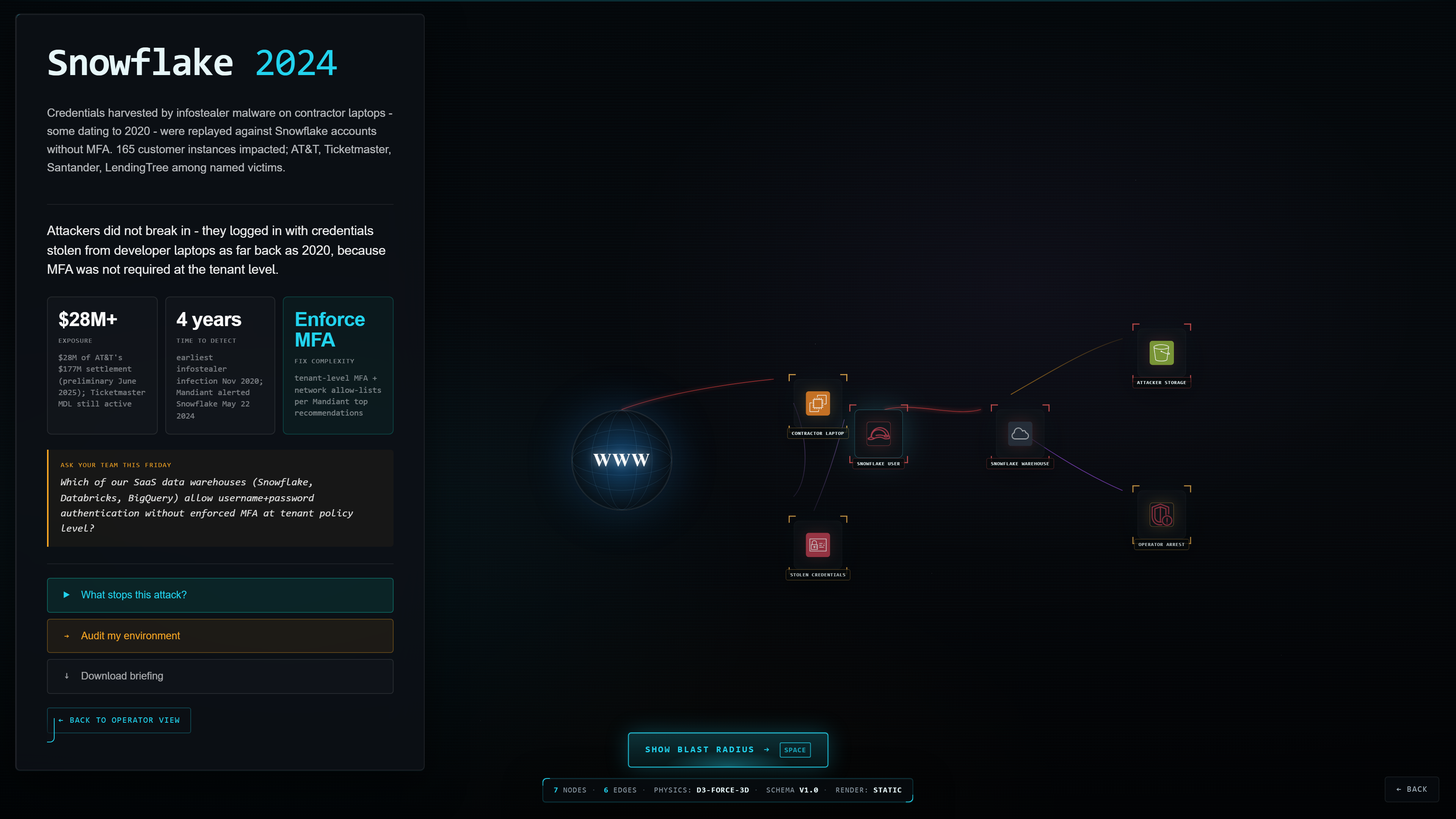
The visualizer runs entirely in your browser on a blast-radius --format json export.
What's inside
| Capability | Size | Command |
|---|---|---|
| Configuration checks, each with an AWS CLI and Terraform fix | 110 checks, 25 services: IAM, S3, EC2, VPC, RDS, KMS, CloudTrail, CloudWatch, GuardDuty, Config, Lambda, ECS, EFS, SSM, Secrets Manager, DynamoDB, Backup, Inspector, Security Hub, WAF, Bedrock, SageMaker, Bedrock AgentCore, Data Perimeter, account | scan, list-checks |
| IAM privilege escalation | 64 methods in 9 categories: IAM self-mutation, credential access, PassRole to a service, Lambda code modification, trust-policy abuse, permission-boundary bypass, resource-policy abuse, compute hijack, lateral AssumeRole (BFS over the trust graph) | scan (aws-iam-018) |
| Attack chains | 31 rules correlating findings and live relationships (EC2 to role, Lambda to role, OIDC to policy) into paths with MITRE ATT&CK references and a priority fix | scan |
| Root causes and quick wins | groups findings by the fix that removes them and ranks by chains broken | scan |
| What-If | before/after score, chains and exposure for any set of checks, offline | simulate --fix |
| Blast radius | forward BFS from an EC2 instance, IAM role or user, Lambda, S3 bucket or secret; JSON contract for the visualizer | blast-radius |
| Exposure ranking | every security-graph node scored by internet reachability and escalation | exposure |
| AI agents | inventory of Bedrock Agents and AgentCore runtimes, gateways, code interpreters, browsers with their IAM identities and tools; two-threat-model reach; OWASP Agentic and MITRE ATLAS tags; simulator proof | agent-blast |
| Proof Mode | iam:SimulatePrincipalPolicy on escalation paths (broad) and on concrete (principal, action, resource) triples (agent-blast) | scan --verify, agent-blast --verify |
| Threat feed | 10 detectors of active abuse, each tied to a documented 2025-2026 incident pattern, versioned as a rules pack | threat-feed |
| Data perimeter | 5 checks on resource policies: confused deputy and cross-organization exposure, evaluating condition values | scan (aws-dp-*) |
| AgentCore configuration | 6 checks: code interpreter and runtime network mode, MMDSv2, memory KMS, gateway authorizer, gateway policy engine | scan (aws-agc-*) |
| Breach cost | USD range per finding and per chain with the public source behind each number | scan |
| Compliance | 6 frameworks with per-control evidence: CIS AWS v3.0, SOC 2 Type II, ISO 27001:2022, HIPAA, NIS2, BSI C5:2020 | scan --compliance, list-frameworks |
| Drift and trend | diff two scans with exit codes; posture history with sparklines | diff, trend |
| Coverage gaps | a read the scanner was denied is reported as "not assessed", never as a pass | every command |
| Outputs | console, JSON, HTML report, SARIF (GitHub Code Scanning), Markdown | scan --format |
| MCP server | 7 read-only tools for Claude Code, Cursor and any MCP client, including get_agent_blast | cloud-audit-mcp |
The ten threat-feed detectors, as cloud-audit threat-feed --list prints them (rules pack 2026-Q2):
| Pattern | Severity | What it catches |
|---|---|---|
| TF-001 | MEDIUM | SES recently verified identity (phishing setup precursor) |
| TF-002 | HIGH | Public Lambda Function URL (AuthType=NONE) |
| TF-003 | CRITICAL | AWS-attached credential quarantine policy |
| TF-004 | CRITICAL | Leaked-credentials scanner user-agent observed in CloudTrail |
| TF-005 | HIGH | Recently-created IAM role with cryptomining-style compute access |
| TF-006 | HIGH | EC2 or AgentCore using IMDSv1 / MMDSv1 (SSRF credential theft vector) |
| TF-007 | MEDIUM | CI/CD role at risk of whoAMI confusion attack |
| TF-008 | HIGH | CloudTrail tampering precursor (logging stopped or delivery failing) |
| TF-009 | HIGH | IAM Roles Anywhere trust anchor with external CA |
| TF-010 | HIGH | AmazonDataZoneFullAccess attached to a non-admin principal |
Proof Mode: simulated, not guessed
Static analysis of IAM policies over-reports. Proof Mode asks AWS's own authorization engine,
iam:SimulatePrincipalPolicy, which is read-only and carries no per-call charge.
scan --verifychecks every detected escalation path.verified: truemeans the simulator allowed every required action;falsemeans it denied one (the path is very likely a false positive);nullmeans not asserted, with the reason inverification_detail.agent-blast --verifychecks every concrete (principal, action, resource) reach, supplies the context an attacker with stolen or assumed credentials has, and names the layer that denied.
What the simulator evaluates as of 2026-07-30: identity policies, the attached permissions boundary,
the organization's SCPs including their condition keys, and the context keys you supply. What it does
not: resource control policies, VPC endpoint policies, role chaining, and resource-based policies for
IAM roles. cloud-audit says so on every verified line. A true proves the permission exists. It does
not prove an end-to-end attack; nothing is executed.
Reports
CI/CD
--quiet exits with a code only: 0 clean, 1 findings, 2 error. Gate on severity with
--min-severity high. cloud-audit diff old.json new.json --quiet exits 1 on new findings, so a
daily scan catches ClickOps drift. The repository is also a composite GitHub Action
(gebalamariusz/cloud-audit@v0). Ready-made workflows: basic scan,
daily diff, post-deploy.
Installation
Docker with credentials:
Python 3.10 to 3.13. Dependencies: boto3, typer, rich, pydantic, jinja2, pyyaml, mcp.
AWS permissions
Read-only. Attach the AWS-managed SecurityAudit policy; it covers every check, the IAM escalation
analysis, the agent inventory and Proof Mode:
cloud-audit never modifies your infrastructure. simulate, blast-radius, exposure, diff,
trend and agent-blast run locally against a saved scan and make no AWS calls; --verify adds
simulator calls only. Regions where a service does not exist are skipped; regions where the scanner
is denied a read are listed as coverage gaps.
MCP server
Seven read-only tools for AI assistants: scan_aws, get_findings, get_attack_chains,
get_remediation, get_health_score, list_checks, get_agent_blast.
Then ask: "scan my AWS account and tell me what my Bedrock agents could reach if hijacked".
Common flags and configuration
Defaults live in .cloud-audit.yml (regions, min_severity, exclude_checks, time-boxed
suppressions). Environment variables (CLOUD_AUDIT_REGIONS, CLOUD_AUDIT_MIN_SEVERITY, ...)
override the file; CLI flags override everything. See the
configuration guide.
Documentation
Full documentation at haitmg.pl/cloud-audit: getting started, agent-blast, attack chains, IAM escalation, blast radius, Proof Mode, threat feed, data perimeter, AgentCore, compliance, and the full check reference.
Commercial support
cloud-audit is free and stays free. If you want a human on the findings, the author offers professional services:
- Scanner output review (free): send your cloud-audit, Prowler or Security Hub output, get a short written review of what actually matters and what to fix first
- AWS security audit: full account audit with a prioritized report and ready-to-apply fixes
- AI agent access review: what your Bedrock and AgentCore agents can reach, with the policy changes to narrow it
- Remediation support: Terraform and IAM changes, verified against your workloads
- Palo Alto VM-Series on AWS: architecture and security review (GWLB/TGW, HA, routing)
Details: haitmg.pl/cloud-audit-support or email kontakt@haitmg.pl.
Development
See CONTRIBUTING.md to add a check. Releases in CHANGELOG.md.