Concurrent Builder + Breaker agents generate code and adversarial tests at once, gated in CI.
Quick Install
Automated & IDE SetupCopy the AI prompt to install this server into Claude Code, Cursor, or another agent — or use 1-click editor setup below.
Manual Client & Custom JSON ConfigExpand JSON ▾
Client Config & Setup
Choose your client or environment
Target File:
💡 Paste the JSON block into your client's configuration file under mcpServers, then restart the application.
Documentation Overview
⚔️ GAUNTLEX
Adversarial Co-Generation Engine
Generates code and adversarial attacks from the same specification, at the same time — before a commit exists.




What it is · See it run · Quickstart · Commands · Domains · IDE Integrations · Deep Dive
What it is
Every AI coding tool ships code and hopes someone tests it for security later. GAUNTLEX removes the "later." It runs two agents concurrently against the same specification:
- Builder — generates the implementation
- Breaker — generates adversarial attacks against the same spec, at the same instant
An Arbiter scores every attack (mitigated / partial / missed) and produces an Adversarial Resilience Score (ARS). A configurable gate blocks your CI pipeline when the score falls below threshold — the same way a failing test suite blocks a merge.
No manual test authoring. No separate security review step. No waiting for a scanner to catch up to code that shipped last week.
See it run
📊 One-page overview — what it is, what's different, how it deploys. Built for sharing with a technical lead or architecture review board.
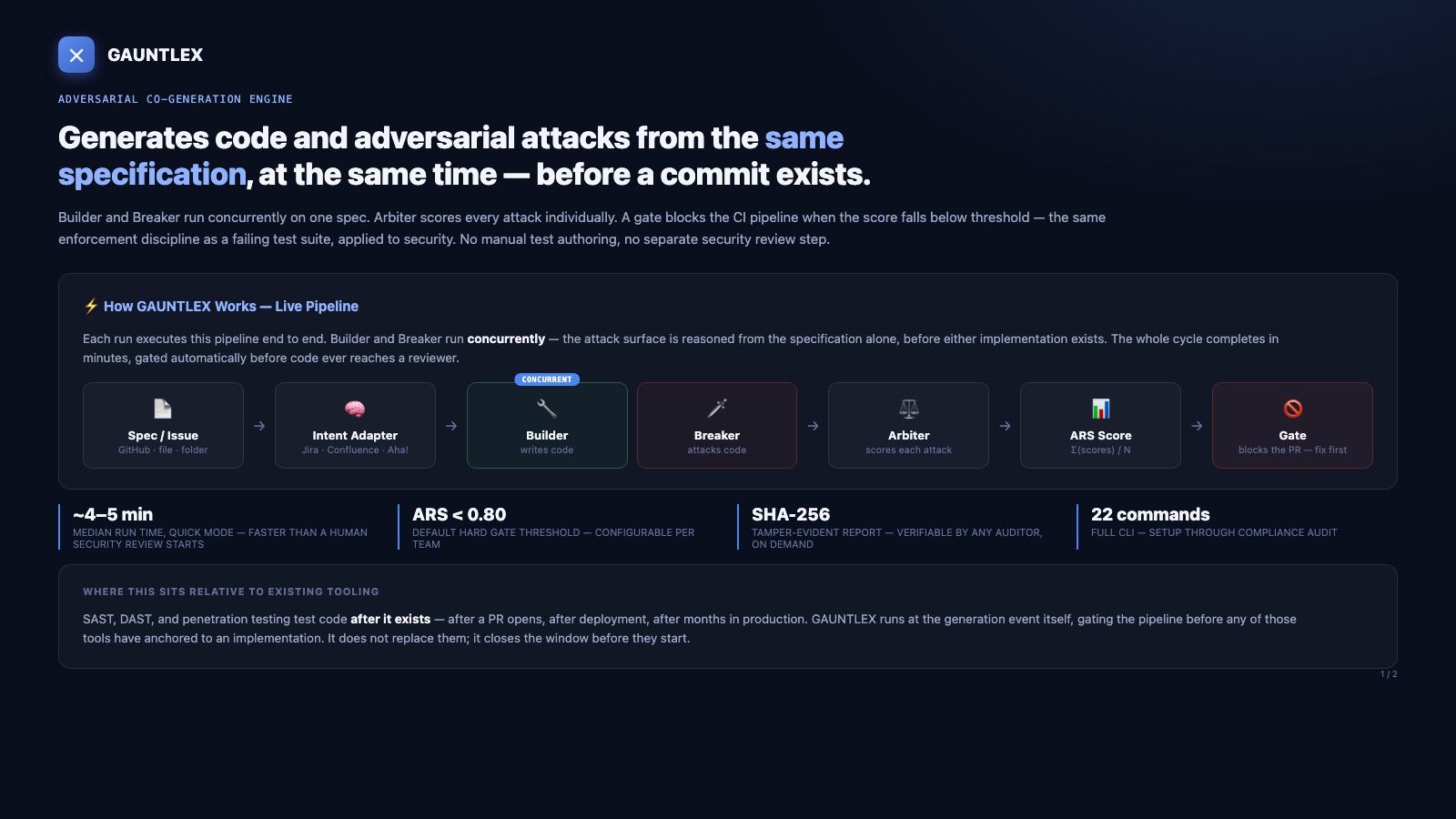
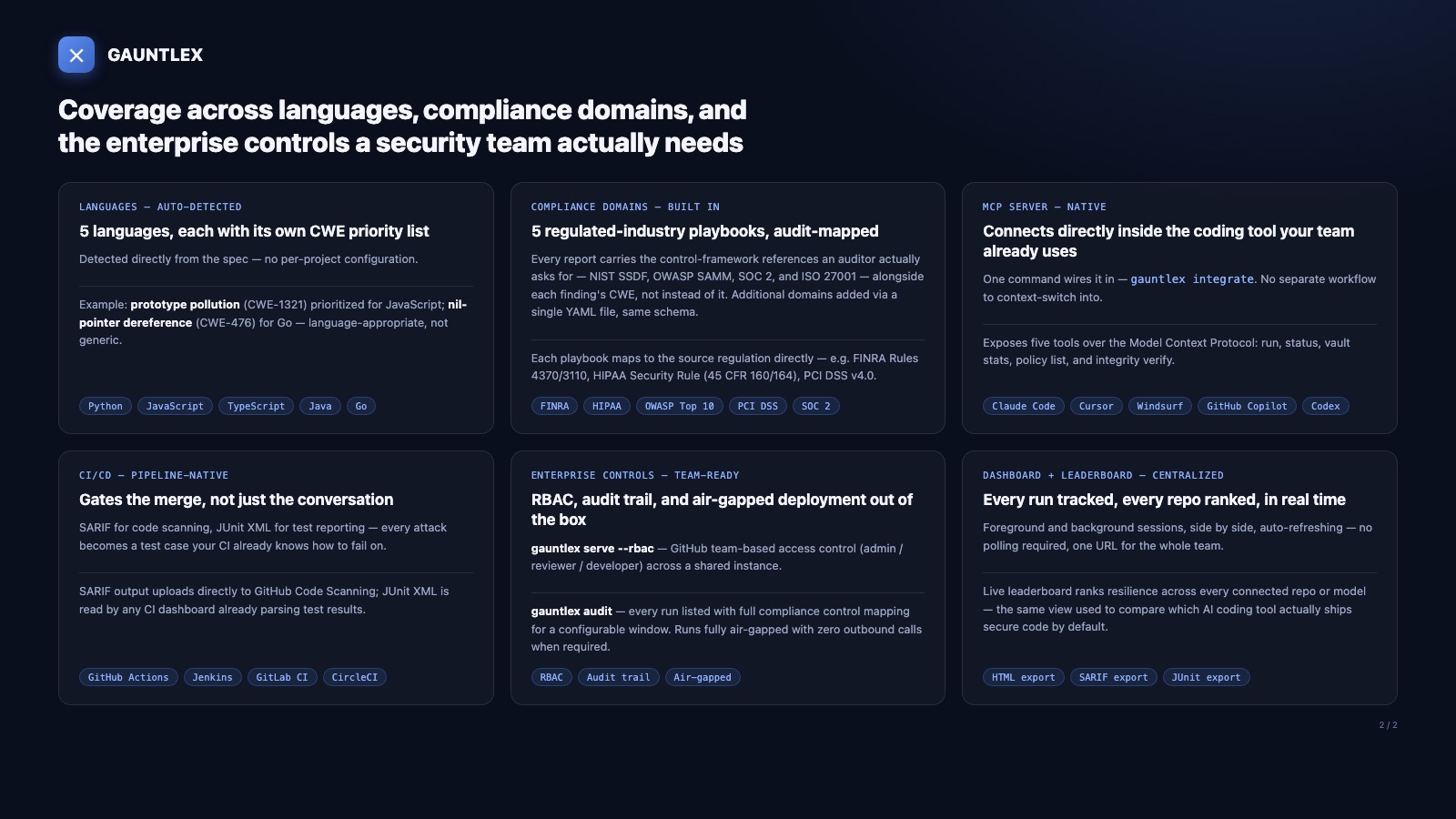
Watch the Demo Setup through the CI gate, real terminal output, real dashboard — concurrent Builder + Breaker, HIPAA domain testing, and every IDE integration in one pass.
Why it's structurally different
Three properties, not features — the reasoning behind each is in the Deep Dive:
- Concurrent, not sequential. Builder and Breaker fire at the same instant via
asyncio.gather(). The Breaker never sees generated code — it reasons from the specification alone, the same surface a real attacker would work from before your implementation choices exist. - A native MCP integration, both directions. GAUNTLEX exposes itself as an MCP server so Claude Code, Cursor, Windsurf, or Zed can trigger and poll runs directly from your coding tool — and it consumes external MCP servers (plus built-in CISA KEV / NIST NVD feeds) to enrich every run with live threat data. See the Domain Intelligence page for exactly what's live vs. static.
- Regulatory domains as first-class input. FINRA, HIPAA, PCI DSS, SOC 2, and OWASP Top 10 playbooks steer the Breaker toward the scenarios that actually matter for a regulated codebase — not a generic scan re-labeled per industry.
Where GAUNTLEX fits vs. other security testing
Not a replacement for any of these — a different point in the lifecycle. Static analysis and pentests are still worth doing; GAUNTLEX exists because neither of them runs while the code is being generated.
| Traditional SAST (Semgrep, Snyk, etc.) | Manual pentest | No dedicated testing | GAUNTLEX | |
|---|---|---|---|---|
| When it runs | After code is written | After code is written, periodically | Never, until an incident | Same instant as generation |
| What it tests | Known vulnerability patterns in existing code | The live, deployed system | Nothing dedicated | The spec-to-code pipeline itself |
| Speed | Minutes per scan | Days to weeks per engagement | — | ~45s–12min per run (mode-dependent) |
| Cost | Free–moderate | High (specialist time) | "Free" until it isn't | Free, open source |
| Compliance mapping | Varies by tool | Manual, engagement-specific | None | Built-in — OWASP/HIPAA/FINRA/PCI-DSS/SOC2 + CWE + NIST SSDF/SAMM/ISO 27001 |
| Output you can verify later | Scan report | Pentest report | — | SHA-256 tamper-evident report (gauntlex verify) |
Quickstart
Install first with pip install gauntlex-ai, or skip the install entirely with uvx --from gauntlex-ai gauntlex setup.
gauntlex setup writes your model provider and credentials to .env for
you — there is no manual configuration step, and no fallback to whatever API
key happens to be lying around the environment. What you configure during
setup is what runs, always (run gauntlex init separately if you also want
a .gauntlex.yml with tunable defaults like rounds_max or the gate
threshold).
Wall-clock time depends on which model you configure — anywhere from single-digit
seconds with a fast paid API to several minutes with a free-tier or local model.
Attack count targets 5/20/50 by mode (quick/standard/thorough), spread
across the adversarial rounds — actual totals land close to but not always
exactly at the target (a thorough run might fire ~30–50, for example),
since it depends on how many attacks the model actually returns per round.
Run against a GitHub issue directly
Add business intent — attack surface = spec + why it's needed
--issue is the spec — precise enough for the Builder and Breaker to implement and attack. It answers what to build. --intent adds a second, separate input answering why it's needed, pulled from wherever your team actually tracks that: a Jira key, a Confluence page, or an Aha! roadmap item. GAUNTLEX reasons from both together, not just the spec alone.
gauntlex setup connects Jira/Confluence/Aha! automatically if it detects credentials in your environment — see the interactive wizard's business intent step.
Requirements
- Python 3.11+
- macOS, Linux, or Windows (WSL2 recommended on Windows)
- One model provider: Ollama (free, local), OpenRouter free tier, or an Anthropic/OpenAI API key
CLI reference
All 22 commands, grouped by when you'd reach for them:
| Getting started | |
|---|---|
gauntlex setup | Configure model provider and integrations (run any time to reconfigure) |
gauntlex init | Scaffold .gauntlex.yml with sensible defaults |
gauntlex doctor | Full environment health check |
gauntlex validate | Dry run — checks config and connectivity, fires zero attacks |
| Running assessments | |
|---|---|
gauntlex run | Run adversarial Builder + Breaker on a spec |
gauntlex status | Show running and recently completed runs |
gauntlex findings | Vulnerability findings from the last run — fix-first, score last |
gauntlex compare | Diff two Resilience Reports — ARS delta and attack-level changes |
gauntlex learn | Feed a run into the Knowledge Forge + Forge Ledger (runs automatically after every gauntlex run — use this to re-process an older run) |
| Evidence & compliance | |
|---|---|
gauntlex report | Render a stored report in any output format (HTML/SARIF/JUnit/JSON) |
gauntlex verify | Re-derive SHA-256 integrity hash, confirm a report hasn't been altered |
gauntlex audit | List all reports with compliance control mapping over a time window |
gauntlex vault | Browse the Forge Ledger — human-readable Markdown attack records |
gauntlex stats | ARS trends, learning-curve, and cost metrics |
| Domains & policy | |
|---|---|
gauntlex policy | List, install, search, or validate policy domains — see Domain Intelligence |
Related MCP Servers
Reviews
No reviews yet — be the first to share how this listing worked for you.
Frequently Asked Questions about GAUNTLEX
AllMCPs Directory Badge
Showcase your server listing on GitHub or your project documentation. Embed this dynamic SVG badge to highlight official listing status and live engagement.
Badge Style:
Live Dynamic SVG Preview
Markdown (GitHub README)
[](https://allmcps.com/mcp/gauntlex)HTML Embed
<a href="https://allmcps.com/mcp/gauntlex"><img src="https://allmcps.com/api/badge/gauntlex?style=directory" alt="GAUNTLEX on AllMCPs" /></a>