The Universal Agent Gateway (UAG) enables in-process agentic automation using Form.io.
Quick Install
Automated & IDE SetupCopy the AI prompt to install this server into Claude Code, Cursor, or another agent — or use 1-click editor setup below.
One-click editor setup isn’t available for this listing yet — we don’t have a confirmed install command, and we’d rather show nothing than point your editor at the wrong package or host. Follow the project’s own setup instructions, linked above.
Manual Client & Custom JSON ConfigExpand JSON ▾
No confirmed setup config for this listing yet. We only publish a config block when the install details come from the project itself — its README, its docs, or a verified owner. We haven’t found those for formio-uag, and we’d rather show nothing than a guess you’d paste into your client. Follow the project’s own setup instructions for the current steps.
Documentation Overview





The Universal Agent Gateway (UAG) leverages the Model Context Protocol (MCP) to enable in-process agentic automation using Form.io. It provides to an AI Agent the same thing that our JavaScript Renderer provides to a human; an interpretation of the Form JSON schema into an understandable format. In the case of UAG, it transforms the Form JSON model into an AI readible markdown format so that the Agent can easily understand the purpose and structure of the data that needs to be collected.
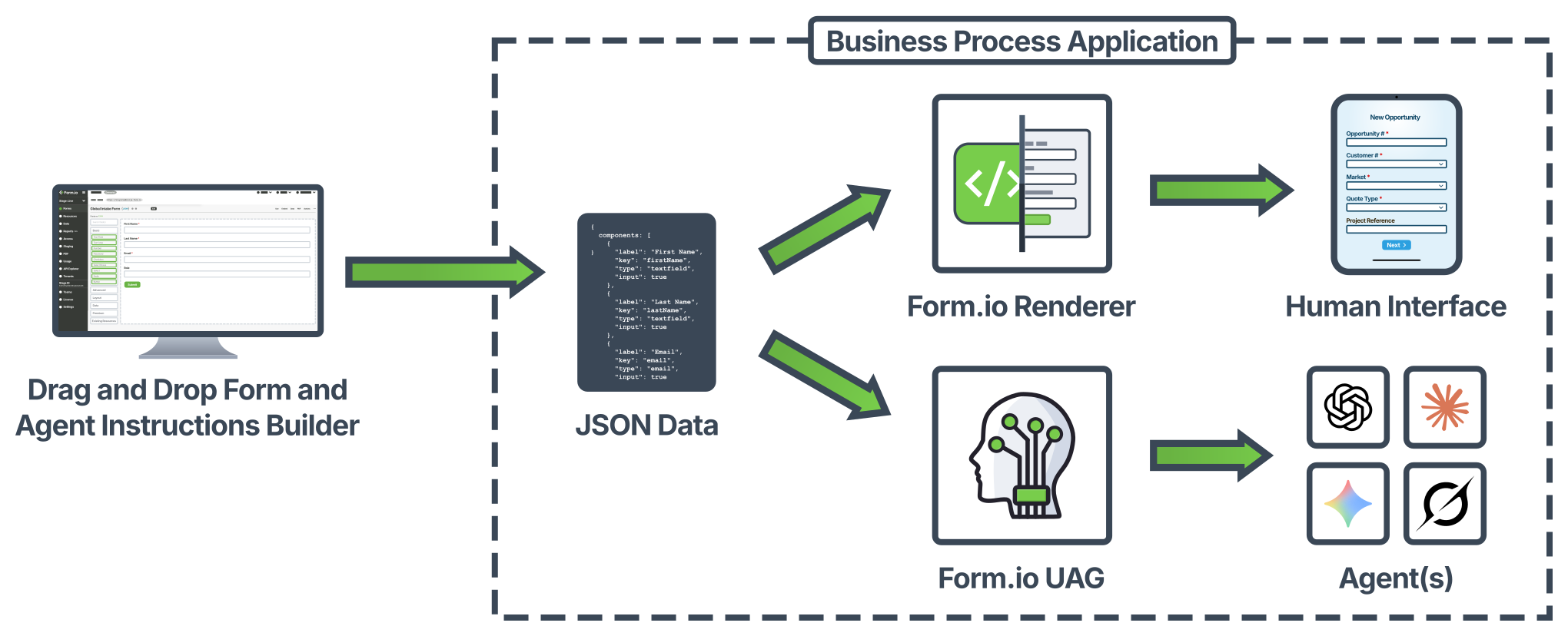
There are two primary scenarios that the UAG enables:
- Unstructured 'chat' input to deterministic form submission: This capability uses the JSON schema of a Form.io form to produce a deterministic structured data object provided natural language conversational input.
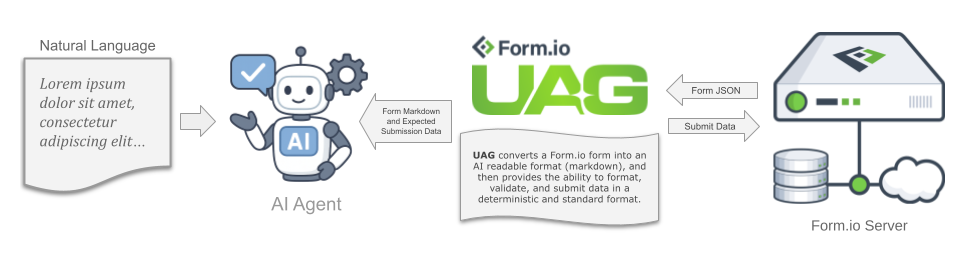
For a working example of this flow, please try out the Conversation Form Example.
- Agentic Form.io Workflows: UAG provides an AI Agent the ability to take existing submission data + "context" criteria in order to prompt an AI Agent to provide its own data and analysis within a workflow scenario. The following example, which shows a college application process using a Form.io application form, shows how this primary scenario works.
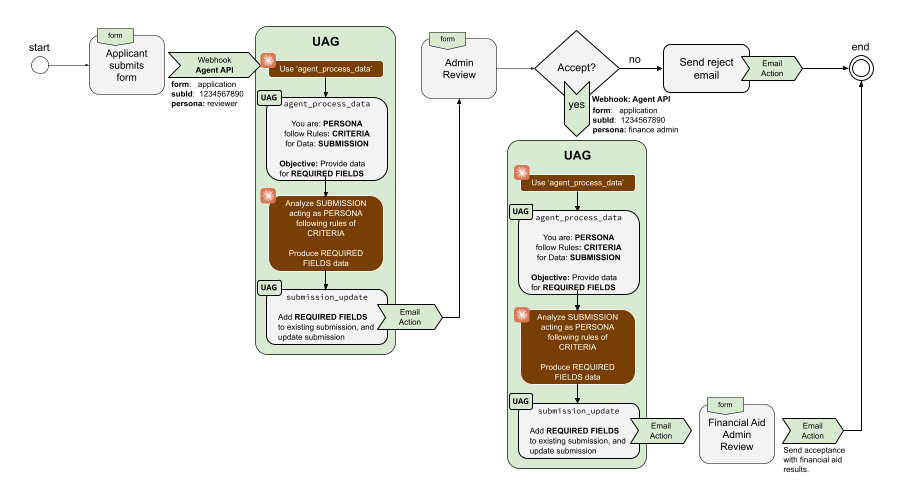
For more information on Agentic workflows, checkout the dedicated Agentic Workflows section. For a working example of this flow, please try out the Agentic Workflow Example.
One of the many benefits that the UAG has to offer is the ability to inject Dynamic Context into an AI processing cycle. This is achieved from the dynamic nature of the Form JSON schemas that can easily be modified and deployed to any environment without the need to update your application or re-train the agents within the process. Because of this, dynamic context changes can be injected seamlessly into an existing running process which will automatically update the behaviors of the Agents utilizing the UAG.
Try it out!
There are three working examples in this repo, each spinning up a Form.io server alongside the UAG with Docker Compose. Pick the one that matches what you are building.
| Example | Pattern | Licensing |
|---|---|---|
| Custom Module | Conversational, existing client. Connect Claude Desktop to your forms and talk to them: "I would like to add a new customer." Built as a custom module, so roles and permissions decide what the agent may do. | Open Source — free |
| Conversation Form | Conversational, your own UI. A chat application whose questions come entirely from a form. About 200 lines, no field names in the code — edit the form and the conversation changes. | Open Source — free |
| Agentic Workflow | Autonomous. A submission triggers an agent that scores it against a rubric and writes its decision back, which in turn triggers a second agent. No human, no chat window. | Enterprise |
There is also a Flow Viewer — a small proxy that shows every leg of an agentic run live, which is the fastest way to see what an agent is actually doing.
Documentation in this repository
This file is the main reference: what the UAG is, how to configure a form for it, how to deploy it, and how to troubleshoot it. The rest of the documentation lives next to the code it describes.
| Document | What it covers |
|---|---|
| README.md (this file) | Concepts, agentic workflow setup, the MCP tools, deployment, environment variables, and troubleshooting. |
| module/Readme.md | Building a custom module — adding your own MCP tools, form actions, pre-defined forms and resources, and configuration overrides, then mounting it into the Docker container. |
| integrations/claude/Readme.md | The Claude integration: its API endpoints and commands, how to run it with Node or Docker, its environment variables, and how to trigger it from a Form.io Webhook action. |
| examples/custom-module/Readme.md | Example — a custom module driven conversationally from Claude Desktop, where roles and permissions govern what the agent may do. |
| examples/conversation-form/Readme.md | Example — a chat application of your own whose questions come entirely from a form. |
| examples/agentic-workflow/Readme.md | Example — an autonomous, webhook-triggered workflow with two chained agent personas. |
| examples/flow-viewer/Readme.md | A small proxy that shows every leg of an agentic run live — the token request, each tool call, and the write-back. The quickest way to see what an agent is doing. |
| examples/custom-module/module/templates/Readme.md | Overriding the response templates the UAG returns to the agent, using Lodash templates. |
| test/e2e/Readme.md | The end-to-end test suite — its three layers, what each covers, and how to run it. |
Agentic Workflows
One of the more powerful features of the UAG is the agent_provide_data tool. This tool provides the ability to instruct a generically trained agent how to analyze existing submission data, and then produce its own data by following a configurable Criteria. This behavior historically could only be achieved using a specifically trained agent, which does not provide any benefits of dynamic configurability that the Form.io platform offers. This tool is able to achieve this goal by providing a generally trained agent with the necessary "context" it needs to accurately produce its own data as part of an automated workflow. This feature is particularly helpful if you wish to utilize the UAG within an Agentic Workflow, where the AI Agent is capable of understanding structured data, and then contribute its own data by following the configured Criteria "context" provided by the UAG.
For example, let's suppose you wish to automate the backend administration behind a College Application Process. In this example, a potential student submits an application that consists of many different fields of data, such as Academics, Extra curricular activities, Honors, Volunteer work, as well as possibly written Essays. Historically, these applications would be reviewed by an administrator in order to assess the candidates qualifications for acceptance. With the agent_provide_data tool, it is now possible to automate this process as the following diagram illustrates.
To achieve this feat, the agent_provide_data tool utilizes the following information, which is then fed to the Generally trained agent to produce its own submission data.
- Existing Submission Data: In order for the agent to be able to contribute its own data, it must first have an existing submission to be used as the data that it will analyze according to the configured Criteria.
- Criteria: This is a piece of content that provides the agent the Criteria to follow when analyzing the data, but also provides instructions on how the agent should populate the Required Fields.
- Required Fields: These are the form fields which the Agent is required to fill out as part of the
agent_provide_dataprocess.
Setup
To configure a form to use the agent_provide_data tool, you must first designate a section of your form that will be read and used by the AI Agent. This is similar to what you would see in a form that says "For Office Use Only", but instead of a Human contributing to the values of this section, it will be an automated AI Agent. There are two types of fields that can be added to a form to configure it for use by the agent_provide_data tool: Criteria and Agent Fields
A complete setup is four steps, and all four are required:
Related MCP Servers
Adoption & maintenance
Factual signals from GitHub, npm, and our automated checks — not a rating.
GitHub stars
11
Stargazers on the source repository.
Last commit
5d ago
Most recent push to the default branch.
Directory activity
1 views
Config copies, upvotes, and views on AllMCPs.
Reviews
No reviews yet — be the first to share how this listing worked for you.
Frequently Asked Questions about Formio Uag
AllMCPs Directory Badge
Showcase your server listing on GitHub or your project documentation. Embed this dynamic SVG badge to highlight official listing status and live engagement.
Badge Style:
Live Dynamic SVG Preview
Markdown (GitHub README)
[](https://allmcps.com/mcp/formio-uag)HTML Embed
<a href="https://allmcps.com/mcp/formio-uag"><img src="https://allmcps.com/api/badge/formio-uag?style=directory" alt="Formio Uag on AllMCPs" /></a>Technical Specs & Signals
CategoryCloud Platforms
5/6 checks healthy over the last 45d
36Quality signal: Fair · 36/100How this signal is calculated ▾
Server availabilityNot measured
Not scored for repo-hosted servers — we can't reach the running server, only its GitHub page. Hosted MCP endpoints are health-checked live.
Verified ownership10/20
Documentation & tools11/30
Adoption & activity6/15
Community engagement0/10
A guidance signal from public completeness & health data — not a user rating. New listings start lower and rise as they add docs, get verified, and grow adoption. Signals we can't observe for a listing are skipped, not counted against it.
Own this project?
This directory is pre-filled from public sources. Claim via GitHub README, site badge, or DNS TXT to unlock edit access and the Official badge — proof is checked automatically, then reviewed by our team.
Free dofollow backlink: add your website and place the AllMCPs badge on it — no claim needed. We detect it automatically and keep it verified as long as the badge stays live.
Claim & get free dofollowShare & Embed
Add our SVG badge (dark/light directory styles) or embeddable widget to your site.